
Growing Kale in a Greenhouse
Bloomcabin field notes / cool season
Growing Kale in a Greenhouse
A distinctive cool-season crop for sweet, firm leaves, repeat harvests and a greenhouse that stays productive after tomatoes, capsicums and cucumbers.
Crop typeCool-season brassica for repeated harvests
Best greenhouse roleAutumn, winter and early spring harvests
Ideal conditionsCool air, bright light, even moisture
Key ruleProtect the central growing point
The case for winter light
Kale does not need a tropical greenhouse. It needs a sheltered, cool space: less persistent rain, steadier root zones, clean leaves and enough airflow for dense, curled rosettes to dry.
Read the plant, not only the thermometerFirm, compact leaves and an active centre indicate steady growth. Soft stems, yellowing or damp foliage in the heart call for an early response.
A greenhouse does not remove the seasons; it makes them easier to manage. Short days still slow growth, and an unheated house is not automatically frost-free. Yet shelter lets you influence stresses that trouble kale: continuously wet leaves, wind, uneven watering and sudden temperature shifts. Reserve a bright bed area in a small house and keep the path clear so every crown remains accessible. A Classic Aluminium Greenhouse offers height, roof ventilation and practical paths for a long-lasting, well-organised cool-season crop.
Kale tolerates cold, but it is not indifferent to stress. The best leaves come from plants that keep growing calmly instead of switching between cold, waterlogged roots and sudden heat under glass. The aim is not to force growth in midwinter. Create a stable space where each new leaf can mature firmly, dry after damp nights and remain harvestable in good condition for as long as possible.
01 / Choose the growth habit
Choose kale for the space it needs.
A variety is more than a flavour choice. It determines height, leaf density, harvest style and airflow through the bed. Choose a growth habit that suits the path, eave height and intended cropping period.
Curly kale
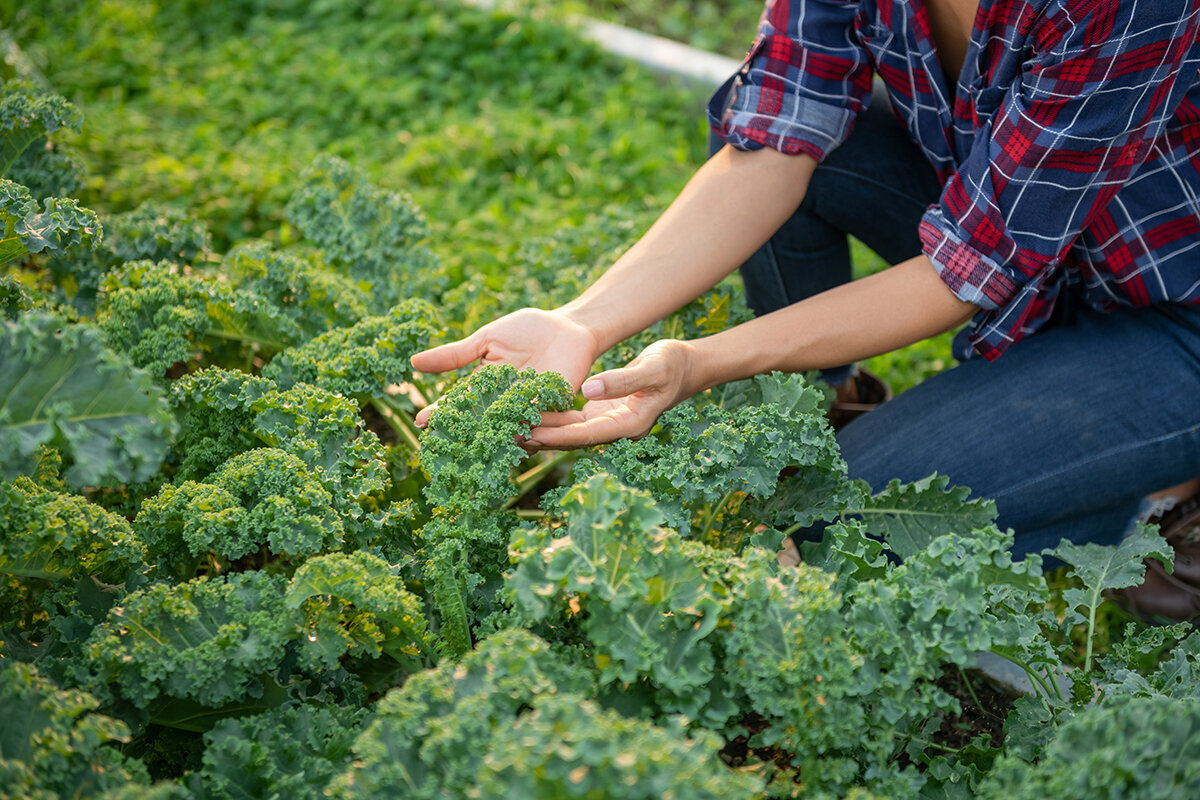
Heavily frilled leaves offer a generous harvest area and classic winter character. Their folds retain moisture, so generous spacing and early ventilation are especially important.
Best forOngoing outer-leaf harvesting
Under coverPlant widely and maintain airflow
Tuscan kale / cavolo nero
Long, dark blue-green leaves create a calm, upright structure in the bed. Its relatively slender habit is easy to manage and convenient to harvest along a path.
Best forSmall beds and narrow rows
Under coverPick lower leaves regularly while young
Red-leaf kale
Purple stems and red-veined leaves add colour to cool-season mixed plantings. Many varieties suit tender young leaves; inspect soft growth regularly for aphids.
Best forBaby leaves and staggered sowings
Under coverCheck the leaf centre for aphids
Compact types
Low-growing varieties solve space problems in narrow beds, raised beds and houses with low eaves. Their smaller rosettes give a worthwhile crop without turning the path into a damp wall of foliage.
Best forContainers, raised beds and tight layouts
Under coverUse sufficiently deep containers with drainage holes
For mature, larger plants, around 45 cm within the row and 50 to 60 cm between rows is a reliable starting point. Closer spacing belongs to planned baby-leaf harvests or plants thinned later. In a compact greenhouse, good access matters more than maximum plant numbers. You should be able to see every stem, water the root zone accurately and harvest without constantly brushing wet leaves.
Use loose, humus-rich, well-drained soil rather than a compacted, overused bed. Work in mature compost before planting and remove old crop debris. Kale prefers neutral to mildly alkaline soil and an even nutrient supply. Where soil is very acidic or clubroot is known, test the soil before liming or planting another brassica crop. A clean rotation is more reliable than a quick fertiliser correction. After several years of intensive greenhouse use, a soil test is particularly helpful for adding nutrients deliberately rather than by guesswork.
02 / Start in waves
Sow in succession rather than all at once.
One large sowing gives plenty at first, then can easily leave a harvest gap. Two or three smaller sowings create a better rhythm: a young planting, a harvest-ready group and plants that can be cleared in time.
First wave
Direct sow
Sow into a fine, evenly moist seedbed and cover seeds only lightly. Direct sowing avoids transplant interruption and is especially suitable when the greenhouse bed is already vacant, clean and prepared.
Thin deliberately. Closely spaced seedlings can be harvested as baby leaves; retain only the strongest plants for large rosettes.
Second wave
Transplant gently
Raise young plants in small pots, cell trays or a clean propagation tray while summer crops still occupy the bed. After around three to four weeks, and with several true leaves, sturdy plants can be moved.
Set young plants a little deeper than in their pots, water them in immediately, and shade only briefly if a bright late-summer day becomes unexpectedly hot.
Third wave
Repeat after two to three weeks
Make a small follow-up sowing while light and temperatures still allow sturdy development. In late summer and autumn, it spreads the harvest and provides replacement plants. During the darkest winter weeks, a pause is better than forced, soft growth.
Record the date, variety and position. Every greenhouse has its own microclimate; these notes soon become more valuable than a general calendar.
Across much of New Zealand, the main raising period for autumn and winter harvests is generally late summer into autumn, but timing varies widely with region and altitude. A midsummer sowing behind hot glass should not be left unprotected. Later sowings may still provide young leaves, although lower light may prevent them reaching the size of a classic winter plant. For protected propagation and compact leafy kale types, an Aluminium Mini Lean-to Greenhouse can provide useful transition space without filling the main bed too early.
Keep the growing medium evenly moist during germination, but never waterlogged. After emergence, seedlings need bright light and gentle air movement to make short, sturdy stems. During late-summer propagation, check not only the air but also the tray’s temperature and moisture: a pot in direct afternoon sun can dry unexpectedly fast. If only one plant is needed per pot, continue growing the strongest seedling after emergence. Weak, stretched plants rarely regain their lost ground completely as light levels fall.
03 / Watch the climate
Cool air, dry crowns, even roots.
Kale is a cool-season crop, and its leaf quality follows the steadiness of its setting. Encourage even leaf development rather than quick, soft growth followed by stress.
Sowing
Day length
Heat pressure
Harvest
Sowing, light, warmth and harvest move together through the season.
Read these four tracks together. As daylight declines, growth naturally slows. Reduce expectations then, not plant spacing, and do not increase fertiliser or water through impatience. As light increases in late winter and spring, ventilate earlier because heat builds under glass faster than the calendar suggests. Small successive sowings spread this transition across plants of different ages and keep leaves available while younger crowns develop.
Open rosettes
Clear air paths
Crowded rosettes
Trapped moisture
With open spacing, air reaches both the soil surface and leaf bases. You can water directly at the base, remove ageing outer leaves and see after a damp night whether the crown has dried.
In a crowded bed, overlapping leaves hold moisture and make pest checks harder. The apparent yield from extra plants is often lost through lower quality, slower drying and poor access.
Ventilation matters in winter as much as in summer. In a closed house, plants and soil release moisture into a limited volume of air. A short, purposeful air exchange removes that moisture. Roof vents are especially effective because warm, moist air rises. Still check the centre of each plant: even when the glazing is dry, moisture can remain in curled rosettes. The roof ventilation of a Classic Aluminium Greenhouse supports this daily routine and combines manageable conditions with a clear, enduring greenhouse layout.
Water according to the root zone rather than a fixed weekly schedule. In cool weather, check moisture around 5 to 8 cm below the surface before watering; a dry crust does not automatically mean the deeper soil is dry. Containers lose moisture faster than ground beds, while kale needs far less water in weak winter light than in bright spring conditions. Water as early as practical so splashes can dry before evening. Saucers must not hold water, and heavy soil must drain excess moisture reliably.
04 / Protect the crown
Harvest outside leaves. Preserve the next crop.
The most productive harvest technique is also the gentlest: remove mature outer leaves one by one and preserve the compact centre where new leaves form.
Outer leaf ring / active inner leaves / protected heart
Outer ring Harvest the oldest, fully developed leaves first. Bend them carefully downwards or cut the leaf stem cleanly.
Active inner ring Leave growing leaves in place; they make the next harvest.
Protected heart Never cut into the compact growing centre. An injured crown may stall, branch irregularly or stop producing.
Wrong cut Removing the whole top gives one large harvest, but sacrifices the plant’s repeat harvests.
Wait until a leaf is large enough to justify the plant’s invested energy. Then take a few leaves from each rosette instead of stripping one plant completely. Start low on the stem and work around the crown. Clean scissors help with stout leaf stems; tender stems can be released with a controlled downward movement. Leave at least half the leafy rosette at each harvest, and considerably more during slow winter growth.
“The heart is not a leaf for today. The next harvest is already waiting inside it.”
For baby-leaf kale, a deliberately dense sowing can be cut above soil level for one or two quick harvests. For mature individual plants, the outer-leaf method is superior. It keeps the growing centre active, preserves the upright shape and spreads harvests over many weeks. Young plants removed during thinning can also be used as a tender kitchen harvest.
Ideally harvest in late morning, after dew and condensation have dried but before the greenhouse warms. Place leaves loosely in a basket rather than pressing them into a tight container. Large midribs can be removed before cooking. Older leaves suit stews, soups and braised dishes; tender inner leaves can be eaten raw, lightly steamed or used as a cool-season salad base.
05 / Read stress signals correctly
Correct the cause before the symptom.
Kale problems often arise from several factors at once. A tight canopy, persistent moisture and a warm afternoon are more informative together than any one factor alone. Check leaf undersides, the heart and the soil before reaching for a treatment.
Symptom
Small holes in young leaves
Likely cause
Caterpillars or other brassica pests, which can enter the greenhouse through doors and windows left open longer in late summer.
Correction
Inspect leaf undersides regularly, remove caterpillars by hand and protect young plants with crop netting where needed. Remove old brassica residues completely after cropping.
Symptom
Sticky, curled heart leaves
Likely cause
Aphids sit deep in the tender centre, where dense and frilled leaves can easily conceal small colonies.
Correction
Open the rosette gently and inspect young growth. Remove small colonies early in the day with water or by hand, take out heavily infested leaves and improve spacing.
Symptom
Yellow patches or dark spots
Likely cause
Possible leaf disease or rot, encouraged by wet foliage, poor airflow and infected plant debris.
Correction
Remove affected leaves completely, clean tools, water only at soil level and do not plant kale straight after other brassicas in the same bed.
Symptom
Tough, bitter or limp leaves
Likely cause
Heat stress, drought, uneven nutrition or a plant moving towards flowering as day length increases.
Correction
Ventilate earlier, stabilise watering and feed sparingly only where older leaves are pale. If the central stem stretches markedly, harvest good leaves and sow again.
Good greenhouse hygiene is quiet prevention: remove yellow outer leaves, clean soil from tools and do not leave harvested stems on the bed or workbench. Plan a three- to four-year break after kohlrabi, broccoli, pak choi, rocket, radish, mustard and other brassicas, especially where clubroot has been an issue. The young crown deserves particular attention at every check. For a permanently accessible, well-ventilated growing space, a Classic Aluminium Greenhouse is particularly suitable because paths, plant spacing and airflow can be planned clearly from the outset.
If direct treatment becomes necessary, identify the cause first. For home crops, early detection, hand removal, hygiene, crop netting and better air movement are usually the most useful first steps. Avoid broad-spectrum products in a greenhouse where possible. Do not compost severely diseased material where the cause is unclear, and clean the bed thoroughly after the crop ends. Extra water or fertiliser will neither solve a pest outbreak nor repair an injured growing point.
06 / Consider the region
Three New Zealand greenhouse realities.
Regional weather, glazing, aspect and the ventilation you can actually provide matter more than one universal schedule. Use these pointers for planning; a thermometer at plant height, moisture checks and your own records will ultimately guide decisions.
Coastal and humid areas
Here, humid air can strain the crop more than low temperature. Build sturdy rosettes before the darkest weeks, keep leaf bases clear and ventilate deliberately whenever conditions allow. In deep winter, kale may hold rather than visibly grow. Harvest lightly and expect stronger regrowth as daylight increases.
Inland and frosty districts
Hard frosts and strong day-to-night differences shape management. Keep horticultural fleece ready for severe frost periods and lay it directly over the crop. After cold nights, ventilate during the day as weather permits so condensation does not remain beneath the glazing.
Mild northern areas
Here the challenge more often shifts to winter sun. A house that is cold in the morning may be much too warm by midday. Open early, use external shading where needed and clear older plants once spring warmth and longer days visibly reduce leaf quality.
Across all regions, the core principle remains the same: kale benefits from shelter, not tropical warmth. Large day-to-night changes can encourage compact growth, while persistently wet leaf centres are troublesome. Each week, observe whether leaf bases stay dry, how quickly temperature falls after sunset and whether the crown pushes new leaves after harvest. These three questions guide the crop more precisely than a rigid watering or feeding routine.
Even small spaces can feel productive and visually calm: dark Tuscan kale beside a path, compact types in a raised bed and quick-growing herbs between young plants. For propagation and transition months, an Aluminium Mini Lean-to Greenhouse offers sheltered space; plan the handover to warm-season crops before light and temperature rise significantly.
07 / Common practical questions
Kale in a greenhouse: FAQ
Clear answers to decisions that turn a brief trial into a dependable crop for the cool months.
Can kale grow in an unheated greenhouse?
Yes. An unheated greenhouse keeps rain off leaves, reduces wind stress and moderates temperature extremes. Kale grows much more slowly during short days and prolonged hard frost. Treat the house as weather protection and season extension, not a guarantee of continuous winter growth. Fleece laid directly over plants gives additional frost protection.
When is it too warm for kale under glass?
Single warm hours matter less than repeated heat peaks. If the house regularly gets hot on sunny days, open doors and roof vents earlier. External shading can help in late summer, but it does not replace airflow. Ongoing heat encourages soft or tough leaves and increases pressure to flower.
How often should kale be watered under cover?
Water by the root zone, not the calendar. In cool weather, check moisture 5 to 8 cm deep. Soil should be evenly supplied but never saturated. Containers dry faster than ground beds; plants in dark winter conditions use much less water than in bright spring weather.
Can kale grow in containers in a greenhouse?
Yes. Compact varieties are especially suited to sufficiently deep containers with reliable drainage. Use quality, humus-rich potting mix, water evenly and feed moderately during active growth. Position pots so rosettes do not overlap and saucers cannot retain standing water.
Why is my kale starting to bolt?
Increasing day length, warmth and earlier stress encourage flowering. Once the central stem begins to stretch clearly upward, harvest usable leaves promptly. A fresh sowing is usually more productive than trying to return a plant already moving into flower to a compact leafy rosette.
Should yellow lower leaves be removed?
Yes. Remove yellow, damaged, diseased or soil-splashed leaves promptly. This improves airflow and cleanliness, keeps the stem easy to inspect and prevents dying foliage becoming a damp shelter for pests. A few old yellow leaves are not automatically a warning sign.
Technical information
Sources and
further reading
These German technical resources cover home-garden growing, commercial production, soil care and small-greenhouse climate. Variety, regional weather, soil and the actual ventilation conditions in your own greenhouse remain central to every decision.
More from Bloomcabin: Bloomcabin Magazine: Made-to-measure aluminium greenhouses · Plan for the long term · Explore equipment and design
- Hortipendium: Kale in the home garden
- Hortipendium: Kale and Tuscan kale in commercial production
- Hortipendium: Kale – soil and nutrition
- Hortipendium: Small greenhouse fundamentals
- German Federal Centre for Nutrition: Kale – a powerful winter vegetable
- Hortipendium: Kale in the home garden – growing notes
A sheltered space for cool-season crops
Turn limited winter light into a recurring harvest.
A greenhouse gives kale more than protection. It creates a place where you can observe weather closely, manage moisture and airflow, and supply the kitchen with fresh leaves while the garden outside rests.
Classic Aluminium Greenhouse