
How to grow rosemary successfully in your greenhouse
Bloomcabin Garden Journal · Issue 21
Grow rosemary successfully
in your own
greenhouse
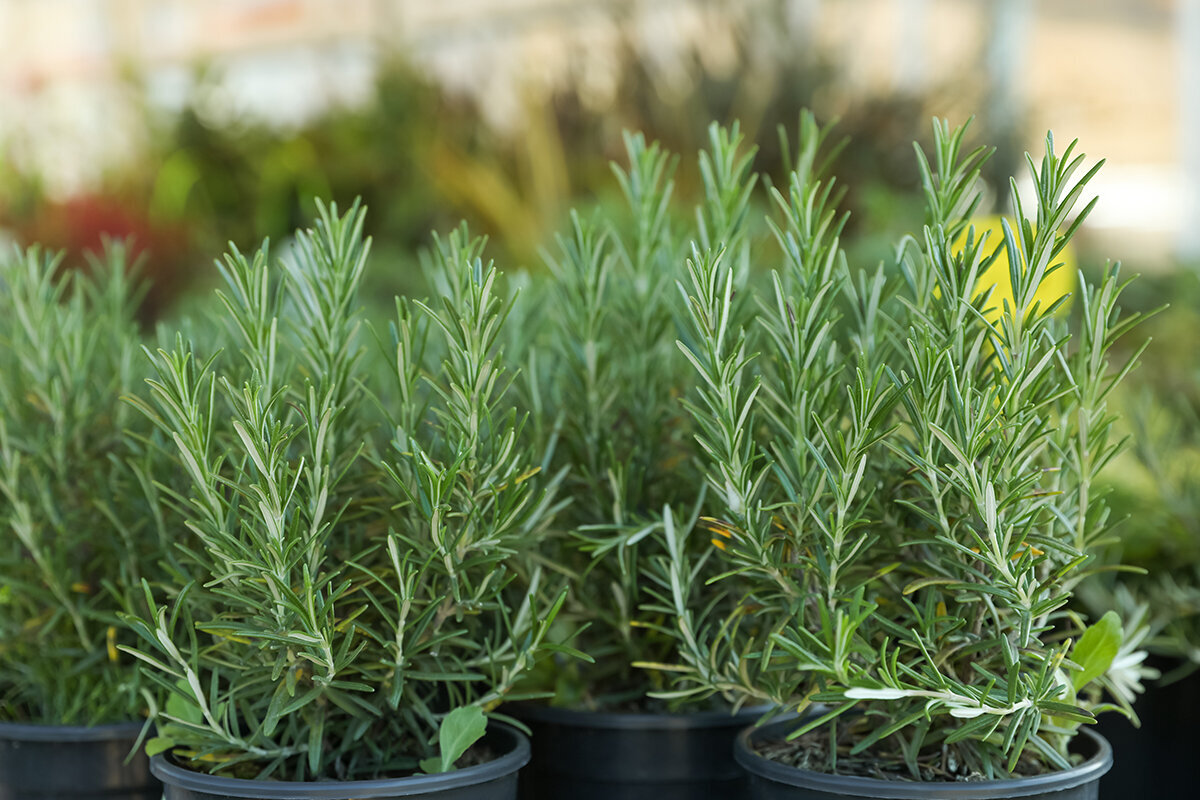
Give this aromatic subshrub the conditions of a bright Mediterranean courtyard: abundant sun, a stable root zone, moving air and pruning that always leaves living green growth.
Rosemary is not basil with tougher leaves. It is a small shrub whose scent, shape and lifespan depend on the relationship between light, roots, air and woody growth.
That distinction determines how it should be grown under cover. A soft annual herb often needs even moisture, quick feeding and regular replacement. Rosemary instead needs a clear cycle of thorough watering and drying, a bright position and a pot that does not become a cold reservoir of water. Its narrow leathery leaves tolerate sun and conserve moisture, but its roots react badly to lack of oxygen in dense, wet compost.
In New Zealand gardens, a greenhouse is especially useful through difficult changes in weather: late winter, cold wet spring spells, humid summer conditions and the low-light months. It should not turn rosemary into a tropical plant. Used well, it shelters the plant from persistent rain and wind while roof vents and doors provide needed fresh air. In September the space can heat quickly; in May the same pot may dry very slowly.
Start with a healthy young plant or a cutting from a reliable variety, then shape the position and care around that plant. A carefully configured classic aluminium greenhouse gives committed home gardeners a bright, lasting setting where ventilation, placement and seasonal care become part of the garden design rather than an afterthought.
01 / Position under glass
Light first; moving air is the second discipline.
Rosemary needs a genuinely bright position. Put the pot on the sunniest suitable bench or an open floor space, usually on the north or north-west side in New Zealand. Under glass, sunshine can become intense from late morning. Watch a newly moved plant during its first warm weeks rather than assuming every greenhouse day is harmless. Pale, elongated shoots and wide gaps between leaf clusters indicate inadequate light. Pale or grey tips after an abrupt move may instead show a need to acclimatise or for temporary light shading.
Choose an accessible place where air can circulate around the crown. Rosemary does not belong on a crowded herb shelf behind basil, parsley and lush young plants. An open bench, a low stand near a roof vent or a position with effective cross-ventilation is usually better. Leave room between pots so foliage dries quickly after humid nights. Especially in winter, open space is an important growing condition, not a luxury.
Ventilation matters because rosemary can face two opposing stresses in one day: intense heat under glass and stagnant moisture within its crown. Open roof vents early on sunny days. Use the door and an opening opposite it so air is genuinely exchanged rather than forming a hot layer beneath the ridge. A well-planned classic aluminium greenhouse makes it easier to respond daily to rapidly rising temperatures and changeable New Zealand weather.
Practical orientation A north or north-west aspect suits many New Zealand gardens. In very warm districts and small greenhouses that heat rapidly, generous vent areas, early opening and movable pale shading during the strongest midday sun are particularly important.
Order on the bench Keep rosemary separate from crops with high moisture needs. A greenhouse can contain several microclimates, but the watering routine for a wet propagation bench should not dictate care for every plant.
02 / Plant and pot
Choose a plant that suits the available space.
Upright rosemary types work well for cooking and create a clear architectural line as single container plants. Their longer shoots can be harvested regularly without the plant immediately losing its shape. Compact varieties are easier to manage on a greenhouse bench. Trailing forms look attractive in raised bowls, but need plenty of light too. Do not place them where falling shoots block air movement beneath a shelf or constantly rest on damp surfaces.
Named varieties are best propagated from cuttings because seedlings can vary in growth habit and aroma. Buy a plant with firm, strongly scented leaves and a root ball that is neither dust-dry nor sitting in water. Blackened stem bases, grey growth within the crown or a heavy fine peaty root ball that remains wet for days are clear warning signs.
03 / Root-zone architecture
Drainage is not an accessory. It is the real planting plan.
Use a pot with unobstructed drainage holes and an open, structurally stable medium. As a home-mixing guide, the Bavarian Garden Academy suggests roughly 40 percent each of bark compost and garden soil, plus around 20 percent pumice, scoria or expanded clay. Function matters more than a rigid recipe: the medium should distribute water, retain nutrients, drain fully and admit air again as it dries. A sterile gravel layer is no more the goal than a collapsing peat-heavy root ball.
Pot raised
Drainage clear / air below
Saucer full
Standing water / avoid
Pot oversized
Too much wet compost / risk
Raise the pot: Set the container on pot feet or a free-draining bench. The plant base should sit level with, or slightly above, the finished compost. Excess water must be able to leave through an open hole instead of collecting beneath the pot.
Check the saucer: A saucer may catch runoff briefly, but it should be emptied afterwards. If left full, moisture is drawn back into the root ball and keeps the lower roots wet long after the surface appears dry.
Match pot size: Match the container to the existing root mass. A large volume of cool, unrooted compost around a small plant can encourage root damage long before the pot looks wet from outside.
Set the root ball so its woody base is not buried beneath the new compost. A crown planted too deeply stays unnecessarily damp, especially through winter. Water thoroughly after repotting and allow all surplus water to drain. Water again only when the upper layer has dried and the container feels noticeably lighter.
Do not rely on a decorative gravel layer in the pot base to correct an unsuitable medium. It reduces the available root space and replaces neither drainage holes nor an evenly free-draining mix. Better results come from distributing structural ingredients through the whole compost and raising the pot itself.
04 / Moisture rhythm
Water thoroughly, then let the root zone breathe.
Spring
As days lengthen, new shoots use noticeably more water. Check more often, but do not switch to daily watering from habit. Water only when the upper layer is dry and the pot feels lighter; then empty the saucer.
Summer
On bright hot days, a container may dry quickly. Water the full root ball in the morning rather than merely wetting leaves and the surface, and ventilate before heat builds up inside.
The rosemary test
Check the compost with a finger in several places and lift the pot if practical. A dry surface combined with a clearly lighter container says more than a calendar. If water is needed, apply it slowly and evenly until a little emerges below. This moistens the whole root ball and confirms that drainage is working.
Neverkeep rosemary continually moist simply because it is protected under glass. In cloudy weather, a greenhouse can slow drying considerably.
Usuallyallow the upper compost layer to dry between waterings. Established rosemary tolerates brief dry spells, but an actively growing container should not dry out completely for long in summer.
Alwaysconsider pot material, plant size, sunlight, air movement and season together. A terracotta pot on a sunny bench behaves differently from glazed ceramic on a cool shaded floor.
Feed sparingly. Fresh compost usually contains sufficient nutrients at first. For plants that have stayed in the same pot longer, a low-dose herb fertiliser during active spring and summer growth is enough. Frequent nitrogen-rich feeding makes soft, unstable shoots; lush growth is not proof of quality in an aromatic subshrub. Do not feed in autumn or winter.
Autumn
As light fades and growth slows, water demand falls. Do not let the pot enter a run of dull days or a cold night saturated with water.
Winter
Water only when the root ball has begun to dry. At 5 to 10 °C, a finger check may show that two to three weeks are enough between waterings. A sunny winter day can still dry small pots faster: observation comes before routine.
Mistake log / 01 A little water every day keeps the lower root ball permanently wet without thoroughly wetting the entire root zone.
Mistake log / 02 An outer pot or saucer used as a permanent water reservoir displaces air from pores in the root zone.
Mistake log / 03 Fertiliser places extra strain on waterlogged, stressed roots that already cannot absorb water and nutrients properly.
05 / Wood and renewal
Prune for living green growth, not dramatic effect.
Rosemary responds well to regular modest harvesting and light tip pruning. However, it does not reliably reshoot from completely bare old wood. The aim is to retain younger leafy branches throughout the crown. Do not let a substantial shrub become bare at its base before trying to rejuvenate it with one severe rescue cut.
After flowering or a strong growth flush, trim several green tips lightly. Cut just above a leafy side shoot and leave visible leaves beneath every cut. Remove dead, damaged or crossing branches first; then correct the outer shape. If the plant leans towards the glass, turn the pot regularly and direct flexible shoots with small cuts instead of intervening heavily later.
Harvest tender tips. Cut strong green shoot tips for the kitchen. Spread harvesting evenly across the whole plant.
Read the wood. Productive older shoots are firm and leafy. Bare old wood provides structure but is not a reliable starting point for new growth.
Renew gradually. Over several months, shorten selected long shoots back into leafy areas. Never remove a large proportion of the green crown at once.
Fresh green growth — harvest Leafy mature zone — shorten Bare old wood — do not cut Semi-ripe tips — cuttings
06 / Propagation bench
Raise semi-ripe cuttings as a reserve.
Cuttings are the sensible way to retain the aroma and habit of a proven rosemary plant. They also provide a practical reserve in frost-prone New Zealand regions: a small rooted cutting is easier to protect in winter than a sprawling container. Choose healthy non-flowering side shoots that are slightly firm at the base but still flexible and green at the tip. Summer to early autumn is a suitable window.
With clean scissors, cut shoot tips 12 to 15 cm long just below a leaf joint. Remove leaves from the lower third so no foliage later lies in the compost and rots. Use clean pots and fresh airy propagation medium rather than heavy garden soil. Insert the prepared stem about 2 to 3 cm deep. Consistent light moisture and hygiene matter more than complicated additives or tropical humidity.
01 / SelectHealthy shoot tip
02 / PrepareRemove lower third of leaves
03 / Insert2–3 cm deep
04 / RootMoist, never waterlogged
05 / CheckNew growth
06 / Pot onAcclimatise slowly to sun
Make a small hole in the medium before inserting the cutting, so the cut surface is not damaged and the stem is not unnecessarily scraped. Several cuttings can share one container if spaced adequately. Firm the compost gently. A light cover reduces excessive moisture loss, but must not remain airtight. Check regularly for standing water and dead plant material.
After several weeks, new growth and gentle resistance when a cutting is carefully tugged suggest roots have formed. Only then pot young plants separately into small containers. Keep the first watering cycles controlled and acclimatise the plants gradually to direct sun before treating them as mature rosemary.
07 / Flower and aroma
Harvest with restraint while preserving a clear plant shape.
Blue, pale violet, pink or white flowers are decorative and attract insects when doors and windows are open. Let some shoots flower. The lasting culinary harvest, however, comes from the aromatic leaves. Cut preferably in the morning once foliage is dry. Take young branches from across the crown rather than stripping one side in a single session. Regular small harvests also encourage a compact silhouette.
For drying, cut clean stems and tie them into small loose bunches. Hang them somewhere warm, shaded, dry and well ventilated. A strongly heated greenhouse is not automatically suitable as a summer drying room, because temperature and humidity can fluctuate too much. Use fresh leaves promptly. Whole sprigs or stripped leaves can also be frozen, retaining their aroma better than rosemary stored ground for a long time.
“Rosemary’s culinary quality comes from concentrated growth in abundant light—not from confusing controlled drying with thirst and neglect.”
08 / Climate through the year
A greenhouse softens winter but does not erase the seasons.
In mild areas, suitable rosemary can survive outdoors in a sheltered free-draining place; in a pot, extra protection is more predictable. An unheated greenhouse excludes wind and persistent rain but cannot guarantee adequate temperatures in severe frost. The Bavarian Garden Academy recommends a bright winter place at about 5 to 10 °C for containers. During prolonged hard frost, provide a bright cool indoor space or extra frost protection. Even a temperature-controlled greenhouse needs managing for light and air: cool, bright and ventilated is better than warm, dark and damp.
WinterVentilate when frost-free. Do not leave pots on wet ground.
SpringIncrease checks; use strong new growth for cuttings.
SummerRelease heat early; maintain cross-ventilation.
AutumnReduce water and prepare for frost in good time.
Winter risk mainly results from the combination of low light, cool compost and trapped moisture. Water sparingly, but do not leave a small pot to dry unnoticed for weeks. In spring, increase water only with visible new growth. In summer, open roof vents and doors early; movable pale shading helps in extreme midday heat. In autumn, stop feeding, and the local forecast determines when a large pot needs more protection. Brief ventilation on frost-free winter days reduces condensation and pest pressure.
When planning a permanently useful herb space, explore the options of a classic aluminium greenhouse and its practical classic aluminium greenhouse. A good rosemary position keeps clear routes for light, ventilation and daily access in every season.
09 / Reading symptoms correctly
Check the growing system before treating individual leaves.
Soft base, dull leaves, brown tips
Possible cause: Root stress or rot from overwatering, poor drainage or a cold, permanently wet root ball.
Response: Check drainage holes and saucers. Remove standing water and, if needed, repot into clean open compost. Water carefully during recovery and do not feed the damaged root system.
White or grey coating in the crown
Possible cause: Powdery mildew or other fungal pressure encouraged by close spacing and still humid air.
Response: Remove clearly affected plant parts, increase spacing and ventilate more consistently. Water the compost rather than the foliage, and do not keep the greenhouse closed during mild damp weather.
Fine speckling, webbing, pale leaves
Possible cause: Spider mites, especially in hot dry air and on already weakened plants.
Response: Isolate the pot and inspect leaf undersides carefully. If appropriate, rinse the plant gently and check more regularly in future. Dry air does not mean the root ball may be allowed to fail completely.
Other possible greenhouse pests include aphids, whiteflies, mealybugs and scale insects. Early detection is far easier than restoring a dense crown that is already badly damaged. Link each harvest to a short inspection: take a branch in hand, look into the centre of the plant and check its base. Then decide whether rosemary needs water, air, a small prune or simply time undisturbed. Use plant-protection products on edible herbs only after a clear diagnosis and after checking the New Zealand label, EPA approval and controls for the exact crop, pest and use.
10 / Four calm routines
Seasonal checklist for rosemary
Late winter Clean glazing, check roof vents, look for spider mites and remove dead branches. Water only when the root ball visibly begins to dry.
Mid-spring Repot gradually if roots are tightly circling, renew compost and begin modest feeding only with steady new growth.
High summer Ventilate early, water thoroughly when needed, harvest tips moderately and do not trap humid air overnight after watering.
Early autumn Take reserve cuttings, stop feeding, follow weather forecasts and decide on a protected winter position for large pots in good time.
If you are planning a herb-focused greenhouse from the ground up, a classic aluminium greenhouse provides a clear basis for ventilation, shading, bench space and accessible working routes. For rosemary, room around one or two substantial pots is usually better than filling every surface with thirsty annual herbs.
Greenhouse rosemary FAQ
Questions from the potting bench
Can rosemary grow in a greenhouse all year?
Yes, provided it receives ample light, moving air, free-draining compost and seasonally appropriate temperatures. Growth slows with winter light, so water demand also falls. An unheated greenhouse is sufficient only where temperatures do not remain very low for long or additional frost protection is available. In severe frost, a bright cool indoor place may be safer.
How often should rosemary be watered under glass?
There is no universal number of days. Check the upper compost layer, pot weight, depth of the root ball and the weather. When there is a real need, water thoroughly, let everything drain and then wait for clear drying. Frequent checks are needed in sunny summer; use can be very low during dull winter weeks.
May rosemary stand in a full saucer?
No. A saucer can protect the bench or floor while watering, but must be emptied after drainage has finished. Roots are sensitive to a permanently wet, poorly aerated lower root ball.
Can heavily woody rosemary be cut back hard?
Proceed carefully. Rosemary does not reliably reshoot from leafless old wood. Shorten it gradually and leave green leafy sections below every cut. If a plant is already very bare, first secure healthy tips as cuttings, then make only modest corrections.
Why are lower leaves turning brown although the compost is wet?
This often indicates root stress rather than thirst. Check for blocked drainage, a full saucer, an oversized pot, compacted compost, insufficient light and stagnant air. Correct those conditions before giving more water.
Sources and further reading
Grounded in horticultural practice
More from Bloomcabin: Classic aluminium greenhouse essentials · Door position and access · Greenhouse blinds
- Bavarian Garden Academy — rosemary:Rosemary – scent of the south
- Bavarian Garden Academy — herb growing:Growing herbs for fresh use
- Royal Horticultural Society — rosemary care:How to grow rosemary
- UMass Amherst — rosemary root diseases:Rosemary – Phytophthora root rot
- University of Connecticut IPM — greenhouse herbs:Plant protection for herbs under glass
- UC Statewide IPM — rosemary:Identifying rosemary pests and diseases
A greenhouse with room to breathe
Give rosemary a bright, ventilated space with character.
A healthy rosemary plant is a small lesson in good greenhouse planning: clear light, easy access, restrained watering and air that never stays still for long. Choose a Bloomcabin greenhouse that makes these routines natural. Then this fragrant evergreen subshrub becomes not only a kitchen crop, but a lasting part of your garden design.
Classic aluminium greenhouse