
Planning Hot Tub Delivery: Gates, Access Routes and Lifting
HOT TUB DELIVERY
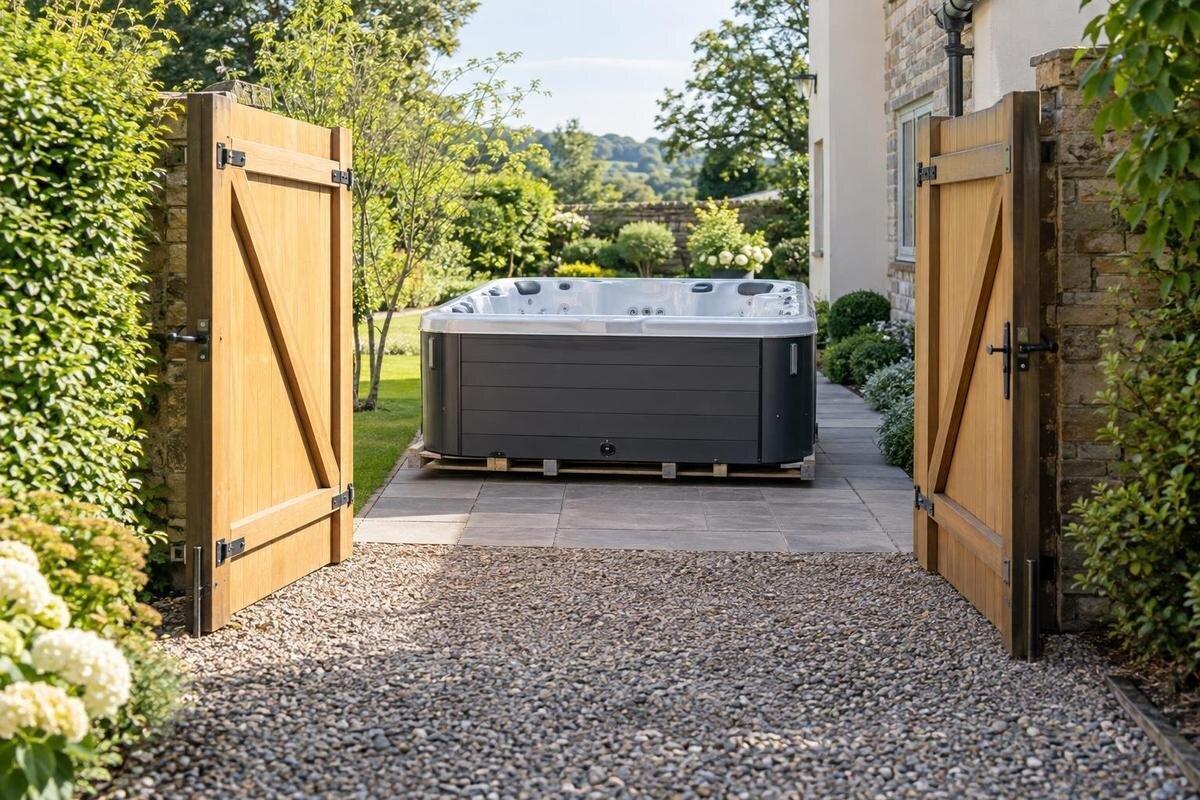
A hot tub may fit the space you have in mind yet still be unable to reach it. Gate width is only one part of delivery access: the packed unit, handling clearance, tight turns, changes in level, overhead obstacles and room for the vehicle all matter. Before ordering, trace the full route from the likely stopping point to the planned position and send the details to the supplier. Ask for written confirmation based on the exact model and delivery method, including any specialist lift, responsibilities and extra charges. That gives you a practical basis for deciding whether to proceed or revise the plan.
01
Map the route from the street to the planned position
Start at the point where a delivery vehicle could stop, whether that is on the street or in a driveway, and trace the route all the way to the planned hot tub position. Walk it rather than relying on a property plan or an estimate from the gate. A side passage can narrow at a downpipe, a gate may not open to its full usable width, and a path can turn behind a garage. Include every opening, passage, corner, threshold and change in level. Sketch the route in order so the supplier can see where each restriction occurs, not just the straightest section.
Mark any alternative route separately and note what would need to change to use it. A route through a neighbour’s property, shared driveway, locked gate or part of a fence you do not control cannot be treated as available without agreement. List possible changes as points to discuss; do not assume a delivery crew will move an obstacle or that it can be removed without damage. Identify the actual destination too. A measurement to the backyard entrance is not enough if the tub must pass through another gate or around an outbuilding to reach its planned position.
Measure gates, paths and narrow openings
Measure the clear opening of every gate and doorway along the route, including the narrowest usable width, rather than the advertised gate size or the distance between fence posts. Open each gate as far as it normally can and check whether hinges, handles, latches or a post intrude into the passage. Record height as well as width, especially where an arch, lintel or canopy crosses the route. If an opening is irregular, measure it at more than one point and record the smallest clear space. Use metres or millimetres consistently and write down where each measurement was taken.
Measure paths at their tightest points too: between walls, garden edging, downpipes, steps or fixed equipment. A path that looks wide enough at its entrance can narrow halfway along, so do not rely on an average. Note whether a gate would need to be removed or an obstacle altered, and whether your measurement assumes that change. For a specific option, such as Bloomcabin’s Cove 2 hot tub, compare your route with the supplier’s confirmed transport measurements and handling clearance. Do not assume that any model fits based on a single width measurement, product photograph or name.
02
Check tight turns and handling clearance
Turns are easy to overlook when measuring a route. At each corner, record the width of both approaching paths and the available space around the bend. Include walls, posts, fence returns, planters or other features that reduce room to manoeuvre. A long item may need more space to turn than a short item of the same width, so a straight measurement alone cannot show whether the corner is passable. Take a photo looking into the turn from each direction, and add a sketch if the shape or available turning space is hard to understand from the images.
Packed dimensions and handling clearance answer different questions. The first describes the outer size in a stated transport condition; the second is the extra room required for the item to be handled using the proposed method. Ask the supplier to assess the actual unit, any packaging and every turn along your route. If you are considering the Haven 6 hot tub, include your corner measurements and photos so the supplier can assess the available turning space. Do not base a plan on tipping, rotating or taking anything apart unless the supplier confirms the handling method.
Record steps, slopes and changes in surface
Include every step, stair flight, ramp and slope in your route notes. Record the number of steps, where a flight turns, and the width and usable landing space at the top, bottom and any intermediate turn. For a ramp or sloping path, describe its direction and approximate extent, and take a side-on photo as well as a view from the approach. A view from one angle can make a change in level hard to see. You do not need to calculate a technical grade; give the supplier an accurate description and ask whether a more detailed assessment is needed.
Describe surface changes along the way, such as paving, loose gravel, grass, uneven pavers, drainage channels or a threshold. Note where the surface changes and whether any sections look soft, damaged or particularly uneven. These observations help with access planning; they are not a technical assessment of what equipment can travel over the surface. Flag several steps or a steep slope before ordering and ask whether the proposed delivery method can use the route. If you are considering the Fjord 8 hot tub, send these details with your route sketch so the supplier can assess how the steps and surface changes affect delivery.
03
Look for overhead obstacles along the route
Look above the route as carefully as along it. Record low eaves, gutters, arches, carports, pergolas, tree branches, cables and any other overhang that might limit the height of the product, packaging or handling equipment. Note the lowest clear point and exactly where it occurs; a high entrance followed by a low canopy can be the deciding restriction. Measure the clearance only where it is safe and practical to do so. If overhead services are nearby, flag them clearly and leave any assessment or work around them to the relevant provider or qualified professional.
Photos can show how an overhead obstacle relates to the route: take a wide view that shows its location and a closer view of the low point. Include the entrance and the space beyond it, and label the images so the supplier can identify each spot. A lifting provider also needs to assess overhead clearance, not just the product’s path along the ground. Do not assume branches or fittings will be moved on the day. If removal or alteration may be needed, clarify who can authorise and arrange it before relying on that route.
Confirm vehicle access and unloading space
Check the vehicle’s approach as well as the tub’s route. Describe the way in from the street or shared access, including any entrance gate, driveway width, turning space, slope, low overhead point and distance from a possible stopping place to the start of the route. Tell the supplier about narrow roads or driveways, tight bends, parked vehicles and places where a delivery vehicle might not be able to turn or wait. Ask what type or size of vehicle the quote assumes and what access and unloading space it needs. A vehicle that reaches the property may not be able to set up close to the route.
Mark a possible stopping and unloading area on a sketch or photo, and note whether it is on private, shared or public land. The provider needs to know whether equipment would be set up there or whether the unit would have to travel further to the destination. If stopping or lifting could affect a public road, shared access or another person’s property, ask the provider and relevant owner or authority whether any permission or traffic arrangements apply, and who would arrange them. Whether you are considering Bloomcabin Hot Tub Aurora 10 or another catalogue model, confirm vehicle access and stopping arrangements for that delivery.
04
Send the supplier measurements and photos
Give the supplier one organised access pack rather than a set of unlabelled measurements. Include the exact model, a simple route sketch, the clear width and height at every gate and pinch point, photos of corners, notes on steps and slopes, surface changes, overhead obstacles, the vehicle approach and the likely stopping place. Label each measurement with its location and say whether a gate is fully open or an obstacle would need to be altered. A wide photo helps explain the route; close-ups show details such as hinges, turns and low points. Include every part of the journey from the vehicle to the planned position.
Ask the supplier to confirm the exact model’s current dimensions in its delivery condition, packed outer dimensions where applicable, transport weight, handling instructions and any additional clearance needed for the proposed method. Product dimensions, packed delivery dimensions and handling clearance are not interchangeable. Clarify whether quoted dimensions include protective packaging and whether a particular orientation is assumed. If you are comparing the Bloomcabin Haven 6 model, make sure the information refers to that exact product, not another model or a generic photo. Ask the supplier to identify anything that remains unconfirmed.
Ask whether a specialist lift is needed
A specialist lift may need to be considered when no measured ground route appears to have enough clearance, when steps or slopes cannot be managed by the proposed delivery method, or when a barrier blocks access. That does not make a crane an automatic solution. The lifting provider needs to assess whether its vehicle can reach and set up in a suitable place, whether the lift path is clear overhead and whether the unit can be placed at the destination using an agreed method. Give the provider the exact transport weight and handling instructions once the supplier has confirmed them.
Ask who should make the assessment: the supplier’s delivery team, a specialist lifting company, or both. Find out whether they need a site visit rather than photographs, which access details they require and whether their quote assumes a particular stopping or setup location. A crane being available locally does not establish that it can serve your address. Do not plan a do-it-yourself lift or assume the product can be tipped, suspended or reoriented without the responsible professionals confirming the method. For the Cove 2 model, as for any choice, the lifting plan has to match the site and transport details.
05
Clarify who arranges the lift and what delivery includes
Agree who is arranging each part before you commit. Ask whether the hot tub supplier books the lifting provider or whether you must contract one; who checks the route, confirms the transport measurements and shares them with the lifting team; and who coordinates dates and access. If more than one company is involved, make sure each has the confirmed model and route assumptions. Clarify who checks any permissions or traffic arrangements that a provider says may apply, and whether a property owner or another party needs to approve access. A written allocation of responsibility is easier to rely on than an assumption passed between businesses.
Ask exactly what delivery includes and where the service ends. Delivery to the kerb, driveway, property boundary and agreed final position can mean different scopes. Confirm whether unloading and placing the unit, any specialist lift, packaging removal and a pre-delivery site inspection are included, excluded or separately quoted. Do not infer that buying the product includes all handling at your property. For Bloomcabin’s Fjord 8 model or another selection, tie the agreed service to the chosen model and route, including any extra charges if the arrangement changes after an assessment. Make sure you know whom to contact if conditions differ from the information supplied.
Get access assumptions and charges confirmed in writing
Before placing the order, ask the supplier to confirm in writing that your measurements and photos have been reviewed against the exact transport details and agreed delivery method. The confirmation should identify the assumed stopping point, route, clearances, obstacles left in place, vehicle access, any specialist lift and who is responsible for each arrangement. Request an itemised quote showing any separate charge for a site visit, longer carry, extra handling, lifting, traffic arrangements or possible re-delivery. These are potential cost factors, not a price estimate; ask for current amounts and the conditions that could change them.
If access is not confirmed, pause rather than relying on a guess. Discuss whether a supplier-approved alternative route, a professionally assessed lift or an authorised change to an access opening is feasible, or whether to reconsider the model or order. None of these options is automatic: check who is responsible, what it costs and how the supplier’s terms apply if the route changes or delivery cannot proceed. If you are weighing the Aurora 10 model or another catalogue option, compare it only once the delivery method and its assumptions are clear. A confirmed route, named responsibilities and written charges give you a sound basis for deciding whether to proceed.
Frequently asked questions
Is the hot tub’s product width enough to compare with a gate?
Not by itself. Ask for the exact model’s packed or transport dimensions, as applicable, and the handling clearance required for the delivery method. Even if the gate is wide enough, a nearby turn or narrow passage may leave too little room to manoeuvre the unit.
Can the hot tub be turned on its side to get through a narrow opening?
Do not assume that it can. Ask the supplier or manufacturer for model-specific handling instructions, then have the delivery provider confirm whether the proposed method is suitable. Do not plan to tip, rotate or dismantle the unit yourself.
Does delivery include placing the hot tub in the backyard?
The service scope can vary. Ask whether the quote covers delivery to the kerb, driveway, property boundary or agreed final position, and whether unloading, placement, a lift and packaging removal are included or priced separately.
When should I ask about a crane or other specialist lift?
Raise it before ordering if the measured route has narrow openings, tight turns, steps, steep slopes or overhead obstacles that may prevent the proposed ground route. The supplier and lifting provider can assess the exact transport details, vehicle setup and access conditions.
What photos should I send to the supplier?
Send wide views that show the route in sequence, plus close-ups of gates, narrow points, corners, steps, slopes and overhead obstacles. Include the vehicle approach and likely stopping area. Label each photo and pair it with measurements so the supplier can tell where each restriction is.
The key question is not whether a hot tub looks as though it will pass through the gate. It is whether the supplier can confirm that the exact transport dimensions and handling method work along the complete route, with a suitable vehicle and any required lift accounted for. Keep the agreed service scope, responsibilities and charges in writing. If any part of the route or delivery method remains uncertain, resolve it before placing the order rather than relying on a last-minute adjustment.
