
Are Louvered Pergolas Watertight in Heavy Rain?
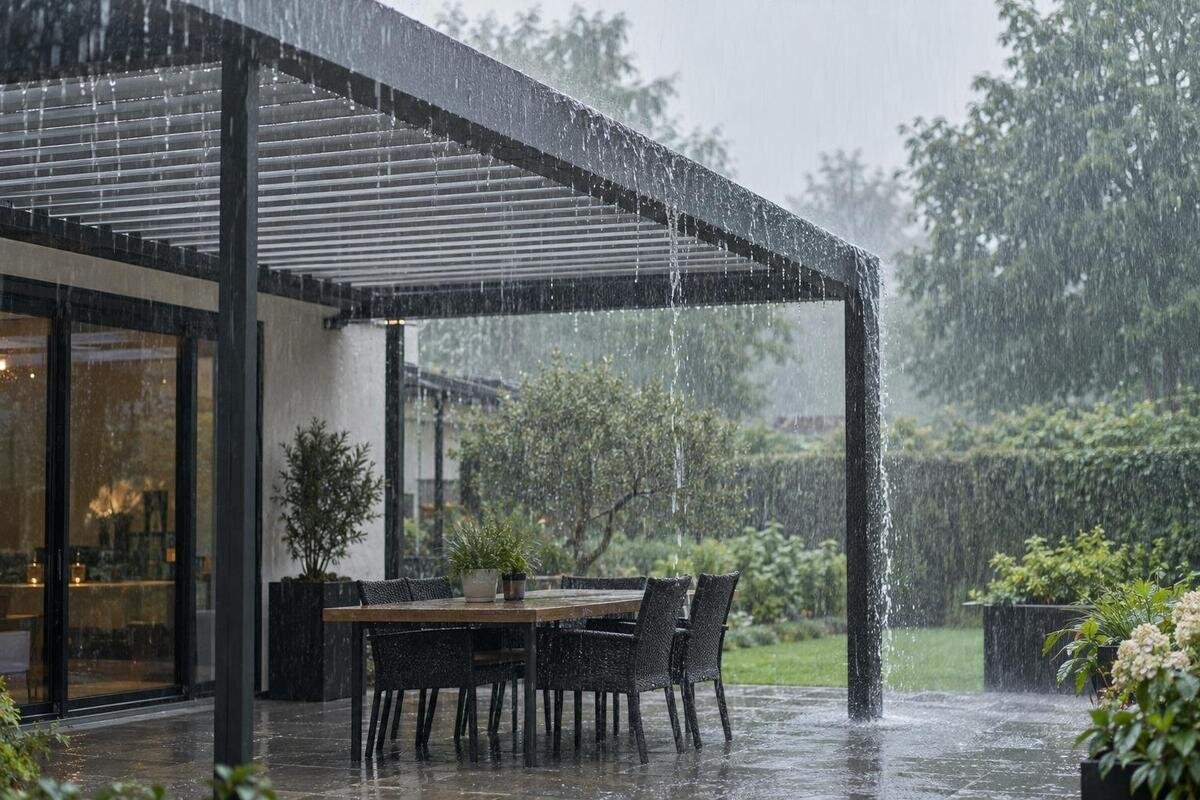
Pergola rain performance
A louvered pergola roof may direct rain into built-in channels when it is fully closed, but no category-wide answer makes every model watertight in heavy rain. The result depends on the blade design and closed position, the route and capacity of drainage, installation, maintenance, wind, and how exposed the perimeter is. Also, “watertight” can sound like a sealed room, while many pergolas have open sides. The useful buying question is what the exact model has been shown to handle—and under which conditions—not simply whether its louvers close.

What “watertight” means for a louvered pergola
A louvered pergola uses adjustable roof blades that can open, partly open, or close over the space below. When closed, the blades may overlap or meet to create a surface that sheds water. Blade shape, end joints, seals, and the intended closed position vary by design. Some systems guide runoff into a perimeter beam or gutter; others use a different route. Look at a section drawing or technical diagram: a closed-roof photo may not show the underside joints, blade ends, or connection to a gutter. Do not assume every roof closes into a sealed plane.
Rain protection is not the same as a sealed building envelope. A roof may intercept direct rainfall and still let water through a joint, an edge, or open sides. If dry storage or protection for sensitive furnishings is essential, ask whether a claim refers to the roof alone, the complete installed structure, or an enclosed configuration. Also clarify what “watertight” means in the claim: no direct rain in the center, no leakage at blade joints, or a particular test result are not interchangeable descriptions. The Bloomcabin Bioclimatic Aluminum Pergola listing identifies a model by name; the name itself does not establish a heavy-rain test or drainage performance.
The roof must be in its specified closed position
Position changes how much rain can pass through. With blades open, rain falls through; at an intermediate angle, the roof may redirect some water while leaving openings. A manufacturer-defined closed setting is the position to check when reviewing rain performance, but “closed” does not automatically mean sealed. Blades may overlap, meet against a gasket, or rely on particular alignment. If instructions identify a rain or closed position, use that term when comparing claims. Looking up from below may not show whether the blades have reached their intended stop.
For the Bloomcabin Pergola product page, request the operating instructions and roof drawing for the exact model and size under consideration. Confirm the roof type first, then check whether any stated rain performance applies to a fully closed position rather than an assumed angle. If the model offers powered controls or weather sensors, ask what triggers movement, whether automatic operation has limitations, and how the instructions address interrupted power. Do not assume that a sensor closes a roof before the first drops arrive or that its presence establishes rain protection. Also distinguish a position used in a rain test from the manufacturer's operating guidance during severe weather. If the instructions call for a different position under particular wind conditions, a closed-roof rain result does not override that guidance. These details determine how the roof can actually be used, not just how it performs in a demonstration.
Heavy rain is a different test from a shower
“Heavy rain” is not a precise performance description on its own. A brief cloudburst delivers water quickly; steady rain over several hours tests whether drainage continues to work throughout a longer event. Duration alone does not mean water accumulates in a system that is draining effectively. Roof area matters too: under the same rainfall, a larger roof collects more water than a smaller one. Wind adds another variable by pushing water sideways against joints and edges. These factors mean that a claim based on ordinary showers does not automatically describe prolonged rain with gusts. A video showing water poured onto a few blades can illustrate a local runoff path, but it does not establish the performance of an entire roof receiving rain across its full area.
Look for the conditions behind any stated result: rainfall rate and duration, roof size, blade position, wind conditions, and whether the observation covered the complete product or only one part. Ask what the test counted as leakage, such as drips at joints, water entering at an edge, or any water beneath the roof. A statement without details about its setup is hard to compare with your patio. Check whether the tested roof included its normal drainage components and whether the result applies to your planned configuration. If a report gives a numerical rainfall rate, retain its units when comparing results; an amount collected over an hour is not directly comparable to an unspecified burst from a hose. Also note whether observations continued after the water supply stopped, since delayed drips would otherwise be missing from the record.
Trace the full drainage route
Follow the water rather than stopping at the roof surface. Depending on the design, rain may run off the louvers into channels in a perimeter beam, travel through corner connections, and leave through outlets at or inside the posts. Other systems may route it differently. A drainage diagram should show the path from the roof to the discharge point, including how the corners connect and which parts must remain clear. It should also show whether an existing gutter or drainage system forms part of the route. Water emerging from an intended outlet is not itself roof leakage; water escaping from a connection may be a different issue. Identify those locations before judging an observation. The discharge destination matters as well: successfully moving water off the roof does not establish that the surrounding patio or building drainage can receive it.
Ask what happens if rainfall arrives faster than an outlet can carry it, or if an outlet is partly obstructed: does water spill at a defined point, back up, or escape at a joint? Those are model-specific questions, not details to infer from appearance. The Bloomcabin Pergola listing gives a catalog area range of 97–258 sq ft. Roof area helps frame how much water reaches a drainage system, but it is not a flow-capacity rating. Confirm the selected size and its drainage details together.

Wind can carry rain past the roof edge
Wind changes the direction from which rain approaches. In still rain, water falls mostly onto the roof; in gusts, it can strike a side, pass beneath a roof edge, or reach blade-end gaps before it is collected. Open sides also mean that a roof designed to drain rainfall cannot keep all rain out of the space below. A test without meaningful wind exposure answers a narrower question than a patio exposed to gusts. Nearby walls or fences may shelter one side while leaving another more exposed.
Consider which edges face the weather at your site, and describe which sides will remain open when asking about performance. Use the Bloomcabin Lean-To Pergola listing to identify the wall-mounted model when discussing those exposed sides. A simple site sketch can show the building wall, open perimeter, nearby barriers, and the seating area you want to protect. Note where rain has entered the existing patio during previous storms, without treating one event as a prediction of every future storm. This helps distinguish a roof-joint concern from rain arriving through an open side. Ask whether available evidence covers the relevant wind conditions and configuration; protection from rain falling vertically is not the same as protection from rain coming in at an angle. Do not reproduce severe-weather tests at home to resolve a missing performance claim.
Wall connections need their own detail
A wall connection is a separate water-management detail from the louvered roof. Rain can run down the building face, collect at a roof-to-wall transition, or reach an interface that is not visible from below. Existing eaves, flashing, gutters, and wall-surface conditions affect how that junction can be finished, so a general product image is not enough to judge it. Request the applicable installation drawing and have a qualified installer explain how the interface is intended to manage water at your particular wall.
For a wall-mounted example, use the exact Lean-To Pergola model as the reference when requesting its wall-side detail, rather than relying on a generic pergola diagram. Check whether the documents show the upper edge, the adjacent building surface, and the route for water running down that surface. If the published details do not cover your wall condition, have the installer identify what needs separate attention before work begins. Do not assume that the roof’s rain performance includes the attachment joint.
Side panels do not automatically make a room watertight
Adding side screens, sliding panels, or glazing may reduce direct exposure, but it does not automatically turn a pergola into a watertight room. Accessories can leave gaps at corners, tracks, doors, or the roof edge, and their fit can vary by product. A screen that reduces wind is not necessarily designed to stop wind-driven water; a panel system may have separate limits. Treat roof performance and enclosure performance as related but distinct questions.
Ask whether the exact roof, side accessories, doors, and operating positions have been assessed together. A result for a roof with open sides may not describe a setup with panels; a panel’s presence does not prove that water is sealed where sections meet or at the top. Confirm that accessories are compatible with the model and will not obstruct the designed drainage path. If you need a reliably dry, room-like interior, look for documentation for that complete enclosure rather than assuming a pergola provides it.
Installation and maintenance affect drainage
Even a design with a defined runoff route depends on being assembled and maintained as specified. Alignment, connections, seals, and channel positions can affect where water travels. Leaves, seed pods, dirt, and other debris can collect in exposed gutters or outlets and impede flow. A unit that drains as intended when clear may behave differently when channels are obstructed. Consider how accessible the outlets are for inspection and cleaning, especially near trees. If water appears unexpectedly, record its location from a safe, sheltered position and note whether it began immediately or later in the rainfall. A drip along a blade joint, water at a corner, and rain entering an open side describe different observations. Photos taken without approaching moving parts or exposed areas can help an installer investigate. Avoid assuming that every wet spot has the same cause or applying sealant before the intended water path is understood.
Ask for care instructions for the exact model, including which outlets need clearing, how to inspect them safely, and whether the manufacturer specifies a louver position during rain. Identify the unit with the Bloomcabin Pergola page when requesting those instructions; product names alone do not establish that every range is assembled, cleaned, or operated identically. Follow the stated safe access method, and do not climb onto the roof or dismantle a channel to investigate a leak. Have an installer assess outlets or components that are difficult to reach.

What to request in rain-performance documents
A useful document set pairs a performance statement with a roof drawing and a drainage diagram. The documents should identify the model, size, tested configuration, observation criteria, and any stated limitations. Check dates and revision references so the drawing and report describe the same version of the product. Distinguish a demonstration, a manufacturer's declared performance, and a formal test report: each can provide information, but they are not interchangeable forms of evidence. A drawing explains the intended water path without proving a rainfall limit. A test report describes results within its stated scope without necessarily covering other sizes or accessories. If a seller summarizes a report, ask for the relevant document or excerpt showing both the result and its conditions. A headline such as “weatherproof” is less useful than a clearly bounded statement you can apply to your intended setup.
Request evidence tied to the specific item and chosen configuration, not just a broad product category. When assessing the Bloomcabin Bioclimatic Aluminum Pergola, for example, ask which model-specific weather documents apply and whether they describe the roof and drainage arrangement being considered. A diagram can explain where rain should go; a relevant test or explicit manufacturer statement is needed to understand the conditions that route is intended to handle. Keep the answer in writing so you can compare it with the planned installation and follow up on any missing limits.
Match the evidence to your site and intended use
Set your own threshold before comparing claims. If you want shade and some protection from routine rain while accepting occasional water at the perimeter, a rain-shedding roof may fit your expectations. If cushions, electronics, or other water-sensitive items must stay dry through wind and storms, an open-sided pergola may not meet that need. Define which part of the space needs protection and when: keeping a central dining table usable during ordinary rain is different from leaving belongings outside unattended all season. Consider the direction of exposure, nearby walls and roof runoff, and whether items can be brought inside or covered. Do not count the entire roof footprint as guaranteed dry space. Water entering at the edges can affect usable seating even when no water passes through the blades, so separate your expectations for the roof from those for the space beneath it.
Match those needs to documentation for the actual roof, size, drainage route, and any side enclosure you plan to use. For a wall-mounted setup, the Bloomcabin Lean-To Pergola product page can identify the model for discussions with the installer. Agree on which drawings apply to the wall interface and where the planned outlets will discharge. At handover, ask the installer to identify the drainage outlets, explain the permitted operating positions, and show how routine inspections are performed safely. Keep those instructions with the relevant performance documents so later observations can be compared with the intended setup. An ordinary-rain observation may help reveal an installation issue, but it cannot establish an undocumented storm rating. If no evidence addresses the combination you need, include that uncertainty in your decision rather than assuming the roof will behave like a sealed building.
Frequently asked questions
Are louvered pergolas completely watertight when the blades are closed?
Not as a category-wide guarantee. Blade joints, edges, seals, drainage, and tested conditions differ by model. Check whether the manufacturer describes the roof as rain-shedding or provides model-specific evidence for a stated level of water protection.
Can a pergola’s drainage overflow in heavy rain?
It can, depending on rainfall, outlet capacity, the drainage layout, and whether channels are obstructed. Ask where water goes if it cannot leave through the intended route, and follow the maintenance instructions for keeping outlets clear.
Will a closed louvered roof keep out wind-driven rain?
Not necessarily. Wind can carry rain beneath exposed edges or into open sides even when the roof is closed. Look for evidence that matches the wind conditions and the exposure at your site.
Do side screens or glass panels make a pergola waterproof?
No, not automatically. Panels, doors, tracks, and roof connections can have gaps, and performance may depend on the exact combination and position of the accessories. Check compatibility and any test conditions for the complete configuration.
What rain-performance information should I request before buying?
Ask for documents tied to the exact model and size, including the tested louver position, rainfall and wind conditions, drainage diagram, outlet locations, and any limits or compatible enclosure options. A product name alone does not establish rain performance.
A closed louvered roof can reduce direct rainfall where its design collects and drains it, but “watertight in heavy rain” is too broad without model-specific conditions. Trust a claim only when it matches the actual closed position, wind exposure, roof size, drainage route, installation, and side configuration you intend to use. If the evidence is limited, plan for water at the perimeter rather than treating the pergola as an enclosed room.
