
What to Consider When Buying a Pergola for a Windy Location
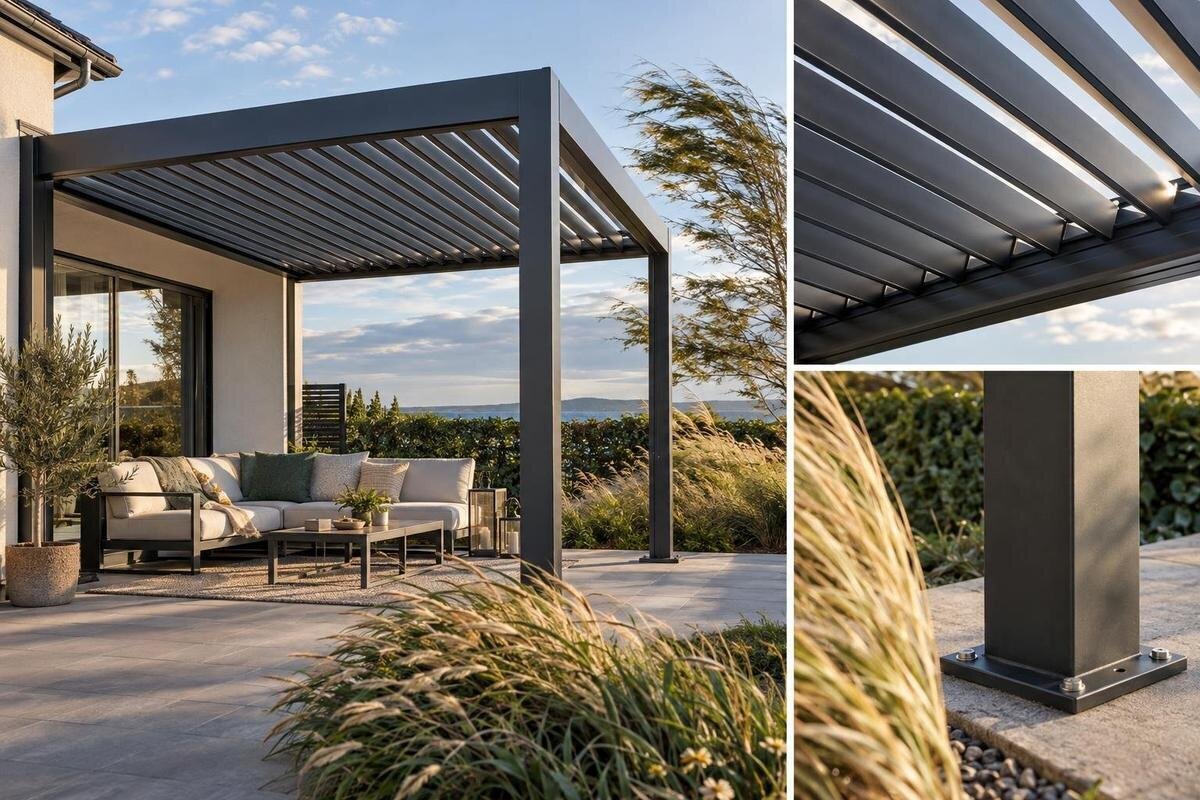
Pergola buying guide
Buying a pergola for a windy location requires more than choosing a frame that looks substantial. The important question is whether the manufacturer’s guidance covers the exact model and setup you want, and whether the intended anchoring can be used at your site. A city forecast or a broad “wind-resistant” label cannot answer both. Before comparing finishes and accessories, describe the exposure, request model-specific wind information, and have the supporting surface and installation plan reviewed where needed. This makes the purchase decision about a documented match—not a guess that any pergola will withstand strong gusts.

Map the wind exposure at the installation site
Map exposure at the actual installation point, not from a citywide weather description. Note what lies upwind—open land, a ridge, a gap between buildings, trees, or nearby structures—and whether gusts can reach the site from several directions. Terrain and obstacles can alter local wind, so two patios a short distance apart may not have the same exposure. Record the directions associated with the strongest local gusts and whether planned construction or seasonal foliage could change the shelter. Note recurring observations, such as gusts during storms or wind that funnels along a side yard, but do not treat informal observations as a substitute for site criteria. If you lack site-specific wind criteria, ask a local building official or qualified design professional what information should guide a pergola purchase.
Describe the proposed location clearly: beside a wall, in an open yard, or near the edge of a terrace can mean different conditions for the person assessing it. Keep those details with the model you are considering. When reviewing the Bloomcabin pergola listing, treat it as a candidate to investigate, not proof of wind suitability. Share the intended placement, nearby walls or screens, and likely directions of strong winds with the manufacturer or installer. That gives them a useful basis for answering questions about the exact product and setup, and helps you compare other candidates on equal terms.
Request wind guidance for the exact model
Ask for documentation tied to the exact model and configuration you intend to order. It should identify which size, roof arrangement, attachments, and accessories the guidance covers, rather than relying on a family name. A manufacturer may provide a wind rating, test information, design guidance, or operating limits; find out which information is available and what each item is meant to establish. When considering the bioclimatic aluminum pergola listing, treat its name as an identifier only and check whether the product documentation describes the specific setup you are considering.
Ask for the stated wind basis, units, test or design method, and any important qualifications. Confirm whether the guidance applies to a complete installation, the frame alone, or particular roof and side settings, and whether a professional must select or approve the anchoring. Ask for the document date or revision and whether it applies to the version currently offered, especially if a quote includes options not shown in the basic listing. The seller should be able to direct you to manufacturer information rather than just repeat a descriptive claim. Save the response alongside the exact model name and order configuration. If details are missing, ask the manufacturer to clarify before comparing options or committing; a similar-looking model cannot fill a documentation gap.
Check what a wind rating actually measures
A pergola wind rating is not meaningful as a bare number. Ask whether it refers to sustained wind, a gust, pressure, a test result, a design criterion, or an operating limit, and note the units and method used. A speed-based figure and a pressure-based figure are not automatically interchangeable. Ratings developed on different bases may not be directly comparable even when they appear to describe similar conditions. The site exposure, mounting method, and tested configuration also matter. Ask whether the stated figure is tied to assumptions about location, height, terrain, or shielding, since an unqualified comparison can be misleading. Have the manufacturer and a qualified professional explain whether the stated rating can be compared with the criteria for your location.
Check any limits or exclusions before treating a rating as a match. Ask whether it covers wind from all directions or only a stated orientation, whether it applies with optional sides or screens, and whether it describes an operating condition or a separate condition for the structure. If the Bloomcabin pergola product page is on your shortlist, request the applicable wind basis and installation assumptions for that exact candidate. A general phrase such as “wind-resistant” is not a substitute for defined conditions, and a rating should not be read as a guarantee beyond the limits the manufacturer states.
Evaluate the complete anchoring path
Wind forces pass from the roof and frame through posts, bases, fasteners, and the surface or structure supporting the pergola. A claim about a frame alone does not establish that this whole connection path is appropriate for your site. Ask what anchoring method the manufacturer specifies, which components are supplied or separate, and whether the wind guidance assumes a particular foundation or connection. For the Bloomcabin lean-to pergola listing, clarify whether the proposed installation connects to a building and what the manufacturer requires at that connection; the product name cannot establish whether a particular wall is suitable.
A paved surface, concrete slab, deck, and soil are different support conditions, not interchangeable mounting points. Appearance is not enough to confirm that a surface can accept the specified installation. Ask a qualified installer or design professional to assess the actual substrate and connection against the manufacturer’s instructions and the site's wind requirements. This review should account for the condition of the existing surface and any limitations on drilling, fastening, or attaching to a building. Confirm who supplies any required anchoring components and who checks that the planned setup matches the documentation. If the proposed surface or attachment cannot be confirmed, resolve that before ordering rather than assuming the installer can adapt the product later.
Compare roof positions and accessories
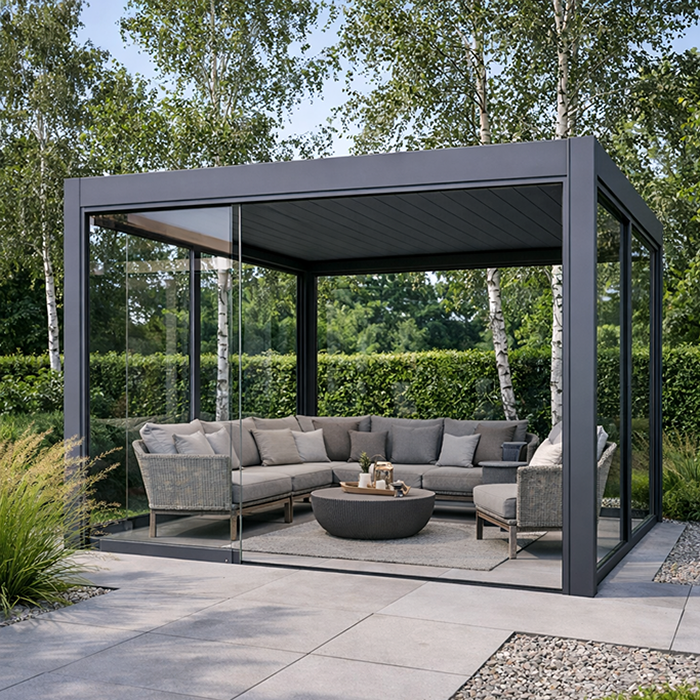
Compare complete configurations, not just bare frames. If a candidate offers fixed, adjustable, retractable, or removable components, ask which position is covered by its wind documentation and whether that guidance changes with optional screens, curtains, panels, or enclosures. Added side surfaces can change how a pergola meets the wind, so do not assume that guidance for one setup also applies to another. For the Bloomcabin bioclimatic aluminum pergola page, check what the exact product documents say about roof operation and optional components rather than relying on category wording.
Think about the arrangement you actually plan to use, including any accessories you might add after installation. Ask whether each accessory is included in the documented configuration, must be purchased separately, or changes the manufacturer's instructions. The same question applies if you expect to add privacy panels or screening later: a new component may affect which guidance applies. Ask whether later additions require a separate review rather than assuming the original installation documentation continues to cover them. Keep the answer specific to the model and setup rather than assuming that an accessory sold for a pergola is automatically suitable in an exposed location.
Plan installation before you place the order
Decide how the pergola will be installed before checkout, and check whether the manufacturer's instructions fit the intended site. Ask whether the design is freestanding, attached, or available in different installation arrangements; do not infer the requirements from a product name. For the lean-to pergola page, ask what the installation requires at the building side if the planned design attaches there, and who will verify that the structure is appropriate. A general assembly video or a separate anchor package is not confirmation that a particular site installation matches the manufacturer's guidance.
Get a written scope from the seller or installer that identifies who assembles the pergola, handles anchoring, checks the supporting surface, and resolves questions about site conditions. Clarify the sequence of those checks so that concerns about the support or connections are addressed before delivery or assembly is scheduled. If you are considering self-installation, compare your plan with the exact manufacturer instructions and ask whether the work requires a qualified professional. You can also check with the local building department about any approvals that may apply to your project. Knowing who is responsible for each part before ordering can prevent a gap between the product documentation and the installation plan.
Understand wind-related operating instructions
If a roof, shade, screen, or panel can move, ask for the wind limits and instructions for each relevant position. There is no universal rule that an open, closed, or partly open setting is best in strong wind; the answer depends on the product. For that bioclimatic aluminum pergola candidate, request the manufacturer's operating guidance for the exact configuration rather than inferring what the category name means. Also ask whether the published wind information concerns operation, a stationary position, or both.
Consider what following those instructions would require in everyday use. Ask whether any component must be repositioned, removed, or stored when particular conditions are expected, and whether the manufacturer specifies who should do that work. Find out where the operating instructions will be provided and ensure that the people who will use the pergola can readily access them. If you may be away from home, find out whether the required steps can be managed in advance and whether they depend on an operator being present. These questions are part of choosing a practical model: a pergola is a poor match if its documented weather procedures do not fit how you plan to use and maintain it.
Compare candidates by documented fit
Make a side-by-side record for each candidate: exact model and configuration, applicable wind information, site assumptions, anchoring requirements, and installation scope. Add the planned dimensions and accessories once you have confirmed them from the relevant documentation. Use this Bloomcabin pergola option as one row in that comparison, not as a recommendation for an exposed site. A written comparison makes it easier to spot when one seller has answered a question that another has left open, and it keeps a polished product description from being mistaken for technical guidance.
Do not rank choices by material label, apparent weight, or the phrase “wind-resistant” alone. Those details do not establish how the complete product is assembled, how it is anchored, or whether the documented configuration fits your location. Keep the comparison tied to the same version of each product, since a different roof arrangement or accessory package may call for different information. Once the wind and installation questions are answered, compare the remaining practical factors: the footprint that suits your outdoor plans, the roof and accessory arrangement you want, and the installation work each option involves. This keeps style in the decision without allowing it to stand in for evidence about site suitability.
Confirm order details and responsibilities
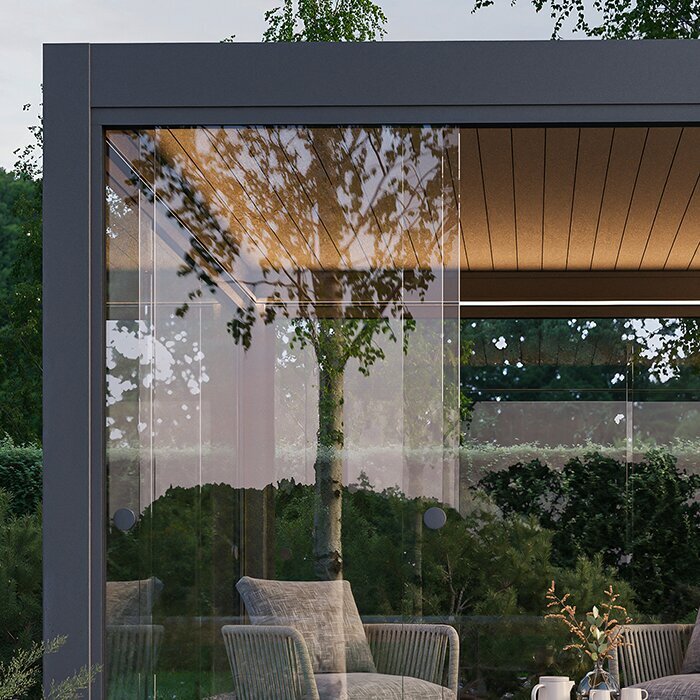
Before placing an order, make sure the written quote or order record identifies the exact model and configuration discussed with the manufacturer or installer. Confirm which accessories and anchoring components are included, which are separate, and whether any substitutions would change the applicable wind guidance. Keep the relevant product documents and written answers together so that the ordered setup can be compared with the one that was assessed. If the quote or listing uses a broad product name, ask the seller to clarify the specific version before you commit.
Check practical arrangements too: delivery access to the intended site, who will receive and assemble the product, and what work is outside the installation scope. Review the seller’s ordering, cancellation, and return terms rather than assuming what they allow. If an installer is involved, confirm when the site and anchoring will be reviewed and who handles questions that arise before installation. These details do not determine wind performance, but they help ensure that the pergola, documentation, and installation plan you paid for are the ones you intended to buy.
Set a clear go-or-no-go threshold
Before committing, check that you can answer four questions: Does the documentation cover the exact model and configuration? Can its wind guidance be compared with the requirements for your site? Is the proposed anchoring suitable for the actual supporting surface? Is there a clear installation plan with the right responsibilities assigned? If any answer is unknown, pause the purchase and resolve it. This is a more useful threshold than choosing a model because it looks sturdy or because a sales description uses confident language.
If the manufacturer or seller cannot provide meaningful, model-specific guidance, consider another candidate with clearer documentation or reconsider the proposed location. Do not treat a generic rating, a product from the same family, or a successful installation elsewhere as proof that your setup will be suitable. A pergola for an exposed site is a sound purchase only when the product information, site conditions, and anchoring plan agree. If they do not, waiting is better than ordering on an assumption.
Frequently asked questions
What wind rating do I need for a pergola?
There is no single rating that suits every site. The relevant criteria depend on local wind conditions, the exact pergola configuration, and how it will be installed. Ask a qualified professional to identify the criteria for your location, then compare them with manufacturer guidance that uses a clear, applicable basis.
Is a heavier pergola automatically safer in wind?
No. Weight alone does not show whether the complete structure, its connections, and its anchoring are suitable for a particular site. Look for model-specific wind information and confirm that the specified installation can be used with your supporting surface.
Can I anchor a pergola to an existing patio?
Do not assume that a patio is suitable just because it looks solid. Pavers, slabs, and other surfaces can differ in how they support an installation. Have a qualified installer or design professional check the actual surface against the manufacturer's instructions and your site conditions.
Should an adjustable pergola roof be open or closed in strong wind?
There is no universal answer. The appropriate position depends on the specific product and its manufacturer's instructions. Ask which operating positions and accessories are covered by the wind guidance, and what the manual says to do when high winds are expected.
What if a product page doesn't show a wind rating?
Ask the manufacturer or seller for written, model-specific wind guidance and for an explanation of what it covers. If they cannot provide information that can be compared with your site requirements, don't infer suitability from marketing language or a similar-looking model; consider another documented option.
A good buying decision connects four things: the wind exposure at your site, the manufacturer’s guidance for the exact pergola configuration, suitable anchoring, and a clear installation plan. Keep the relevant documents and written answers together as you compare options. If any part of that chain is uncertain, resolve it before ordering instead of relying on appearance or a general wind claim.
