
Buying a Pergola for Rain Protection: Roof and Drainage Limits
Pergola buying guide
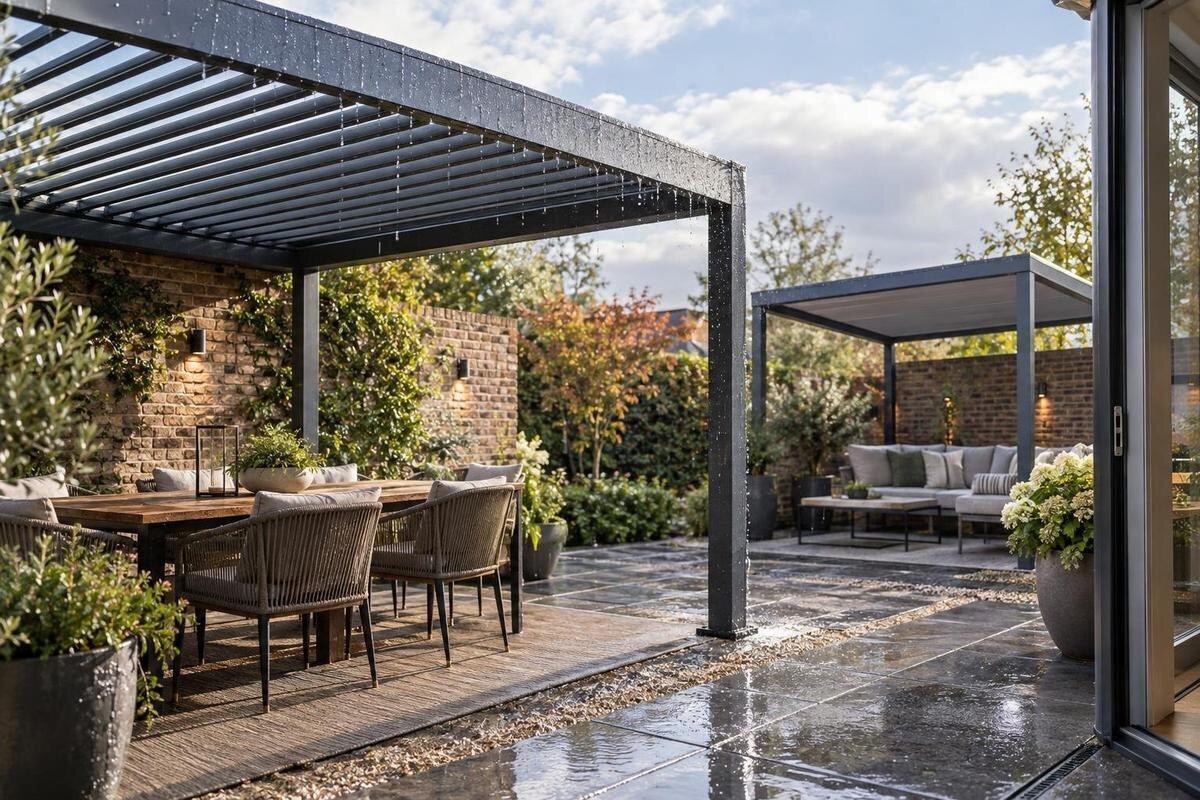
Buying a pergola for rain protection starts with a specific question: what needs to stay dry, where, and in what conditions? Roof style affects whether rain can pass through or be directed elsewhere; joints, edges, wind, and the discharge point affect how much shelter that creates on the ground. A product name or rendering cannot answer every part. Compare the documented roof configuration and drainage route, then consider whether the site can receive the water. This guide focuses on those limits, not on promises of a fully enclosed space.

01
Define the rain protection you expect
Before comparing roofs, define what rain protection means for your space. Waiting out a brief shower under cover is a different requirement from keeping a dining setup usable, protecting cushions left outside, or keeping the route from a door to a chair dry. Decide which activities or belongings matter, and whether you need shelter over part of the patio or across its full usable area. That distinction prevents the roof’s overall footprint from being mistaken for the area that will stay dry.
Note the conditions that shape your expectation: how exposed the patio is, which direction wind usually pushes rain from, whether seating sits near an edge, and whether water reaches the space from nearby surfaces. Consider seasonal use as well: a setup that is acceptable for an occasional summer shower may not suit regular meals during a wet period. You do not have to predict every storm, but you should decide whether overhead cover from ordinary rain is enough or whether you expect protection around the edges too. Write down that requirement before shopping. The phrase rain protection can describe very different levels of shelter, so a specific use case makes comparisons more meaningful.
Compare roof styles by how they handle water
An open roof made of spaced, fixed slats has gaps through which rain can pass; it is not a continuous cover. A pergola with adjustable louvers may change how much of the roof is open, but a closed position does not by itself prove that its joints or perimeter are watertight. Retractable covers and solid or panelized roofs have different seams, edges, and operating arrangements. Within each style, details vary, so treat the roof type as a reason to ask questions, not as a performance rating.
Compare each option in the position you expect to use during rain, and look for documentation describing what that configuration is designed to do. Ask whether the roof is intended to reduce direct rainfall, route water to a drainage system, or provide another level of coverage. Also check whether its rain-related position affects how you use the outdoor area, such as ventilation or the amount of light below the roof. When reviewing the Bloomcabin pergola product page, identify the exact roof arrangement offered and look for its rain-related documentation; the product name and image alone do not establish how it handles water.
02
Trace the drainage route from roof to ground
Rain protection depends on where water goes after it reaches the roof. Follow the route shown in the product documents: from the roof surface to any channel or gutter, then to an outlet, downspout, or other discharge point. Some designs may use concealed channels or designated outlets, but do not assume that a particular route exists. Check where the water exits and whether the drainage parts shown in a diagram are included with the configuration you are considering.
Ask for a drawing or written explanation if the route is unclear. Find out whether an outlet can be placed on the side that suits your patio, whether additional parts are required, and whether water is directed through or alongside any part of the structure. Identify the final discharge point rather than stopping at the first visible gutter or channel. For the bioclimatic aluminum pergola listing, look for documents that explain the exact drainage arrangement; the listing’s identity does not establish where water leaves the roof. A clear answer helps you compare products before deciding whether their runoff can work at your site.
Check what the roof claim actually covers
Words such as water-resistant, weatherproof, and rainproof are not enough on their own to describe how a particular roof performs. Look for a stated use condition: which roof position is required, whether the claim concerns direct rainfall only, and what the manufacturer says about seams and perimeter edges. If the available description uses broad language without explaining these points, ask for the product manual or a more specific written answer before relying on it.
Check the roof drawing and installation information for details that affect the water path, such as joints, overlaps, pitch, and the treatment of edges or wall connections. Compare the documents for the particular size and configuration you intend to order, since a general product description may not answer every configuration question. Do not infer any of these details from a rendering. When reviewing the lean-to pergola product page, look for documentation for the exact item and configuration, and ask what its stated coverage does not include. A precise limit is more useful for a buying decision than a general promise of shelter.
03
Allow for wind-driven rain and splash
A roof can intercept rain from above while leaving the sides exposed. Wind can carry water under a roof or past its edges, so the sheltered patch may be smaller than the roof plan suggests. This matters especially if the seats, table, or doorway you want to protect sit close to an open side. Think about where people will actually use the space, rather than assuming that every point beneath the roof will receive equal coverage.
Rain can also bounce off hard paving or arrive from a nearby surface, leaving areas wet even when the roof catches water overhead. Observe where puddles, spray, and runoff already appear after rain if you can, because those patterns can affect furniture placement. If a dry entry route or a particular seating position is essential, include its location in your buying brief and ask how the product’s documented coverage relates to that point. On the Bloomcabin pergola listing, look for exact roof details rather than relying on an image to predict how far the shelter extends. Keep the distinction clear between reducing overhead rain and protecting an open-sided area in wind.
Match the roof footprint to the usable area
The dimensions of the roof, the space between the posts, and the area that stays relatively sheltered are not necessarily the same. Check the dimensional drawing for overall measurements, post positions, clear space, and any stated roof projection. Use those details to compare the proposed arrangement with the patio, doors, paths, and furniture you actually have. A roof may fit the patio on paper but leave the spot where you sit close to an exposed edge.
Sketch the intended layout or mark it out on the ground before ordering. Include the table or chairs, the route people use to reach them, and the location where runoff is expected to fall. Leave room to move chairs without placing them at the roof edge, where exposure can be greater than at the center. Then compare that plan with the exact product dimensions; do not estimate from a photograph. The Bloomcabin bioclimatic pergola page can be one place to look for the relevant drawing, if provided, but the product name does not establish its measurements. If the dimensions or post locations are missing, ask before treating the covered footprint as a fit.
04
Choose an outlet location that fits the site
A drainage route that works on a drawing may still be awkward at the installation site. Consider the surface below each outlet, nearby doors and walls, paths people use, and any low spots where water could collect. A discharge beside a frequently used walkway may create a nuisance, while a route near a wall or existing drainage system needs site-specific assessment. Note these constraints before choosing a roof arrangement, not after the structure has been ordered.
Do not assume that runoff can simply be connected to an existing gutter or drainage line. Ask the installer or a qualified drainage professional to assess the proposed route and the site, especially where several roof outlets or an existing building are involved. The assessment should account for where discharged water will travel across the surface after it leaves the pergola. When reviewing the Bloomcabin lean-to pergola listing, treat the outlet position and its destination as questions to resolve for the exact product and site. The goal is to understand where rainwater will go, not just how it leaves the roof.
Confirm installation and maintenance requirements
The intended drainage path depends on the structure being assembled and installed according to the manufacturer’s instructions. Before buying, review the installation documents for requirements that affect roof alignment, joints, connections, and water discharge. If the arrangement involves a wall or an existing building, have a qualified installer assess that connection and the surrounding site. This is a purchasing check, not a reason to improvise changes to the roof or drainage system.
Also find out what upkeep the manufacturer expects. Where a design includes channels or gutters, ask how debris is cleared and whether those areas remain accessible after installation. Consider whether nearby trees, leaves, or other debris could make routine access particularly important at your location. If the roof has moving parts, check the stated care instructions for them as well. Ask who is responsible for installation, what drainage components are included, and whether the proposed placement allows the stated maintenance. Use Bloomcabin’s pergola listing only as a starting point for these questions; confirm the requirements for the exact configuration rather than assuming details from its name.
05
Compare product details before placing an order
Compare options using the same information for each one: exact model and roof configuration, dimensional drawing, stated rain conditions, drainage route, and installation requirements. Record whether gutters, outlets, or other drainage pieces are included, optional, or not described. Separate confirmed details from unanswered questions. This makes it easier to spot when two listings use similar roof language but provide different amounts of useful information about water handling.
Ask the seller or manufacturer to clarify any point that could change whether the pergola suits your patio. Useful questions include which roof position is intended for rain, where the water exits, what happens at the perimeter, and what the product documents do not promise. Ask whether a response applies to the selected configuration rather than to the product family in general. Keep the response with the order details so the configuration being purchased is clear. The bioclimatic aluminum pergola product page can be one entry in that comparison; record only what the page or its documents actually state, not what the model name seems to imply.
Turn the rain question into buying criteria
Set minimum requirements before weighing appearance or convenience. For example, identify the area you need covered, the roof state you expect to use in rain, and a drainage route that can work at your site. Then decide which details must be confirmed in manufacturer documents before a product remains on your shortlist. This creates a useful pass-or-fail test: an attractive option cannot meet a must-have requirement if its coverage or runoff route is still unknown.
Treat missing information as unknown rather than assuming that a pergola is waterproof, that its outlets are included, or that runoff can be handled easily. Rank unresolved questions by their consequences: the water route and the area to be sheltered are often more important than a visual preference. If occasional overhead shelter is enough for your plans, you may accept limits that would not suit a space expected to remain dry around its edges. If reliable dryness through wind-driven rain is essential, look for explicit documentation for that expectation and do not rely on a broad product label. The best choice is the one whose stated limits match how you intend to use the space.
Frequently asked questions
Will a pergola keep a patio dry during a rainstorm?
Not necessarily. The answer depends on the exact roof design, its seams and edges, and how wind carries rain into the open sides. A roof may reduce direct rainfall over part of a patio without keeping the whole area dry. Before you buy, check the manufacturer’s stated rain performance for the roof configuration you plan to use, and consider where its runoff will go.
Is a louvered pergola waterproof when the louvers are closed?
A closed position alone does not establish that a roof is watertight. Louvers, joints, edges, and drainage details differ between products. Look for documentation that describes the permitted roof position in rain, the conditions covered, and how water is collected or discharged. If those details are not published, ask the manufacturer or seller for clarification rather than treating the word closed as a guarantee.
How can I tell where pergola rainwater will drain?
Look for a product drawing or installation document that traces water from the roof surface to a channel, gutter, outlet, or downspout, then shows where it leaves the structure. Confirm whether drainage components are included or sold separately and where the outlet can be positioned. The route matters as much as the roof: water should not create an unwanted wet spot by a doorway, walkway, or seating area.
Does a pergola installed beside a house prevent leaks at the connection?
No. A nearby wall does not by itself explain how the roof-to-wall junction handles rain. Check whether the exact product is intended for that arrangement and what the manufacturer says about the connection, flashing, sealing, and runoff. Have a qualified installer assess the site and the relevant product documents. Do not assume that a product described as lean-to is automatically suitable for every wall or drainage setup.
What should I verify before ordering a pergola for rain protection?
Confirm the exact roof configuration, the manufacturer’s stated rain conditions, the covered dimensions, and the complete drainage route. Ask what gutters, outlets, or other drainage parts are included, and review the installation and maintenance requirements. If the information is unclear, get an answer in writing before ordering. Treat an undocumented feature or performance claim as unknown, not as proof that the pergola will keep your intended area dry.
A pergola’s usefulness in rain depends on more than the roof surface. The roof configuration, seams, open sides, drainage route, and site all affect the result. A sound buying decision starts with the area you want to protect, then checks whether the product documents explain the water path and its limits. Where a key detail is missing, treat it as unknown. That keeps expectations realistic and helps you choose a pergola whose documented coverage and drainage suit the way you plan to use your outdoor space.
