
A Ceiling Fan Under a Pergola: Is It Compatible?
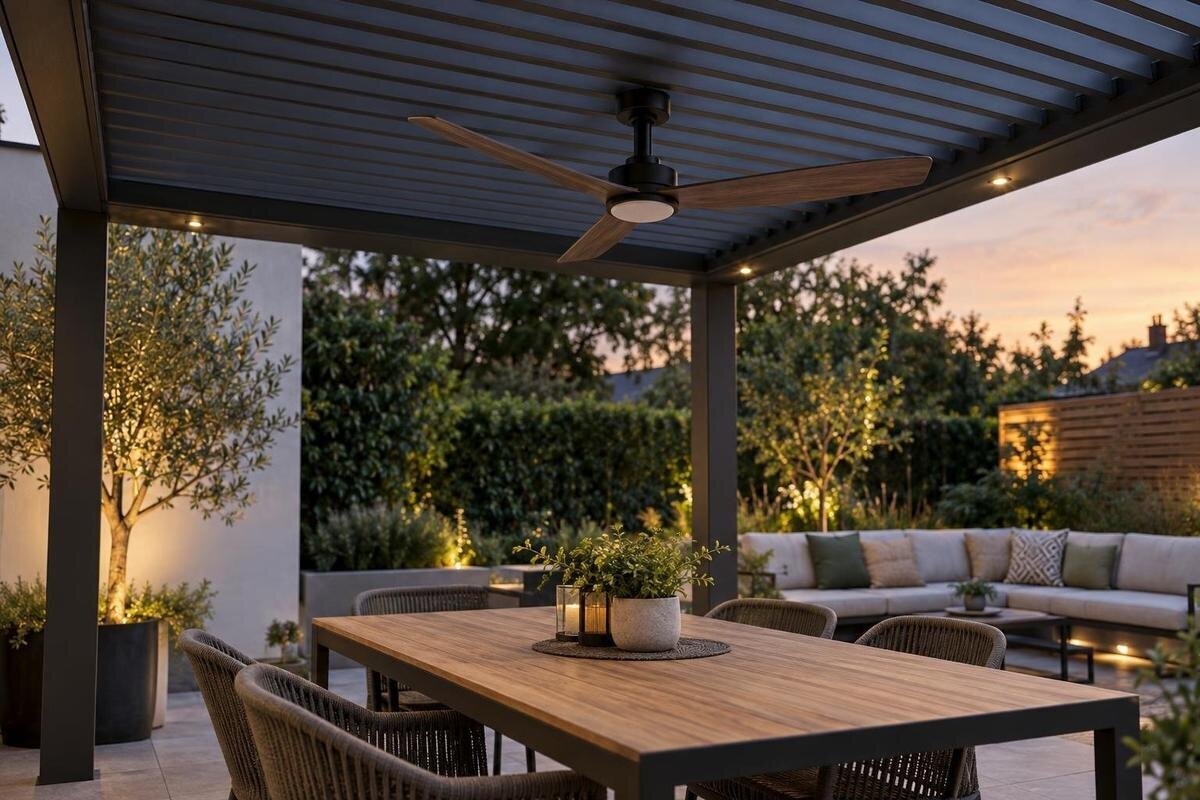
Pergola planning
Installing a ceiling fan under a pergola may be feasible, but a fan is not a simple add-on to any beam or roof member. Its moving assembly creates operating forces, its blades need clear space, and its motor and wiring must suit the actual outdoor exposure. Compatibility depends on the exact pergola, fan, mounting point, and configuration—not on a product photo or the phrase “outdoor rated.”

01
When a ceiling fan is compatible with a pergola
A pergola provides overhead shade, but that does not mean its frame was designed for a rotating appliance. Compatibility depends on an approved load path from the fan’s mounting point through a suitable member and its joints to the posts or building connection. The fan contributes its own weight, while its motor and moving blades create vibration and repeated operating forces. A statement about the pergola’s general weather performance, overall size, or ability to carry its own roof does not establish that a particular beam can support a fan in use. The decision applies to a mounted assembly, not simply to a frame category or product photograph.
Treat the decision as three checks that must all pass. The pergola supplier or a structural professional needs to confirm the frame and mounting point for the selected fan. The fan maker’s manual must permit the intended outdoor location and specify mounting and clearance requirements. A qualified electrician must assess the site-specific supply and installation. A positive answer in one area does not cover the others: an outdoor rating does not establish that a frame is strong enough, and a suitable support does not make an indoor fixture weather-suitable. When documents are silent, ask for a clear written answer rather than interpreting silence, photos, or a general product label as approval.
Documents for the exact pergola and fan
Record the exact combination under consideration, not just the pergola style. Note the product name and selected configuration, its size, whether it is freestanding or wall-attached, the roof arrangement, and the precise proposed mounting point. For the fan, note its full model number, listed weight, blade diameter, and any light kit or other accessory; those details can affect the review. Use the Bloomcabin Pergola product listing to identify the model in your inquiry, then request documentation for your selected configuration. Keep model numbers and document revisions together so an answer about a similar frame or an earlier fan version is not mistaken for approval of yours.
Read current instructions for both products and look for statements that apply to the exact model and configuration: permitted accessories, required support details, location restrictions, installation conditions, and clearances. If the pergola documents do not mention fans, ask the supplier whether there is an approved mounting provision for the proposed point. Provide a plan or photos if requested, showing nearby posts, roof members, walls, lights, and furniture. Do not infer approval from a catalog photograph, a similar model, a material name, or a verbal comment that the pergola is “strong.” Those clues do not identify the member, connection, fan, or operating conditions being assessed.
02
Why a fan needs dynamic-load approval
Static weight is only a starting point: an operating ceiling fan rotates and can transmit vibration and repeated forces to its support. The effect is not determined by the fan’s weight alone; its size, mounting arrangement, support, and connection details matter. Outdoor air movement can also differ from that in a sheltered room, so the fan manufacturer’s operating limits remain relevant. The structural question is not whether the whole pergola feels sturdy, but whether the exact mounting point and load path are approved for the specified fan while it is operating. A general roof or weather-load rating cannot be treated as an allowance for a rotating appliance. Leave that assessment to the supplier or qualified structural professional.
Ask the pergola supplier or a qualified structural professional to confirm the proposed installation for the exact assembly, member, and fan model, and to identify any required support or operating restrictions. If you are considering the Bloomcabin Bioclimatic Aluminum Pergola, include that model identity in the request, but ask for an answer tied to the selected configuration and proposed mount. The reply should distinguish approval for a rotating fan from permission to hang a stationary accessory. If additional bracing or a different mounting location is needed, have that solution specified and reviewed before work begins. Do not drill, reinforce, hang, or test the structure to find out whether an undocumented point works.
Choose an approved mounting point
An approved mounting point matters as much as a strong-looking frame. Decorative trim, a thin shade slat, a movable roof element, a narrow rail, or a beam end may not be intended to carry a rotating fixture. The fan manual may specify the kind of support and mounting method it permits, but that requirement covers only the fan side; the pergola supplier or structural reviewer must also approve the receiving member and its connections. A standard ceiling-fan bracket does not upgrade an unapproved pergola member. Avoid attaching a fan to a convenient spot simply because it is centered, accessible, or close to a power source, and don’t add a crosspiece without approval.
For a wall-attached structure, do not confuse the wall connection with an approved fan support. When requesting a mounting review for the Bloomcabin Lean-To Pergola, identify the proposed member and its position relative to the posts and building connection. Ask the reviewer to address the installed assembly, including any existing alterations, rather than a generic wall-mounted layout. A nearby wall does not by itself establish how the fan’s forces reach the supporting structure. If the reviewer proposes a separate building-mounted support instead, that arrangement needs its own assessment; it should not be treated as approval to attach the fan to the pergola.

03
Check blade sweep and headroom
Clearance is a geometry question, not a visual judgment. The blades need the distances specified by the fan maker from the floor, walls, posts, beams, screens, lights, and other obstructions; occupants also need the headroom required by the manual. Make a plan view that shows the full blade-sweep circle and a side view showing the fan’s lowest point above the walking or seating area. Measure from the proposed center and mounting height, then compare those measurements with the exact fan instructions. There is no reliable universal clearance number for every blade diameter, mounting style, and pergola layout.
Include furniture and everyday routes in the drawing, especially raised seating, doors, umbrellas, and tall objects that could enter the blade area. For the regular Bloomcabin Pergola, the listed area range is 97–258 sq ft, but floor area cannot confirm headroom or blade clearance for a selected configuration. Use actual installed dimensions and the proposed fan’s measurements. Account for the complete mounting assembly rather than measuring only the motor housing: the canopy, support, and any light kit affect its position and lowest point. If any roof or shade part moves, show its full travel on the side view and check clearance in every permitted position.
Match the fan to real outdoor exposure
An overhead cover does not automatically make a location suitable for an indoor or lightly protected fan. Wind-driven rain, splashes, condensation, dust, direct sun, and salt air may affect a fixture, depending on the site and where it sits under the structure. Manufacturers may distinguish between exposure categories such as damp and wet locations; use the exact wording and limits in the fan’s manual rather than treating “outdoor” as a complete specification. A fan meant for a sheltered porch may have restrictions that matter under an open-sided pergola. Assess conditions at the proposed mounting point, not just whether the overall patio feels covered.
Check the complete fan package, including the motor housing, blades, canopy, light, controls, and supplied electrical components, against the relevant instructions. Ask the fan maker whether that exact combination is permitted in the conditions at your site, including any limits on rain or cleaning. For a location beneath the Bloomcabin bioclimatic pergola, describe the exposure at the proposed mount rather than relying on the pergola’s product name to describe shelter. Explain whether rain can enter from the sides, whether nearby activities create splashes, and whether the location has other environmental concerns. Photographs can help communicate the setting, but the manufacturer’s stated limits determine whether the fan package is suitable.
04
Plan the electrical work with a qualified electrician
Plan electrical work before fixing the fan position or ordering a fixture. Give a qualified electrician the fan’s exact model, any light or remote-control package, its proposed mount, the site’s exposure, and the intended cable route. The electrician can determine whether the existing supply is appropriate, what protective measures and controls are required for that installation, and how local requirements apply. An existing outdoor receptacle or light connection is not automatically a suitable connection for a ceiling fan. This is a coordination question, not a do-it-yourself wiring task; do not improvise connections or use a cord as a substitute for a planned installation.
Coordinate the electrical route with the pergola supplier and installer, especially if it could cross a moving member, exposed edge, drainage path, or service area. If your project involves the Bloomcabin wall-mounted pergola, show the electrician where the structure meets the building and where the proposed fan sits; do not assume that connection provides a usable cable route. Have the professionals resolve the route without altering unapproved structural members. Agree on an accessible control location and how the fan will be isolated for service. If the fan includes a light or control module, ask whether its intended controls are compatible with the complete package rather than planning around the motor alone.
Account for moving roof parts and maintenance
When part of a pergola roof or shade moves, evaluate the fan and structure as one operating system. A panel may occupy space that looks clear in only one position, and an automatic control may move it without someone watching the fan. The supplier’s documentation must confirm whether the fan is permitted with that exact roof configuration and through which operating positions. Check that moving members cannot touch the blade tips, motor housing, support, or any permitted wiring route. A gap at the fully open or fully closed position is not proof that the full travel is clear.
Ask what roof positions and operating conditions are allowed, and whether the fan must be off or the roof held in a particular state; follow written instructions rather than inventing a rule. For a configuration of the Bloomcabin regular pergola, include service access in the layout review alongside any roof movement. The installer needs room to reach the attachment and remove the fan without disturbing structural connections or neighboring equipment. Discuss how inspection, cleaning, and eventual replacement would be handled with the patio furnished, not just while the structure is empty. Keep the relevant maintenance instructions accessible so future work does not introduce a different support, fan, or accessory without review.

05
Consider another airflow plan if approval is unclear
Some layouts should not have an overhead fan. If the supplier cannot approve a mount, the required headroom does not fit, the fan’s environmental limits are exceeded, or moving roof parts leave no clear path, stop rather than adapting the frame without approval. You can revisit seating positions or consider a separate airflow option designed for the intended outdoor location and used according to its own manual. A freestanding fan avoids adding load to the pergola, but it still needs a suitable surface, clear space, and a safe electrical arrangement. Changing the product form does not remove the need for site-specific checks.
An approved mounting location also needs to serve the seating area. When reviewing a configuration of the Bloomcabin bioclimatic pergola model, mark where people actually sit and compare that layout with the permissible fan position. A structurally acceptable location at one end may not suit a dining area at the other. Outdoor airflow is affected by wind and the open sides of the space, so do not assume the fan will serve every seat equally or behave like one in an enclosed room. Consider whether rearranging furniture would make the approved location useful without obstructing circulation. If not, choosing a different airflow approach may be more practical than pursuing an overhead fan.
Put the approval request in writing
Before placing an order, send a clear review package to the people responsible for the structure, fan, and electrical work. Include the exact pergola model and configuration, selected size, fan model and accessories, proposed mounting member, site photos, and a plan and side view with measured obstructions. Describe roof movement if applicable and the exposure at the fan location. Ask directly: is this fan approved on this member, on this configuration, with these clearances and at this site? That question is more useful than asking generally whether a pergola can have a fan, because it identifies the combination that needs review.
Keep written replies with both manufacturers’ instructions and make sure each answer refers to the same pergola, size, assembly, fan, and accessories. Ask whether the proposed addition affects applicable product terms or requires a specified mounting detail; do not assume that a verbal assurance, another model’s approval, or a photograph settles those points. If structural approval, outdoor suitability, clearance, or electrical planning remains unresolved, pause before drilling or buying. A qualified installer should work from a documented, approved arrangement, not from a guessed load or improvised support.
Frequently asked questions
Can any outdoor-rated ceiling fan go under a pergola?
No. An outdoor rating addresses the fan’s permitted exposure; it does not approve the pergola frame or a particular mounting point. You also need to confirm the fan’s clearances and have the electrical plan reviewed for the location. Each of those checks applies to the exact fan and pergola configuration.
Can I attach a ceiling fan directly to a pergola beam?
Only when the fan’s instructions permit the mounting method and the specific pergola member and connections have documented approval for that fan’s operating loads. Obtain the structural confirmation from the pergola supplier or a qualified structural professional, with any manufacturer restrictions addressed. A beam’s appearance or general strength is not proof of approval. Don’t drill or add a bracket to test whether the location works.
How much clearance does a pergola ceiling fan need?
Use the requirements in the manual for the exact fan; there is no single clearance number that fits every fan and pergola. Check the blade sweep, the fan’s height above the occupied area, and distances from nearby posts, walls, lights, furniture, and any moving roof parts.
Will a pergola roof keep a fan dry?
Not necessarily. Wind-driven rain, splashes, condensation, and other exposure can reach a fixture beneath an overhead cover. Check the fan maker’s location rating and instructions against conditions at the proposed mounting point. Don’t rely on the word “outdoor” or on how sheltered the patio looks.
Can I install a fan under a pergola with a moving roof?
Possibly, but only if the manufacturers’ instructions and the project review allow the fan in the relevant roof positions. Confirm that moving parts cannot reach the blades, housing, support, or any approved wiring route. A clear gap in one position does not confirm clearance through the roof’s full movement.
A ceiling fan can be compatible with a pergola when its mounting point is approved for the operating loads, its blades remain clear of occupants and nearby objects, and the complete installation suits the outdoor exposure. Any moving roof parts must also stay clear throughout their permitted travel. The best choice is a fan that meets those requirements and serves the seating area without forcing changes to an unverified frame. If that combination is not available, a different airflow plan is the more practical option.
