
Child-Friendly Pergola Layouts for Play and Supervision
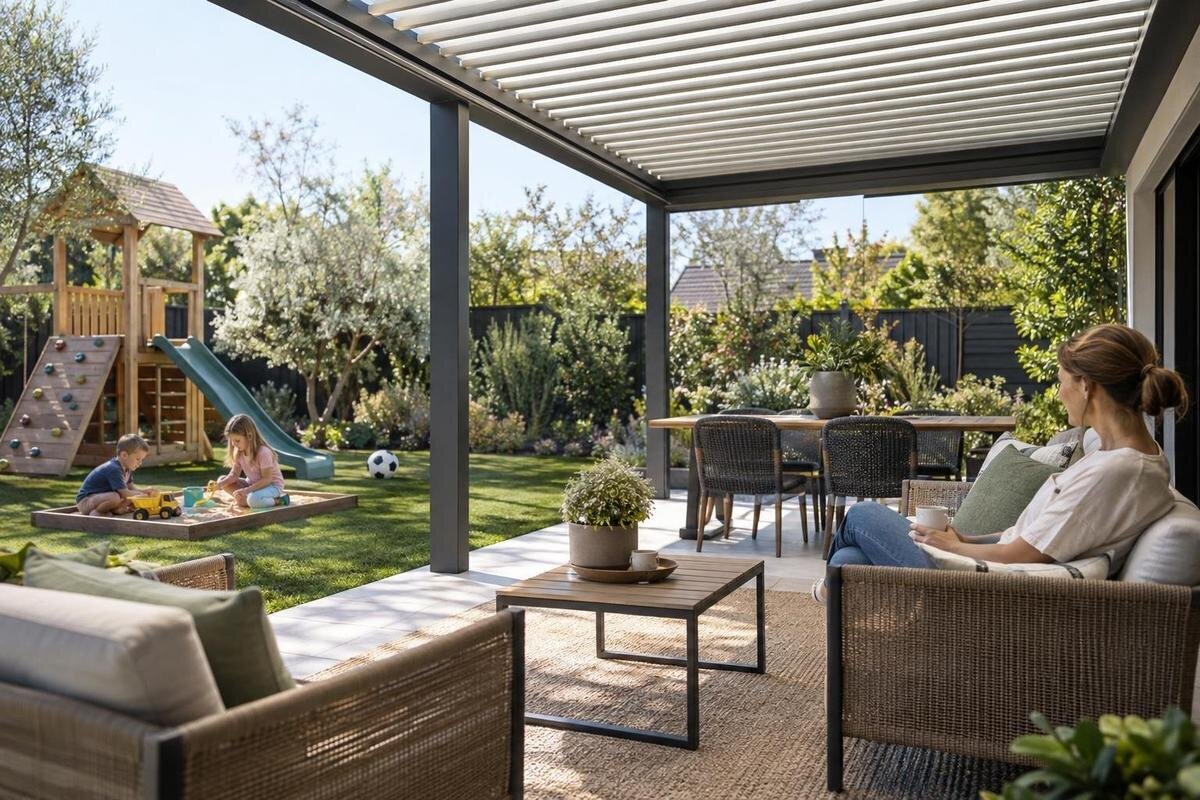
Family pergola layout guide
A child-friendly pergola layout is less about putting play equipment under a roof and more about making daily supervision workable. Adults need useful places to sit or move while keeping the play area in view; children need play spaces that do not overlap every route to the house, gate, or table. Furniture, supports, screens, and nearby hazards all affect the arrangement. A pergola does not make a space child-safe, contain children, or replace attentive supervision. Plan around your household’s actual routines and the site itself, then choose a structure that fits the layout rather than asking the structure to solve every problem.

Plan around your family’s outdoor routine
List what happens during the busiest ordinary hour outside, not only the activities you hope to add later. A young child carrying toys, an older child kicking a ball, and siblings drawing at a table create different movement patterns. Note how many children are likely to be outside, whether they play together or move between activities, and where the supervising adult usually sits. If that person serves food or steps inside, record those routines too. A path that repeatedly takes an adult through the play area is part of the layout, not an afterthought.
Sketch the house, doors, steps, yard access, and existing trees before placing the pergola. Mark the likely play area, adult seat, and route between them. For a layout beside the home, compare the wall-mounted pergola option with the doorway and proposed viewing position, using configuration drawings rather than the product photo to assess the arrangement. Decide where an adult will actually supervise, not simply which indoor window overlooks the patio. If that adult needs to step inside or handle another task, plan how supervision will continue. Mark where toys will be stored, too, so putting them away does not send people through active play.
Check sightlines from seated and standing positions
Look from the places where an adult is likely to be: a dining chair, a lounge seat, the doorway, and any regular work spot that faces outside. Check the view at the child’s usual play height as well as from adult eye level. A child can be hidden by a chair, tall planter, storage bench, umbrella, privacy panel, or pergola support. Walk the likely play route and view it from each seat before fixing furniture in place. If a corner cannot be seen, move the activity or obstruction rather than relying on occasional glances from another part of the patio.
Use chairs, boxes, or removable tape to mark proposed furniture and supports on the ground. Sit in the actual chairs and ask another adult to stand or move through the play area; a small drawing can conceal a blocked view. Check low play positions, such as sitting beside a toy bin, as well as standing positions. If adults switch places during a meal or play, test each seat. When considering a regular pergola option, request the exact configuration drawings and transfer its support positions to your test layout. Photograph the view from each supervising seat so you can compare arrangements without relying on memory.
Keep everyday routes out of the play zone
Draw a continuous route from the house door to the gate, dining area, and any frequently used storage. Keep it separate from the space needed for running, wheeled toys, ball play, or equipment with a moving path. When adults carry food, laundry, or supplies through the patio, a route that crosses play can create repeated interruptions and make toys easy to trip over. Avoid relying on a narrow gap behind chairs or between a support and a table. Measure the route with furniture in use and consider whether people need to pass each other. There is no single clearance that works for every site.
Check doors, steps, and gates in their real positions. Mark a swinging door’s full arc, chair pullback, and the space needed to turn with a stroller or toy cart if your family uses one. For a house-side plan, compare the Bloomcabin Lean-To Pergola listing with the door locations on your sketch and request dimensions for the configuration you are considering. Test the busiest combination: someone opening the door while another person carries a tray or pushes a stroller past occupied chairs. Keep loose toys and storage bins out of that route, with a designated place for them when play ends. Clear circulation is a planned part of the layout, not leftover space.
Space and equipment requirements for play
Separate quiet activities from movement that needs more open room. Drawing, blocks, or a small table may work near adult seating if the toys remain visible and the walking route stays clear. Running games, scooters, balls, or equipment with moving parts need a distinct zone, away from chairs, posts, walkways, glazing, and other equipment. Follow the maker’s directions for the exact model, including its setup and clearance requirements, rather than estimating from the item’s footprint. Check where play equipment will be put away, too; stored items should not narrow a route or create a new blind spot.
Do not treat a pergola frame as a play structure. Do not hang a swing, climbing hold, hammock, or other child-use item from it unless the manufacturer explicitly approves the exact structure and attachment for that use, or a qualified structural professional confirms it is suitable. The bioclimatic aluminum pergola listing identifies a model; it does not establish a permitted play load or attachment point. For freestanding equipment, follow its own setup instructions and keep its instructed use area free of furniture and through-traffic. Make the play zone’s boundaries easy to see and keep clear.

Arrange adult seating for comfortable supervision
Place the seat used most often where an adult can see the play area without constantly twisting or standing in a doorway. Angle chairs toward the activity rather than putting the supervising person’s back to it. With a dining setup, test the view from more than one chair: the person nearest the end of the table may not be the person watching. Check whether a high chair, cooler, serving cart, or side table blocks the view when it is in its normal position. If adults supervise from both a lounge seat and the dining table, test both viewpoints.
Measure the full furniture envelope, including the table, chairs when pulled out, recliner footrests, and the route around them. Do not use a pushed-in or folded position if that is not how the furniture is normally used. When reviewing the Bloomcabin Pergola listing, compare the exact configuration under consideration with those measured footprints rather than assuming its listed area leaves room for a particular table. Keep the supervising seat out of the busiest route, and avoid arrangements that require adults to cross active play to fetch a drink or move a chair.
Account for posts, screens, and patio edges
Plot every fixed support and existing obstruction before choosing a play location. A post can divide what looks like one open rectangle into two partial views; a planter or privacy screen can hide a child near its far edge. Avoid creating a narrow pocket where toys collect and an adult cannot easily see the activity. Compare the lean-to configuration page with the actual site sketch, and confirm the exact support locations and installation requirements for the selected setup with the seller or a qualified installer. Do not use chairs, storage boxes, or decorative planters as makeshift barriers; they can move and are not a substitute for a purpose-designed barrier where one is needed.
Identify where the pergola area opens to the rest of the yard. Posts and overhead coverage do not enclose a patio or prevent a child from heading toward a driveway, steps, water, or another area. If a boundary or access restriction matters, plan it as a separate feature designed for the specific hazard rather than assuming the pergola provides it. Keep gates and exits usable for adults, and avoid placing items near an opening in a way that blocks the route or invites climbing. Draw the patio’s edges and openings explicitly instead of treating the pergola’s outline as an enclosure.
Plan for changing shade and weather
Shade moves as the sun changes position, and an overhead structure may shade only part of the patio at a given hour. Observe the intended play area and adult seat at the times your family expects to use them; a midday view may not represent breakfast or late-afternoon play. Nearby trees, buildings, the exact roof arrangement, and seasonal sun angles all affect where shade falls. If children move between shaded and sunny areas, make sure an adult can still see the activity. Do not treat a pergola as guaranteed sun protection or assume its entire footprint stays shaded.
Rain, wind, wet paving, and changing temperatures can also affect whether a patio is a suitable place to play. Note where water collects or toys could move into a walking route, and be prepared to use another area when conditions call for it. Before choosing a Bloomcabin Bioclimatic Aluminum Pergola, review documentation for the exact configuration instead of inferring shade or weather performance from its name. Keep the layout flexible so supervision does not depend on the structure providing a particular level of cover.
Separate play from water, heat, and household tasks
Map hazards near the patio, including a pool or pond, driveway, grill, fire feature, tools, cleaning products, and hot food or drinks. Keep play, adult food service, storage, and active tasks from converging at the same pinch point. A ball rolling toward a cooking area or a child passing through the grill route can create a predictable conflict, even if the furniture looks neatly arranged. Store tools and chemicals according to their instructions and out of children’s access. If a fixed hazard cannot be moved, keep it outside the play route and make a separate access-control plan; a line on a pergola sketch does not change the hazard.
A pergola is not a pool barrier, gate, or secure boundary. If water, a driveway, stairs, or another serious hazard is close by, use a barrier or access control intended for that specific purpose and seek qualified, site-specific guidance where appropriate. Keep adult supervision in place even when the patio is visually open. Locate hot drinks and tools so an adult can manage the task without walking through active play or leaving children unseen. Revisit the layout after adding equipment, a grill, or outdoor storage, since each can change the route and sightlines.

Measure the usable footprint before choosing a model
Measure the patio’s usable dimensions and note walls, eaves, doors, steps, trees, drains, and other fixed features. Then measure the furniture, play equipment, and clear areas required by the equipment maker’s instructions. Put them all on one scale drawing. Distinguish the pergola’s stated footprint from the space left for seats, movement, and supervision. A square-foot figure alone cannot tell you where a support lands or whether chairs can pull out without entering the play zone. If the site is irregular, sketch its corners rather than rounding it into a simple rectangle. Ask a qualified professional about site-specific attachment or support questions.
The regular pergola page lists an area range of 97–258 sq ft. Use that as a catalog range, not as a ready-made play-area size or proof that a selected configuration fits your patio. Confirm the exact dimensions and support positions for the configuration under consideration, then compare them with the measured furniture and routes. The same check applies whether the structure is near the house or elsewhere in the yard. Keep the furniture and route marks visible as you compare options; an empty outline can hide a chair back, doorway, or tight turn.
Test the concept with furniture in place
Before finalizing a layout, mark it at full size with removable tape or another temporary outline. Put the actual chairs and table in position, walk the house-to-yard route, pull chairs out, and sit in the supervision seats. Ask another adult to stand where a child would play and check whether each proposed seat can see that spot. Try the routine during a meal and during active play, not only in an empty patio. This concept test can reveal conflicts before you choose a structure; it is not a safety certification, construction drawing, or substitute for product instructions.
Leave room for change. Children grow, activities shift from floor toys to balls or wheeled play, and siblings may need different spaces at the same time. Identify which furnishings can move and which features would be difficult to relocate. A portable drawing table may let you change the arrangement more easily than a fixed installation, provided its new position still meets the activity’s requirements. Include a place for equipment that is temporarily out of use, rather than leaving it in the shared area. Keep the dated concept drawing and your measurements so future changes can be assessed against the original plan, not just fitted into whichever corner happens to be empty.
Frequently asked questions
Does a pergola make an outdoor play area child-safe?
No. A pergola may organize a patio, but it is not an enclosure or a safety system. Sightlines, nearby hazards, equipment instructions, and attentive adult supervision still matter for every layout.
Where should the play area go?
Choose a spot an adult can see from the seats and locations used most often. Keep it out of main walking routes and away from hazards, and follow the equipment maker’s instructions for its exact setup and clearances.
Can I hang a swing or climbing equipment from a pergola?
Do not assume the structure can support play equipment. Use an attachment only if the manufacturer explicitly approves it for that exact structure and use, or a qualified structural professional confirms it is suitable.
How much room should I leave around play equipment?
Follow the equipment maker’s specified clearances for the exact model. Include furniture in its usual position, with chairs pulled out, and keep a clear everyday route. There is no single measurement that suits every patio and activity.
Will a pergola keep the play area shaded or dry?
Coverage depends on the specific configuration, its position, and conditions at the site. Check product documentation and observe the patio at the times you expect to use it rather than inferring shade or weather protection from a model name.
A useful family pergola plan brings the adult’s view, children’s activities, everyday routes, and nearby hazards together on one drawing. Its value becomes clearer when you put the actual furniture in place: can an adult watch comfortably, can someone leave the table without crossing play, and can toys be put away without blocking the door? Choose a configuration that fits those everyday needs, with shade and equipment requirements checked separately. The best arrangement is one your household can use consistently and adapt as children’s activities change, without treating the pergola itself as a safeguard.
