
How to Choose a Pergola for Strong Summer Sun
Pergola buying guide
Buying a pergola for strong summer sun is less about choosing the largest roof than about matching its shade to your yard. The shadow moves, and roof openings, height, and orientation affect where it falls. Before comparing styles, decide which area needs shade and when you use it. Then check stated dimensions, roof details, materials, and installation requirements against that plan. This keeps a generous-looking footprint from becoming a seating area that still sits in direct sun.

Before you buy 1
Define the shade you want and when you need it
Begin with the activity you want the pergola to support, not a product photo. Mark the table, lounge chairs, or other place people actually use, then note whether the problem is midday overhead sun, a bright patch that moves across the seating, or late-day light coming in from one side. Write down the hours that matter instead of saying simply “all day.” A pergola sized to cover the entire patio may be unnecessary if you need shade over one table; the reverse is true if different activities happen in separate areas. If your routine varies, rank the hours that matter most so you have a clear basis for comparing roof styles.
Make a short brief with the target area, use times, preferred light level, and anything you do not want to darken, such as an adjacent doorway. Separate requirements from preferences: reliable shade over seats may matter more than an open view of the sky, or keeping the yard bright may matter more than continuous cover. That gives pergola shade coverage a practical meaning when you compare options. Treat the Bloomcabin pergola listing as a page to assess against your needs, not proof of how much shade a roof creates; its name alone does not establish coverage. Mark missing details as unknown rather than filling them in from appearance. Note whether shade must cover people, furniture, or a wider area, since that affects how you compare size and roof design.
Map the sun at the hours you will use the pergola
Watch the intended spot at the times you plan to use it, rather than checking only at noon. When the sun is high, rays may reach the area mainly from above; in the morning or late afternoon, lower-angle light can pass under a roof edge. The exact pattern changes with season and location. Note which side is bright, when a shaded patch moves, and whether direct light crosses the seats or nearby doors. Walls, fences, trees, and neighboring structures change the pattern, so map the actual yard instead of relying on a generic diagram of a sunny patio. Try to observe from the place where the table or chairs will sit.
Sketch the patio and mark sunlit and shaded areas at a few useful times, noting the local clock time and the side the light comes from. Repeat observations on more than one clear day if practical; a single pass can miss a shift in your routine. Consider seasonal changes too: a leafy tree, for example, may not block the same amount of sun when its foliage changes. The purpose is not a precise solar calculation. It is to identify when the pergola must help, where sunlight reaches the seating, and whether a roof alone is likely to solve the problem or side exposure needs separate attention. A simple sketch is enough to show the main pattern.
Before you buy 2
Size the footprint around the area you want shaded
Measure the usable area, not just the full patio. Put the proposed table and chairs in your sketch, include room to pull a chair out and walk past it, then mark the roof area you hope to shade. Compare this with the product’s stated outside dimensions and, when provided, the positions of its supports and the clear opening beneath it. Those measurements answer different questions: the roof outline may extend beyond the open area below, while supports can affect where furniture or paths fit. Check overall height and overhead clearance near doors, eaves, lights, and branches. Note these measurements on the plan rather than relying on memory.
Do not assume the ground footprint will match the shadow through the day. Roof height and design, together with the sun angle, change where shade falls; a single dimension cannot guarantee coverage at every hour. Mark the planned footprint with tape or a temporary outline so you can see whether it crowds a route or clashes with an existing feature. Product photos are not measuring tools, so use stated measurements or a dimensioned drawing. Compare a Bloomcabin product page only after finding its actual size and layout; do not use an image as a scale drawing. If support positions are not shown, keep that fit question open.
Compare roof styles by the shade they allow
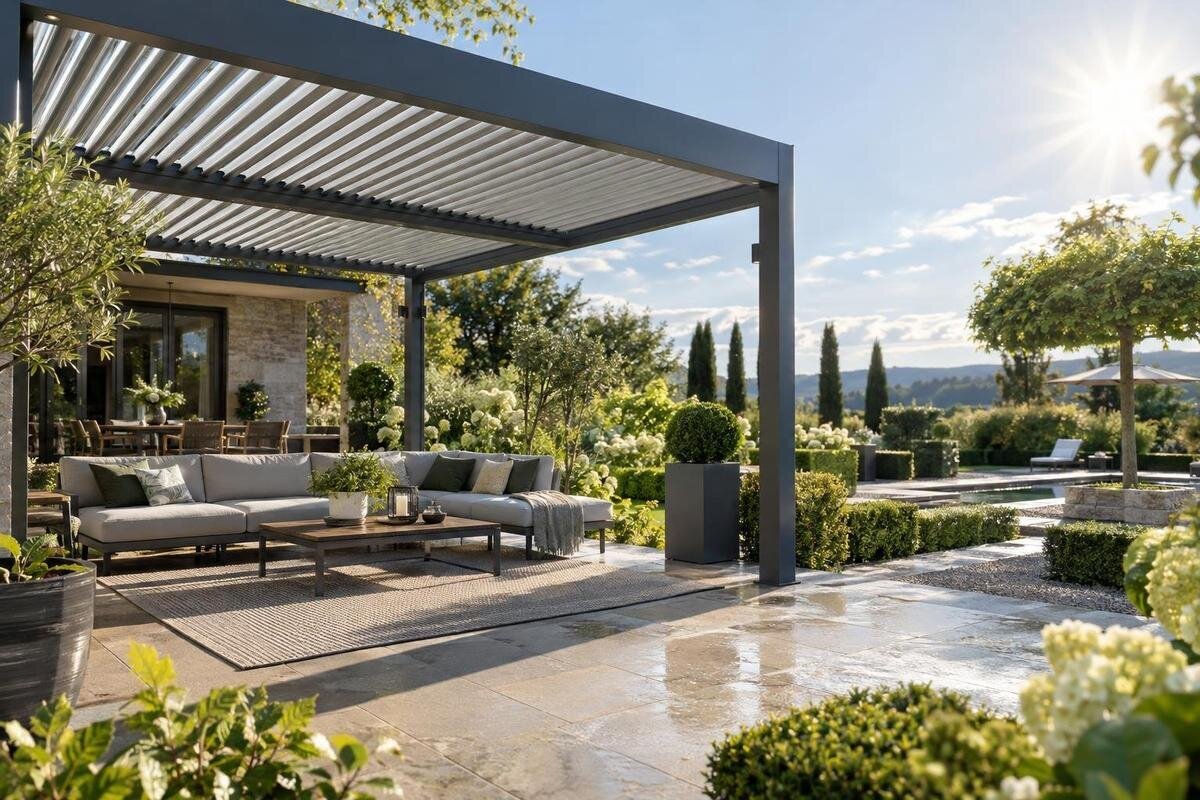
Roof style sets the basic balance between direct shade and open sky. A fixed slatted roof leaves gaps, so it can cast broken light whose pattern shifts with the sun. Adjustable louvers can change how open the roof is, but their useful range and operation vary by product. A pergola fitted with a retractable canopy, or one with a more continuous roof surface, may limit overhead light when closed; the exact coverage depends on the design and written specifications. These are broad comparisons, not guarantees about any model: spacing, pitch, height, and sun angle all affect the result. Check whether a roof described as closing actually leaves gaps.
Ask which roof position you would use most. If you want to respond to changing light, confirm what adjustments are possible and whether they are practical for your routine; if you prefer a fixed setting, compare its openings and stated shade guidance. Also decide how much sky view and daylight you want to retain. Do not treat a style label as a coverage rating. For another Bloomcabin pergola listing, look for the stated roof configuration and documented operation, then compare them with your sun notes rather than inferring performance from the name. If key details are absent, ask before comparing it as adjustable or fully covering.

Before you buy 3
Check slat layout and low-angle sunlight
If a roof uses slats or louvers, look beyond the broad roof label. The width and spacing of the gaps, their direction, and whether they can move all influence how direct sun passes through. Ask for a roof plan or clear written description of the layout; if the seller supplies a shade diagram, check that it matches the exact size and configuration you would order. A photo taken at one time of day cannot show what the roof will do later in your yard. Treat unstated spacing or adjustment details as unanswered, not as evidence of full shade. A line drawing is more useful for comparison than a dramatic camera angle.
Even a roof that blocks overhead rays may leave low-angle sun coming in from the side. If that is the source of glare, note the exposed side and decide whether another feature is needed; do not assume screens, curtains, or panels are included with the pergola. If an option is offered, verify compatibility, whether it is part of the order, and how it changes openness, views, and airflow. Keep the product page you are assessing beside your site sketch and compare the side-light problem with what the listing actually specifies. A roof’s shade description alone cannot answer a question about sunlight entering from an open side.
Compare materials and finishes for a sunny site
In a sunny yard, compare the frame and roof materials separately instead of relying on one material word. Posts, beams, roof elements, and finishes may not all use the same material, and a product image rarely identifies each component. Ask what each exterior part is made of and what the manufacturer says about its finish, outdoor exposure, cleaning, and expected appearance over time. Sunlight can affect some finishes, but outcomes depend on the material and coating; a broad label alone does not establish fade resistance or how a color will age. Keep material facts separate from shade-performance claims.
Maintenance is part of the purchase, especially if the structure will stay outdoors through changing seasons. Compare written care instructions, recommended touch-up steps, and whether replacement parts or repair guidance are described. If you are choosing between wood and metal options, judge the actual finish and upkeep guidance rather than assuming one category is automatically maintenance-free or unsuitable. View a sample outdoors if one is available, since a screen image can make a finish look different in daylight. On a candidate pergola product page, verify the frame, roof, and finish materials explicitly; do not infer them from a photo.
Before you buy 4
Choose a location that works with the house and yard
Position changes both shade and convenience. A freestanding pergola gives you a different placement choice from a structure intended to meet a wall, but its support locations still need to fit the patio. A wall-side layout can interact with windows, doors, eaves, and the shade already cast by the building. Consider what should remain bright inside and whether the structure will shade a doorway, block a view, or interfere with a path. Draw the house and yard together so the pergola is located by actual use, not only by an attractive angle in a product image. Include nearby windows and existing shade in that plan.
Do not assume a pergola shown beside a wall is designed for attachment to yours, or that any wall is suitable. Confirm the exact installation configuration and have a qualified installer assess site-specific attachment and support needs; that review depends on the product and building. For a freestanding layout, check that support positions can occupy the planned spots. For the Bloomcabin pergola page, verify how the specific structure is intended to be placed and what installation guidance applies before treating it as a fit for your wall or patio. The distinction affects both location and installation planning.
Check the site and installation requirements
Check the surface and access before ordering. Soil, paving, a concrete slab, and an elevated deck are not interchangeable installation situations, and a flat-looking patio does not establish that a particular structure can be secured there. Find the manufacturer’s requirements for the base, supports, and anchoring, then ask a qualified installer to assess any uncertain surface or slope. Identify obstacles that could affect the planned position, such as buried services, drains, planting beds, or existing fixtures. This is a site review, not something to settle by guessing from a roof style or product photograph. Review these requirements before you settle on a location.
Measure the route from the delivery point to the installation area, including gates, turns, and overhead obstructions. Check stated package and assembly requirements and allow room to work; do not assume components will pass through a narrow access point because the completed pergola fits the patio. If local property requirements may apply, confirm them with the relevant local office or a qualified professional before purchase. Keep the listing you are evaluating with your installer notes; if installation documents or base requirements are not available, request clarification before ordering. Resolving access questions early may prevent a late change in placement.

Before you buy 5
Review specifications and order details
Create a comparison sheet from written specifications. Record outside dimensions, clear height, support positions, roof type, adjustment range, and any stated shade guidance. Add frame and roof materials, finish, care instructions, and whether side-shading parts are included or optional. Keep a separate column for details that are missing, and note which configuration each measurement applies to. That distinction prevents a product title, diagram, or staged photo from silently filling gaps. If a page does not state a measurement or feature you need, ask the seller or manufacturer for the answer for the exact size and configuration you plan to order.
Check the order as carefully as the structure: chosen size and finish, roof or accessory configuration, included hardware, assembly, and any separate delivery or installation charges where applicable. Read the stated warranty, return, and care terms before committing; these details are product- and order-specific, so do not assume they are standard across pergolas. Compare the full amount shown for the configuration you select rather than treating a headline price as the total. On the Bloomcabin product page in your comparison, record only details it actually states and leave unanswered points open until confirmed.
Build a shortlist around shade and fit
Shortlist by fit first, then preference. Remove any option whose documented dimensions do not fit the site, whose installation requirements cannot be met, or whose roof cannot plausibly address the hours you identified. Among the remaining choices, weigh the shade pattern against daylight, openness, finish, maintenance, and how much adjustment you will use. A simple side-by-side table is useful because it keeps sunlight needs separate from color or style; judge each candidate against the same seating location and sun map, not against different promotional images. Mark hard requirements clearly so an appealing finish does not distract you from an unresolved fit.
If shade performance is not specified, do not turn a product image into a promise. Ask a focused question about coverage at the relevant sun angle, or choose only if the stated design and your observations give you enough confidence. Before ordering, make sure the size, selected configuration, material, installation plan, and total order details all match your notes. If a key answer remains unknown, weigh that uncertainty honestly rather than assuming the strongest shade outcome. The best pergola for a sunny yard is the one that fits the actual place and daily pattern, with its limits understood, not simply the one with the largest listed footprint.
Frequently asked questions
Will a pergola provide full shade?
Not necessarily. An open or slatted roof allows some direct light through, and even a more continuous roof may leave low-angle sun coming in from the side. Compare roof details with the hours you need coverage; do not infer full shade from the pergola’s footprint or name.
Which roof style works best for a sunny yard?
There is no universally best roof. A more continuous surface generally blocks more overhead sun, while a slatted or adjustable design trades some coverage for openness or control. Check the exact configuration, gaps, range of movement, and any shade information for the model you are considering.
How should I measure for a pergola?
Mark the seating and walkways on a sketch, measure the desired roof area and clearances, and compare them with the published dimensions and support positions. Remember that the roof’s footprint is not a guaranteed shade boundary; check where shadows fall at the times you use the space.
Can a pergola block low afternoon sun?
Not by itself in every setting. Low sun can pass under a roof edge, so note which side is exposed when you use the yard. A side screen may help only if it is compatible with the pergola; confirm whether it is included or ordered separately.
What should I verify before ordering?
Confirm the dimensions, roof configuration, materials and finish, included parts, installation requirements, and order terms. Separate stated facts from unknowns, and ask the seller or a qualified installer about details that affect shade or whether the structure fits your site.
A strong-sun purchase works best when it begins with the spot and hours that matter, not with a roof style or product photo. Map the sun, measure the space, and compare the roof’s documented coverage with the shade you want. When the material, site fit, and installation requirements also line up, you can choose with a clearer sense of what the pergola will—and will not—do.
