
What It Costs to Heat a Pergola Seating Area
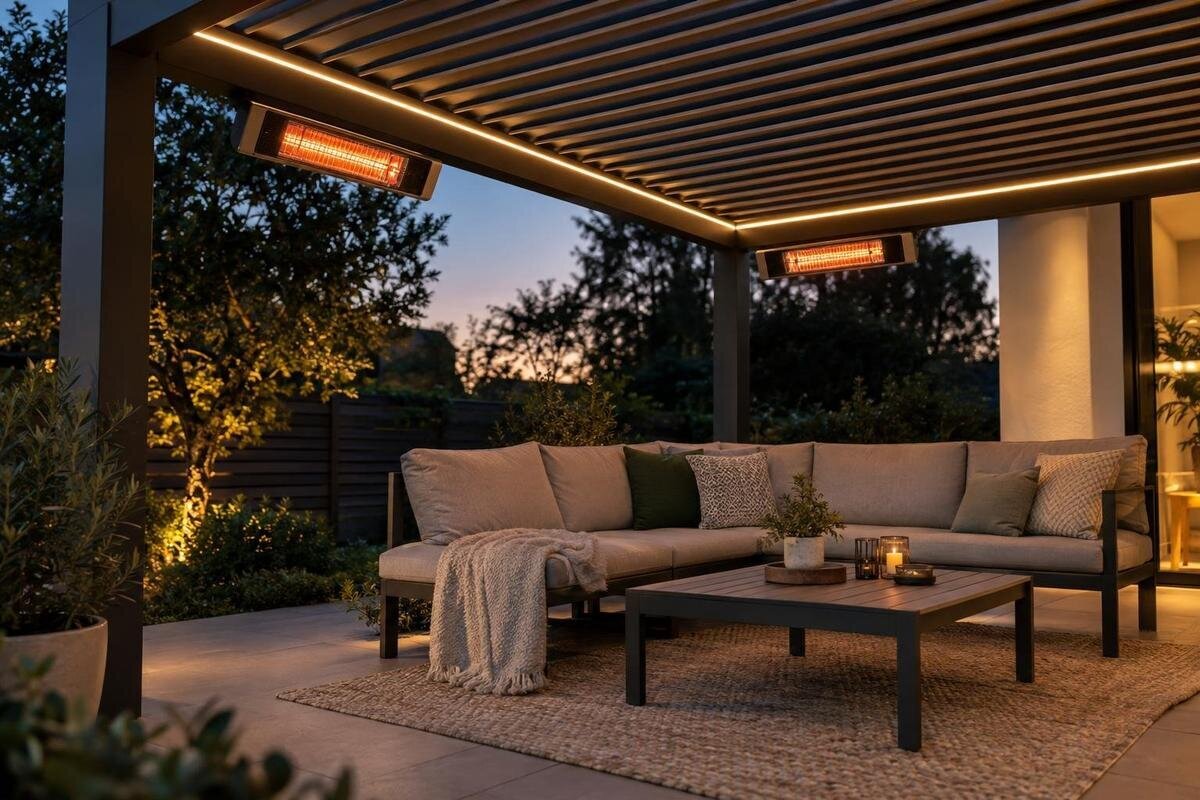
Pergola heating costs
Heating a pergola seating area has two separate price tags: the equipment and installation up front, and the energy used while it runs. For an electric heater, estimate operating cost from its rated electrical input, the hours at that input, and the price you pay per kilowatt-hour. That calculation tells you what a session may cost, not whether every seat will feel warm. Radiant comfort depends on where people sit and where the heater directs warmth; the surrounding outdoor air may remain cool. Plan the budget and comfort assessment separately.

Separate installation cost from energy cost
Start with two totals. The installed-system total may include the heater, its controls and mounting components, and electrical or installation work identified for the actual setup. The running total is the energy used after the equipment is ready. A cost per evening belongs in that second figure, not in the project total. When requesting a quote for the Bloomcabin Pergola, ask for the structure and any proposed heating equipment to appear as separate line items. That makes it easier to see what the base project includes, which additions you are considering, and which expenses would remain even if you decided against heating.
Request an itemized quote that names the heater model and rated input, states which controls and mounting components are included, and separates labor and electrical work from hardware. Ask a qualified electrician to assess the proposed load and existing supply instead of assuming an outdoor outlet will support the plan. Keep each number in the category where it belongs: a higher initial quote does not automatically mean higher energy use, and a low equipment price does not reveal the future electric bill. Compare operating estimates only after you know which heater and control settings they assume.
Calculate electric energy use from watts and hours
For one electric heater, a full-input estimate is: rated electrical input in watts ÷ 1,000 × hours at that input = kilowatt-hours. If the rating is already in kilowatts, multiply that figure by the hours instead. For example, 1,500 watts is 1.5 kilowatts, so three hours at that input uses 4.5 kWh. Multiply the energy figure by your electricity price per kWh to estimate the cost. The calculation is for the heater’s electricity use; it does not include equipment, installation, or other project expenses.
At a hypothetical rate of $0.20/kWh—not a claim about a current or local rate—4.5 kWh costs $0.90. If another 1.5-kW heater runs at full input for the same three hours, the combined use is 9 kWh and the cost is $1.80. If units run for different lengths of time or at different settings, calculate each one separately and then add the totals. When comparing heating proposals for the regular pergola model, ask each supplier to show the number of heaters and the assumed operating hours. Otherwise, an apparently cheaper estimate might simply cover fewer seats or a shorter evening. Keep watts, kilowatt-hours, and dollars in separate worksheet columns so you can see exactly which assumption changes the result.
Read the heater’s input rating and power settings
Check the rating plate and manual for the exact heater model. For an electric running-cost estimate, look for electrical input in watts or kilowatts and note which setting the figure describes. A heat-output figure is not necessarily the same as electrical input. If the documentation gives output but not the information needed to estimate energy use, ask the manufacturer or seller for the heater’s electrical consumption data rather than guessing. For multiple units, record each input rating and whether you expect them to operate at the same time.
Multiplying rated input by every hour in a session gives a full-load estimate, not always the exact meter total. A heater with more than one power level may draw differently on each setting, and a thermostat may cycle the unit. Use the settings and runtime you realistically expect; do not apply an arbitrary discount for cycling. If you later compare the estimate with your utility data, remember that a whole-home bill includes other appliances and can obscure the heater’s contribution. Keep projected figures separate from observed use.
Estimate hours of use across a season
Build the runtime estimate from the way you expect to use the seating area. Note the likely number of evenings per week, the hours the heater will be on, and how many weeks you expect to use it. Include any time it may run before people sit down or after they leave. If a control cycles the heater, elapsed time at the setting is not necessarily time at full input, so treat a full-load calculation as a baseline unless you have dependable consumption information for the chosen model.
For example, three two-hour evenings each week for 12 weeks amount to 72 operating hours for one heater. At a constant 1.5-kW input, that schedule uses 108 kWh before any other equipment is included. If a second heater is used only when guests visit, give it its own schedule rather than doubling the entire seasonal total. When discussing the Bloomcabin Bioclimatic Aluminum Pergola, describe whether your expected use is regular dining, occasional gatherings, or short visits outside. Those habits help explain your budget assumptions without implying that the structure determines energy use. Mark vacations and weeks when you do not expect to sit outdoors; a calendar-based estimate is usually more informative than multiplying a typical evening by every day in the season.

Apply the electricity rate you actually pay
Use the price that applies to the extra kilowatt-hours consumed when the heater runs. A bill may list supply and delivery charges separately, or show different rates at different times. Include the variable per-kWh charges you want represented in your estimate, and apply the same approach consistently when comparing options. Dividing the entire bill by total household usage can give a rough average, but it may include fixed charges that do not rise when you use the heater.
If your plan has time-of-use pricing, match the rate to the hours you expect to heat the area. Split a session that crosses rate periods: a hypothetical 1.5-kW heater running for one hour at $0.15/kWh and two hours at $0.30/kWh would cost $0.225 plus $0.90, or about $1.13. Using the cheaper rate for all three hours would understate that session. If rates change by usage tier or season, use the rate applicable to the expected additional use, or calculate separate cases. Keep fixed monthly service fees outside a per-session figure unless you are deliberately reporting a broader bill average. Note the rate and date on your worksheet so an old estimate does not look like a current price after your utility plan changes.
Radiant comfort is not the same as warmer air
Many outdoor electric heaters provide radiant warmth: energy reaches people and surfaces in the heater’s path, so occupants may feel warmer without a comparable rise in the surrounding air temperature. An open-sided seating area does not hold warm air like an enclosed room. That is why an air thermometer alone may not describe how comfortable the seats feel—and why paying to heat a large volume of outdoor air is not the same as directing warmth toward an occupied spot.
Consider where people actually sit and whether the heater’s intended coverage reaches those positions. Distance, orientation, obstructions, and the manufacturer’s instructions all matter; do not assume every chair under a roof will feel equally warm. For a project involving the bioclimatic pergola model, include the dining chairs or lounge seats on the layout you discuss with the supplier. Ask how the proposed heater arrangement would serve those occupied positions, rather than asking only how much square footage it can heat. A layout for two regularly used chairs presents a different budgeting question from one intended to accommodate guests throughout the seating area, even when the pergola itself is unchanged.
How weather affects your heating budget
The arithmetic can be correct while the runtime estimate is wrong. A breezy or colder evening may make a seat less comfortable and change how long people choose to stay; a more sheltered evening may lead to a different schedule. For a project using the Bloomcabin Lean-To Pergola, describe the existing wall, open sides, and seating positions when discussing expected use. The model name alone does not establish the shelter at your site. Think about the evenings you actually want to spend outside: a brief meal on a cool night and a long gathering in colder weather should not automatically receive the same operating-hour allowance. Neither a correct cost calculation nor a larger budget guarantees comfort.
Avoid adding a made-up percentage to account for wind or assuming a screen will automatically reduce energy use. Changes to screens or other barriers can also affect heater clearances and exposure, so include them only when the relevant manufacturer instructions allow the configuration. After you begin using an approved setup, record the weather, heater setting, powered hours, and whether you stayed as long as planned. These notes can reveal whether your original seasonal schedule was realistic. Distinguish an evening canceled because of weather from one spent outside with the heater running longer; they affect the energy budget in opposite ways.
Compare heater types with the right cost measure
The electric formula applies to electrical input: kilowatts multiplied by hours gives kilowatt-hours, and kilowatt-hours multiplied by the rate gives an energy-cost estimate. A fuel-burning heater needs a different calculation. Use its documented fuel-consumption rate, the time it runs, and the price you pay per unit of fuel. Do not compare a heater’s heat-output rating directly with an electricity bill; output and purchased energy are different measures. If the consumption information is unclear, ask the manufacturer or seller rather than converting by guesswork.
Compare alternatives using the same expected schedule and seating-area use, then include equipment and installation as separate costs. Equal runtime does not necessarily mean equal comfort, so a fuel-cost comparison alone cannot establish which arrangement serves your seats better. If you are collecting proposals for a wall-mounted pergola project, keep the layout consistent and ask for the consumption assumptions behind each heating estimate. For fuel purchased by the container, calculate the price per documented quantity of fuel rather than treating every refill receipt as an identical amount. Compatibility still requires the exact equipment documentation; the pergola category does not determine which heater or fuel is appropriate.

Include electrical work and approved mounting
An energy estimate does not confirm that the planned electrical setup or mounting arrangement is suitable. Before including a heater in the budget, have a qualified electrician assess the expected electrical load and the proposed supply. Check the exact heater’s outdoor rating and manual, as well as documented approval for the intended mounting location from the relevant manufacturer. A pergola’s general product description is not proof that a particular fixture can be attached to any point on its frame or used in every exposure condition.
Ask the installer or electrician to distinguish any required electrical or mounting work from the heater’s purchase price and energy use. Provide the exact equipment and structure details so the proposed arrangement can be checked against their documentation. Include the Bioclimatic Aluminum Pergola product details in that request, along with the proposed heater model, controls, and intended exposure. Ask the quote to identify what has been assessed, what documentation supports the mounting arrangement, and what remains to be confirmed before purchase. This helps distinguish a complete installation proposal from a hardware-only price. Any unresolved supply or mounting question belongs in the project budget as an outstanding item, not as an assumed zero-cost expense.
Build low, typical, and high-use estimates
Put the figures in one worksheet: each heater’s rated input and setting, hours per visit, visits per week, weeks of use, and the applicable per-kWh rate. Calculate energy use for each unit, add the units, and multiply by the rate. Identify the quoted structure, such as the Bloomcabin Pergola product page, alongside the heater model so different project versions do not get mixed together. Give each version a date and a short description of the seats it is intended to serve. Record any separately estimated lighting or control consumption on its own line if you want a whole-system operating total; do not quietly fold it into the heater’s input rating.
Make three versions using reasonable schedules. For one hypothetical 1.5-kW heater at full input and $0.20/kWh, a low-use case of one two-hour visit per week for eight weeks totals 16 hours, 24 kWh, and $4.80. A typical case of three two-hour visits per week for 12 weeks totals 72 hours, 108 kWh, and $21.60. A high-use case of four three-hour visits per week for 16 weeks totals 192 hours, 288 kWh, and $57.60. These are arithmetic examples, not forecasts for your site or promises of comfortable seating. Replace the schedules, input, and rate with your own figures, and add any other heaters according to their individual use. State whether each result assumes full input or uses documented consumption for a lower setting or control. Keep these seasonal energy totals beside the itemized equipment and installation costs. If you also report a first-season total, label it clearly as installation plus that season’s energy, rather than presenting it as a recurring annual expense.
Frequently asked questions
How much does a 1,500-watt electric heater cost to run per hour?
At full rated input, it uses 1.5 kWh per hour. Multiply 1.5 by your electricity price per kWh; at a hypothetical $0.20 per kWh, that is $0.30 per hour. A lower setting or a thermostat that cycles can change actual use.
Does a heater’s wattage tell me how much of the pergola it will heat?
No. Wattage helps estimate electrical use, but it does not establish where a heater will feel comfortable or whether it suits a particular mounting location. Check the exact heater manual and assess warmth at the seats you plan to use.
How many hours should I use in a seasonal estimate?
Estimate the sessions you realistically expect: visits per week, powered hours per visit, and weeks of use. Make separate low, typical, and high-use estimates if your schedule or the weather varies.
Should I include my utility bill’s fixed monthly charge?
Usually, a session estimate should use the variable cost of each additional kilowatt-hour, not a fixed charge you pay regardless of heater use. If your plan has time-based or tiered rates, use the rate that applies during the hours you expect to run the heater.
Is an electric heater cheaper to run than a propane heater?
There is no universal answer. For electricity, use rated input, runtime, and your per-kWh rate. For propane, use the heater’s fuel-consumption information and the price you pay per unit of fuel. Compare the same expected schedule, and keep equipment and installation costs separate.
A useful heating budget is a range, not a universal dollar figure. Calculate electric use from the heater’s documented input, realistic hours, and the rate on your utility plan; keep installation separate and verify the exact equipment and mounting arrangement. Then consider whether radiant warmth reaches the seats you intend to use. This approach estimates the cost of running the heater without treating a pergola’s name, floor area, or wattage as a promise that the whole outdoor space will feel warm.
