
Fixed Glass Roof vs. Louvered Pergola Roof: How to Choose
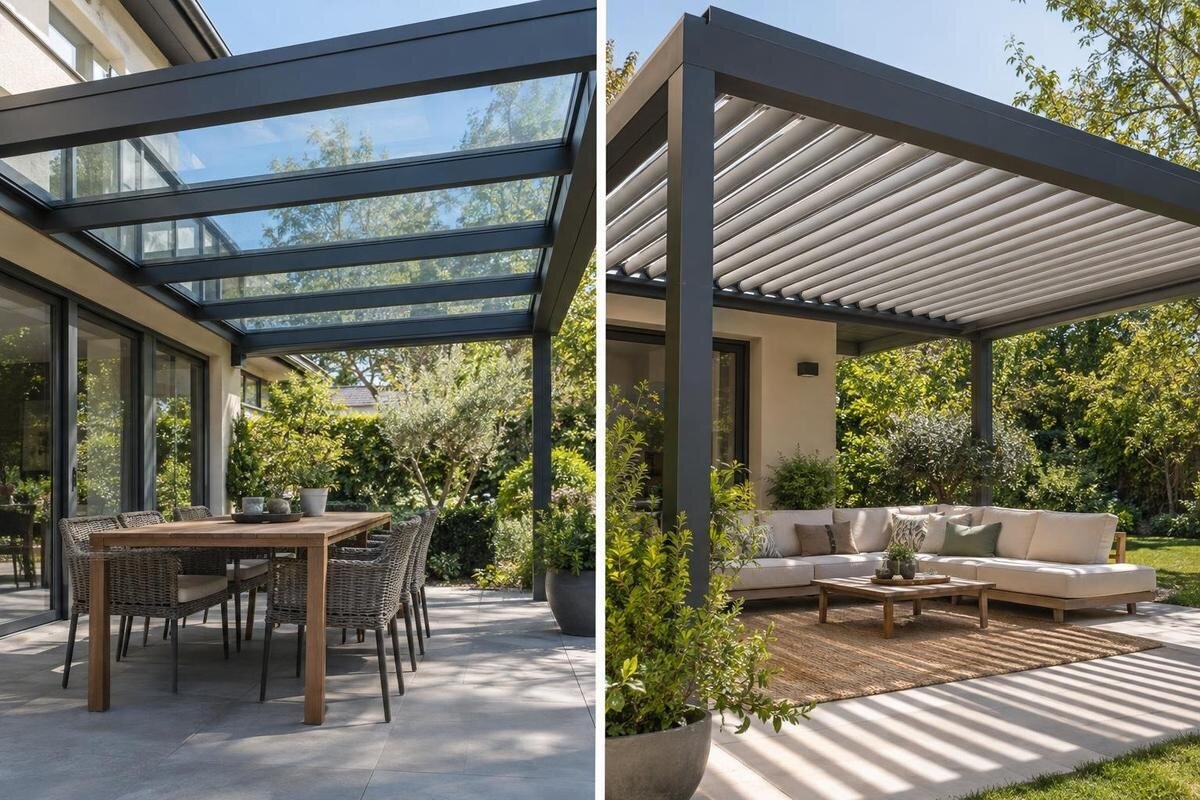
Pergola roof comparison
A fixed glass roof and an adjustable louvered pergola roof create different conditions overhead. Glass stays in one position, while operable louvers can change the balance of shade, sky exposure, and airflow. Rain protection, heat, and useful daylight depend much more on the selected glazing, louver design, and installation. Compare how you use the patio, then verify the exact roof configuration and weather guidance before choosing.

01
What changes between the two roof types?
A fixed glass roof keeps the same overhead surface in place. Its glazing can admit daylight, but the roof itself does not open to create a vent or move aside to deepen shade. How much light and solar energy pass through depends on the actual glazing and frame, so “glass roof” does not specify how bright, warm, or weather-resistant the covered area will be. Treat it as a fixed condition during daily use, even though sunlight, clouds, and shadows still change. If you want the roof itself to respond to a change in sun or breeze, glass gives you no position to adjust. Any added shade would be a separate feature to verify.
An operable louvered roof can change the opening between its blades, altering how much sky is exposed and how much direct sun is interrupted. Its useful range depends on the specific system: confirm whether the blades move, which positions are available, and what the roof looks like fully open, partly open, and closed. This is a more adjustable overhead condition, not an automatic promise of ventilation or rain protection. Compare the system as sold rather than assuming every louvered design operates alike. The central choice is between a fixed light-transmitting surface and a roof whose opening can be changed.
Daylight under a fixed glass roof
To judge daylight under glass, ask about the visible-light performance of the actual glazing rather than relying on a product image or a label such as clear. Tint, coatings, framing, and panel layout can affect how much light reaches the patio; sun angle, cloud cover, and nearby trees or buildings change it through the day. If you use the space for meals, reading, or work, observe it at the hours you expect to sit there. A fixed roof cannot adjust its light transmission as the sun moves, and a bright brochure image is not a reliable substitute for the listed glazing details. Compare a sample only if it matches the panel you are considering.
Think about the rooms just inside the house as well as the covered floor. An attached roof may shade nearby windows, while glazing can preserve some overhead daylight; the result depends on placement, glass properties, and the surrounding site. Separate two questions: how bright will the patio feel, and how much sunlight will reach the room behind it? These are not necessarily the same outcome. When reviewing the Bloomcabin Pergola product details, request glazing information for any fixed glass option under consideration. A sample can help you compare tint and clarity, but it cannot show the effect of the entire roof frame. Include the beams and panel divisions when assessing the view from indoors.
02
Ventilation through the roof
Fixed glass does not open at the ceiling, so it cannot provide roof-level airflow in the way an open roof section can. That does not mean a glass-covered patio has no breeze: air may pass through open sides, doors, or other openings, depending on the site, wind, and how enclosed the area is. Screens, curtains, furniture, and nearby walls can affect the path. If ventilation is your priority, sketch where air could enter and leave instead of assuming that changing the roof material alone will solve stagnant conditions. The amount of side opening is worth considering alongside the roof.
An operable louvered system can let air pass through the roof when its blades create an opening. How much air moves still depends on the opening, blade position, breeze, and available routes through the sides; an open roof does not guarantee a cooler seating area. For the Bloomcabin Bioclimatic Aluminum Pergola listing, request an operating diagram to establish whether and how the offered roof opens. Then consider the conditions in which you would use that opening. A position that admits air may also admit sunlight or rain. If the patio needs overhead rain cover at the same time, assess its side ventilation separately rather than expecting one roof position to satisfy both needs.
How much shade can you adjust?
Shade is not a simple all-or-nothing difference. With fixed glass, shade from the roof cannot be adjusted; the glazing, frame, sun angle, and surroundings determine the result. Louvers can offer shade adjustment if the blades are operable, letting you change how much of the roof is open or blocking direct sun. That can matter at breakfast or late afternoon, when the sun reaches a covered area from a lower angle. Compare the patio at those times rather than assuming a closed roof will keep every beam out. If you expect to add a separate shade, check its compatibility with the selected roof.
Louver positions can create alternating patches of light and shade, and the pattern shifts as the sun moves. A partly open setting may still admit direct sun through gaps, while a more closed setting also changes the view and airflow. Ask for a demonstration of the positions available in the exact configuration shown on the bioclimatic pergola product page. Compare the shade over the seating area, not just directly beneath the center of the roof. Low sunlight can enter under the roof edge regardless of the roof material. Also consider how you would make adjustments during a meal or while reading; do not assume a motor, remote, sensor, or automatic response is included.

03
Rain protection depends on the full roof
For rain, judge the complete roof assembly rather than the material name. A fixed glass roof can provide overhead coverage when its glazing, joints, frame, perimeter, and drainage are designed and installed for that use. Ask where water is meant to go and what conditions the manufacturer says the assembly can handle. Glass by itself does not answer questions about edge runoff, wind-driven rain, or the connection where the roof meets a wall. Consider where runoff could reach a doorway or walking area, and rely on product documentation for the intended use of the exact roof—not a dry-weather photograph.
A louvered roof may direct rain toward channels when fully closed, but that arrangement and its limits vary; do not assume the blades seal like a continuous pane. When louvers are open or partly angled, rain can enter through the roof opening, and wind may carry water in from the sides even when the blades are closed. For a configuration under consideration on the Bloomcabin Pergola product listing, request its drainage diagram and rain-use guidance. Trace the water route from the roof to its final outlet, including where it reaches the ground. Ask what happens to water remaining on the roof when its position changes after a shower, since this may affect when you resume using the table below.
Match the roof to your weather and routine
Use your own weather pattern to frame the choice. Note when you avoid the patio: strong midday sun, passing showers, still humid air, wind, or seasonal leaves and pollen. A fixed glass roof offers no overhead opening when you want more air, while an adjustable louver roof only helps if its positions suit the situation and you can change them as needed. If you expect to react to a sudden shower, ask how the exact system can be moved and under what conditions. Do not plan around a response from a person or automatic control unless that operation is confirmed for the model.
Separate everyday comfort from the conditions a structure is designed to withstand. For the Bloomcabin Bioclimatic Aluminum Pergola product page, request the exact model’s documentation for wind, snow, and other relevant weather conditions. Have a qualified installer or engineer assess its suitability for your location where needed. A sheltered seating area does not by itself establish that a roof or its attachments are suitable for the site. Ask which roof position the manufacturer specifies during severe weather and whether that instruction differs from its ordinary rain-use guidance. If the patio is often unattended, consider whether the required operating routine is practical without assuming the system can sense weather or reposition itself.
04
Consider nearby windows and wall attachment
If the pergola sits beside windows or a frequently used exterior door, check the effect from inside the house too. A roof changes how much open sky is visible and can change the light reaching a nearby room; fixed glass and open or closed louvers will not look identical at every hour. Stand at the window at the times you use the patio, and note direct sun, reflections, nearby trees, and buildings. This site observation complements, but does not replace, specifications for glazing and roof movement. It can also reveal whether preserving daylight inside matters as much as shading the patio.
Roof type and attachment style are separate decisions. A wall-mounted structure needs its own compatibility and mounting review; choosing glass or louvers does not establish that an existing wall can support it. When considering the Bloomcabin Lean-To Pergola listing, have a qualified professional review the proposed attachment and flashing details. Include the height of nearby windows and doors, roof overhangs, and the intended drainage route in that discussion. The house connection can affect both water management and the amount of sky visible from indoors. A roof choice that looks suitable over the patio may still need a different placement to work with the wall. Resolve those constraints before treating the roof material as the final decision.
Cleaning and upkeep for each roof
Overhead glass can make dust, pollen, and water marks easy to notice, particularly when viewed from below. Consider how its exterior surface can be reached safely and what cleaning methods the manufacturer permits before committing to a design. The answer depends on roof height, access, glazing treatment, and the amount of debris around the patio, so do not assume it can be cleaned from a ladder or with an ordinary household product. Ask for care instructions for the actual material and any coating. A cleaning routine that is difficult to carry out may affect how you feel about the roof over time.
Louvered roofs also need a practical care plan. Depending on the design, spaces between blades, moving connections, or drainage paths may need inspection and cleaning; consult the manual for what can be accessed and what maintenance is expected. Do not assume every system needs the same schedule or that one roof is maintenance-free. Compare both options for safe access, permitted cleaners, parts that need periodic attention, and how debris can be removed. These details matter because the benefit of adjustable shade or a fixed glazed surface is less useful if routine care is impractical.

05
What to verify in product documents
Make a like-for-like comparison from written specifications. For glass, note the stated glazing type, visible-light and solar-heat information, roof joints, drainage route, and the manufacturer’s description of rain use. For louvers, confirm they are operable, which positions are available, what the open-area diagram shows, and how water is handled when the roof is closed. For either system, check installation requirements, local weather limits, care instructions, and what is included in the exact configuration. If a detail is missing, ask rather than filling it in from a photo or from a different model.
Keep model identity separate from proof of a feature. The Bloomcabin Pergola listing identifies the product, but its name alone does not establish fixed glazing, operable louvers, or a performance rating. Apply that distinction to all three linked models. Record each quoted configuration separately, with its roof option, included operating equipment, and supporting documents. Do not combine a glazing description from one option with a drainage diagram from another. If the materials leave panel type, movement, or rain handling unclear, mark that point as unanswered and request written clarification. This gives you a usable comparison of what is actually offered rather than a collection of features that may belong to different systems.
Choose by the way you use the patio
A fixed glass roof is worth considering when daylight is a priority and you do not need to open the roof or adjust its shade during the day. Test that preference against an ordinary week: breakfast in cool weather, lunch in bright sun, and an evening meal after a shower. Would the same overhead surface suit each occasion, or would glare and heat make some of them uncomfortable? Any separate shading you need belongs in the comparison, including its effect on daylight and upkeep. This approach helps distinguish a genuine preference for a fixed roof from an attractive photograph taken at one favorable moment. The selected glazing still determines whether the proposed roof meets that preference.
Operable louvers are worth considering when changing the roof opening would make the patio more useful across those same occasions. Decide whether you would regularly adjust the roof or mostly leave it in one position; adjustable features have less value if they do not serve your routine. If attachment to the house is also important, include the Bloomcabin Lean-To Pergola product page in your shortlist as a separate mounting choice, without treating it as proof of either roof type. Rank daylight, adjustable shade, airflow, and rain use in order of importance. When no documented configuration satisfies all four equally, that ranking makes the compromise explicit rather than leaving you to discover it after installation.
Frequently asked questions
Does a fixed glass pergola roof always block rain better than louvers?
Not automatically. Rain protection depends on the complete roof assembly, its joints, drainage, installation, and stated limits. A louvered roof’s closed-position performance also varies by design. Compare the manufacturer’s guidance for the exact configuration rather than relying on the roof material or product photos.
Will a glass roof make the patio too hot?
The result depends on the glazing, sun exposure, surrounding shade, and airflow. Ask for the glass’s daylight and solar-heat information, then consider the patio during the hours you use it most. The word “glass” alone does not predict how warm or bright the space will feel.
Can a closed louvered roof still provide ventilation?
A closed position is not the same as an open roof. Airflow through or around closed blades depends on the specific design, and air still needs a route through the sides or other openings. Check the model’s operating positions if ventilation is a priority.
Can I change the louvers when it starts to rain?
Follow the instructions for the exact system. Do not assume it includes a motor, sensor, remote, or automatic response. Confirm how the roof is operated and what the manufacturer says about changing its position in rain or other weather.
Does “bioclimatic” mean a pergola roof is waterproof?
No. The label does not establish rain performance, drainage, side protection, weather limits, or suitability for a particular site. Look for documentation for the exact model and configuration, including any stated limits on rain use.
Choose by the overhead condition you most want to control. Fixed glass keeps the roof in one position and can admit daylight, with its glazing and drainage details shaping the result. Operable louvers offer adjustable shade and a roof opening, but their range and rain guidance depend on the exact system. Check those trade-offs against your patio’s light, airflow, weather, and upkeep needs.
