
Frozen Pergola Louvers: When Not to Operate the Roof
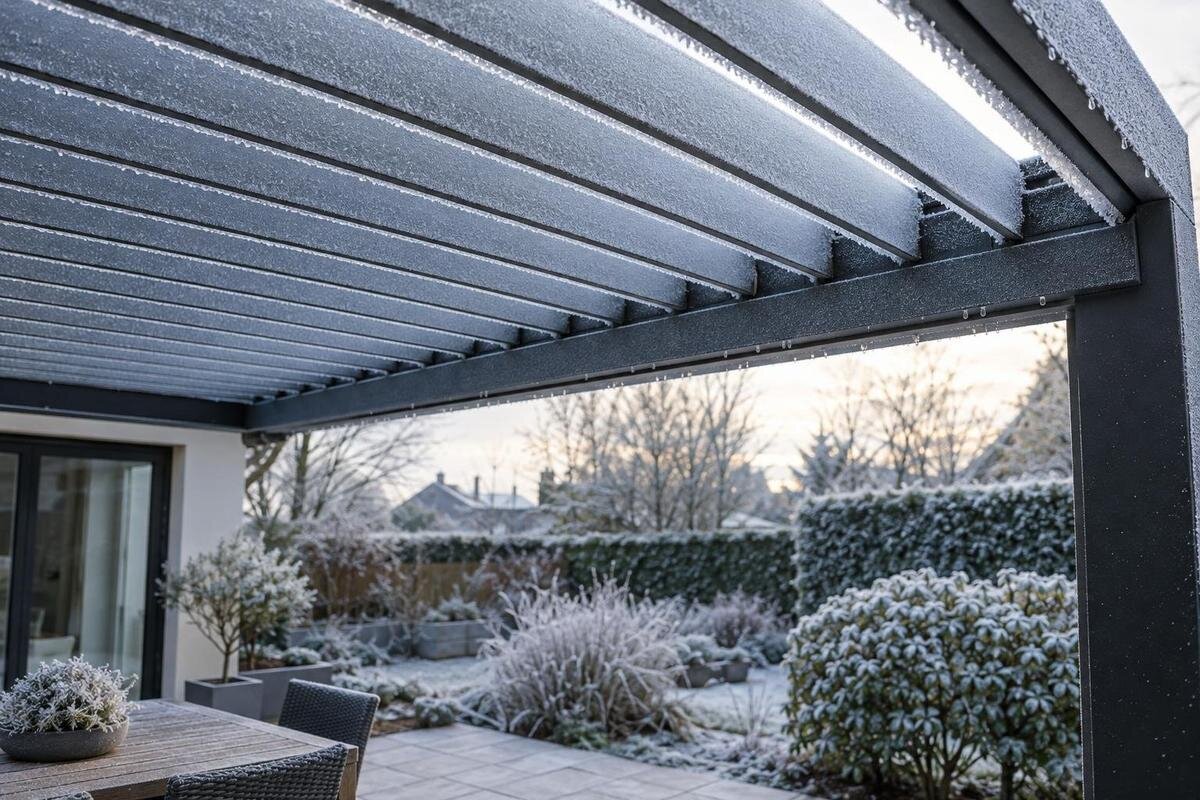
Pergola winter care
Frost can prevent a louvered pergola roof from moving when ice binds a blade or joint. But a stalled roof can also indicate debris or a mechanical issue, and pushing it through resistance risks turning a temporary winter problem into damage. When ice is visible on moving parts, or the roof hesitates, stalls, or sounds different, pause. The right response depends on the exact roof and drive system, so use its manufacturer’s instructions rather than a general winter trick.

01
How frost and ice can immobilize louvers
Frost does not need to coat the whole roof to stop a louver. Moisture can freeze at a pivot, between neighboring blades, or in another narrow moving interface, creating an ice bridge that holds one part while nearby surfaces look clear. Depending on weather and roof design, the water may come from freezing rain, rain or snowmelt left behind, or condensation. Thin ice can be hard to see from below, and the exposed face of a blade may look dry while a joint remains bonded. Moisture does not have to collect in an obvious puddle; a thin film can be enough to join two surfaces as it freezes.
Freeze–thaw cycles make the issue less obvious. An exposed surface may soften during a warmer part of the day while shaded pivots or gaps remain frozen; meltwater can then refreeze after sunset. A short spell above freezing is not a reliable restart signal, and partial movement does not mean every louver has cleared. Wind exposure, shade, and moisture can differ across one roof, so one area may thaw before another. Frost may look white and crystalline, while glaze ice can be relatively transparent. Neither appearance tells you how firmly a joint is bonded. The useful distinction is between observing surface conditions and confirming that the mechanism meets its documented operating requirements; a photograph can help with the former, but cannot establish the latter. Treat air temperature as context, not a universal operating threshold: permitted conditions and approved release methods depend on the exact roof.
Where ice can obstruct roof movement
Potential restriction points extend beyond visible blade faces. Depending on construction, the system may have overlapping louvers, pivot points, connecting parts, seals, end supports, or a drive connection; ice at one point can affect movement elsewhere. The first point of resistance may be hidden from the ground, and one apparently clear blade does not confirm that the rest of the mechanism can move. Where blades are mechanically linked, a frozen point may restrict more than one blade, though layouts vary. Do not reach up, rock a blade, or compare it by hand with its neighbor to diagnose a freeze; each action applies force to a part that may be bonded.
On a powered roof, an actuator can be asked to move while a louver remains stuck. Some systems may stop or signal a fault; others may simply hesitate, and behavior varies by model. A quiet motor, a brief movement, or a control response does not prove the mechanism is clear. Treat any message as diagnostic information, not permission to retry. When reviewing Bloomcabin Bioclimatic Aluminum Pergola, match the product name to its operating documents and ask how that specific roof should be handled if a louver is frozen.
02
Signs to stop operating the roof
Pause if you can see frost or glaze on a moving joint, if freezing rain has coated the roof, or if wet louvers are likely to refreeze before the next use. A roof that starts and then slows, stops unevenly, or makes a new sound also calls for an immediate stop. Treat ice at a blade edge as a warning even if the roof was moving earlier; conditions can change between uses. Look from safe ground rather than testing a joint by touch, climbing a ladder, or trying to loosen a blade yourself.
Cold air on its own does not prove that louvers are frozen, just as a warmer afternoon does not prove that their joints have thawed. Do not invent a go/no-go temperature from a forecast: shade, moisture, roof design, and drive type all matter. If the roof is wet and temperatures are falling, avoid testing it during the freeze and use written guidance for the model. For Bloomcabin Lean-To Pergola, first confirm the exact roof configuration and obtain its frost instructions rather than judging by the listing name.
Why a stuck louver should not be forced
Repeated commands are not a way to melt an obstruction. Holding a switch, pulsing the control, or trying again after each stall can continue loading the drive against an immobile louver. A small amount of movement does not mean it is safe to push farther; resistance can shift as connected parts begin to move. Release the control as soon as movement is abnormal. Do not use a stronger tool, a pole, or another person’s force to finish the cycle. Repeated retries can also make it harder to tell whether the original problem has changed.
An improvised crank, wrench, pry bar, or hand pull can bend a blade, disturb alignment, damage a drive, or release suddenly; the risk depends on the design. Moving parts can also create a pinch hazard if ice breaks and the roof shifts. Do not use a manual override to move seized louvers. A release intended for a power outage is not a de-icing method, and instructions for an unfrozen mechanism do not authorize forcing a frozen one. If reviewing the bioclimatic aluminum model, ask how the manufacturer distinguishes a loss of power from a frozen or mechanically obstructed roof.

03
What to do when the roof is frozen
Release the control and leave the roof where it is; do not issue another command to see whether it has freed itself. Keep people clear of the moving area, and do not climb onto the frame or roof to inspect it. From a safe place, note the louver position, weather, approximate time, and whether the control made a sound, paused, or reported an error. Include the sequence of events: whether the roof was wet before temperatures fell, whether it moved normally on its last use, and whether anyone has already tried to operate it. If the installation has scheduled commands, weather sensors, or connected controls, ask how to prevent further movement requests using the approved user controls. Do not assume those features detect ice or protect a seized mechanism. Photos from the ground can help document visible ice or changes for a service conversation, but do not approach overhead or unstable components. Treat snow removal as a separate issue and follow the model’s specific guidance for it.
Do not pour warm water on the roof, chip ice with a tool, apply salt or deicer, or use an improvised heater, solvent, or lubricant. These methods may create refreezing, damage, or other problems, and should not replace an approved procedure. If your purchase record names Bloomcabin Pergola, include that product name and any available model or serial details when looking for the matching instructions. A product name helps identify what you have; it is not a method for releasing a frozen roof.
When and how to resume operation
Use the thawing procedure in the manual for the exact roof and drive system. If it gives no frozen-roof procedure, or you cannot tell whether it applies to your configuration, leave the system idle and ask the manufacturer or installer for direction rather than applying heat or force. Do not assume that a warm afternoon has thawed shaded joints, or that a roof is ready because its outer surfaces look dry. Ice can remain where moving parts meet even after exposed surfaces have softened.
Once the manual’s restart conditions are met, check visible areas from a safe position for remaining ice or obvious damage; do not climb up to inspect hidden parts. A blade that appears out of line, a displaced connection, or a changed gap warrants service guidance before a restart, even if the visible ice has melted. Thawing removes a possible obstruction; it does not establish that earlier attempts caused no damage. If an inspection requires access to the mechanism, have a qualified service provider perform it rather than removing covers yourself. Follow the stated operating method, keep people out from beneath the moving roof, and stop at once if it hesitates, moves unevenly, or makes an unfamiliar sound. If the wall-mounted pergola listing matches your installation, keep its exact instructions with the product details; a generic louvered-roof guide may describe a different mechanism.
04
What to ask the manufacturer
Have the model name, serial number if available, roof configuration, and drive or control details ready. Ask which operating conditions apply in frost, freezing rain, or thawing weather; whether the roof should remain stationary in those conditions; and what to do if a blade resists. Request the approved thaw and restart procedure, including any method that is expressly prohibited. Also ask whether preparation before a forecast freeze includes a specified louver position, and when that preparation must be completed. A pre-freeze positioning instruction is not permission to reposition a roof that is already frozen. If instructions for simultaneous freezing precipitation, wind, or snow appear to conflict, request clarification rather than choosing a position yourself. If a document gives a temperature limit, ask what it applies to and whether it changes with the installed configuration.
Ask for instructions that match the complete assembly, not just a general pergola description: roof, drive, controls, and any side components. A product listing can help identify a model but should not be treated as an operating manual. For Bloomcabin’s bioclimatic pergola listing, for example, ask which manual and weather-performance documents correspond to the exact model and configuration you are considering. Keep the written guidance accessible so no one has to guess during a freeze.
Why drainage needs separate attention
Roof movement and water drainage are related but separate functions. On designs that route runoff through channels or outlets, ice may obstruct part of that route, while a roof that moves normally may still have a blocked drain. During a thaw, retained water can begin moving again, so identify the intended drainage path in the diagram for the exact model. Note where water appears and when: along a blade edge, at a frame joint, or near an outlet, and during rain or only during thawing. Those observations can help a service provider distinguish a drainage concern from a roof-motion problem without requiring you to dismantle anything. Meltwater may also refreeze on the ground, so keep people away from visibly icy areas. Do not assume that cycling the louvers will clear an outlet, or that visible water flow proves every drainage point is open.
Before freezing weather, follow the manual’s maintenance instructions for accessible drainage areas and clear ordinary debris only as directed. Do not poke into an ice blockage, climb to reach an outlet, or pour a chemical into a frozen channel. If you are comparing the Bloomcabin Pergola listing, ask for the drainage information that matches the specific roof configuration rather than inferring the route from a product image. Snow and ice on the structure also require their own model-specific instructions.
05
How enclosures affect winter planning
Side screens, panels, or glazing do not establish that a louvered roof is protected from freezing or safe to operate in icy conditions. An enclosure can change how the area is exposed to weather, but its presence does not confirm that moving parts stay above freezing. Moisture can still be present, and condensation may occur when temperature and humidity vary. When describing your installation to the manufacturer, distinguish fixed panels from movable glazing or retractable screens and explain their usual winter positions. Movable side components may need their own cold-weather instructions; a roof procedure should not be assumed to cover them. This also helps identify which parts require attention if the roof is clear but a side component is stuck. Do not treat a sheltered feel at ground level as evidence that pivots or drive components are clear.
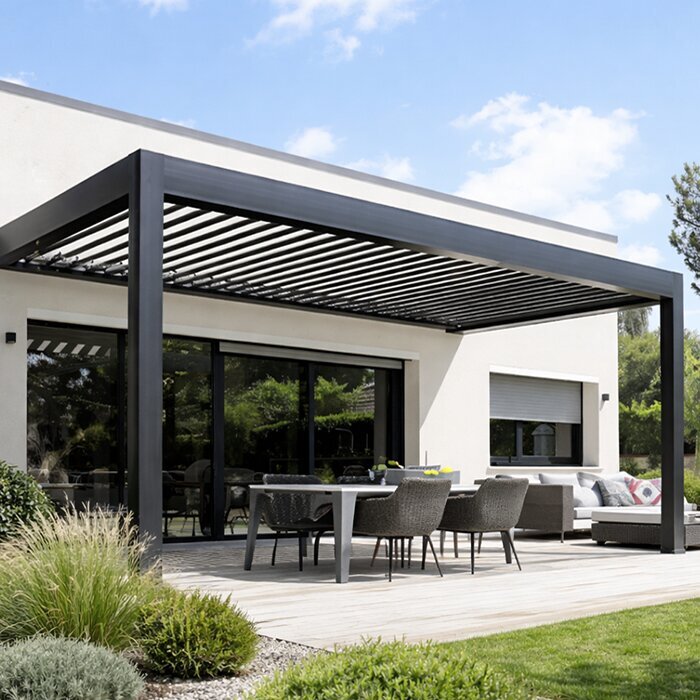
Check whether any enclosure is approved for the exact pergola and whether it changes the operating instructions, drainage path, or winter preparation. Do not assume accessories are included or compatible because they appear together in a picture. When considering Bloomcabin’s lean-to pergola page, ask which side components, if any, match the model and whether they affect the roof’s freeze guidance. Keep snow instructions separate: enclosure details do not establish a snow limit or a safe roof position.
Questions to ask before buying a louvered pergola
Before choosing a model for a cold-weather location, confirm the roof type and how it is operated; not every pergola listing establishes that the roof is louvered or powered. Ask for the operating manual and the model-specific limits for frost, freezing precipitation, and thawing conditions. Check that the document identifies the proposed model, drive, and controls, and ask which revision will apply to your purchase. Where the instructions refer to a separate accessory or control manual, request that document too. Find out what to do if the roof is already stuck, which release methods are permitted, and what conditions must be met before restarting. Request a drainage diagram and separate guidance for snow and ice accumulation rather than assuming one document covers every winter issue. An omitted frost limit is not evidence of unrestricted winter operation; it is a question to resolve before buying.
Compare the quality and specificity of those answers, not just the appearance of a roof or a general description. Written guidance should match the model and the proposed controls and enclosure configuration. Ask how to identify a fault that needs service, where to find the correct model number, and what maintenance is allowed before cold weather. If a response relies on forcing a mechanism, guessing at a temperature, or using an unapproved de-icer, ask for clarification before operating the roof.
Frequently asked questions
Can I move the louvers if there is only a light frost?
If frost or ice is on a blade, pivot, or other moving contact point, do not operate the roof unless the exact instructions say it is safe. Thin ice can bond surfaces and may be hard to see from below. Cold air alone does not prove the mechanism is frozen, but resistance means stop.
Should the roof be open or closed before a freeze?
There is no position that applies to every pergola. Follow the guidance for your model and configuration; instructions for wind, precipitation, and snow may be different from freeze instructions. Ask the manufacturer which position, if any, is recommended when freezing conditions are expected.
Can I use warm water, salt, or deicer to free a louver?
Do not use them unless the manufacturer specifically approves that method for your roof. Water can freeze again, and chemicals or heat may affect components or finishes. Avoid improvised heaters, tools, and lubricants; use only the stated procedure for the exact model.
What should I do if the motor hums but the roof does not move?
Release the control and do not keep trying or use a manual override to push through the resistance. Note the roof position, any control message, and the conditions, then follow the model-specific troubleshooting instructions or ask a qualified service provider.
How long should I wait before trying again?
There is no reliable universal wait time or air temperature that confirms hidden pivots and joints have thawed. Use the manufacturer’s restart criteria. If the roof still hesitates, stops unevenly, or sounds different after the approved thaw procedure, leave it idle and seek model-specific guidance.
Frozen louvers should not be forced into motion. Visible ice, hesitation, a stall, or an unusual sound means it is time to pause. Keep the correct manual and model details available before winter, and distinguish advance preparation from the response to a roof that is already stuck. Roof movement, drainage, and snow accumulation need separate guidance. Restart only when the manufacturer’s criteria for that exact roof have been met.
