
How to Grow Cut Flowers in a Greenhouse
The Stem Theatre · A protected cutting season
How to Grow Cut Flowers in a Greenhouse
A greenhouse can make bouquets feel less like a brief summer event and more like a composed season: earlier stems, cleaner blooms, deliberate succession, and a calm place to cut and condition every harvest.
The aim is not to fill every square foot with flowers. Direct light, airflow, water, timing and labor toward stems that are long, straight and ready at the right moment.
Overture
Why protected cropping changes the cut-flower equation
A greenhouse gives a home grower practical leverage over timing. You can raise plugs while outdoor beds are still cold, protect tender transplants from a late chill, begin warm-season flowers with a head start, and continue autumn cutting beyond the first light frosts where local conditions allow. Protected production is especially useful when it is treated as a managed environment rather than merely a roof over plants: the more enclosed the space, the more carefully you need to direct heat, humidity and air movement.
For cut flowers, that management becomes visible quality. Rain-free blooms are less likely to be battered or stained. Drip irrigation can maintain root-zone moisture without wetting petals and foliage. Support netting is easier to tension across fixed beds. The distance from plant to bucket is short, so stems can enter water promptly instead of waiting in the sun while you finish a long row outside.
A greenhouse is not one universal climate. Cool-season crops such as snapdragons and stock need a different schedule from zinnias, celosia and basil. Reserve protected space for flowers that benefit from shoulder-season timing, shelter or close harvest handling. Use outdoor beds for sprawling summer volume when the weather is already favorable.
Casting the season
Choose flowers for their role on the stem, not only their color in a seed catalog
A cutting greenhouse is more useful when it holds different floral roles: line flowers for height, focal flowers for presence, airy fillers, foliage and textural forms. Within each role, choose cultivars bred for cutting—tall, productive and sturdy, with meaningful stem length or vase performance in the description. Compact patio types may be lovely, but they usually do not earn valuable protected bed space unless their smaller scale is intentional.
Cool line
Snapdragons
Early focal
Spring bulbs
Summer
Warm annuals
Texture
Foliage
Cool-season line flowers
Start snapdragons and stock early for vertical, fragrant spring material. Give them bright, cool conditions and do not treat them like summer heat lovers. Spikes are usually cut once lower florets have opened while buds remain above.
Scheduled focal flowers
Tulips, ranunculus and anemones are planned crops rather than casual fillers. Buy quality bulbs or corms, follow variety-specific chilling and planting directions, and use them to give the early greenhouse a clear purpose.
Summer repeat performers
Plant zinnias, celosia, cosmos and branching sunflowers only after the greenhouse is reliably warm. Successive sowings stop every plant from reaching peak bloom together. Tall selections need early netting.
Foliage and scent
Use a measured edge of basil, scented geranium, ornamental grasses, mint or perennial material where appropriate. Supporting stems make arrangements look grown rather than purchased and distribute the harvest workload.
For ideas beyond the growing beds, see Bloomcabin’s greenhouse setup and layout guide. It is helpful when deciding how much floor area belongs to propagation, production and a clean harvest station.
Backstage
Start each crop by the material it actually wants
Seeds, plugs, bulbs, corms and tubers use greenhouse space differently. Seed gives you cultivar choice and lets you sow in compact, repeated batches. Plugs buy time and reduce the chance that an important succession is lost to weak germination. Bulbs and corms concentrate value in a short seasonal window. Tubers can deliver abundance, but they need storage, warmth and enough bed depth for mature roots.
01
Seed with a destination in mind
Write the intended transplant date on every tray. Do not sow warm-season annuals so early that they become rootbound while nights remain too cold for their final bed. Zinnia seed germinates warm and grows quickly; it is generally better as a short, well-timed transplant run than as an oversized plant waiting on the bench.
02
Use plugs for precision crops
Plugs are sensible when you need a few dependable stems, have limited propagation room, or want a specialty cultivar that is awkward to start. Inspect incoming plants before they join the crop. Check leaf undersides, look for distortion, and keep questionable arrivals separate until you are confident they are clean.
03
Stage bulbs, corms and tubers separately
Keep varieties labeled from unpacking through harvest. Their temperature and moisture needs differ widely, so use supplier instructions rather than a universal greenhouse regime. The discipline pays off when early stems arrive while annual beds are still being prepared.
Act I · The floor plan
Build a room that lets you grow, cut and leave without crushing the cast
Before filling a greenhouse, mark the route your body will actually take: door to water, water to beds, beds to harvest bucket, bucket to conditioning bench. A beautiful crop becomes tiresome when every cut requires sidestepping pots, lifting netting or moving tools. This is a production logic rather than a required footprint. Scale it to your own structure, leaving generous clearance at doors and roof vents.
Place taller, netted crops where they will not shade lower ones or obstruct airflow. Keep propagation on a bench rather than on the floor. Put a lidded waste container near the exit for spent flowers, trimmings and diseased leaves. It is a small operational choice with an outsized effect on hygiene.
For a refined foundation for this work, the Classic Aluminum Greenhouse gives serious home gardeners an architectural setting for beds, benches, ventilation and a longer cutting season. Treat roof vents, shelving and automatic ventilation as production tools, not afterthoughts.
Greenhouse stage planAdapt to your footprint
Low bed
Main aisle
Tall bed
Bench
Air lane
Bucket edge
Crop-height zoning: give tall, netted flowers a dedicated side so they do not shade low spring crops or block your route to the door.
Vent and water access: keep the main aisle clear, position water close to beds, and avoid turning the vent corridor into tool storage.
Harvest movement: maintain a direct, unobstructed journey from a cut stem to a clean bucket in shade.
Act II · Repertory
Use succession as the hand that keeps the curtain moving
Most disappointing cutting gardens fail on timing, not enthusiasm. One sowing of every annual creates a brief parade of abundance and then a long silence. A protected space lets you stage the next crop while the current one is still cutting. Actual dates depend on your USDA hardiness zone, local light levels and whether the structure is heated, but the pattern is universal: overlap propagation, planting, flowering and clearing.
Reading the runs
Wine marks cool-season or early production. Peacock marks warm-season flowers. Brass signals a second run or turnaround. Keep a paper log beside the greenhouse with actual sowing, transplant and first-cut dates; next year’s plan will be more useful than a generic chart.
CropFebMarAprMayJunJulAugSep
For warm-season annuals, a combination of starts and carefully timed sowings gives the greenhouse a longer, calmer rhythm. Remove exhausted plants decisively so the next run receives light and air rather than inheriting a tired canopy.
Act III · The training atelier
Pinch for more stems. Disbud for one better bloom. Net early enough that nobody notices it.
Training is where a cutting plant stops behaving like an ornamental border plant and begins acting like a stem producer. Pinching removes the main growing tip of suitable branching crops, redirecting growth into side shoots. You gain more usable stems but usually delay first flowers slightly. Disbudding does the opposite: it removes side buds on crops grown for one larger, cleaner focal bloom.
Neither practice belongs everywhere. Read each seed packet or supplier sheet as a production instruction. Branching sunflowers should be pinched only when the variety is actually branching; single-stem types are grown differently. Young zinnias often respond well to a timely pinch, while tall selections of many crops benefit from horizontal support netting installed at planting and raised as stems grow.
- Pinch once, cleanly. Use clean snips or fingers on vigorous, suitable plants. Do not keep cutting a crop that needs time to establish its framework.
- Choose the product. Multiple branches suit abundant garden bouquets; disbudded stems suit a smaller number of premium focal flowers.
- Netting is preventive architecture. Install it while stems are short. Threading mesh through a mature stand damages foliage and costs time during harvest.
Leader
Pinched
Untouched leader: one dominant growing point gives earlier, simpler flower production.
Correctly pinched: side branches create a broader and more productive cutting framework.
Dark interval · The environment
Most greenhouse flower problems begin as a climate conversation you missed yesterday
Cut flowers need enough density to make useful stems, but not so much that wet leaves, stagnant air and weak light create a disease-prone canopy. The corrective sequence is deliberately unglamorous: inspect, vent, water at the root zone, remove failing material and review spacing. Do that before reaching for a spray.
Daily airflow check
Roof vents↑Dry canopy
Door intake→Clear aisle
Drip line↓Root zone
Open vents early enough to release heat before the canopy becomes stressed. Water deeply enough for the root zone, then let foliage dry quickly. A consistently usable aisle is part of airflow management, because a greenhouse crowded with supplies cannot be scouted or vented effectively.
The cut call
Every flower has its own entrance cue
Harvest stage is one of the largest determinants of vase life. A stem cut too early may never open. One cut too late has already spent much of its display life on the plant. Learn the correct stage crop by crop, then cut into clean water without delay.
Spike
Lower floretsFocal
Soft color budDaisylike
Open and firmSpray
Several openSpike flowers
Snapdragons and similar spikes are generally cut when the lower portion has begun to open, leaving unopened buds above to continue their display in the vase.
Single focal blooms
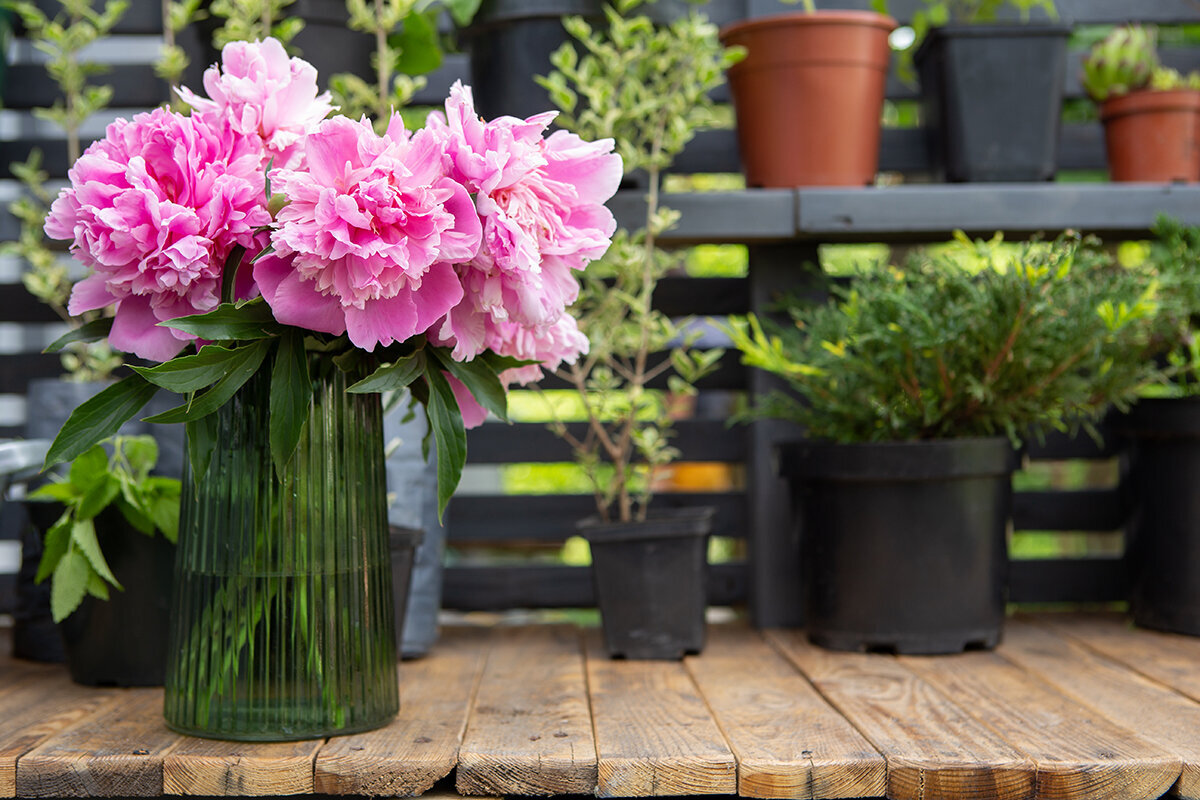
Peonies and some other focal flowers are cut at a yielding, color-showing bud stage. The exact cue varies by cultivar, so test several stems and record results.
Daisylike flowers
Zinnias and dahlias generally need to be properly open before cutting. A mature, firm bloom is less likely to collapse than an immature flower that cannot complete opening.
Sprays and fillers
For spray flowers, wait until enough of the branch is visibly alive in color and texture. Very tight sprays can remain static after they enter the vase.
Harvest in the cool morning once foliage has dried, or in another cool part of the day when stems are well hydrated. Use sharp, clean bypass pruners, cut stems longer than the final arrangement needs, and put them directly into clean water. Remove foliage that would sit below the waterline; this simple step helps keep bucket water cleaner.
Workroom
Conditioning is the quiet luxury behind a long-lived bouquet
Growing the stem is only part of the job. Post-harvest care protects the water balance you worked all season to create. Treat the conditioning bench as a separate clean zone: no potting mix, no used trays, no old water and no pile of fading leaves.
01
Clean bucket02
Fresh cut03
Strip foliage04
Hydrate and cool05
Store by cropClean bucket: wash containers between uses. Bacteria build quickly in dirty buckets and interfere with water uptake.
Fresh cut: recut stems if they have sat dry. Sharp tools slice tissues rather than crushing them.
Strip foliage: remove leaves that would be submerged, while retaining enough healthy foliage for a natural-looking stem.
Hydrate and cool: move stems out of sun and heat. Give them clean water and a shaded place to drink before arranging.
Store by crop: use special treatments where appropriate, keep ethylene-sensitive flowers away from ripening fruit, and change vase water regularly.
Do not turn home conditioning into chemistry theater. Start with hygiene, correct harvest maturity and prompt hydration; these fundamentals do more than improvised additives. Some flowers have particular needs, so keep notes by crop. Daffodil sap, for example, can affect other flowers in a mixed arrangement, while woody stems and latex-bearing species may need their own handling protocol.
For more ideas on equipping a workmanlike but beautiful growing space, visit the Bloomcabin USA greenhouse journal and consider how shelving, irrigation, shading and ventilation can support the way you actually harvest.
Programme notes
Frequently asked questions
Greenhouse cut flowers become manageable when every decision is tied to crop behavior: seasonal preference, mature size, support requirement and harvest stage.
What are the easiest cut flowers to start in a greenhouse?
For a first protected cutting season, use a small group with distinct roles: snapdragons or stock for cool-season line; zinnias and celosia for warm-season color and form; branching sunflowers for focal flowers; and basil or foliage plants for texture. Start with cultivars explicitly described as cut flowers, then expand after you have one season of records.
Can I grow cut flowers year-round in an unheated greenhouse?
Not reliably in every US climate. An unheated greenhouse can extend spring and fall production, but winter flowering depends on outdoor temperatures, available light, insulation and crop selection. Treat it as a season extender unless you have the equipment and crop plan for heated winter production.
How often should I succession sow flowers?
It depends on the crop, day length and your desired finish date. Many home growers sow warm-season annuals in modest batches every two to three weeks during the suitable planting window. Rather than following a fixed rule, sow the next batch when the previous one is established and you can see where the next bed opening will be.
Should I use raised beds or benches for greenhouse cut flowers?
Use beds for taller, deep-rooted production crops and benches for propagation, smaller containers and clean harvest supplies. The most useful greenhouse often combines both: bed space for bulk stems, a bench for starts, and a dedicated edge for buckets and conditioning.
Why are my greenhouse zinnias getting powdery mildew?
Zinnias are susceptible, and a crowded, humid canopy makes the issue more likely. Improve spacing and airflow, water at soil level rather than over foliage, remove heavily affected leaves, avoid excessive fertilizer, and look for resistant varieties where available. Inspect the root zone before assuming more water is the answer.
Sources and further reading
Notes from the production desk
These university Extension resources informed the crop planning, greenhouse-environment, plant-training and post-harvest recommendations in this guide. Pair general production guidance with cultivar-specific seed or supplier instructions and your own local climate observations.
- Penn State Extension — Cut Flower Production
- University of Minnesota Extension — Where bouquets begin: growing a cutting garden from seed
- University of Minnesota Extension — Adding cut flowers to your fruit and vegetable farm
- Utah State University Extension — Basket Flower Cut Flower Production in Utah
- University of Minnesota Extension — Powdery mildew in the flower garden
- Penn State Extension — Bedding Plant Diseases
- Illinois Extension — Bright blooms: how to care for flower bouquets
Opening night
Give your cutting season a proper stage.
Plan the beds, make room for the next sowing, install support before stems need it, and keep a clean bucket waiting by the door. The reward is not merely more flowers. It is the steady pleasure of walking into a greenhouse and knowing exactly what will be ready to cut next.
Explore the Classic Aluminum Greenhouse →For thoughtful layouts, ventilation decisions and a greenhouse that can grow with your floral ambitions, explore Bloomcabin’s custom greenhouse design options.
