
LED Strips or Spotlights Under a Pergola?
Pergola lighting guide
LED strips and spotlights both work as ways to light a pergola, but they create different patterns. A strip follows a line; a spotlight sends light from a discrete position into a beam. Neither form guarantees even, comfortable illumination: diffuser, beam spread, aiming, mounting location, surrounding surfaces, and seated sightlines all influence the result. Compare both options against the same plan of the space and the exact fixture positions permitted for the pergola. Then check outdoor suitability, electrical compatibility, and how each fixture can be serviced. The product label alone cannot confirm any of those details.

Buyer checklist 1
How strips and spotlights distribute light
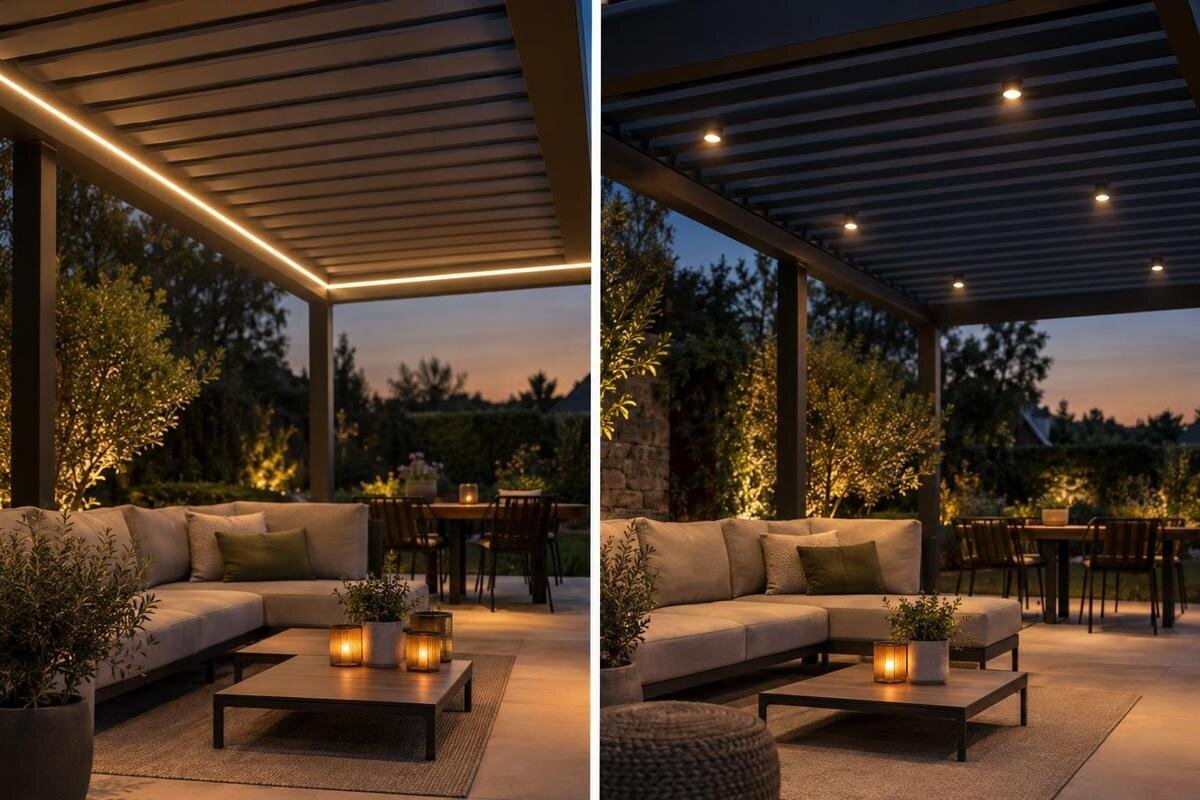
An LED strip is a linear source, so its visible effect follows a run along a supported beam, edge, or other approved position. Depending on its diffuser and the direction it faces, it can read as a bright line, a softer band, or light reflected from a nearby surface. None of those results is guaranteed by the word strip. Exposed individual LEDs may remain distinct, while a cover or concealed location can change the appearance. Output, optical design, mounting angle, and the surface the strip illuminates determine whether it contributes useful light to a table or floor. A long run can create visual continuity, but it can also keep the source in view across a wide range of seats; the path matters as much as its length.
A spotlight sends light through an optic from a discrete point. Its beam can make separate pools; spacing and beam spread determine whether those pools overlap or leave darker areas between them. Aimable and fixed models behave differently, so confirm what the exact fixture allows instead of assuming every spotlight can be redirected. A narrow beam may accent one area and create stronger contrast; a broader beam may cover more surrounding surface but still not light it evenly. Compare optical diagrams, stated output, or a demonstration where available. Beam width and brightness are different properties, so a broad beam should not be treated as a promise of more useful light.
Match the light pattern to the space below
Choose the distribution by marking what needs to be visible below the roof. A long dining table, a route through the seating area, and a small side table pose different layout questions: would a continuous run align with the space, or would particular points be more useful? A strip can be considered where an approved route follows an extended edge or beam. Spotlights can be considered where approved positions and their beams correspond to separate useful areas. These are starting hypotheses, not guarantees; furniture, the roof surface, nearby walls, and nighttime viewing angles can alter the result. Note whether the aim is to see a whole surface clearly or simply avoid a dark patch. If people sit facing different directions, check more than one sightline; a continuous run that works from one seat may interrupt another view. Avoid judging light only from a catalog image.
For a Bloomcabin Pergola, request the supported lighting positions for the selected configuration before comparing coverage. The supplied product information identifies the pergola but does not document a lighting layout. Place the furniture on the configuration drawing, then assess whether a continuous source or separate beams would reach the intended surfaces. If you regularly rearrange the seating, include both layouts: lighting centered over one table position may miss another. Distinguish furniture that stays in place from pieces you move frequently, so the comparison reflects how you actually use the space.
Buyer checklist 2
Use documented mounting positions
Mounting position is a first-order part of the comparison, not a detail to solve after buying lights. Use the pergola manufacturer's current drawing for the exact configuration and identify positions explicitly approved for the proposed fixture. An accessible face or convenient-looking channel does not automatically qualify. Depending on the design, a possible route may be interrupted by a connection, exposed to weather, or affected by a component that moves; only the documented configuration can settle this. Do not assume adhesive, clips, or a general-purpose bracket make an unsupported location acceptable. A fixture's supplied mount may also be approved only for specific surfaces, so check both sets of instructions together.
For the Bloomcabin Bioclimatic Aluminum Pergola, request mounting approval that identifies both the selected configuration and the proposed fixtures. A general statement about the product family is not enough to establish a usable route. Where a roof component moves, ask the manufacturer to confirm that the fixture and its associated components will not interfere with the full intended movement. Keep that confirmation with the configuration drawing and fixture model numbers. If the desired run or spotlight position is unsupported, revise the layout rather than treating a convenient attachment point as an approved one.
Plan around the actual pergola layout
Make the drawing specific enough to reveal what each format needs. A strip requires a continuous or intentionally segmented route the manufacturer permits, with the run, interruptions, and end locations shown. A spotlight plan needs approved fixture points and the direction of each beam, not just circles copied onto a generic roof plan. Add the pergola's exact frame outline, adjacent walls or openings that affect light, and furniture locations. This exposes interruptions, unwanted shadows, and areas that neither option reaches. It also prevents a neat-looking strip line from ending at an unsupported corner or a spotlight beam from meeting an obstruction. A top view alone may not show what people see from seated height, so add the relevant elevation or sightline. Mark where the light is meant to land, not only where a fixture might sit.
For a wall-mounted model such as the Bloomcabin Lean-To Pergola, include the adjacent wall, windows, and door openings in the layout. They help show where reflected light might contribute to the result and where a source could be visible from indoors. Use the exact configuration drawing to locate these features relative to the approved fixture positions. Compare a strip and spotlight layout on the same overhead view and elevation. If lighting a nearby wall is part of the plan, identify the intended illuminated area; do not confuse that target surface with permission to mount a fixture there.

Buyer checklist 3
Compare glare from real viewing positions
Glare depends on whether the bright part of a fixture is visible from where people sit or stand. A long strip may appear as a continuous bright line in a sightline; a spotlight may present a concentrated point or send light toward an occupant. Shielding, diffuser, optics, direction, and mounting position can alter both effects, so neither type is automatically more comfortable. Consider views from seats at both ends of a table, the main standing route, and the approach to the pergola. A fixture that looks discreet from directly underneath may still be conspicuous from an adjacent room or yard. The question is not only how much light reaches a surface, but whether the emitter itself dominates the view.
When reviewing a regular pergola listing, ask for a nighttime demonstration of the proposed fixtures if one is available. Assess the example from comparable viewing positions, noting any differences from your own layout. For a strip, check whether the luminous line crosses the view beyond the table. For a spotlight, check whether the source is exposed or its beam points toward an occupant. Record the troublesome seat or approach on your drawing. This gives the supplier a specific glare concern to address through permitted optics, shielding, or placement rather than simply reducing brightness.
Compare optical information on equal terms
Use the same furniture layout and intended illuminated surfaces when reviewing each option's optical information. A spotlight diagram describes a beam from a particular position; a strip's stated output may describe a length rather than the entire proposed run. Check what each figure represents before comparing numbers. Total light output alone does not show how much light reaches a table, how evenly it arrives, or whether the source is visible. Ask for information about the exact diffuser or optic, not a different version of the fixture. Where coverage remains unclear, request a supplier's layout assessment or a demonstration that reasonably represents the proposed arrangement.
For the bioclimatic aluminum model, assemble a comparison sheet using the approved positions for the selected configuration. Record the strip length or spotlight quantity, optical information, intended illuminated areas, and any gaps that still need assessment. Keep confirmed details separate from estimates. A rendering can illustrate an effect, but it cannot establish mounting approval or measured light levels. If one proposal has detailed optical information and the other has only a photograph, request comparable evidence before choosing. This avoids favoring the better-presented option without knowing whether it provides the more useful light pattern.
Buyer checklist 4
Confirm controls and compatibility
Strips and spotlights may use different drivers, connectors, and controls, even when their appearance suggests they belong to one system. Do not assume a strip can be dimmed, that two spotlights can share one controller, or that fixtures from different kits will work together. Ask for exact model numbers and written compatibility information for every light, driver, power supply, and control. If both fixture types are proposed, confirm whether they can operate together, separately, or only with specific equipment. Compatible controls do not make an unsupported mounting point acceptable, and approved positions do not prove electrical compatibility. Keep these as separate checks.
Control can affect how a pattern feels without changing its physical spread. If evening use calls for different light levels, ask whether the exact system offers compatible dimming and whether the two formats can be adjusted independently. Confirm what is included in the selected option and what must be specified separately; do not infer features from a product photo or a general description of LED lighting. Ask where the control will be located and whether the proposed controls are included in the approved configuration. A qualified electrical professional can assess the system alongside the fixture and pergola instructions. A clear list of part numbers and permitted options helps avoid choosing lights that match visually but cannot be integrated as planned.
Compare replacement access
Replacement access can differ even when two installations look similarly tidy. A strip may be sold in lengths or modules, may or may not be intended to be shortened, and could require access to a driver or connection at one end; these points depend on the exact product. A spotlight may be a replaceable lamp, a serviceable fixture, or an integrated unit, so the word spotlight does not promise simple bulb replacement. Ask what part is replaced if the light fails, whether a single section or fixture can be serviced, and whether reaching it requires removal of nearby covers or other components. Also ask how replacement parts are identified and whether a failed unit means replacing a longer run; availability should not be assumed.
As you review the Bloomcabin Pergola listing, request lighting service instructions for the exact approved kit and mounting position. Confirm who can access connectors and drivers, whether compatible replacement parts are identified, and what must be removed to reach them. These are planning questions, not instructions to open or alter electrical equipment; a qualified professional should handle work that calls for electrical service. A neat installation should remain inspectable and maintainable under the manufacturer's directions, rather than hiding every connection where future access is uncertain. Compare the service path for strip and spotlight options before the frame and furniture make access harder.

Buyer checklist 5
Verify outdoor and electrical suitability
An overhead pergola does not by itself make a fixture weatherproof or establish that its entire lighting system is suitable for the site. Check the outdoor rating and installation conditions for the exact strip or spotlight, along with its driver, connectors, controls, and every other component exposed to weather. Consider how wind-driven rain, splash, condensation, sun, or debris may reach the proposed position; actual exposure varies with design and location. The component with the most visible protection is not necessarily the one that determines system suitability. Ask for documents covering the complete selected assembly and exact mounting location, not a generic product-family statement.
For a Bloomcabin bioclimatic pergola, provide the qualified electrical professional with the configuration drawing and manuals for the complete proposed lighting system. Ask them to review supply, routing, controls, and suitability for the actual exposure, alongside the manufacturer's mounting approval. Make unresolved items explicit: a missing connector rating or unclear driver location deserves an answer before ordering, just as an undocumented fixture position does. Keep the relevant documents together so the review covers one identifiable system rather than a collection of individually described parts.
Choose by the documented light pattern
A strip is a strong candidate when the desired effect is a continuous visual line and the exact pergola has a documented route that accommodates it. Spotlights are a strong candidate when discrete supported positions and verified beams correspond to the places that need light. Either may fall short if its distribution misses the task area, produces an intrusive source, or requires an unsupported mount. A mixed plan can make sense when each fixture solves a distinct distribution problem, but only if the specific products, controls, positions, and outdoor conditions are approved together. For a wall-mounted pergola model, confirm its actual drawings rather than infer suitable positions from the category name.
Before ordering, identify the trade-off that matters most in your layout. A continuous line may suit an extended surface but remain visible from several seats; separate beams may avoid that line while leaving gaps between illuminated areas. Compare those effects alongside the documented replacement method and compatible controls. If both options meet the same requirements, appearance can reasonably decide the choice. If one leaves an important question unanswered, a cleaner catalog image is not a sound reason to prefer it. Choose the supported option whose coverage, comfort, and maintenance requirements you understand.
Frequently asked questions
Do LED strips provide more even light than spotlights?
Not automatically. A strip creates a linear source, but visible LED points, diffuser design, orientation, and gaps in the approved route can affect the result. Spotlights create separate beams; with suitable spacing and spread, those beams may overlap, while other layouts can leave bright pools and darker gaps. Compare the exact optical information against the pergola plan rather than choosing by fixture type alone.
Are spotlights less likely to cause glare than LED strips?
Neither type is inherently glare-free. A strip may sit across a long sightline, while a spotlight can expose a concentrated source or point light toward seated people. Optics and shielding matter, but placement and viewing positions matter too. Check both options from seats, standing areas, and nearby approaches. Dimming, if available and compatible, does not by itself move a visible source out of a sightline.
Can I combine LED strips and spotlights?
Possibly, but do not assume the fixtures can be combined just because both are LEDs. Each needs an approved mounting position, and the exact fixtures, drivers, controls, and electrical supply must be compatible. Ask the pergola and fixture manufacturers to confirm the proposed combination for the selected configuration, then have a qualified electrical professional review it. Without that confirmation, compare the options as separate plans.
Can an LED strip be cut to fit a pergola?
Only if the manufacturer expressly permits it for the exact strip and documents how the system remains serviceable afterward. Products differ, so do not assume a strip can be shortened or reconnected to suit a frame. Altering a product may affect its compatibility or suitability for the location. Confirm the exact product instructions and intended length before selecting a lighting plan.
How can I tell whether a light is suitable for use under a pergola?
Check the outdoor rating and installation conditions for the exact fixture, then check every exposed driver, connector, control, and other component. A pergola roof does not automatically provide a protected environment. Compare the documented conditions with the proposed location, confirm mounting approval for the exact pergola configuration, and have a qualified electrical professional review the complete system.
The useful distinction is the shape of the light: strips trace a line, while spotlights create separate beams. That difference matters only after the permitted positions and exact optics are known. Use the same plan to compare how each option reaches the intended surfaces, appears from seated positions, fits an approved mounting route, and can be serviced. A documented strip or spotlight system is a better choice than an attractive but unverified layout; resolve any unanswered mounting or electrical question before committing.
