
Manual or Motorized Pergola Louvers: Which Fits Your Routine?
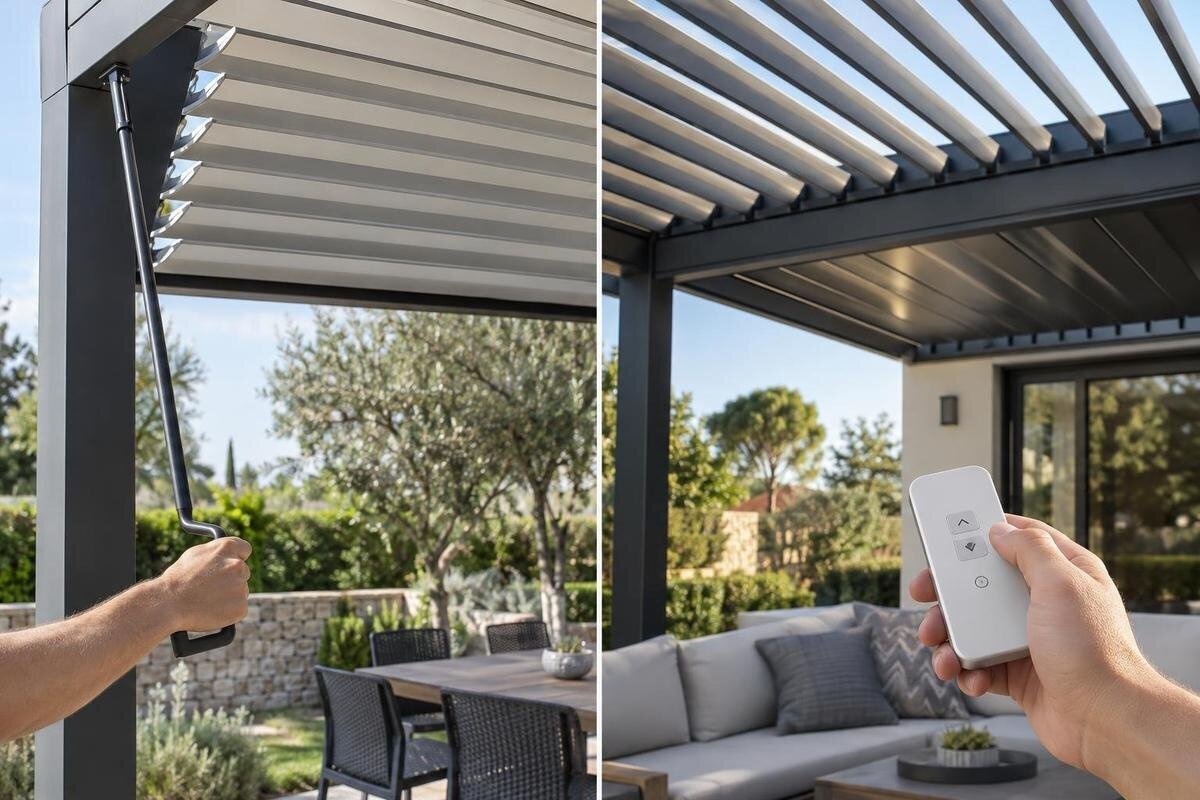
PERGOLA ROOF CONTROLS
Adjustable pergola louvers let you change the amount of sun and airflow passing through the roof. With manual operation, you move the mechanism yourself; with motorized operation, a powered mechanism does that work. The better fit depends on how often you adjust the roof, where the control sits, who will use it, and whether the specified power and service arrangements make sense for your project. A product label or photograph cannot answer those questions. Treat operation as a separate choice from the pergola's overall style, and compare the exact mechanism and documentation for the configuration you are considering.

How often will you adjust the louvers?
Start with an ordinary week, not the most elaborate version of outdoor living you can imagine. Do you set a preferred louver angle when you sit down and leave it there, or expect to make several changes as the sun shifts, meals begin, or the patio changes from a work area to a gathering place? Note the moments when you would genuinely adjust the roof. That quick routine check tells you whether operation will be an occasional task or a repeated part of the day. Include a busy weekend as well as a weekday, but do not let a rare party dictate the control you will use every day.
Manual control can suit a roof you change infrequently, provided the control is easy to reach. Motorization may reduce the effort involved when you expect to make adjustments throughout the day. Count the adjustments you would actually make, rather than treating every hour outdoors as a reason to move the louvers. When considering the Bloomcabin Bioclimatic Aluminum Pergola, use that pattern to ask which operating configurations are available for the precise model and size. The supplied listing establishes product identity, but does not document its control mechanism. This comparison therefore explains how to evaluate the options, rather than confirming that either is offered for that model.
Can everyone reach the control comfortably?
Reach is about more than whether a handle looks close in a drawing. Consider where you would ordinarily operate it: beside the patio door, near the dining area, or along the route you already walk. Account for chairs, planters, screens, and posts that could block the approach once the space is furnished. A control that is technically reachable but requires moving furniture, stretching over a table, or crossing the whole patio may discourage adjustments. If the handle height, crank position, or line of travel is not documented, ask for a drawing or have the installer confirm the location before the layout is finalized.
Check the space needed to operate the control, not just the space needed to reach it. A crank may require clearance for your hand and its turning motion, while a fixed switch needs an unobstructed approach. When considering the Bloomcabin Lean-To Pergola, include the patio door, nearby windows, and the proposed control location on the same layout drawing. Ask the installer to confirm that these features will not interfere with normal operation. For a powered configuration, establish where its supported interface can be used; a wall switch and a handheld control solve different access problems. Do not count on a remote or app unless the exact configuration specifies one.
Using a manual louver control
Manual describes who supplies the movement, not one universal mechanism. A model may use a crank, lever, or another linked control; the method determines how many motions are needed, where the handle must be held, and whether it is practical to set a particular position. Check the operating instructions or mechanism diagram for the permitted sequence, range, and stopping points. If a demonstration is available, try the adjustment from the normal standing position and see whether the control feels manageable without leaning or twisting. Try it with the intended furniture in place where possible; a clear showroom demonstration may not reveal the access route at home.
Manual operation avoids relying on a motor's specified power source and controller, but it still requires a suitable mechanism and a manageable amount of effort. Ask how you stop at an intermediate position and how you recognize the end of the permitted travel. If a handle is removable, find out how it attaches and where it should be stored so it remains available when needed. For the Bloomcabin Pergola, request documentation of any available manual configuration before comparing these details. A demonstration should show the complete adjustment, not just a few easy turns, so you can judge whether the movement suits the people who will use it.
What motorization changes—and what it does not
Motorization changes how the louvers move, not what you need the roof to do. A powered mechanism can reduce the physical effort of adjustment, but the controller remains part of the experience. Depending on the documented system, the user may operate a switch or another compatible control; do not assume a phone app, remote, voice control, or one-touch preset is included. Ask whether the control moves all louvers together or separates them into zones, how a normal command is made, and whether a separate accessory is required. Those details affect convenience more than the word motorized by itself.
Also distinguish a motor from automation. A roof does not necessarily respond to sunlight, rain, or wind just because it has powered movement; sensors, schedules, and automatic adjustments are separate features that need explicit model support. When reviewing the bioclimatic aluminum pergola product listing, request the control diagram and included-components list for any powered configuration being offered. Establish which actions require a user command and which, if any, happen automatically. If automation is documented, ask how manual commands interact with it and how users can tell which mode is active. A convenient interface should make the roof's behavior understandable, rather than leave you guessing why it moved.

Plan for the power source and outages
A powered option needs the power source specified for that exact model. Do not assume it plugs into a standard outlet, uses a particular voltage, or includes a battery; those details depend on the system. Ask for written requirements early enough to coordinate the pergola with the patio project, especially before finishes or furnishings make the intended connection harder to discuss. Have a qualified electrical professional and the installer confirm the planned connection and compatibility where electrical work is involved. If that work affects other trades, clarify who is coordinating it rather than leaving the question until assembly. This is a planning matter, not a reason to improvise wiring.
Ask what happens during an outage or control failure. Does the roof stay where it is, is an approved manual override available, or is there another documented fallback? The answer is product-specific, so do not assume a motorized louver system can be moved by hand. If an outage would make the roof unusable at an important time, that limitation may outweigh the convenience of a button. Check the manual for any approved response and instructions for restoring operation; a general description should not replace guidance for the exact model.
Match the control to your patio routine
Your adjustment pattern may follow how you use the patio as much as the sun. A roof kept in one position during a quick morning coffee has a different routine from one adjusted for lunch, reading, entertaining, or a work call. Describe those activities and when they happen, then ask whether the model's documented range can provide the positions you want. Do not assume all louver roofs have the same range or that a control changes the light in a predictable way in every layout; house overhangs, trees, and pergola orientation affect what reaches the seating area. The choice of control cannot compensate for a roof that does not meet your shade needs.
Your routine also needs to account for times when adjustment may be restricted by the manufacturer's instructions. Ask whether wind, freezing conditions, accumulated debris, or other circumstances affect permitted operation, and what you should do before leaving the patio unattended. These are questions for the specific system, not universal rules about louvered roofs. Use the regular Bloomcabin pergola listing to identify the model for your inquiry, then request its operating limits in writing. If the instructions require checks or a particular roof position, consider whether someone in the household can reliably follow them. Neither a convenient crank nor a powered control removes the need to use the roof within its documented limits.
Consider everyone who will use the roof
A shared patio changes what convenient means. Think about the people who will use the controls regularly, not only the buyer who reads the manual. Is the mechanism clear enough for a guest to understand after a brief explanation? Can each regular user complete an adjustment comfortably, including starting and stopping the movement? A manual handle may be straightforward for one household and cumbersome for another; a powered control can feel easier, but only if its commands are clear. If users have different preferences, agree who will adjust the louvers and how to communicate the intended setting rather than assuming everyone will operate them the same way.
Look at the control itself as part of the pergola plan. A fixed switch can be simple when everyone passes it, while a removable device, if offered, needs a known place and must remain available. Ask whether the system supports additional user controls before planning for more than one operator; no particular number or type should be assumed. Keep the operating instructions with the project records and explain any model-specific limits to everyone who will use the roof. Clear, consistent use helps avoid mistaken expectations, especially when someone else has changed the louver position.
Compare maintenance and service support
Compare maintenance requirements without assuming manual means maintenance-free or motorized always needs frequent repair. A manual configuration still has moving parts and a control linkage; a powered one can add a motor, controller, or power-related components. What matters is the manufacturer's care schedule, parts information, and service instructions for that product. Ask what the owner is expected to inspect or clean, whether scheduled service is required, and what signs call for a service visit. Follow the relevant manual rather than applying a generic interval from another pergola, since mechanisms and materials vary.
Support matters when the roof does not move as expected. Find out who handles diagnosis, whether replacement components can be identified from the model number, and what service is available in your area. Read the written warranty and service terms for the exact configuration rather than assuming coverage. When inquiring about Bloomcabin's Lean-To Pergola, ask whether a mechanism issue is handled through the seller, manufacturer, or installer, and who coordinates any separate electrical service. Keep the quote, manual, model details, and service contact together. That record helps you describe the installed configuration accurately and avoids confusion between a structural component, a control accessory, and the mechanism that moves the louvers.

Confirm the configuration in the manual
Read the manual and mechanism diagram for the exact pergola configuration, not just the family name or a promotional photograph. Confirm how the louvers move, which components are included, what control is supplied, whether there are one or more operating zones, what power source is specified, and what the manufacturer says about normal operation and limits. If a product is sold in several sizes or options, confirm that the document applies to the exact one being quoted. Distinguish items supplied with the configuration from accessories that may need to be ordered separately; a photograph rarely shows the whole control package.
Ask the seller to put any promised control option in the written quote or order description and to identify the matching manual or diagram. For the Bloomcabin Bioclimatic Aluminum Pergola product page, confirm the quoted configuration separately from the product-family name. Record the control type, included accessories, installation responsibilities, and any separately priced items so both parties are discussing the same package. If a demonstration shows equipment that differs from the quote, ask which version you would receive. Resolve conflicting descriptions before ordering, and retain the documents with the order confirmation. This makes the comparison traceable and gives you a clear record of the operation you selected.
How to make the final choice
Put the decision into a side-by-side comparison: adjustment frequency, control reach, effort, interface, specified power, outage fallback, and model-specific service. Mark each item as acceptable or unresolved for the manual and motorized configurations rather than giving a point to whichever sounds newer. When comparing the regular Bloomcabin Pergola with other candidates, request an itemized quote for each documented option, including any separate control accessories, installation work, and service commitments. Compare complete configurations, not just headline prices. Treat an unanswered essential question as a reason to wait, rather than assuming both systems will perform the same way.
Choose manual when adjustments are occasional, everyone can comfortably reach and use the mechanism, and its straightforward routine suits you. Consider motorization when frequent adjustment or awkward access makes manual operation burdensome and the supported interface and power plan genuinely solve that problem. If possible, test the actual control or see a demonstration of the exact mechanism, then compare its instructions with your daily routine. The choice should make shade adjustment practical without relying on unconfirmed sensors, controls, or fallback features.
Frequently asked questions
Is a motorized pergola roof always more convenient?
Not necessarily. Motorization can reduce the effort of making adjustments, but convenience also depends on where the control is, how it works, and whether everyone can use it. If you change the louvers rarely and the manual mechanism is easy to reach, a powered control may add little to your routine.
Does a motorized louvered pergola need electricity?
It needs the power source specified for its particular mechanism, but the source and connection method vary by system. Check the written requirements rather than assuming it uses a standard outlet, a battery, or a plug-in setup. Have a qualified professional review any electrical connection that is required.
Can I move motorized louvers manually during a power outage?
Only if the specific system has a documented manual override or approved backup. Check its manual and ask what happens if power is unavailable. Do not assume the louvers can be moved by hand, and do not force a mechanism that is not responding.
Does a bioclimatic pergola come with a motor or weather sensors?
The category name alone does not confirm a motor, sensors, or automation. Verify the control method and included components for the exact model and configuration. Treat sensors, schedules, and automatic adjustments as separate features that require explicit product documentation.
What should I compare before ordering?
Compare how often you expect to adjust the louvers, how easy the control is to reach, and who will use it. For a powered option, also check the specified power source, outage behavior, included controls, and service arrangements. Use the manual and diagram for the exact configuration.
Choose the method that makes ordinary adjustments easy, not the one with the most impressive label. A reachable manual mechanism can suit a roof you adjust occasionally; frequent changes or awkward access can make a supported motorized control worthwhile. Before deciding, make sure you understand how you would operate the exact configuration on a normal day and what you would do if it stopped responding. The right choice is the one your household can use comfortably and consistently.
