
Can an Aluminum Pergola Be Dismantled and Reinstalled?
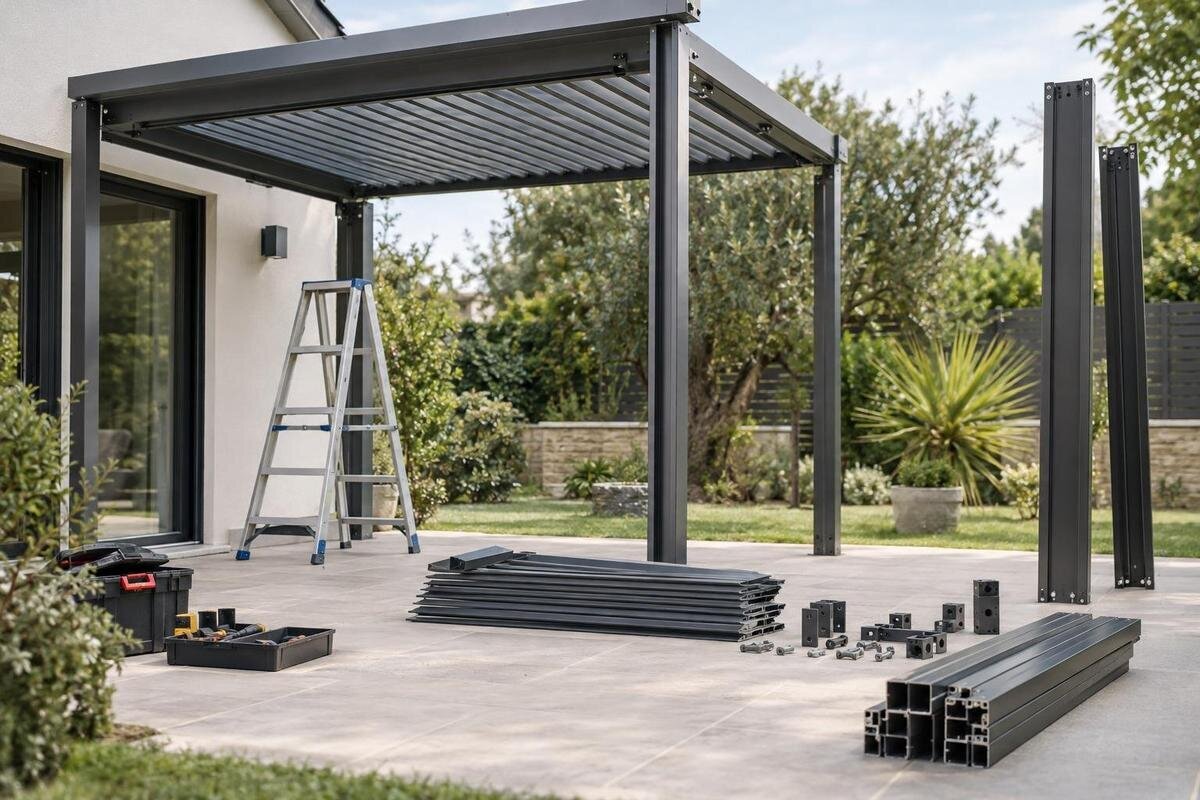
Pergola relocation guide
Moving an aluminum pergola involves more than taking the frame apart. Reuse depends on the exact model, the condition of its connections and fasteners, and whether the new site supports an appropriate installation. Treat the move as a new project: identify the system, document its condition, assess the destination, and involve qualified help where structural support or wiring is involved.

01
Can an aluminum pergola be moved and reinstalled?
An aluminum pergola can sometimes be dismantled and reinstalled, but feasibility depends on the exact system, its condition, the original installation, and the destination. The manufacturer's documentation and any necessary professional assessment must establish whether disassembly and reassembly are appropriate. Being able to undo a connection does not prove that it is intended for repeated assembly. If you are considering moving a Bloomcabin Pergola, identify the installed model before committing to removal. This also matters when buying a used pergola: a seller's description of it as removable is not confirmation that all necessary components are present or reusable. Ask what documentation and installation records will accompany the structure, whether you can inspect it while assembled, and who will assess its suitability for your destination before agreeing to the purchase.
Separate the decision into three questions: can the pergola be taken apart without damage, can its parts be reused, and can it be installed appropriately at the new location? A yes to the first does not answer the other two. Missing drawings, undocumented repairs, cut or drilled members, and connections that are difficult to inspect all add uncertainty. If any of these apply, seek an assessment before removal. Once parts are separated, it may be harder to determine their original position and how they connected.
Identify the exact model before planning removal
Gather the product name, model or configuration details, purchase record, installation paperwork, and any labels that remain on the structure. Photograph the whole pergola and close views of its joints, supports, wall connections, and visible fasteners while it is still assembled. Keep a note of changes made since installation, such as replaced components or added accessories. If the pergola has already been taken apart, photograph the separate pieces and any markings before cleaning, sorting, or discarding anything.
Ask the seller or manufacturer for documentation that matches the exact model and configuration, including assembly instructions, parts diagrams, and guidance on removal or reassembly if available. Similar-looking models do not establish that parts or instructions are interchangeable. If your records identify the Bloomcabin Bioclimatic Aluminum Pergola, include that name in the inquiry along with the order details and photographs. Ask whether the available manual applies to your unit or whether a different version is needed. An accessory may also have separate documentation, so keep those records with the main instructions. Note any discrepancy between the paperwork and the installed structure, such as a different support arrangement or an extra connection. Resolving those differences while the pergola is intact gives the installer a more reliable basis for assessing the move than a collection of unidentified parts.
02
Assess each component, not just the frame
Reuse is a part-by-part decision. An installer or other qualified professional can assess members, brackets, connectors, and any other components against the model-specific instructions. Look for bent or distorted sections, damaged connection points, enlarged or damaged holes, cracks, impact marks, corrosion, and signs of previous modification. A finish that appears intact does not prove that a joint is sound, and a surface mark alone does not tell you whether a component is unusable. Visual checks are useful for documenting condition, not for replacing a competent assessment.
Make an inventory that records each component, its original location if known, its markings, and its condition. Use consistent identifiers in the inventory and photographs so a support team can connect a close-up of damage with the relevant part in the overall assembly. Keep items awaiting inspection separate from those confirmed for reuse; an unmarked or similar-looking part is not necessarily a match. Avoid straightening, cutting, welding, drilling, or enlarging openings unless the manufacturer provides an approved method. When requesting a parts diagram for the regular Bloomcabin Pergola, supply the installed variant and component details. Ask support to identify the correct replacement rather than ordering from appearance alone. Record missing covers, brackets, seals, or other components shown in the applicable parts list, even if they seem minor. Their role needs to be established before deciding that the assembly is complete.
Treat old anchors and fasteners as a separate issue
The frame and its anchoring hardware do not have to share the same reuse decision. Anchors and fasteners are selected for particular connections and supporting materials, so hardware that was suitable at the original location may not suit the new one. Its condition and the way it was installed also matter. Do not assume that an anchor can be extracted and reused, or that a replacement is appropriate simply because it looks similar. Have the manufacturer’s instructions and the new installation reviewed before deciding what hardware to retain.
Record what you can see before removal: attachment locations, the type of supporting surface, and clear photos of accessible fasteners. Keep removed hardware labeled for identification, not as proof that it can go back into service. A new installation may need different approved hardware or a different approach to the supporting surface. For a support inquiry about Bloomcabin Pergola anchoring hardware, include exact model information and photos of the relevant connections. Ask the installer to distinguish fasteners used within the frame from anchors securing it to the site; those groups may require different assessments. The relocation quote should identify who will specify and supply replacement hardware, rather than leaving that decision until reassembly. Also discuss how old attachment points will be addressed after removal, including who will assess and repair the original surface. That work belongs in the relocation plan even though the pergola is leaving.

03
Check whether the new site can support the installation
The new location needs its own review. Identify what the pergola would attach to or stand on, and have a qualified installer or other appropriate professional assess whether that support is suitable. A level-looking patio, pavers, deck, slab, or wall should not be assumed to work for a particular pergola. The condition, construction, and attachment details can differ from the original site. Do not transfer the old anchor plan or make structural calculations from the product’s appearance; ask for an assessment based on the exact system and the actual supporting surface.
Measure the available footprint and note nearby doors, windows, utilities, roof edges, trees, drainage paths, and access routes. Consider whether the new location has different weather exposure and whether there is room for operation and maintenance. Prepare a simple site sketch with dimensions, photographs, and the proposed position of the pergola. Include changes in surface level and places where water currently collects so the reviewer can decide what needs closer inspection. If you own a Bloomcabin bioclimatic pergola, include the exact configuration in this site review rather than relying on the product name alone. Ask whether the original design applies at the destination and what additional information is needed to assess the supports. The sketch is a communication aid, not an installation design. Check with the relevant local office or property association about any approvals that may apply, and establish whether site preparation must be completed before the pergola arrives.
Revisit the layout instead of assuming the old design fits
A move may require a different layout, but that does not mean the frame can be adapted freely. Compare the original footprint, orientation, and support arrangement with the proposed one. A wall-mounted installation and a freestanding installation rely on different arrangements; a used frame should not be converted from one to the other without a design approved for that exact system. For the wall-mounted Bloomcabin Lean-To Pergola, the destination wall therefore needs specific attention during the assessment. Give the reviewer photographs of the proposed attachment area and any available information about its construction. Note features that could obstruct the intended position, including windows, vents, downspouts, and projecting trim. Do not assume that moving the attachment points around those features is an acceptable adjustment. Establish whether the proposed position works with the approved configuration before planning removal.
Check clearances around doors and walkways, access to controls, and the space needed for any moving or adjustable parts that are actually included in your model. If the design directs water to a particular outlet or route, confirm that the new orientation preserves the manufacturer’s intended arrangement. Do not rotate the structure, trim members, or add holes to make it fit without written guidance for the exact product. A drawing or marked site plan can help an installer compare the original and proposed positions before anything is dismantled.
04
Plan removal, labeling, and transport before work begins
Agree in advance who will dismantle the pergola and what instructions they will follow. The installer should establish a safe removal plan for the exact assembly, including how the structure will be supported as connections are released. Do not loosen structural connections or attempt to control a large frame without the right equipment, help, and model-specific guidance. If the instructions do not explain removal, ask the manufacturer or a qualified installer rather than treating the original assembly steps as a complete dismantling plan.
Before transport, document the assembled structure and label parts to preserve their original locations and orientation, using a method agreed with the installer. Keep associated small hardware with the relevant assemblies for identification, and maintain a separate record of missing, damaged, or uncertain pieces. Ask about appropriate packaging and handling for long or delicate components, including protection from impacts, rubbing, and unsuitable stacking. For guidance specific to moving a Bloomcabin Bioclimatic Aluminum Pergola, provide the exact configuration and photographs. Confirm that the transport vehicle, loading access, and destination storage can accommodate the dismantled pieces; a component that fits the installation site may still be awkward to move through a gate or around a corner. If removal and reinstallation happen on different days, assign responsibility for storage and make an inventory at each handoff. Photograph the parts before loading and after arrival to document any change in condition.
Account for motors, wiring, and other accessories
Make a separate inventory of accessories that are actually installed, such as motors, controls, lights, sensors, screens, or other add-ons. Note their labels, model details, connections, and any changes made over time. Do not assume an accessory can be unplugged and reconnected in the same way at the new site, or that it will work with a different configuration. Electrical disconnection, reconnection, and wiring changes should be handled by a qualified electrician or service professional using the instructions for the exact equipment.
Ask whether each accessory, control, and mounting component is compatible with the proposed layout and whether it needs inspection or replacement. Do not open or modify electrical equipment as part of a do-it-yourself move. If your unit is a Bloomcabin Lean-To Pergola with added accessories, identify those accessories separately when requesting help; the pergola's model name does not establish what was installed later. Include records for third-party additions where available. Ask the appropriate service professional which controls and accessory components need to stay together and how they should be documented during removal. Confirm who will handle disconnection, transport preparation, reconnection, and the final functional checks. An installation quote covering only the frame may exclude this work. Keep remote controls, accessory manuals, and identification records with the project inventory so that a missing small item does not become an unresolved problem at reinstallation.

05
Know when to bring in qualified professionals
Professional assessment is especially important when the model or installation history is unclear, components have been modified, connections are damaged, the supporting surface is different, or the new layout changes how the pergola is supported. A qualified pergola installer can assess the assembly and removal plan; a contractor or structural professional may need to review the proposed supports; and an electrician or authorized service professional should handle relevant electrical work. Which expertise is needed depends on the actual installation, not on the frame material alone.
Give the professional the original and proposed site information, product records, photos, and your component inventory. Ask for a written scope identifying which parts are approved for reuse, which need replacement or further inspection, what the new site must provide, and who is responsible for installation and accessories. Separate preliminary observations from decisions that require an on-site inspection or access to concealed connections. If a recommendation depends on an assumption, such as a particular wall construction, establish who will verify it and when. Agree on how newly discovered damage or missing parts will be reported before additional work proceeds. Where several contractors are involved, identify who coordinates their work so that removal, support preparation, and electrical service are scheduled appropriately. Keep the final assessment with the installation records, including any restrictions on reuse or configuration. This gives everyone a shared record rather than relying on verbal assurances.
Compare the full relocation with replacement
Compare the entire relocation project, not just the cost of moving the frame. Include professional removal and assessment, replacement parts, transport, storage, new supports or anchoring work, reassembly, accessory service, repairs at the original site, and any approvals or site preparation that apply. Ask which amounts are confirmed and which depend on later inspection. For a meaningful comparison with replacement, use the same destination, intended layout, and accessory requirements in both quotes; otherwise, you may be comparing different projects. Consider scheduling as well as cost: an unidentified replacement component or unfinished support work can leave dismantled parts in storage. Establish which findings would trigger a pause or a revised quote before removal begins. A reusable frame may still be worth moving, but the decision should reflect the complete work needed to return it to service, not just the apparent value of the existing structure.
A practical decision is to proceed only when the product is identified, the relevant documents are available, the parts and hardware have been assessed, and the new installation has a suitable plan. Pause if essential information is missing; decide on replacement if the system cannot be safely matched to its instructions or the destination cannot support an approved configuration. Keep photos, reports, and parts records together either way. They will also help if you later need to ask about compatible components or explain why the existing structure was not reused.
Frequently asked questions
Can every aluminum pergola be dismantled and reinstalled?
No. Feasibility depends on the exact product, its connections and condition, the original installation, and the proposed new site. Check the manufacturer's instructions and have uncertain or altered assemblies assessed before removal.
Can I reuse the pergola’s old anchors?
Do not assume so. Anchors and fasteners need to suit the particular connection and supporting material, and their condition must be assessed. Reuse them only if the manufacturer and qualified installer approve them for the exact new installation.
Can I change a wall-mounted pergola into a freestanding one?
Not without an approved design for that exact model. Wall-mounted and freestanding installations rely on different support arrangements. Ask the manufacturer or a qualified professional whether a new configuration is supported rather than adapting the frame yourself.
What if I cannot find the assembly manual?
Look for the order record, product label, and any installation or repair paperwork, then contact the seller or manufacturer with the model details and clear photos. If the system still cannot be identified, arrange a professional assessment before dismantling it.
What information helps with a relocation assessment?
Provide the exact product and model details, original installation records, photos of the whole frame and its connections, a list of alterations or repairs, and information about the new site and supporting surface. Include details of any electrical or other accessories.
A pergola is a realistic candidate for relocation only when its identity, condition, and new installation can all be verified. The safest decision comes from checking the exact documentation, assessing parts and old fixings separately, and reviewing the destination before removal. If any of those pieces of information are missing, pause the move until the uncertainty is resolved rather than relying on appearance or a similar-looking model.
