
Pergola Insect Protection: Screens, Curtains, and Their Limits
Pergola planning
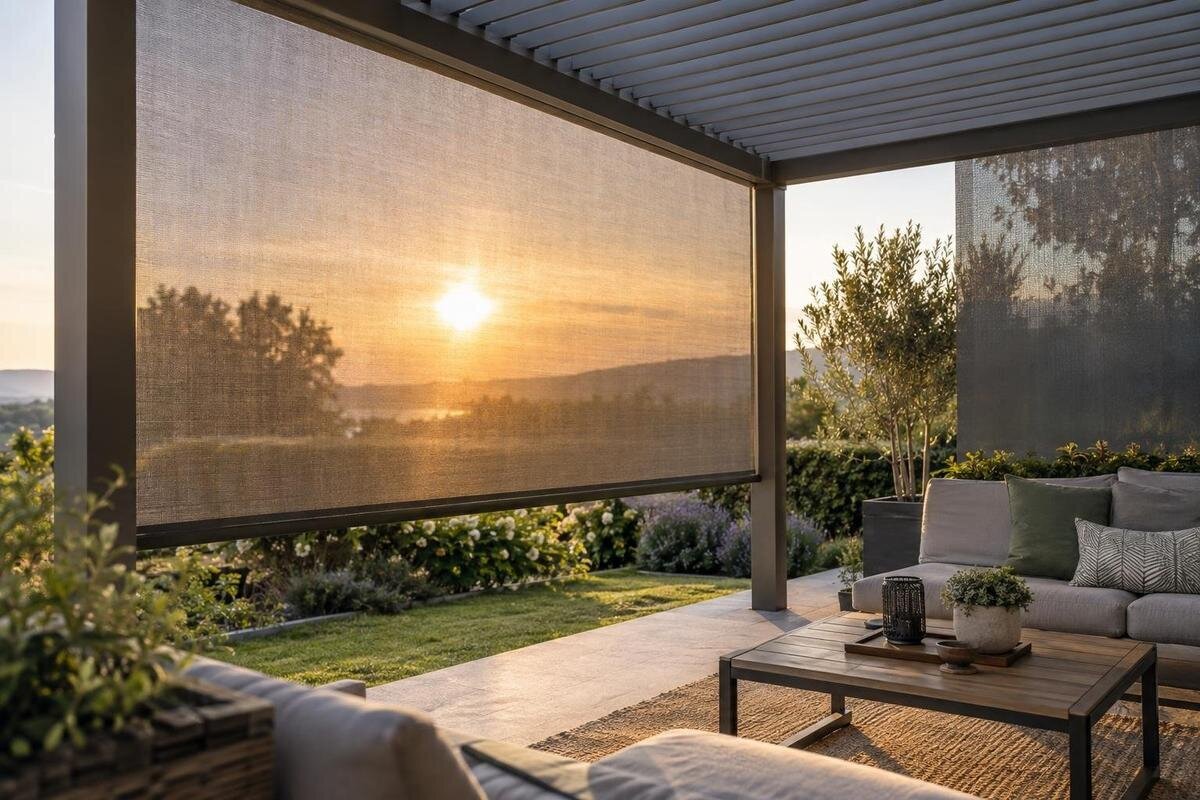
Pergola insect protection depends on more than a curtain across one side. Mesh type, edge fit, the roof transition, and the way people enter all affect how much access remains. A purpose-made screen can reduce access for many flying insects while retaining a view and some airflow, but an open pergola does not become a sealed room. Ordinary outdoor curtains are mainly for shade or privacy and often leave openings around their edges. The practical goal is to reduce insect entry around the seating area, identify the gaps that remain, and choose a setup you will close and use consistently.

What insect protection can a pergola screen provide?
Treat a pergola screen as a way to reduce access, not as a promise that insects will stay out. A screen on one side blocks a direct route through that opening, but insects can still move around it through other open sides or gaps at the roof perimeter. Even a well-fitted mesh barrier is interrupted each time someone enters, and insects may already be inside before the panel is closed. The useful question is not whether the pergola becomes sealed, but how much of the boundary around the seating area can actually be closed during use. A partial barrier may be worthwhile, but its effect is less predictable than that of a continuous screened enclosure.
Different insects and site conditions change what counts as a practical barrier. Larger flying insects may be easier to exclude than very small ones, and finer mesh may trade openness for a tighter barrier. The result depends on mesh and fit, so do not assume the word ‘fine’ means a complete seal. A breezy terrace, a sheltered patio, and a seating area beside dense planting present different challenges. Set the goal as reducing nuisance where people sit, then decide how much of the perimeter you can reasonably cover and how you will handle openings that remain.
Mesh screens and outdoor curtains serve different purposes
An insect screen is mesh intended to form a physical barrier while allowing some air and light through. Its usefulness depends on the mesh openings, the condition of the material, and how its edges are secured; a loose edge or tear can undermine otherwise suitable fabric. Ask what insect size or type the proposed screen is intended to address rather than relying on a label such as “screen” or “mesh.” Those words can also describe materials selected for shade or privacy. If you are considering the Bloomcabin Lean-To Pergola, compare any proposed screening separately from the pergola itself: the supplied product information does not establish an included insect-screen system.
An outdoor curtain is usually chosen for privacy, softness, or some reduction in direct sun, not for a close insect seal. Fabric may be opaque or loosely woven; a panel can shift in a breeze, overlap unevenly, or leave a gap beside a post or below the hem. Some products called curtains are mesh, so judge the actual fabric and closure rather than the category name. If insect reduction is the priority, ask whether the panel is insect-screen mesh and how the top, sides, bottom, and entry are meant to close. A curtain can suit a mixed goal, but should not be counted as a complete barrier just because it spans one side.
Where gaps remain around a screen
Trace the perimeter at eye level and around the roof line. Common weak points include the junction between a screen and a post, a gap under its lower edge, an unclosed corner, and the transition where a wall-mounted structure meets the house. A gap between the panel and the underside or edge of the roof can create another route in. A panel may look continuous from the patio yet leave openings where two sections meet. Sketch the sides you expect to cover and mark each seam, end, and change of surface; this helps expose missing connections before you buy. If a panel rolls, slides, or gathers, check its closed position as well as where it sits when open.
Look at the space during normal use, not only when every panel is closed. A chair or planter can block a panel’s travel, while a step or uneven patio surface can leave a gap below it. These are layout issues as much as fabric issues. When evaluating the Bloomcabin Pergola, request details of the lower edge and corner connections for any proposed screen system. An overall product photo may not show these junctions clearly. Record changes in patio level and obstacles along each opening so the supplier can assess the actual fit. If an opening cannot be closed with a compatible panel, mark it as a remaining access route rather than describing the whole perimeter as screened.
Plan the entry before screening the sides
Every usable screened space needs an entry, and the opening used most often can become a repeated route for insects. Consider who passes through, whether people carry dishes, and whether children or pets may leave a panel open. A flap, overlapping opening, or screen door may be possible in some systems, but options vary; do not assume a particular arrangement comes with a pergola or can be added. Decide where an entrance can work without colliding with seating, steps, or the main path. If people arrive from both the house and yard, consider which route they naturally use so the entry does not cut across the table. A closure people will actually use after each passage matters more than one that is awkward in daily use.
Pay attention to how a door or overlap meets the rest of the barrier. An entrance that closes at the top but leaves a broad side or bottom gap is still an opening; one that is awkward to operate may simply remain open. If you are considering the lean-to pergola listing, include the house door and its swing in your entry sketch. A household doorway and a screen entrance should not interfere with each other or require someone carrying a tray to squeeze between them. Check the proposed closure with furniture in its usual place, and ask how the entrance connects to adjacent panels without leaving an unprotected passage.
Confirm compatibility with the pergola model
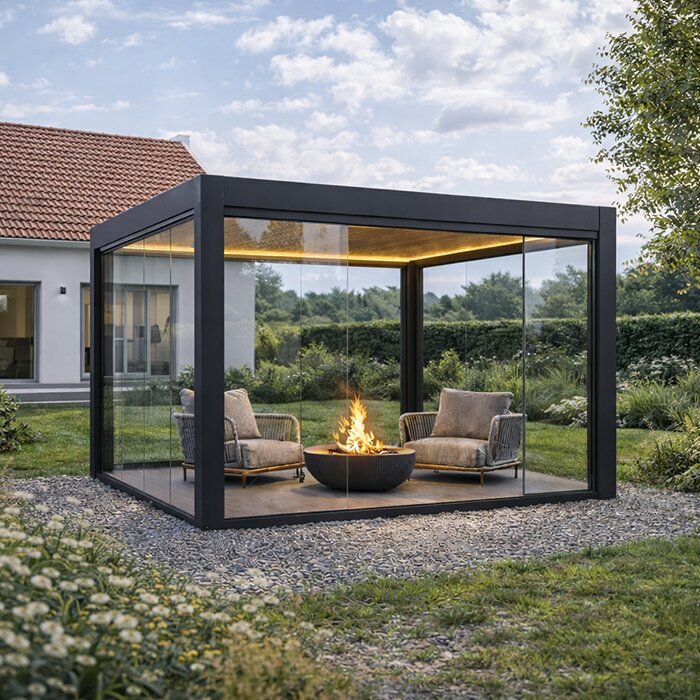
Before buying a screen separately, confirm how it attaches to the exact pergola model. A frame, track, fastener, or bracket changes clearances and may affect whether an accessory is approved; an accessory can be incompatible even if its advertised width looks right. Ask the seller to identify the approved panel or attachment, whether it is fixed or movable, and how its edges are intended to meet the posts and roof. If you plan to use a third-party product, ask who can confirm the interface and any effect on the structure. Do not drill, clamp, or alter a frame based on appearance alone; have installation questions assessed by the manufacturer or a qualified professional.
Use the precise model name and configuration when asking. For the Bloomcabin Bioclimatic Aluminum Pergola, request written confirmation identifying the proposed accessory and the sides on which it can be used. The supplied product information does not verify insect-screen compatibility. Useful documentation should distinguish the pergola, the screening material, the attachment components, and any separate entry closure, so you can see what the proposal actually includes. It should also identify who supplies and installs each part. If compatibility remains unclear, resolve that question before purchasing the accessory; matching a nominal opening width is not enough to establish a suitable connection.
Balance screening with airflow and visibility
Mesh reduces wind and visual openness to some degree, but the effect depends on the material and how much of the perimeter is covered. More screening can make the area feel enclosed; closing opposing sides can also limit a cross-breeze. Before covering several sides, compare a single-sided panel with a two-sided layout at the times you use the space. Privacy curtains and insect mesh are not interchangeable: opaque fabric changes sightlines and light differently from open mesh. Aim to address the most troublesome approach path while leaving practical open sides where insect exposure allows. If possible, inspect the actual material in daylight rather than choosing from a catalog photo, since weave and color affect how open it looks.
Sketch the view from each seat and mark the openings you expect to leave available for air movement or passage. This does not predict comfort or eliminate insects; it helps reveal the trade-off between a more continuous barrier and an open seating area. If the regular pergola listing is on your shortlist, use its proposed layout to compare where screened and unscreened openings would sit relative to the table. Request a sample of the proposed mesh when available, and view it against both a bright background and nearby planting. Compare visibility while seated as well as standing, because a material that looks unobtrusive from outside may be more noticeable from the chairs.
Check care, movement, and seasonal storage
Any screen or curtain is exposed to outdoor dust, pollen, moisture, sunlight, and repeated movement; upkeep depends on the specific fabric, hardware, and local exposure. Before choosing, ask how it is cleaned, whether it should be retracted or removed in particular conditions, and which parts need periodic inspection. Follow the accessory maker’s care and operating instructions rather than assuming a panel can remain in place year-round. For mesh, look for snags, tears, stretched corners, or gaps that appear as material shifts. For curtains, check that hems and overlaps still fall where intended, especially after frequent opening and closing.
Think through daily use as well as storage. A panel that is difficult to raise, gather, or secure may be left open; one that must be removed can be inconvenient during periods of changing weather. If you are comparing an accessory proposal for the bioclimatic pergola model, ask for its operating and storage instructions before deciding. Find out whether panels remain attached when stowed, whether removable pieces need labeled storage, and whether damaged mesh can be replaced separately from its frame. Keep the proposed storage location in mind: wet or dirty material may need cleaning and drying according to its instructions before being packed away.
Reduce attractants around the seating area
Screening addresses routes into the seating area, while habits around the patio affect how attractive it is to insects. Clear food residue after meals, keep drinks covered when practical, and avoid leaving waste open beside the table. Check containers, trays, or other spots where water may collect after rain, and empty or clean them when appropriate. These steps do not replace a screen or eliminate insects from an outdoor setting. Include serving areas in the cleanup routine, not just the dining table: an uncovered dish or sticky spill on a nearby counter can remain after the meal is finished. Keeping lids and waste containers within easy reach makes these habits easier to maintain.
Observe insect activity both before and after a meal rather than assuming every insect inside came through the mesh. Check whether insects were already resting inside before the panels closed, whether an entry remained open during serving, or whether activity is concentrated around a particular opening. Nearby lights, doors, and planting are worth noting as part of that observation, but they do not establish a single cause. Compare evenings with similar use and record which panels were closed; a busy gathering with frequent trips through the entrance is different from a quiet evening with little traffic. These observations can help distinguish a closure problem from the limits of an open layout without promising a particular level of control.
Screen the space people actually use
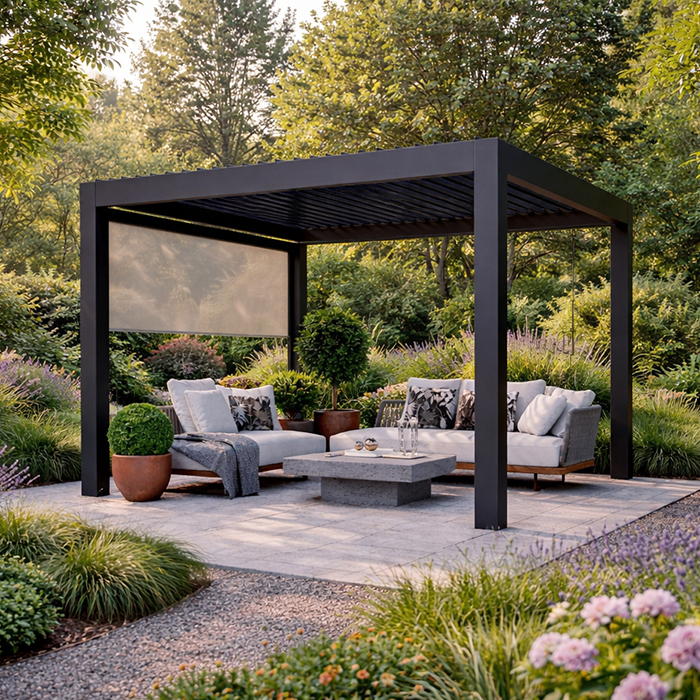
The occupied area includes more than the tabletop or the outline of a sofa. For dining, allow for chairs pulled back, people standing to serve, and the path to a nearby counter. A screen placed too close to the chairs can be bumped or pushed aside whenever someone gets up. For a lounge, account for reclined seats, side tables, and the route between them. Mark these positions on your sketch before locating panels or an entrance. If only part of the pergola will be screened, distinguish a genuinely closed seating zone from a few isolated panels. The latter leave routes around their edges, even when they sit close to where people gather.
Compare layouts with the furniture at its largest normal footprint, including extended tables or additional chairs used for guests. For a proposal based on the Bloomcabin lean-to model, draw the occupied area alongside the house wall, door, and intended screen boundary. Check whether a person can reach every seat without brushing against mesh or moving a curtain out of position. Also leave access to panel controls and any parts that need cleaning or inspection. A layout that works for two people may become awkward during a larger meal; reviewing both arrangements helps you decide whether a smaller screened zone is practical or whether it would interrupt normal patio use.
Set realistic expectations before ordering
Before ordering, describe the result you want in concrete terms: fewer insects reaching the dining table, a screened boundary during evening meals, or a seating corner that can be closed between trips outside. Ask the supplier to show the proposed system in both its open and closed positions, with any unavoidable gaps identified. Compare the complete proposal rather than the fabric alone, including panels, attachment components, operating hardware, and the entry closure. Note which items are included and which require a separate purchase. This makes it easier to spot a quotation that provides side panels but leaves the entrance or another essential connection unresolved.
If the Bloomcabin regular pergola is under consideration, organize the comparison around that exact configuration rather than a generic accessory photo. Evaluate each proposal against your priorities: insect exclusion, privacy, shade, air movement, access, and upkeep. A privacy curtain may meet one goal while leaving the insect problem largely unchanged; a mesh system may offer a more continuous barrier but require more deliberate entry and closure habits. Decide which compromises you would accept before ordering. If the roof or unscreened sides leave substantial openings, judge the purchase as a partial improvement rather than paying for it with the expectation of an insect-proof outdoor room.
Frequently asked questions
Do outdoor curtains keep mosquitoes out?
Not reliably unless the fabric is insect-screen mesh and the top, sides, bottom, and entry are designed to close. Ordinary curtains can move in a breeze and leave gaps. Treat them as a privacy or shade feature unless the supplier confirms their insect-screen function and explains which openings remain.
Can a screen make an open pergola insect-proof?
A screen can reduce insect access, but an open pergola should not be treated as a sealed room. Gaps at the roof, posts, ground, or entry can remain, and people may bring insects in as they pass through. The result depends on the mesh, its fit, and how consistently openings are closed.
Can I add an aftermarket screen to any pergola?
No. An accessory that appears to fit may not be approved for the structure or its configuration. Check compatibility with the manufacturer or a qualified professional before buying or attaching a third-party screen, and ask how its edges are meant to meet the posts and roof.
How many sides should I screen?
There is no universal number. Map the full boundary around the seating area, including the roof, corners, ground, and entrance. Screening one or two sides blocks those openings, but insects can still travel around the panels through unscreened areas. Choose the extent of screening based on the gaps you can close and the airflow and access you want to retain, not on a presumed direction of insect approach.
Will an insect screen block the breeze?
Mesh allows some air through, but the effect depends on the material and how much of the perimeter is covered. Closing more sides can reduce cross-breezes. If possible, look at the actual mesh and compare proposed layouts before choosing a setup.
Treat pergola insect protection as a targeted improvement, not an indoor-style seal. Choose insect-screen mesh when reducing entry is the priority, plan the edges and entrance around how the patio is used, and account for openings that cannot be closed. Curtains can still serve privacy or shade, but they are not a substitute for a fitted screen. A well-planned barrier may make a meal or conversation less exposed without turning an open pergola into an insect-proof room.
