
Should Pergola Louvers Be Open or Closed in Strong Wind?
Pergola wind guide
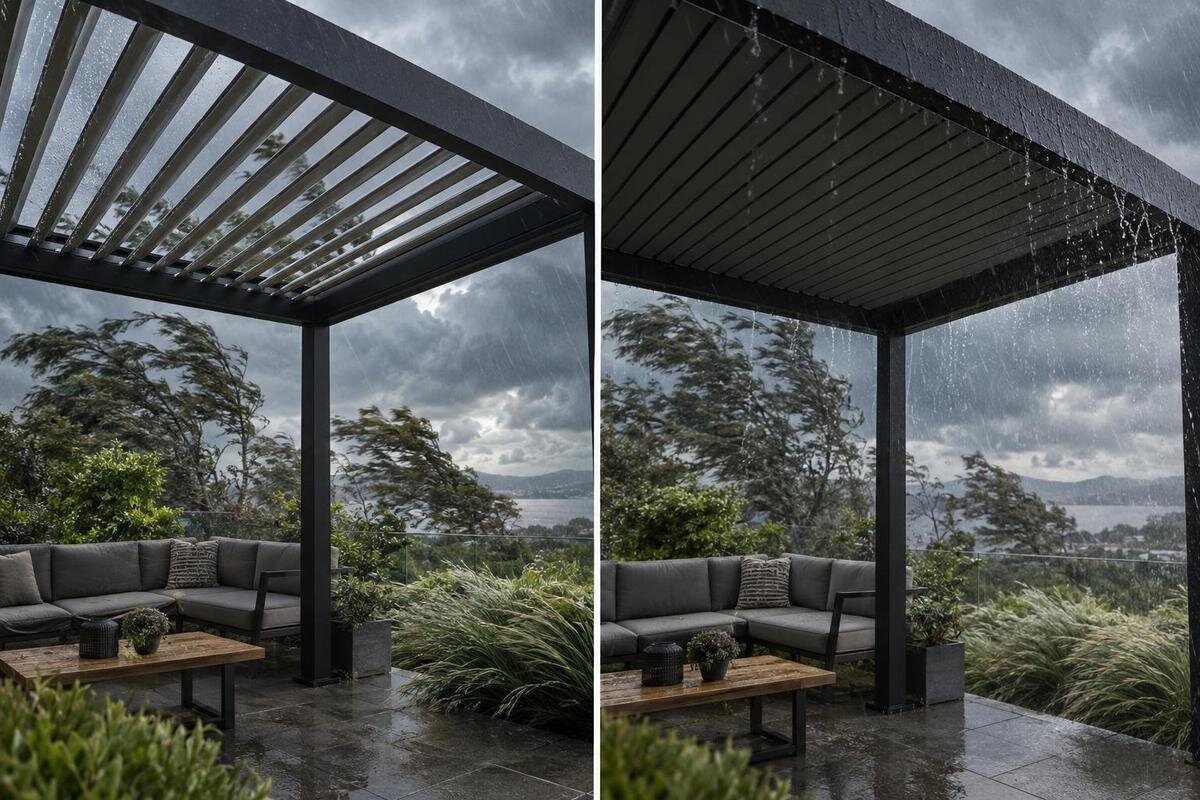
When strong wind is forecast, there is no safe rule that applies to every louvered pergola. An open roof may look as if it will let air pass, and a closed roof may look more secure, but appearances do not identify the position the manufacturer designed for that model. The right answer comes from the exact operating instructions, including any wind limit, required position, and conditions for moving the louvers. Check those instructions against the installed roof and side enclosure; do not borrow advice from a similar-looking pergola. If the documents do not answer the question, get model-specific guidance before relying on a setting.

Before you buy 1
Why there is no universal open-or-closed setting
A louvered roof does not respond to wind like one fixed panel in every position. With the blades open, air may pass through the roof plane, but that alone does not show that the frame, blades, pivots, or drive mechanism experience less force. With the blades closed, the roof presents a more continuous surface, but that does not prove closed is safer. Gusts, wind direction, roof geometry, and nearby surfaces all affect how air moves around a structure. Blades, connections, posts, and any drive components work as part of an assembly. What you feel beneath the canopy is not a reliable measure of forces on that assembly.
The approved position might be fully open, fully closed, or a manufacturer-defined angle or parked state; a halfway setting is not automatically a safe compromise. Instructions may distinguish ordinary adjustment from leaving the roof unattended or preparing for severe weather. They may also limit movement at certain wind speeds, even if the roof can remain in a specified position under different conditions. Check whether the advice covers moving the louvers, holding them in place, or storing the roof in a designated position. If a manual illustrates an angle without explaining its use in wind, treat that as an unanswered question, not a recommendation.
What strong wind means in the instructions
An alert in a weather app and a pergola’s operating limit are not interchangeable. Forecasts may report sustained wind and gusts separately, while product documents may state a maximum speed for operating the mechanism, a wind-resistance value under defined conditions, or an instruction to leave the louvers in a particular position. These terms answer different questions. Check the unit, whether a figure refers to gusts or sustained wind, and any test or measurement conditions stated with it. Do not assume that a number in a specification applies to every roof angle, size, enclosure, or stage of installation. Compare like with like before using a figure to make a decision.
Wind at a particular patio can differ from a regional forecast because buildings, walls, terrain, and open exposures affect local airflow. Direction and short gusts can matter even when an average reading seems moderate. That does not mean you should estimate a safe setting by watching trees or judging how the pergola feels. Use the manual’s definitions and stated limits, and ask how they relate to the forecast measure if the comparison is unclear. If a listed threshold is near or exceeded, follow the manufacturer’s preparation or stop procedure. Do not continue operating the louvers simply to reach a position that seems preferable.
Before you buy 2
Operating limits and structural wind ratings are different
One number in a product sheet can be misleading when its purpose is unclear. A structural wind-resistance statement may describe an assembly under a specified test or design condition. An operating limit concerns whether it is permissible to move the louvers in wind. A required position for an approaching storm may address another condition. None of those statements substitutes for the others, and a test result is not a guarantee for every storm or installation. When reviewing Bloomcabin Pergola, request documents that clearly separate structural performance, permitted roof movement, and preparation for high winds. Keep those categories separate in your comparison notes, even if a sales summary groups them together.
Read the notes that qualify any figure. Verify the product and size covered, the louver position, the installed configuration, and whether the value applies during movement or only when the roof is stationary. Check what wind measure and direction were used and whether the document describes a test, observation, or design limit. If a page uses a general phrase such as wind-resistant without defining a test or safe operating range, do not turn it into a numerical operating rule. Ask the manufacturer to explain in writing which figure governs operation and what action is required before conditions reach it.
Match the instructions to the exact pergola
Start with the actual unit, not a photo or a broad product family. Gather the manufacturer name, complete model name, size or configuration, serial or other identifying number if present, and the manual’s revision. Compare these details with the order paperwork and any label on the installed pergola. Record the roof type and controls, plus attached screens, panels, or other accessories. Two units that look alike in a photo may not share the same actuator, dimensions, or instructions. Visual similarity is not a reliable way to identify a roof’s wind procedure.
When researching the Bloomcabin Pergola listing, save the details of the configuration you intend to order so you can match them to the delivered unit. Locate the owner or operating instructions and installation document supplied for that unit; if they are missing, ask the seller or manufacturer for the applicable versions. Keep those files with the order confirmation and installation records. If a manual covers several models, verify that yours is explicitly included and that no footnote excludes its size, controls, or installed options. If parts or controls have been replaced, ask whether the replacement changes which instructions apply rather than assuming the original manual still covers every function.

Before you buy 3
What to look for in the operating manual
Use the operating manual as a question checklist. Find out whether it states a maximum wind condition for moving the louvers, whether it names a required position before high winds, and whether a separate instruction applies while the roof is unattended. Check whether the manual defines gusts or uses a different measure, and whether the figure is an operating cutoff or a design value. Look for instructions about wind direction, approved angles, and any interlock or warning shown on the control. Record the exact wording and page number rather than summarizing it as simply open or closed; a short note is easier to verify later.
Then check the situations a short instruction may leave out: whether the roof may be moved once wind has started, what to do if power or a control stops responding, and whether attached side panels change the required position. Do not infer an answer from a drawing of the blades or a demonstration video; neither necessarily defines safe use in wind. While reviewing the Bloomcabin Pergola model page, keep a separate list of unanswered operating questions to send with your document request. Mark each answer with its source and date. This makes it easier to distinguish a documented instruction from a question still awaiting clarification.
Read performance data and diagrams in context
Review the operating instructions alongside any technical sheet, model-specific weather-performance document, controlled observation, test report, or installation drawing the manufacturer provides. The goal is to see what was observed or tested, under which setup, and what conclusion the manufacturer actually draws. Note whether the information names a particular louver angle, supports, size, enclosure, or wind condition. A report about one setup should not automatically be applied to a different combination. A controlled observation can describe what happened in a particular situation without establishing an operating limit. Keep the full document and its qualifications rather than relying on a cropped chart or a sentence copied into a sales page.
Drainage diagrams belong in the same document file but answer a separate question. They can show how water is routed through the roof and outlets; they do not, by themselves, establish a wind limit or tell you how to park the louvers. When comparing Bloomcabin Bioclimatic Aluminum Pergola, separate questions about water routing from questions about roof operation. If a rain instruction calls for one position and a wind instruction appears to call for another, ask which procedure applies when both conditions occur together. Do not resolve that conflict by choosing the setting that keeps the patio drier. Record the manufacturer's combined-weather guidance with the relevant pages from both documents.
Before you buy 4
Check the roof and enclosure as one configuration
Think about the entire installed arrangement, not only the slatted roof. A side screen, curtain, sliding panel, glass wall, or other enclosure can change how air moves around the covered space and can affect the combination being evaluated. Whether it increases, reduces, or redirects a particular force is not something to infer from appearance. Record which components are fitted and whether they will be open, closed, retracted, or left in place when wind arrives. A roof instruction for a basic configuration may not cover added sides or accessories, so check whether the guidance describes the assembled setup you actually plan to use.
Ask the manufacturer or installer whether the wind guidance applies to that precise combination and to each permitted position of its sides. Look for a compatibility or configuration document that names both the pergola and the enclosure, rather than relying on a generic limit for one component. For the Bioclimatic Aluminum Pergola listing, include the names of any proposed accessories in your request and ask which combinations the documentation covers. Note any separate preparation steps for the roof and sides, including their required sequence if one is specified. Keep accessory instructions together with the roof manual so that a user does not follow one component's procedure while overlooking another's.
Make a wind plan before gusts arrive
A useful wind plan is made while the weather is calm, not when gusts reach the patio. Write down the manual’s trigger, the prescribed roof position, and any limit on operating the louvers. Decide who will check forecasts and make a change only if the instructions allow movement in the conditions then present. If a controller has a schedule, wind sensor, or remote function, verify from its documentation what it does and whether it controls the roof in the required way; do not assume automation will choose a safe position. Keep the correct manual and control information accessible, and make sure other users know where to find them.
If high winds are already underway and the required setting is unclear, do not hurry outside, climb onto the structure, force a blade, or improvise a manual override. Keep people clear of moving parts and follow the manufacturer's emergency instructions. If there is immediate danger, prioritize moving people to shelter rather than trying to adjust the roof. Once conditions are safe, document what happened, including any control message or interruption, without recreating the fault. When requesting instructions for Bloomcabin’s Bioclimatic Aluminum Pergola, ask for the applicable power-failure and control-failure procedures as well as the normal wind procedure. Add those responses to your plan before the next weather event.

Before you buy 5
Resolve missing or conflicting guidance
If the manual does not say open or closed, contact the manufacturer or seller with the complete model details and installed configuration. Ask for a direct answer in writing: which position is required before high winds, what wind measure and threshold trigger it, whether the roof may still be operated as the threshold approaches, and what to do if power is lost or a control fails. Ask whether guidance changes with attached screens, panels, or a wall-mounted installation. A useful answer should identify the document revision or apply explicitly to your unit, not merely refer to a broad product family.
If two documents appear to disagree, check their dates and scope before choosing one. An installation guide, an operating manual, a sales page, and a third-party demonstration may have different purposes; a verbal answer may not resolve a written limit. Send the manufacturer the conflicting passages with their page numbers and ask which instruction applies to your unit. For Bloomcabin Lean-To Pergola, include the model identification and wall-mounted configuration in that request. Have the installer confirm that the installed assembly matches the configuration described in the response. Keep the dated clarification with both documents, clearly identifying the superseded instruction so other users do not encounter two competing procedures.
Questions to settle before you buy
Before buying, ask for the exact operating manual and wind-related technical information, not just a general claim about durability. Check whether the documents state a louver position for high winds, a limit for operating the mechanism, and the conditions behind any wind-resistance figure. Confirm that they cover the size, supports, controls, and side enclosure you intend to order. If a salesperson cannot tell you which model revision the instructions cover, resolve that gap before comparing numbers or committing to a particular setup. Clear documentation helps you understand what is known and what still needs a site-specific answer.
For a wall-mounted option such as the wall-mounted Bloomcabin Lean-To Pergola, ask an installer or other qualified professional to review the proposed supporting structure, attachment, and exposure where a project-specific assessment is needed. Provide the product's installation documents and identify any planned side enclosure rather than asking for an opinion based only on a photograph. Keep that assessment separate from the operating instructions: one addresses the proposed installation, while the other explains how to use the documented assembly. Before placing the order, make sure you know who will answer each type of question and which documents will be supplied with the completed installation.
Frequently asked questions
Should I open or close pergola louvers during a wind warning?
Follow the operating instructions for your exact model and installed configuration. A weather warning does not tell you which louver position the manufacturer requires. If the manual does not specify a position or operating limit, do not guess from general advice or another pergola’s instructions.
Does opening the louvers reduce wind load?
Not necessarily. Air passing between open louvers does not prove that the whole roof and its connections experience less force. The effect depends on the design and conditions. Use model-specific manufacturer guidance rather than assuming that open is safer.
Is a pergola’s wind rating the same as its operating limit?
Not automatically. A wind-resistance figure may describe a tested or designed condition, while an operating limit concerns moving the louvers in wind. Check what each statement covers, including any required parked position, test conditions, and configuration.
Can I use instructions for a similar pergola?
Use the manual for the exact model and configuration. Similar-looking roofs may have different dimensions, controls, or operating instructions. If you cannot identify the right manual, confirm the model with the seller or manufacturer before relying on a wind setting.
What should I do if the power fails while the louvers are moving?
Follow the model’s power-failure instructions. Do not force the blades or improvise a manual override unless the manufacturer specifically directs you to do so. If the instructions do not cover the situation, keep clear of the mechanism and ask the manufacturer or installer how to proceed.
There is no dependable general rule that pergola louvers should always be open or always be closed in strong wind. Use the exact manual to distinguish the permitted position, the limit for operating the roof, and any structural wind information. Check that the guidance covers the installed enclosure and configuration. When those documents leave a gap, resolve it with model-specific guidance instead of relying on appearance or advice for another pergola.
