
Pergola Privacy at Night: What Changes When Lights Are On?
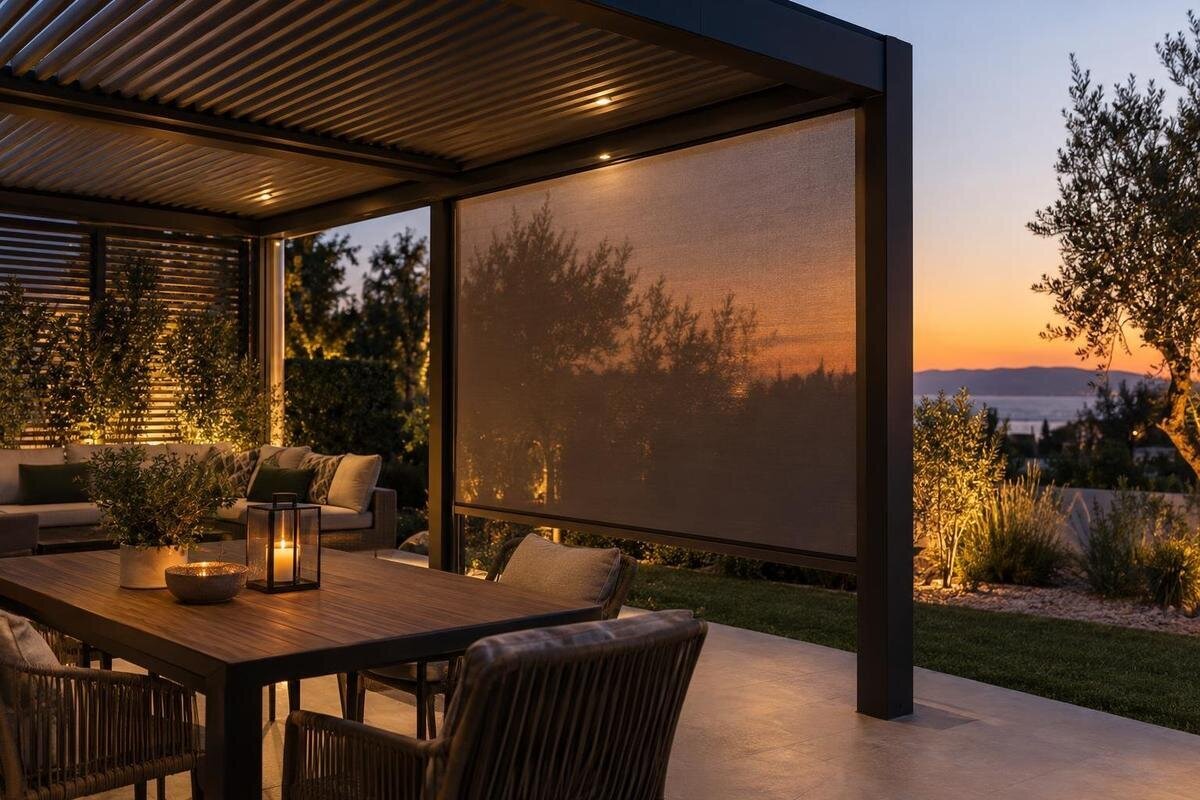
PERGOLA PRIVACY AT NIGHT
Privacy under a pergola can change sharply after sunset. A fabric panel or glass side that seems to screen the seating area in daylight may reveal silhouettes—or more—when the space behind it is brighter than the yard. The reliable way to assess it is to map the views first, then test the actual lighting and side material from both sides.
Why a pergola can feel less private after dark
Daytime privacy is easy to misread. In daylight, the bright sky and yard can reduce the visible contrast through some materials, while foliage and ordinary activity draw attention away from people under the pergola. After sunset, a lamp can make the seating area brighter than the garden, driveway, or adjoining yard. From that darker viewpoint, faces, gestures, and movement may become easier to see through clear glass, mesh, or an open side. The pergola has not changed; the contrast and direction of the view have. A screen that looked visually solid from the patio at noon may not do the same job at night, especially near an open end.
Think of visibility as two separate questions: what someone seated inside can see, and what a person outside can see back in. Glare can hide detail from the occupant without hiding the occupant from a neighbor; reflections can distract without making glass opaque. Someone who cannot see into a dark yard may therefore feel more concealed than they actually are. If you are considering the Bloomcabin Pergola, describe your privacy goal from the observer’s perspective: whether faces, activities, or simply the presence of people should be hidden. That distinction gives you a useful basis for comparing possible side treatments rather than judging privacy by how enclosed the seating area feels.
Map the views before choosing a side treatment
Begin with a simple plan of the patio and pergola footprint. Mark seats, the table, doors, paths, the street or driveway, and nearby windows that can look toward the seating area. For each likely observer position, draw a line to places people actually sit and stand. A side screen helps only when it interrupts the relevant line; a view around a corner or through the entrance may remain open. Check at seated and standing eye levels, and note whether someone is visible directly or only when moving toward an opening. This makes the privacy problem specific instead of treating every side as equally exposed.
Include angled views, not just a straight-on glance from the property boundary. Someone walking along a path may see through a gap that is hidden from a chair, while an upstairs window can look down over a side panel. On your sketch, distinguish a fixed viewpoint, such as a window, from a moving viewpoint, such as a walkway. Mark the stretch of the walkway from which seats are visible rather than drawing only one line. If you are considering the Bloomcabin Bioclimatic Aluminum Pergola, use this sketch to explain which sides need attention. Record any viewpoint you cannot reproduce so that its coverage remains an open question.
How glazing affects nighttime visibility
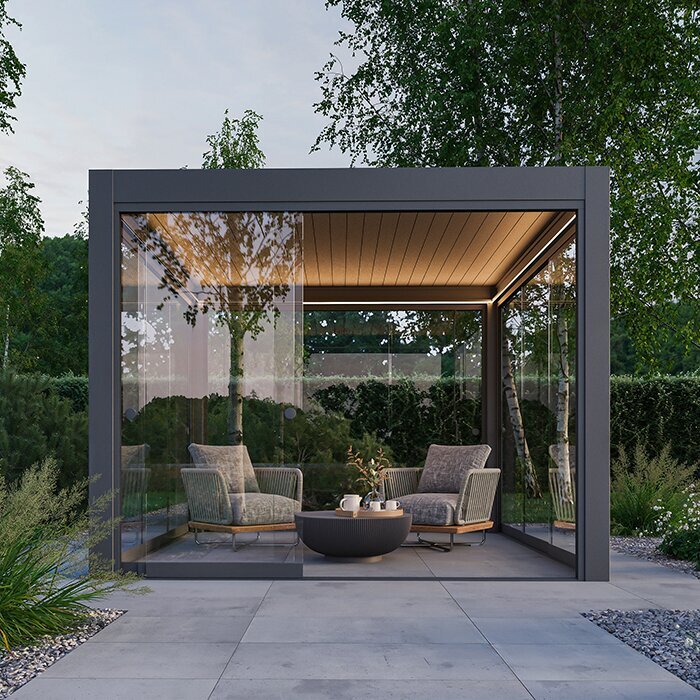
Clear glazing is not a privacy screen. At night, when the pergola or room behind the glass is brighter than the exterior, an observer may see people through it. Reflections of outdoor lights can make glass look mirror-like from one position, but reflections are not a dependable substitute for screening. Someone at a different angle—or looking after the brightness balance changes—may see through. Do not judge nighttime privacy by looking at glass in daylight or checking it from only one side. Include reflections from nearby fixtures and windows when you assess what an observer is likely to notice.
Translucent or obscured glazing can soften details while still passing light, but an illuminated person behind it may produce a recognizable outline. The result depends on the actual finish, viewing distance, angle, and illumination, so labels such as frosted or tinted do not answer the question by themselves. For a layout using the Bloomcabin Lean-To Pergola, include light from adjacent rooms in your assessment of any proposed glazing. Test a sample vertically, with a person behind it, and compare what happens as that person moves closer to and farther from the surface. Record whether the glass hides facial detail, obscures activity, or merely blurs the view; those are different levels of privacy.
What a fabric screen can and cannot hide
Fabric screens range from open meshes to denser materials that interrupt more of a direct view. An open weave can preserve a view through the panel, but it also leaves paths for sight and light. A denser weave may obscure more detail, yet a person behind it can still register as a silhouette if strongly backlit. A screen is not automatically one-way because it looks darker from one side. Which side appears clearer can shift with the lighting balance, and a small swatch may not show what a full panel reveals at a greater viewing distance.
Evaluate the actual fabric and finish you can buy, not a generic photo or a color name. Mount a substantial sample vertically, put a person behind it, and look from the likely observer side with the pergola lights on. Repeat from straight-on and oblique angles, and check the top, bottom, and edges; a private-looking center does not close a sightline around the perimeter. When discussing a screen for Bloomcabin’s regular pergola, identify the exact sample you tested, including its material reference and color. Ask whether the finished panel uses that same material. A result from one fabric should not be carried over to another just because both are described as privacy screens.

Place lights to avoid exposing the seating area
Lighting placement can reduce exposure, but no lamp arrangement turns a see-through side into an opaque one. Avoid making a person the brightest object against a dark background: a strong fixture behind a chair or a bright room visible through an open door can create a clear silhouette. Where practical, keep bright sources out of a likely observer’s direct line and aim or shield light so it falls on a task area rather than toward neighboring windows. Compare the result from outside, too; reducing glare for the person seated under the pergola does not necessarily hide that person from someone in the yard.
Use the arrangement you would genuinely use, rather than switching every lamp off for a flattering test. Compare available brighter and dimmer settings while retaining enough light for ordinary movement. Change one light at a time so you can tell which source increases visibility: a table lamp, an overhead fixture, or light spilling from the house. For a planned setup around the bioclimatic aluminum pergola, note proposed light locations on the same drawing as the seats and side treatments. Include occasional lighting, such as a nearby motion-activated fixture, if it could change the result. Have an appropriately qualified professional handle the design and installation of any permanent electrical changes.
Test the setup in real darkness
Run the test at dusk and again after dark; twilight can make a screen seem more private because the surroundings are still relatively bright. Put chairs, tables, and lights where they will be used. Ask one person to sit, stand, and move through ordinary activities while another checks each marked viewpoint that can be reached safely and with permission. Leave inaccessible viewpoints, including neighboring upper windows, marked as untested. Switch on the house lights that could face the pergola, then repeat with the candidate screen or glazing in place. A sample should face the same direction as the proposed panel and sit at a similar distance from the people; a hand-held swatch is only a preliminary check.
Do not rely on a phone photograph as the privacy test. Automatic exposure can brighten a dark view or dim a bright one, making the contrast unlike what an observer sees. Photos can record a test position, but confirm visibility in person. Keep a short record of the viewpoint, light settings, material, and what was visible: facial detail, movement, an outline, or nothing discernible. If you are comparing a layout for the lean-to pergola, include the adjacent room’s lighting and door position in that record. This lets you repeat the test under the same conditions instead of comparing impressions from different evenings or overlooking a light that was previously switched off.
Include views from the house and above
Do not test only the yard-facing side. A lit kitchen or living room may be visible through an open end or a glazed panel, and light near a doorway can make people stand out from inside as well as outside. Check views from your home toward the seating area and from the seats toward lit rooms. If curtains or shades are part of your evening plan, test them in their usual position. A treatment that solves one direction may not solve the other, because openings, light sources, and observer positions are not symmetrical.
Separate views through a panel from views that bypass it. A neighbor’s second-story window may have a downward view over the top, while a ground-level observer may see through a corner or entrance. For a layout based on the regular pergola, mark each of these routes on the drawing rather than treating a covered side as fully private. From the seating area, note which elevated windows remain visible above the proposed panel; this flags a possible exposure but does not establish exactly what someone there can see. Any roof-level coverage needs its own assessment in the position you intend to use. A side-screen sample alone cannot demonstrate privacy from above.
Match the side treatment to the view you want to block
Choose a treatment for a particular line of sight, not for an abstract goal of making every side private. If a neighbor sees the dining chairs from one angle, a panel on that side may matter more than covering a garden-facing view you want to keep. Clear glazing preserves a direct visual connection but offers little visual screening; a translucent surface softens detail; a denser screen may block more of the view while changing what you see out. Moving a chair or turning a table can also address a direct view without treating the whole perimeter. Compare each choice at night as well as during the day.
Map the trade-off by side: desired view, observer position, proposed material, and expected lighting. Note whether you want a permanent visual block or privacy only during evening use. A treatment that can be opened may preserve a daytime view, but its closed position must still cover the nighttime sightline. For a configuration involving Bloomcabin’s bioclimatic pergola, bring this side-by-side comparison to the accessory discussion rather than selecting panels solely by appearance. Include the space needed to enter, move chairs, and use any movable treatment. A panel that interrupts the right view but is routinely left open because it gets in the way will not meet your evening privacy goal.

Verify accessory compatibility before ordering
Match your question to the exact pergola model and the exact side you intend to treat. Ask whether the accessory is approved for that configuration, what area it covers, and whether an opening or edge gap remains where your sightline crosses. Confirm whether the item is included, optional, or a separate purchase. A photograph of a complete setup does not show which pieces were supplied with the structure, and compatibility with one model does not prove compatibility with another. Keep the model name and side position together in your notes so a general answer is not mistaken for confirmation.
Ask how the panel is meant to operate and what its normal position is when you want privacy; a movable treatment may leave the view exposed when open. Clarify whether the actual material is transparent, translucent, or intended to obstruct direct views, and request product-specific information rather than relying on a term such as privacy screen. Ask about coverage at corners and entrances, plus any limits on pairing it with other approved components. These are configuration questions, not assumptions to make from the word pergola. Precise answers help you test the right surface instead of evaluating a generic substitute.
Set a realistic nighttime privacy goal
Decide what you want hidden. You may want to prevent someone across the yard from identifying faces at the dining table while accepting that a silhouette or movement remains visible. A window directly facing the seats may call for a stronger visual block. State the observer position and the acceptable view, then test against that standard. Privacy is not a single outcome without those details. Making the goal specific helps you compare glazing, fabric, panel placement, and lighting without expecting any one treatment to perform beyond its limits.
Treat nighttime privacy as a combination of sightline, surface, and light. A targeted screen may help in one direction, while changing a lamp’s position or seating angle may address another. Recheck after furniture, fixtures, or your evening routine changes; a result that works for one arrangement may not carry over to a new one. If a complete visual barrier is essential, confirm that the proposed enclosure actually blocks the directions that matter rather than assuming a pergola roof or side accessory does. Choose the configuration whose tested result matches your expectation.
Frequently asked questions
Why can a pergola screen seem private by day but not at night?
Daylight can make the exterior side brighter and reduce the visible contrast through some materials. After sunset, a lamp may leave the occupants brighter than the yard, making people and movement easier to see through the same screen. Check from likely viewing points with the usual lights on.
Does turning on more outdoor lighting guarantee privacy?
No. A light aimed at the seating area or screen can make people more visible, and a bright source can cause glare without blocking a sightline. Compare the actual fixture positions and settings from likely viewing points. Lighting can complement a screen, but it does not replace one.
Is frosted glass private at night?
It may soften details, but backlighting can reveal a silhouette, and finishes described as frosted or translucent vary. Test the specific glass vertically after dark, with a person behind it and lights in their normal positions. Do not treat a finish label as a guarantee.
What is the best way to test fabric privacy?
Mount a large sample vertically where the finished screen would sit. Have someone behind it sit, stand, and move while another person checks from the likely observer side, with house and pergola lights on. Repeat at an angle and inspect the edges as well as the center.
Can a side screen block views from an upstairs window?
Not necessarily. A vertical screen may interrupt a horizontal view but leave a downward sightline over its top or around an edge. Identify elevated windows in your plan and assess those angles separately; do not assume a side panel creates a fully enclosed private space.
Nighttime privacy is a sightline-and-lighting question, not something you can judge from a material name or daytime photograph. Map where people sit and where observers can stand or look from, then test the chosen fabric or glazing with the house and pergola lights in their usual positions. A good plan addresses the views that matter while making the remaining trade-offs clear before you choose a side configuration.
