
Planning a Pergola for Outdoor Exercise
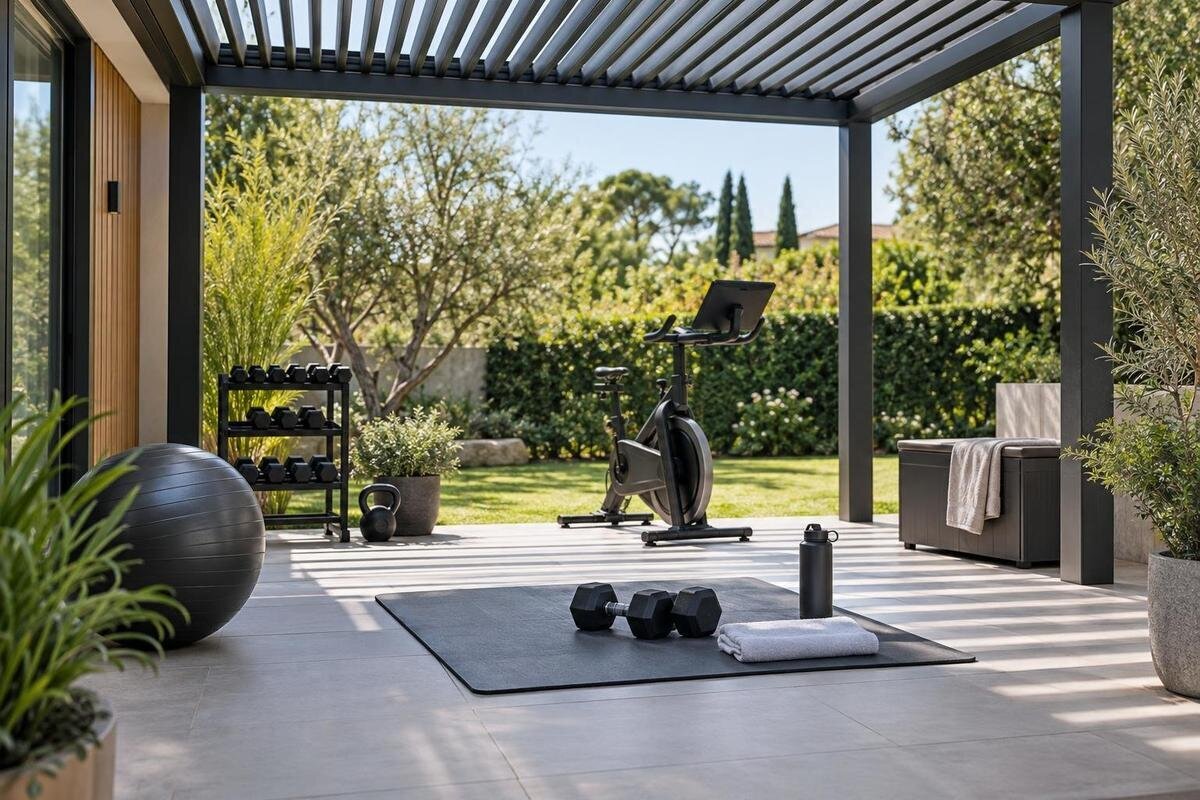
Outdoor exercise planning
An outdoor workout space beneath a pergola must accommodate movement, not merely a mat inside a roof outline. Its useful footprint includes the reach and travel of each activity, room for equipment at rest, and an unobstructed route past posts. Floor traction and changing sun or moisture matter as much as the listed pergola area. Plan for the routine you actually expect to do; treat anything suspended from the structure as a separate load question that requires specific structural approval.

List the activities the space must support
Before choosing a pergola, write down the activities the area must support. A mat routine, standing mobility work, step-based movements and strength work with free-standing equipment occupy different shapes. Note whether you reach overhead or to either side, change direction, move between a mat and bench, or walk around weights between sets. Include the normal order of tasks, not just the largest movement: carrying gear in, using it and putting it away also takes room. This is a space brief, not an exercise prescription; use the movements and equipment you already expect to use. If several people will share the area, record each person’s usual range and gear.
Divide the brief into an active zone, a place for gear while it is in use, and a route for entering, leaving or passing through. These functions can overlap at different times, but a water bottle, weight or rolled mat should not sit in the center of the movement area. Sketch the busiest intended use, including a second participant or anyone who regularly crosses the patio. This exposes conflicts early: a storage tub may fit beside a post when the patio is empty but become an obstacle during a circuit, while a doorway that looks accessible from one position may be blocked when equipment moves. Note which items must be removed between activities.
Measure the movement area, not just the mat
Measure the movement envelope rather than using mat dimensions as the answer. A mat marks a starting surface; it does not include an arm sweep, a change of stance, a lunge, or the space needed to step around floor equipment. Mark the mat and each equipment outline with painter’s tape on the candidate floor, then rehearse familiar movements at your normal range without increasing speed or adding a challenge. Adjust the marks until a hand, foot or item no longer approaches a post, wall, door edge or another user. Include transitions between movements: people travel between positions, not just stay inside one box. There is no universal buffer for every routine, so test yours.
Include vertical room as well as width and depth. Overhead reaches, standing movements and equipment used upright need clearance below beams, not merely open floor. Mark supports, door swings and low fixtures against the taped plan; a total area figure cannot show whether the clear rectangle has an awkward cutout. Bloomcabin Pergola’s listed area range is 97–258 sq ft, a useful size reference, but it is not by itself a dimensioned floor plan. Check the chosen configuration’s actual drawing or measurements against the movement envelope and overhead clearance before treating the area as a fit. If a height is not stated, get it confirmed.
Keep entry and circulation routes clear
Draw the route from the home, gate or yard into the workout area before placing equipment. It should remain obvious and open when the mat is down, weights are set out, or another person is moving. Account for door swings, steps, posts, planters and any path people regularly use. The route does not need to cut through the exercise zone; a clear path along its edge can make the layout easier to share. Check the space around each post, too, because a route that looks wide on a blank sketch can narrow once supports are marked to scale. If anyone uses a mobility aid, include the approach and turning space they actually need.
An attached location deserves an extra check at the wall and openings. Bloomcabin Lean-To Pergola is identified as a wall-mounted model, but its name cannot answer whether a particular doorway, window, gutter or wall leaves enough room for the planned movements. Mark doors in both open and closed positions and preserve access to spaces that must remain reachable. Confirm the selected design’s dimensions and attachment requirements for the actual site with the appropriate qualified professional. Do not assume that a model label resolves either clearance or suitability.
Choose a floor with dependable traction
A workout floor needs a predictable, stable feel under the footwear you intend to use. A surface that seems grippy when dry may change when damp, dusty or covered with leaves, and outdoor exercise can bring grit in from the yard. Check the surface in conditions you genuinely expect; if it becomes slick, pause activity until the floor is suitable or move elsewhere. A mat can help define a zone, but it should lie flat and stay in place rather than bunching, sliding or lifting at an edge. Comfort and grip are separate checks, so consider how both the bare floor and any mat behave during your usual movements.
Look closely at joints and transitions between materials. Raised edges, loose pavers, flexible boards, gaps and cables can interrupt foot placement or catch equipment; keep these away from the busiest movement path where possible. If you add a floor surface or outdoor mat, ask its supplier or installer whether it is intended for the exposure and type of use you have in mind. Keep leaves and debris cleared, and recheck the floor after rain, cleaning or a seasonal change. A finish that works under one set of shoes may not feel the same barefoot, so base the choice on the way the space will actually be used.

Account for changing sun and weather
Treat shade and weather as variable rather than assuming the pergola creates a fully protected workout room. Shade moves as the sun changes, and neighboring buildings or trees may alter it; observe the intended spot at the time you expect to use it. A shadow that covers the mat in the morning may shift later, while wind-driven rain can reach an area that appears covered. Do not infer year-round shade, a dry floor or protection for stored equipment from the word pergola or from an overhead outline. Plan a backup location or schedule for conditions that make the outdoor area unsuitable, and check the forecast before relying on the space.
Compare roof design and weather expectations as separate model details. Bloomcabin Bioclimatic Aluminum Pergola is a named configuration, but its title alone does not establish the amount of shade, ventilation or rain protection at your site. Review the selected configuration’s documented operation and limits, and consider the directions from which sun and rain usually arrive. High wind, lightning, extreme heat, cold or a wet floor can call for a different place or a postponed session; a pergola is not a substitute for shelter designed for every condition. Avoid leaving electronics, mats or weights where moisture or direct sun can damage them unless their instructions allow it.
Do not hang equipment without structural approval
Keep a clear distinction between equipment that rests on the floor and equipment that transfers force to the pergola. Dumbbells, a bench or a free-standing rack still need a stable location that does not block movement, but rings, suspension straps, pull-up bars, hammocks and similar gear can load a beam or post. Never treat a sturdy appearance as evidence that the structure can support dynamic exercise. Do not attach, loop or hang workout equipment from the pergola unless a qualified structural professional has approved the exact structure, connection and intended use.
Approval needs to cover the forces generated during the intended activity, not merely the weight of the equipment at rest. Give the professional the equipment instructions, proposed attachment location and documentation for the regular pergola model if that is the structure you are considering. Do not improvise a connection or substitute a different attachment point after an assessment. If approval is unavailable or unclear, use floor-based equipment or a purpose-built free-standing option according to its own instructions. Allow room around that equipment for use and access without crowding the pergola posts.
Keep storage outside the movement zone
Storage affects usable space even when equipment is not in use. Count the footprint of a bench, rack, box, mat holder, fan or towel basket, and decide where each item will sit during exercise and afterward. Keep frequently handled objects within reach but outside the path of moving feet, and avoid leaving loose weights where they can roll into the active zone. If the patio serves another purpose, work out which pieces must move before a session and how much temporary space that takes. A workout area that works only after a full furniture rearrangement may be inconvenient to use, and returning gear should not require crossing someone else’s exercise space.
Measure storage with its lid or doors open, not just closed. A box may fit neatly beside a post yet need additional room to retrieve a mat, while a rack needs an unobstructed approach for lifting equipment on and off. When reviewing Bloomcabin’s pergola listing, compare the selected support layout with both the closed storage footprint and its access space. Put heavier items where you can retrieve them without reaching across other gear. Check each item’s outdoor-use instructions and provide suitable storage elsewhere for anything that cannot remain exposed; coverage by a pergola does not establish weatherproof storage.
Plan for visibility, privacy and sound
Light and privacy affect whether the space works at the times you expect to exercise. Check the changing sun angle from mat level, not only from a standing viewpoint, and note whether a neighboring roof, tree or wall casts a shadow across the movement area. At dusk, make sure you can see floor transitions and equipment clearly. If fixed lighting or electrical work is part of the plan, have it evaluated and completed by an appropriately qualified professional. Keep cords out of the movement path, and do not treat an outdoor setting as a dry, protected place for powered gear.
For privacy, identify the specific sightline you want to interrupt before adding planting or a screen. Check it while standing and while using a mat, since those viewpoints differ. When comparing the bioclimatic aluminum model, ask for the selected configuration’s drawings so you can place supports accurately in your sightline sketch. Any separate screening also needs space of its own and should not obstruct circulation or access to controls. Consider how footfalls, weights being set down and music may carry toward nearby homes at your usual workout time. Avoid dropping weights, and keep speaker volume considerate rather than assuming that screening will contain sound.

Allow room to use and move equipment
Measure exercise equipment in its working position, not only as it appears in a catalog or when folded for storage. Include projecting handles, adjustable parts and the space needed to get on, get off or change settings. Use the equipment manufacturer’s stated clearances where available; do not replace them with a guess based on the pergola’s area. A bench or machine that fits between posts may still leave too little room to approach it. For heavy equipment, have the supporting deck or surface assessed by an appropriate professional rather than assuming that an existing patio is suitable for every load.
Check how equipment will reach its planned position. Measure narrow gates, turns and changes in level, and consider whether an item can be moved as its manufacturer directs without contacting the structure. When considering the wall-mounted pergola model, include access around equipment placed along the wall, especially where adjustment or maintenance requires reaching behind it. Keep access to building fixtures unobstructed. On your plan, distinguish equipment that stays in place from items carried out for each session. This reveals whether a compact storage arrangement will become crowded once everything is set out, even if each piece fits individually.
Test a concept layout before ordering
Turn the measurements into a simple concept plan before making a purchase decision. Mark posts and walls, door swings, the active zone, storage, walking route and any equipment that stays in place. Tape that plan on the actual patio where possible. Walk in carrying the gear, set it down, follow the ordinary sequence of your routine, then put everything away. Notice where a movement approaches a post, where an open door blocks a path, or where a weight has no suitable resting spot. Label a paper sketch or tape layout as a concept, not as a confirmed installation drawing.
Use the tested concept to compare exact configurations rather than simply choosing the largest listed area. For each option, note what fits comfortably, what must move between activities and which measurements remain unconfirmed. Bloomcabin’s bioclimatic pergola page can serve as one starting point for that comparison; request the dimensions and support locations for the configuration you would actually order. If a layout depends on removing storage or blocking the household’s usual patio route, revise it before committing. Keep the final concept with your measurements so that any later change in equipment, pergola size or placement can be checked against the same practical requirements.
Frequently asked questions
How much space do I need for exercise under a pergola?
There is no single size that works for every routine. Mark the full movement envelope, equipment footprints, circulation route and overhead clearance, then compare them with the clear dimensions of the selected configuration. An overall area figure alone does not show where the supports sit or how much open floor remains.
Can I attach a suspension trainer or rings to a pergola?
Only if a qualified structural professional approves the exact structure, attachment point and intended use. A pergola’s appearance or listed area is not evidence of its capacity for exercise loads. Without specific approval, keep workout equipment on the ground and use it as its manufacturer directs.
What kind of floor is best for an outdoor workout area?
Choose a stable surface that gives dependable traction with the footwear or mat you plan to use. Check how it feels in the outdoor conditions you expect, since moisture, grit and leaves can change footing. Avoid activity when the floor is slick, uneven or obstructed.
Will a pergola keep the workout area dry and shaded?
Do not assume it will. Shade shifts with the sun, and wind can carry rain into an area that looks covered. Check the documentation for the selected configuration and observe conditions at your planned workout time. A pergola also should not be treated as weatherproof storage unless the product information confirms that use.
What should I measure before comparing pergola models?
Measure the usable patio, movement envelope, equipment and storage footprints, post locations, entry route and overhead clearance. Include door swings and any transitions or obstacles in the floor. Then compare those measurements with the dimensions for the exact configuration, rather than relying on a general model name or area range.
A practical pergola exercise area gives your routine enough clear space without making the rest of the patio difficult to use. The best fit is the configuration that accommodates actual movements, equipment access and storage on a suitable floor—not necessarily the one with the largest listed area. A taped concept layout helps reveal those differences before ordering. Keep suspended equipment out of the plan unless its specific use has structural approval, and retain an alternative for weather that makes outdoor exercise unsuitable.
