
Rain or Condensation Under a Pergola: How to Tell the Difference
Pergola moisture guide
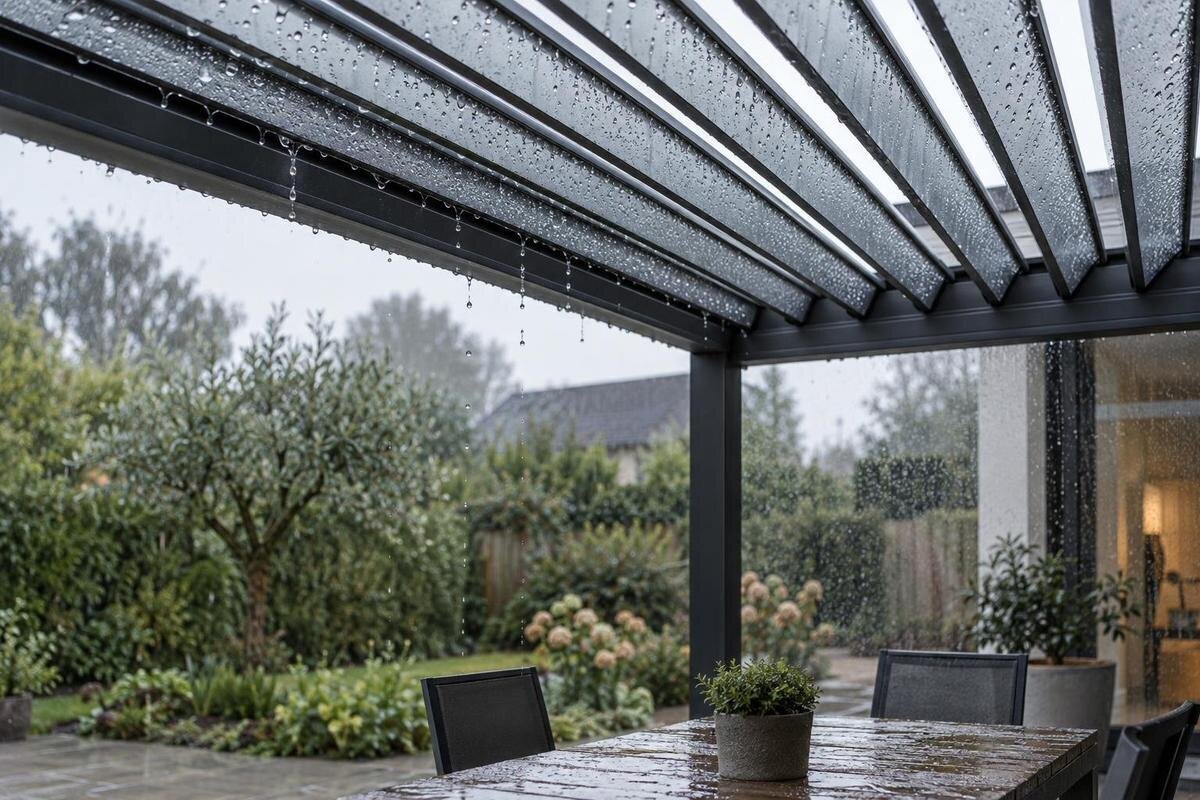
Water beneath a pergola can come from rain passing through or around the roof, condensation forming on a cool surface, or another nearby source. A wet patio alone cannot identify which. The strongest clues are when the first droplets appear, what the weather has been doing, where moisture forms, and whether the same pattern returns during dry conditions. Compare those observations before calling it a leak or assuming that ordinary condensation explains it.

01
When the drops first appear
The first question is not simply whether the pergola is wet, but when it first became wet. Drops that appear during rainfall or soon afterward, especially on a side exposed to the wind, make rain entry more plausible. Condensation is more plausible when moisture appears overnight or near dawn after a rain-free evening, then fades as surfaces warm and conditions change. This is a clue, not a rule: rainwater may remain in a profile and drip later, while condensation can form after a damp, cloudy day as well.
Separate three observations: when droplets first form, when they begin falling, and when the surface dries. Those moments may be hours apart. An underside that was already wet when you arrived tells you less than a surface you watched change from dry to damp. Observe before rain, during it only from a safe sheltered position, and afterward without moving the roof just to test a theory. If you missed the onset, record that uncertainty rather than treating the time you noticed a puddle as the start. A drip that continues after a shower may be draining stored water; newly forming beads on a previously dry underside suggest a different process. The distinction helps explain why “it dripped after rain” is not enough to identify a leak.
Compare the moisture with local weather
Check rainfall at the pergola, not just whether an app shows precipitation somewhere in town. A nearby station may miss a brief shower over the patio, while a roof can stay wet after rain stops. Record when rain began and ended, whether wind pushed it toward one edge, and whether drops first appeared on the windward or sheltered side. Rain can travel sideways under an open edge or be redirected by a nearby wall, so the direction of a trail may matter as much as the amount of rain. A dry forecast does not prove that no rain reached the structure.
Condensation forms when moist air meets a surface cooler than the air’s dew point—the temperature at which water vapor begins to condense. For example, air at 60°F with a dew point of 55°F can leave moisture on a roof underside that cools below 55°F. The roof need not be below freezing, and its temperature need not match the air temperature. Overnight cooling can create these conditions without rain. Relative humidity alone does not establish that condensation is occurring, and a weather app cannot measure your roof’s surface temperature. When considering the Bloomcabin Pergola model page, ask what information is available about moisture beneath the roof in the intended configuration. For your observations, use weather readings as context rather than proof; a shaded, sheltered patio may experience different conditions from the reporting station.
02
Look at where moisture forms first
Look before wiping the surface or moving furniture. A fine film or many small beads spread across a broad, cool underside can fit condensation better than one concentrated entry point. Similar widespread droplets may appear on several cool surfaces at once. By contrast, a fresh line of drops below one joint, roof edge, or wall connection after rain is a reason to investigate a possible rain route. The surface matters: drops on the underside of a roof panel, moisture on a post, and water sitting on the paving are different observations and should be recorded separately.
Map the first appearance, not just the puddle or largest drip. Water can travel along a beam before falling, so the spot below a drip may be some distance from its entry point; condensation can also collect at a low point. Take a wide photo to establish the location, then a closer image of the wet surface from a safe ground-level position. Distinguish droplets attached to the underside from a stream crossing it, and note any dry areas between wet patches. A wet chair or table shows where water landed, not where it originated. No single pattern settles the question: rain can spread over a broad surface, while condensation can gather where the roof’s shape channels it. The useful evidence is how the pattern develops, rather than the size of the final puddle.
Account for the type of pergola roof
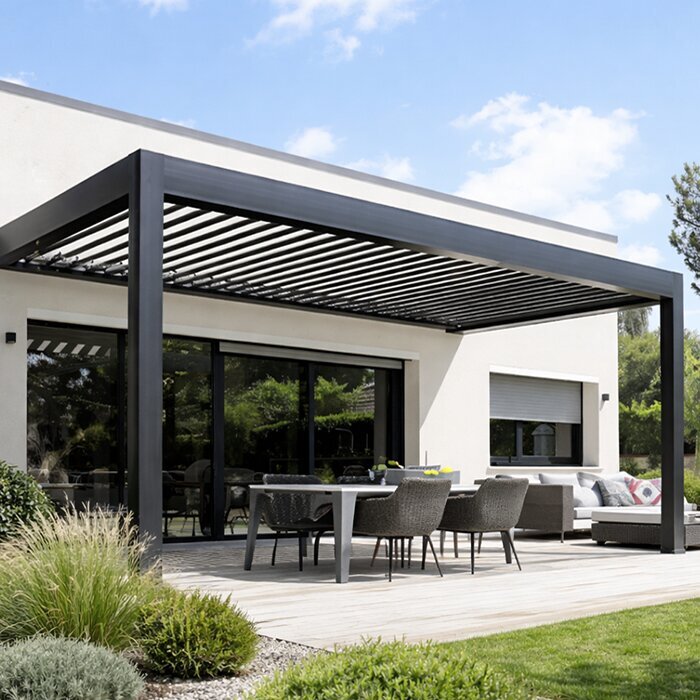
Roof construction changes what it means for water to be under a pergola. An open-beam or widely spaced-slat roof has gaps, so rain passing through them is ordinary exposure, not evidence that a continuous roof has failed. An adjustable louver system may behave differently at different positions; its behavior depends on the specific design and approved operating instructions. A fixed panel or fabric cover also has its own way of shedding, retaining, or admitting water. Do not judge any of these as sealed or weatherproof from appearance alone.
During observation, write down the roof position instead of changing it to test a theory. “Closed” should describe what you saw, not imply a guaranteed seal. If the instructions prescribe a particular rain position, compare the observed position with that guidance. When evaluating the Bloomcabin Bioclimatic Aluminum Pergola, request operating instructions and a drainage diagram for the proposed roof before interpreting its behavior. A useful diagram distinguishes surfaces that collect rain, channels that carry it, and outlets where it leaves the structure. It can also help you tell whether a wet edge is beside an intended water route or somewhere that requires closer assessment. Keep the diagram matched to the installed version: a drawing for another roof mechanism cannot explain your unit simply because both products are described as bioclimatic.
03
Keep a log across dry and rainy periods
A short log is more reliable than memory, especially when a shower ends before you notice the first drop. For each episode, record when moisture first appears and when it stops, recent rainfall, wind direction, approximate outdoor conditions, roof position, and the first wet areas. Use a simple sketch or numbered photos to distinguish the underside, perimeter, wall connection, support posts, and floor. Include dry nights as well as wet days: noting that no droplets appeared is useful comparison evidence, not wasted space.
Keep the same observation points and organize each episode as a separate entry rather than combining several days into one description. Compare rainy periods with rain-free nights, but note important differences such as stronger wind, a colder morning, or closed side panels. An entry might read: “No rain observed overnight; underside dry at sunset; scattered beads at dawn; floor still dry.” Another might show a single edge becoming wet during a shower. These descriptions preserve evidence without labeling either event a leak. Use the regular Bloomcabin Pergola listing to confirm the product name in your record, and add the installed roof and enclosure details separately. If you cannot observe an interval, leave it unknown. A gap in the record is more useful than an assumed starting time that makes an apparent pattern look stronger than it is.
Trace a possible rain route from the ground
After rainfall, inspect only what you can see safely from the ground. Follow a visible trail backward from a drip to the roof perimeter, a joint, a frame, or the point where the pergola meets a building. Note whether water starts at one repeatable spot, appears along a long edge, or enters from a direction exposed to wind. Photograph a wet seam or continuous streak, but remember that a stain left from an earlier event does not identify the source by itself. Do not climb onto the roof or dismantle parts to trace moisture, and do not use a hose to imitate a storm.
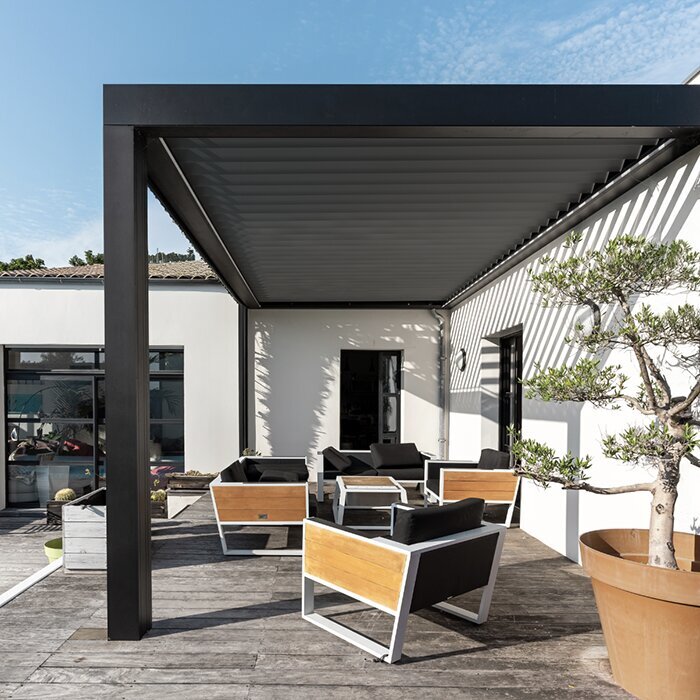
At a wall connection, distinguish water emerging from the pergola interface from water already running down the building above it. For the Bloomcabin Lean-To Pergola, identified as a wall-mounted model, ask the installer to explain the intended junction with the building and show it on the installation drawing. From the ground, note whether the first visible wet patch is above the connection, along it, or underneath it. Water arriving from higher on the wall calls for a different investigation than droplets forming across the roof underside. A trail may disappear behind a component and reappear elsewhere, so mark the hidden portion as uncertain. Do not pry at the connection or apply sealant to find out where it leads; have the installer or a qualified professional assess any route that cannot be seen safely.
04
Consider side panels and airflow
Side panels change both air movement and rain exposure. Screens, curtains, or solid and glazed panels can make one part of a pergola more sheltered than another; wind-driven rain may be deflected, while limited air exchange can allow damp air to persist. Condensation can appear on the underside of a roof or on a cooler enclosure surface, so record moisture on a side panel separately from drops falling from overhead. A panel’s temperature can differ from the surrounding air, making its moisture pattern a useful clue but not a stand-alone diagnosis.
Record which panels were fitted, which were open, and whether moisture is on the inside or outside face. A wet exterior face during rain and beads on an interior face at dawn are different observations, even when they occur on the same panel. If dampness appears only with the enclosure closed during dry weather, reduced air exchange is worth discussing, but opening a panel does not provide a conclusive test: wind, temperature, and humidity may change at the same time. When reviewing Bloomcabin’s regular pergola product page, ask separately which enclosure options are available and how the proposed arrangement is intended to ventilate. Do not assume that adding sides will solve overhead dripping. They may reduce some rain exposure while also changing drying conditions, and their suitability must be assessed for the specific setup.
Check for water sources beyond the pergola
Rain and condensation are not the only sources of wetness. A roof above the pergola, an adjacent downspout, a balcony edge, or a building surface can send water into the area after rain. Sprinklers, a hose, or a recently cleaned roof can also imitate a rain-linked leak. Check whether dampness begins when irrigation runs or only beneath a particular overhang, and whether drops are falling from the pergola itself or arriving from beyond its footprint. Water appearing after rain is worth noting, but it does not prove that the pergola roof is the source.
For a structure beside a house, look for a separate trail along the exterior wall or from the roof above, without removing flashing or opening the wall. When considering the Lean-To Pergola product listing, include the surrounding building in the site assessment, not just the area beneath the proposed pergola. An overhang, balcony, or nearby roof outlet may place an outside water source directly above that space. During diagnosis, compare the time that source starts dripping with the time the pergola becomes wet. Irrigation that runs before sunrise can also confuse an apparent morning-condensation pattern, so check its schedule and direction. Keep photographs of these outside sources separate from close-ups of roof droplets. This helps an inspector distinguish water delivered into the area from moisture forming on the pergola itself, without prematurely ruling out either cause.
05
Know when repeated wetness needs inspection
Repeated rain-linked wetness deserves more attention than one isolated drip, particularly if the same joint, edge, or wall connection becomes wet during several showers. Persistent staining, a visibly opening connection, or deterioration around a joint is a reason to arrange an inspection, not proof of a particular failure. Note whether the area dries fully between storms, whether dampness spreads, and whether the same point gets wet again. Photograph the evidence before anyone patches it; an improvised seal may obscure the route and may not match the design.
Give the manufacturer, installer, or qualified contractor a concise summary of the recurring problem, followed by your log and dated photos. State whether you are seeing fresh droplets form, water flow along a component, or only wet furniture below. For a unit identified through the bioclimatic aluminum pergola product page, also provide any order or model information that distinguishes the installed version. Ask the inspector to explain the likely source, what evidence supports that conclusion, and whether more observation is needed before repair. If a repair is proposed, ask which component or connection it addresses and how the result will be assessed under comparable conditions. This avoids treating every drip as a sealing problem. If water reaches electrical fixtures or wiring, stay clear of the wet area and have a qualified professional assess it.
Use documentation for the exact configuration
Before deciding that a pergola needs repair or replacement, match the observed conditions to documentation for the exact roof and enclosure. Look for the weather-performance limits, the roof positions covered by the instructions, the intended drainage route, and any conditions attached to those statements. Check that documents describe an enclosure matching what is actually installed; components can change exposure. A diagram can show where water is designed to travel, but it does not automatically prove that a particular installed joint is sound.
Buyers should distinguish a roof’s stated rain performance from the conditions beneath it. Ask which areas remain open to wind-driven rain, whether the proposed side panels are included in the documented configuration, and what the manufacturer says about condensation. Someone comparing the wall-mounted Bloomcabin pergola page should also request the information needed to evaluate the planned building connection. Keep the answers with the quote so the specified roof, enclosure, and installation details can be compared with what is supplied. If a document uses a broad term such as “weather protection,” ask what conditions and operating positions that statement covers rather than interpreting it as a promise of an always-dry patio. A condensation pattern does not establish adequate rain performance, and successful rain drainage does not by itself prevent condensation.
Frequently asked questions
Can condensation form under an open-sided pergola?
Yes. Open sides do not prevent humid air from meeting a roof or frame surface that has cooled below the air’s dew point. Airflow can affect how quickly moisture disperses, but the presence of droplets alone does not establish whether the pergola is sufficiently open or whether rain has entered.
If drops appear after rain stops, does that mean the pergola is leaking?
Not necessarily. Water may remain in part of a roof or frame and drip later, while condensation can also form after rain has ended. Note when the first droplets appear, where they form, and whether the same pattern occurs on rain-free nights. Check the instructions for the exact roof design.
Does a broad patch of droplets mean the cause is condensation?
It can make condensation more plausible, particularly if droplets appear across a cool surface during a dry night or morning. It is not conclusive: rain can spread over a surface, and condensation can collect at one low point. Record where moisture appears first and compare that location with the weather and roof design.
Should I hose-test the roof to find the source?
Do not improvise a hose test. It may not reproduce natural rain or wind direction, and it can send water along a route that would not occur in ordinary conditions. Photograph what you observe and follow the manufacturer’s instructions, or ask the installer or a qualified professional how to assess the specific model.
What information should I provide when asking for an inspection?
Share the exact model and installed configuration, dated photos, when the wetness began and stopped, recent rain and wind conditions, roof position, and which areas became wet first. Include observations from dry periods as well as rain events. These details help distinguish a repeatable rain route from moisture forming on a cool surface.
Treat timing and the first wet location as evidence, not a verdict. Drops that repeatedly follow rain call for a closer look at the water route; moisture that appears across cool surfaces on rain-free nights makes condensation more plausible. When the pattern is mixed or persistent, keep the observations and compare them with documents for the exact pergola configuration before deciding what the water means.
