
Removing Algae From Pergola Posts and Nearby Paving
PERGOLA CARE
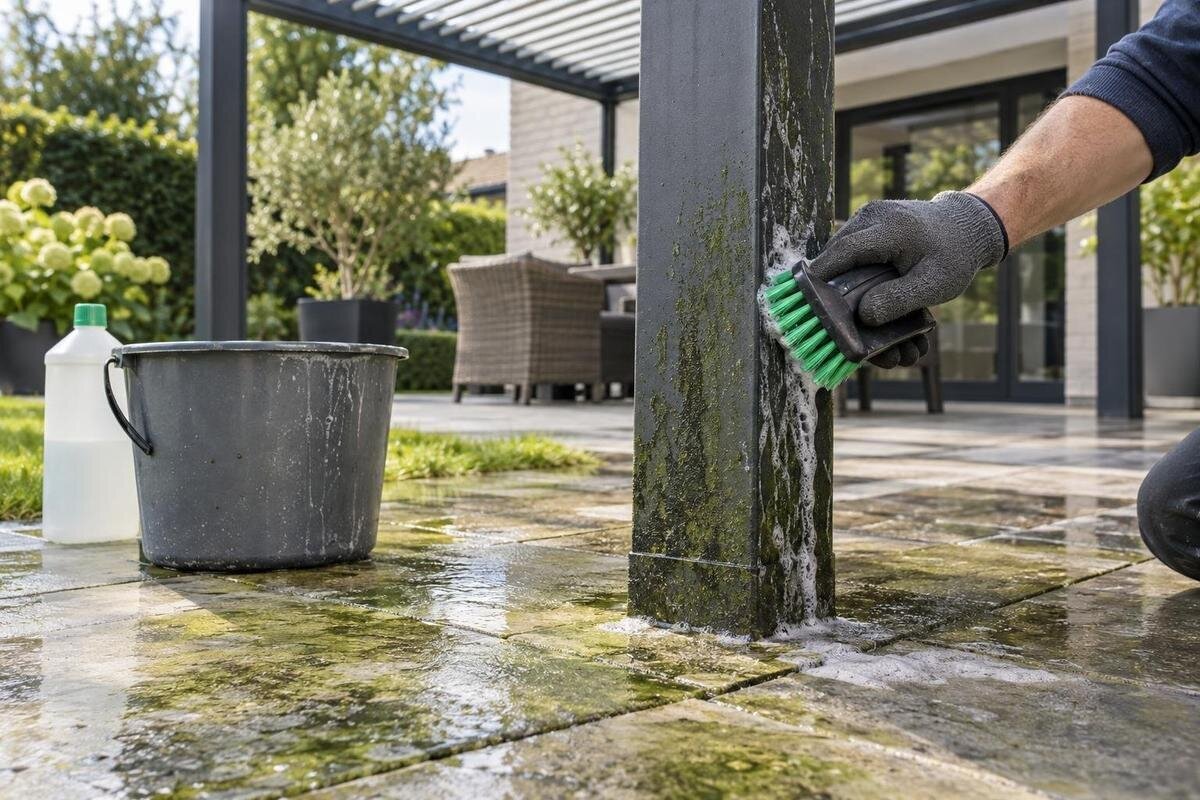
Green film on a pergola post and slippery growth on nearby paving may look like one cleaning problem, but they involve different surfaces and different risks. A product that is acceptable for a paver may stain or dull a coated aluminum finish, and spray or runoff can carry it straight to a post. Identify both materials first, then use separate, surface-appropriate methods.

Before you clean 1
Is the growth algae, and where is it?
Green film often develops where water lingers, shade slows drying, or leaves and dust collect. On paving it may leave a slick walking surface; on a post it may concentrate near the base or on a less-sunny face. Color alone cannot confirm algae: dirt, leaf staining, mildew-like growth, oxidation, and a coating that is changing can look similar. A soft film sitting on the surface calls for a different response than peeling, chalking, pitting, or a patch that changes the finish itself. Photograph the pattern while dry; it may help distinguish recurring dampness from a one-time spill.
Keep people and pets off slippery paving and out of the cleaning area. Rinsing and drying alone do not establish that a walkway is safe; reassess it before reopening the area. Move furniture, cushions, and outdoor textiles away so they cannot be splashed. Work in a small zone and keep hoses, brushes, and buckets out of the walking route. Note whether growth follows a sprinkler, shaded edge, downspout, or low spot. Those clues can help you address a moisture source later, but they do not justify a stronger cleaner by themselves. The growth may return simply because the same place stays damp.
Identify the pergola post finish first
Before choosing a cleaner for a post, identify what you are touching. The frame may be coated aluminum, but verify that from order papers, a care label, or the manufacturer instead of judging by appearance. Record the finish or color if known and find instructions covering routine washing and stain removal. If the post has chips, exposed metal, or a different material at its base, do not treat every visible part as one surface. Advice for a coated finish may not apply to masonry, plastic trim, sealant, or hardware beside it. Keep the care information with your purchase records for future cleaning.
If you need to match paperwork with a catalog model, the Bloomcabin Lean-To Pergola product page is a naming reference, not a cleaning specification. Confirm that it corresponds to your installed unit, then request the care instructions for that version and finish. Include the purchase date if known, order details, and a photograph showing the whole structure rather than only the stain. For a wall-mounted structure, also identify any adjoining wall finish that cleaning water could reach. Read the care document for permitted products, tools, and exclusions. If it simply says to use a mild cleaner, ask what that means for the proposed product rather than choosing by its marketing description. Keep the response with your purchase records so future cleaning does not depend on remembering an informal conversation.
Before you clean 2
Check the paving material and its finish
Identify paving as carefully as the post: concrete, natural stone, clay brick, manufactured pavers, and sealed surfaces can react differently to cleaning products and brushing. Even two pavers that look alike may have different finishes or joint treatments. Check installation paperwork or care guidance for the surface and any sealer. If uncertain, remove loose debris and try a discreet water-only test, then judge it after drying. Avoid a strong test on a visible corner: lightening, roughness, residue, or color transfer can be harder to undo than the algae. Test on the same type of surface the cleaner will touch.
Keep pergola and paving guidance separate when comparing cleaning options. If you are considering the Bloomcabin Pergola listing for an existing patio, first establish how that patio is maintained and which products are already used on it. Then ask for the pergola’s exact finish-care requirements so you can plan separate cleaning zones. For an installed structure, send the paving supplier the surface name, sealer details if available, and photographs of the affected area. Include a close-up of a joint: its treatment may impose different restrictions from the paver face. Describe any previous cleaner or coating rather than assuming the surface is untreated. A label saying outdoor or patio use is too broad to resolve these questions. If the paving type or sealer remains unknown, ask the supplier or a paving professional to identify it before selecting a chemical treatment.
Keep paving cleaner off coated aluminum
A simple sequence can reduce accidental transfer: clean the pergola first with its approved method, rinse as directed, and let nearby surfaces drain. Before using a cleaner on paving beside a post, read its label for allowed surfaces, application, dilution, and rinsing; follow those instructions rather than another owner’s routine. Work in a controlled area, shielding the post and nearby trim from splash. A cover is a backup, not proof of compatibility, and it should not hold wet cleaner against the finish. If wind or runoff makes control difficult, wait for conditions that let you contain it.
Where paving meets a post, inspect the likely splash and runoff paths before opening a cleaner. Liquid can reach the lower coating through downhill flow or a brush flicking droplets upward. Use a removable barrier only if it stays secure and can be removed promptly; do not tape unknown adhesive to the coating or wrap a wet towel around a post. Check behind the barrier during work, because a hidden wet surface defeats its purpose. Keep the brush strokes directed away from the post and avoid dipping a contaminated tool into the post-cleaning bucket. If you cannot isolate the area, choose only a method permitted for both surfaces or pause for advice. When considering the Bloomcabin Bioclimatic Aluminum Pergola, request care documents to help plan cleaning access at the paving-to-post junction; photographs cannot establish cleaner compatibility.

Before you clean 3
Clean posts with a finish-safe method
Once the finish guidance allows washing, start with clean water and a soft, nonabrasive cloth or sponge; add a small amount of mild detergent only if the instructions permit. Use a clean bucket and a separate cloth from the paving tools so grit or paver cleaner is not carried onto the finish. Work gently in short passes, rinsing the cloth often, and rinse the post as directed. Watch for a change in sheen or color. Do not allow a product to dry on the coating if its label or care instructions call for rinsing. Follow the stated sequence instead of extending contact time.
A product labeled for algae, siding, metal, or exterior furniture is not necessarily suitable for your coating. Avoid abrasive pads, wire brushes, scouring powders, solvents, bleach, acids, or high-pressure washing unless the manufacturer explicitly approves the method and product. Never mix cleaners or improvise a dilution. Check the applicator as well as the liquid: a soft cloth that has picked up grit is no longer a clean tool. Inspect folded edges and replace or thoroughly clean the cloth before continuing. If gentle, approved washing leaves a mark, photograph it rather than rubbing harder; a remaining mark is not proof that more force is needed. For an installed unit matching the Bloomcabin Lean-To Pergola model, use the model identity in your support inquiry and ask whether the mark needs a different approved treatment or inspection.
Remove growth from paving in small areas
On paving, clear leaves and loose soil first so you can see the growth and avoid grinding grit into the surface. For a trial, follow the paving instructions for a small patch: plain water and a suitable brush may loosen surface film without chemicals, but choose brush stiffness for that material and finish. Rinse as directed and compare the area after drying. If a cleaner is needed, select one whose label names the paving type and any sealer; use its stated application and contact time. If the first attempt does little, do not simply increase the concentration or layer on a second product.
Choose a test patch that lets you evaluate the whole method, including brushing, contact time, and rinsing, without sending liquid toward a post. Keep an adjacent untreated area for comparison and photograph both after they dry. A patch that looks cleaner while wet may still reveal residue or a changed finish later. Include a representative joint only if the proposed method is permitted for its material. Record the brush type so a successful trial can be repeated without substituting a stiffer tool. For a patio around a Bloomcabin Pergola, identify the installed finish when asking about work near its posts; paving approval alone does not cover the frame. If the test is acceptable, proceed in similarly sized areas rather than treating the entire patio at once. Follow the cleaner label’s weather restrictions and keep the area closed for any stated period.
Before you clean 4
Protect paving joints and control runoff
Pay attention to paving joints, edges, drains, and the point where each post meets the ground. A hard jet or vigorous scrubbing can disturb joint material or drive dirty water into gaps; do not pressure-wash unless the paving guidance and pergola instructions approve the method for those surfaces and locations. Prevent cleaner from pooling around post bases or entering seams, channels, or installed components. Follow the label for directing rinse water, and keep it from finishes not named as compatible. Where there is no controlled route for runoff, stop before applying a chemical.
Before chemical application, check whether the label requires runoff collection or other precautions, including protection of plants and nearby water. Do not assume that a drain is an acceptable disposal route; if the label does not resolve the situation, get advice from the cleaner supplier. Avoid using a garden hose to push concentrated residue out of sight. Small work areas make changes in water direction easier to notice, especially where paving slopes toward a post. Stop if a barrier shifts or liquid escapes the planned area. If cleaner reaches a coating, follow the finish instructions for an accidental splash and retain the cleaner label for support. For a structure matching the Bioclimatic Aluminum Pergola model, describe exactly where contact occurred and provide photographs. Include any seams or attached components in the pictures without opening them or attempting a repair.
Rinse thoroughly and reassess when dry
Rinse according to the cleaner label, taking care not to send the rinse across coated posts. For a post, use its own care instructions; do not assume a powerful hose is safer because it removes residue quickly. Change to clean cloths and fresh rinse water as needed instead of wiping a chemical film around. Let the surface dry, then assess cleanliness and finish in daylight. Wet stone may look darker, so wait for a dry comparison before deciding that more cleaner, pressure, or a second product is needed. Follow any label direction about repeat applications rather than making one up.
Keep a cleaning record with the surface identification, test location, product name, label-directed dilution, brush or cloth type, and application and rinsing method. Photograph the same area from a similar angle before treatment and after drying; note lighting differences that could make a color comparison misleading. Record a successful result as well as a problem so the next cleaning does not start from guesswork. If you see chalking, peeling, persistent residue, or unexpected color transfer, stop repeating the treatment. For an inquiry concerning a Lean-To Pergola, attach purchase paperwork and show both the affected post and its surroundings. Ask whether the visible change is residue, a finish issue, or something requiring inspection. If a replacement component is proposed, have support confirm its identity and finish compatibility before ordering; do not select it solely because the catalog photograph looks similar.

Before you clean 5
Address recurring moisture and debris
Cleaning removes what is present; it cannot keep a surface dry or prevent regrowth if moisture and debris remain. Clear leaves and soil from paving edges and accessible drains without disturbing joints, and notice whether irrigation routinely wets a post or shaded strip. Correct obvious sprinkler overspray or a water leak only where you can do so safely. For drainage changes or work affecting a pergola base, ask an appropriate professional rather than digging or altering support areas. Recheck the same spots after ordinary wet weather to see whether the source has changed.
Some shade and dampness may be unavoidable, so base upkeep on what you observe rather than expecting one treatment to prevent all regrowth. Note which areas stay wet longest after rain and whether leaves repeatedly collect against a post. These observations help distinguish a localized moisture problem from a patio-wide cleaning need. Sweep accessible debris regularly, but do not scrape joints or probe openings in the structure to improve drainage. Avoid preventive coatings or biocides unless the relevant surface guidance supports them. If comparing the Bloomcabin Pergola for a patio that needs frequent cleaning, request maintenance information before purchase and consider how you would reach each post without spreading paving cleaner onto it. Ask separately about the patio’s treatment requirements. A practical cleaning plan should accommodate both surfaces without relying on stronger chemicals or repeated heavy scrubbing at their junction.
Know when cleaning should stop
Stop if the coating blisters, flakes, chalks, changes sheen, shows fresh scratches, or transfers color; also stop if you uncover pitting, a loose connection, or cracking around a post. These signs call for identification and inspection, not stronger algae remover. On paving, newly roughened or discolored stone, loosened joints, or visible surface loss can also signal that a method is unsuitable. Do not sand, scrape, repaint, seal, tighten structural parts, or open components as part of a cleaning attempt. Take photos from a safe position and record the product label and steps used.
Ask the pergola maker or installer for exact finish-care instructions when the coating is affected, and consult a qualified paving professional if paving or joints appear damaged. Share the model name if known, purchase paperwork, close and wide photographs, surface type, cleaner label, and how it was applied and rinsed. If a post moves, its attachment looks damaged, or cleaning would put water near installed electrical components, stop and contact an appropriately qualified professional. Cleaning is a surface task, not a repair for a compromised support or finish.
Frequently asked questions
Can I use the same algae remover on pergola posts and paving?
Not by default. Check that a cleaner is approved for the exact paving material and any sealer, and separately verify that it is compatible with the pergola’s coating. If either surface is not listed or its care instructions are unclear, keep the product away from it and ask the relevant manufacturer before proceeding.
Is bleach safe for coated aluminum pergola posts?
Do not assume that it is. Follow the care instructions for the specific finish, and use bleach only if those instructions explicitly allow that product and method. A cleaner that works on one kind of paving may still be unsuitable for coated aluminum, so keep the two jobs separate.
Can I pressure-wash algae from paving beside a pergola?
Only if the paving guidance and pergola instructions permit pressure washing for those surfaces and locations. A strong jet can affect paving joints and send water or residue toward a post. If approval is unclear, use a gentler method allowed by the surface instructions or get product-specific advice.
How can I keep paving cleaner off the pergola posts?
Clean posts first using their approved method, then protect them while treating a small paving area. Apply the paving product as its label directs, avoid broad spray, and control the rinse path. A cover can help limit splashes, but it does not make an incompatible cleaner safe for a coating.
What should I do if algae comes back quickly?
Look for recurring moisture, such as sprinkler overspray, leaf buildup, or a persistently damp edge. Address an obvious cause where you can do so safely, then use only a surface-approved cleaning method. If the coating or paving changes, stop rather than increasing the cleaner strength and ask for specific advice.
Treat the pergola posts and paving as separate cleaning jobs: verify each surface, follow its own care instructions, and control where cleaner and rinse water travel. If growth returns, look for recurring dampness rather than immediately using a stronger product. If the finish changes or the paving is damaged, stop cleaning and get guidance for the specific material.
