
Repairing an Older Pergola or Replacing It: A Checklist
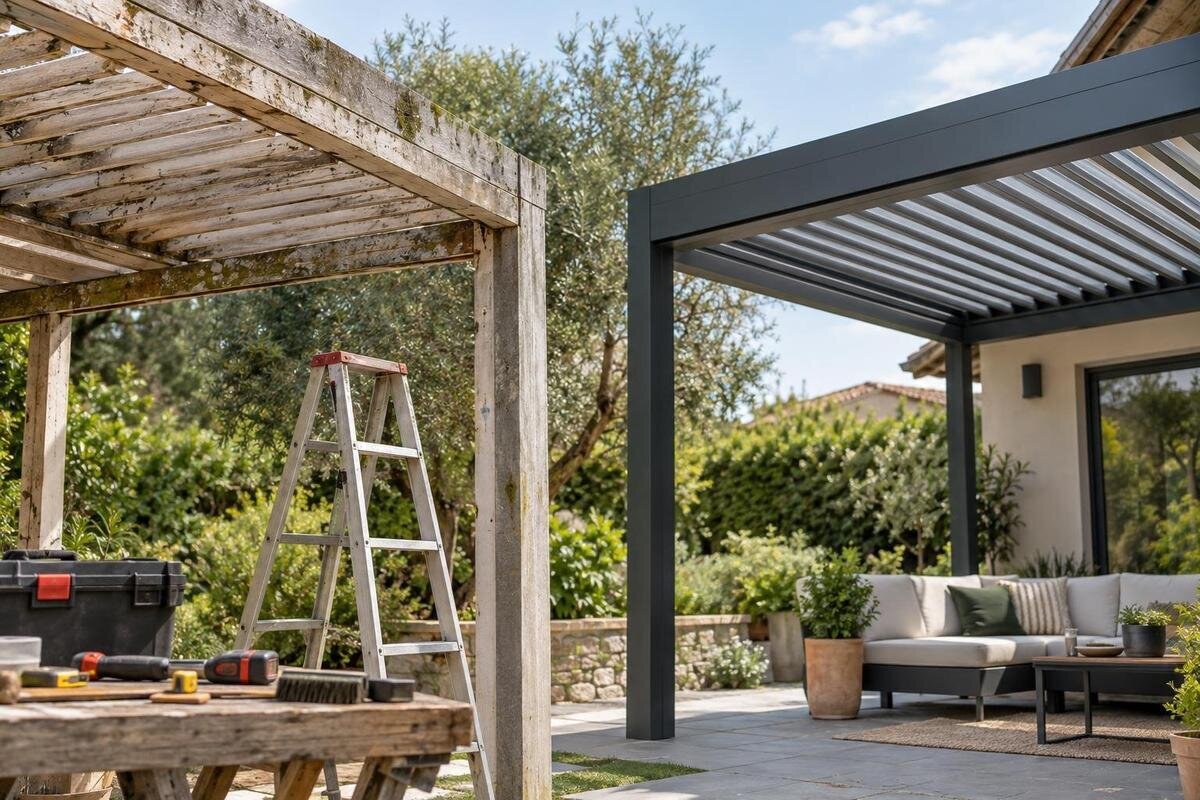
Pergola repair and replacement
An older pergola may have a repairable fault, an unavailable part, or a problem that extends beyond one component. Age alone does not settle which route makes sense. A sound decision depends on identifying the model, documenting what has changed, confirming compatibility before ordering parts, and comparing the full repair scope with the work required for replacement. Use this checklist to separate visible wear from issues that need professional assessment, ask more useful service questions, and avoid comparing a small parts price with an incomplete replacement estimate.

Identify the pergola and its service history
Before comparing costs, identify exactly what is installed. Gather the purchase confirmation or invoice, manual, order or serial number, installation record, and earlier service invoices. Note whether the pergola is freestanding or attached to a building, and list accessories such as screens, lighting, or controls if present. Record when components were installed or changed, not just when you bought the main structure. These details help a service provider distinguish the original system from later additions and help a parts desk check the right version. Keep the records together so you are not reconstructing the history from memory each time.
If paperwork does not identify the model, take an overall photo and clear close-ups of labels and the affected area from a safe position. Do not identify a model from appearance alone or order a part because it looks similar; revisions may differ. Ask the supplier to confirm the exact identity and part match before purchase. Record any information you cannot recover, including who originally supplied or installed the structure. Missing records are a question to resolve, not proof that repair is impossible. Keep replacement research in a separate file, where you can save options such as Bloomcabin Bioclimatic Aluminum Pergola. That separation prevents a current product name from being mistaken for the identity of your older pergola.
Separate visible wear from changes in movement or stability
Describe what you can see without turning a visual impression into a diagnosis. Faded color, scuffs, or isolated finish damage may affect appearance, but none alone tells you whether the pergola needs replacement. Equally, clean-looking surfaces do not confirm the condition of connections or moving parts. Record where a mark or change appears, whether it is spreading, and when you first noticed it. Note separately any gap, shift, wobble, misalignment, sag, or unusual sound. Avoid pushing, pulling, loading, or cycling parts to test them. The goal is a useful record for assessment, not a home strength test.
Treat movement or separation differently from cosmetic wear. A support that appears displaced, a connection that has opened, a member that looks distorted, or a mechanism that moves unexpectedly deserves prompt attention from a qualified professional. Do not force a mechanism or try to tighten parts as a test. If operation seems unsafe, stop using the affected area and keep people clear while you arrange an assessment. A visible symptom may come from one component or a wider issue; a photograph can document it, but cannot establish the condition of the full assembly.
Build a clear record of the fault
Write down when the problem began, which part is affected, and what happened immediately before you noticed it. Include whether it has occurred once or repeatedly, whether it changes over time, and which controls or components were involved. If relevant, note conditions such as recent service work or a visible obstruction, but separate observations from assumptions about cause. For example, describe that a control was used and the mechanism did not move, rather than diagnosing a failed motor. A precise account helps a technician decide what information or inspection is needed before proposing a repair.
Take a wide photo to show the affected area in context and close-ups of the symptom, labels, and any visible part number. Make photos or video only from a safe position; do not remove covers, detach components, or expose wiring to get a better view. Send original images where possible, and label each one with its location so a service provider can follow the sequence. Include the manual and earlier service records if available. A short, factual description plus clear images is more useful than a long list of possible causes.
Confirm parts availability and compatibility before ordering
Ask the parts provider to verify the model and revision, the exact part number, and any details needed to distinguish similar components. Depending on the part, a match may also depend on its position or connection to adjoining components. A visual resemblance is not proof of compatibility. Ask whether the exact part is available, whether related pieces are needed, and whether the proposed replacement is confirmed for your system. If the part is no longer supported, ask what service options remain instead of assuming a substitute will work.
Do not improvise with an unverified substitute or bypass a control because the original part cannot be identified. Find out whether the proposed work is limited to one component or requires a larger assembly, and ask what manual or parts documentation supports that scope. Request written confirmation of compatibility and a list of everything required for the repair, including any associated components the service provider specifies. Also clarify who will supply the parts and who will be responsible for installation, so neither party assumes the other has checked the match. If no supported parts option emerges, Bloomcabin Lean-To Pergola can be included in a separate replacement shortlist. An unresolved parts inquiry and a replacement proposal should remain distinct options until you know what each involves.
Look for the cause behind repeat repairs
Put past work in date order and note what symptom each repair addressed, what was changed, and when the problem returned. A recurring fault can mean that the first repair did not address the underlying cause, but recurrence alone does not prove that the whole pergola needs replacing. It may also help to record relevant observations, such as a visible obstruction or a change near the affected area. Do not try to investigate connections, supports, or wiring yourself. Ask the service professional to explain what evidence points to the cause and whether nearby components were assessed.
A useful service summary distinguishes a confirmed cause from a possibility and says what remains unexamined. Ask what could make the same problem return and how the provider will determine whether the proposed repair has resolved it. Compare the dates and descriptions of earlier faults: an identical symptom after every repair raises a different question from unrelated issues spread across several years. Where service records are incomplete, mark the gaps rather than treating remembered details as confirmed findings. If a replacement comparison includes Bloomcabin Pergola, identify which current problems the new project is intended to resolve. A change of product will not necessarily address a separate site or attachment issue. The comparison should therefore distinguish work on the pergola itself from any surrounding conditions that a professional says also need attention.
Compare the full cost and scope, not just one part
For a repair, ask for a written scope that separates inspection or diagnosis, parts, labor, access, and any follow-on work. Clarify which findings are confirmed and which costs could change if another issue appears during service. Include removal and disposal of old components, if needed, rather than comparing only a part price with a replacement product. If more than one repair is proposed, ask whether the work can be grouped and what each item is intended to resolve. Distinguish a diagnostic visit from authorization to carry out the repair: agree on what happens if the inspection reveals a larger problem. Ask whether you will receive a revised estimate before additional work proceeds. Keep unknown costs visible rather than entering them as zero in your comparison. A lower initial figure is not necessarily a lower total if substantial work remains outside the quoted scope.
For replacement, compare the complete project: product, removal and disposal of the old pergola, installation, site work, and any accessories or existing connections that need attention. Ask which items are included and which are assumptions, and make the repair and replacement estimates cover comparable outcomes. A product page such as the bioclimatic pergola listing can identify a model for research, but it is not a complete project budget or an installed quote. There is no universal repair-cost percentage that decides the issue; judge the scope, uncertainty, and result you need together.
Check the site and attachments before considering a replacement
A replacement is a new site-fit decision, even when it will occupy the same general area. Record the accessible footprint, the space needed for doors and walkways, and how the area is used. For a wall-attached pergola, note the existing attachment area; for any type, note visible paving or other nearby features. Do not assume that old holes, supports, or surfaces can be reused. Have a qualified professional assess attachment points and site conditions before treating a product description or rough measurement as confirmation of fit. The wall-mounted pergola listing can help name a model category for an enquiry, but it cannot confirm your wall, anchor points, or footprint.
Make a separate list of accessories and connections you expect to keep, such as screens, lights, or controls. Record their model information where possible and ask whether they can be used with a replacement; do not assume that an accessory will transfer just because it is nearby. For each item, record whether the proposal includes reuse, removal, replacement, or a decision after inspection. Consider access for service, the work needed to remove existing items, and how much disruption the project can accommodate. Describe practical constraints such as a narrow route to the patio, furniture that must be moved, or landscaping you want protected. Ask the installer which constraints affect the proposed work rather than trying to prescribe a removal method yourself. This inventory gives the replacement estimate a defined scope and makes it easier to spot an omitted accessory or restoration task before agreeing to the project.
Use qualified professionals for complex or uncertain work
Get qualified service help when the issue involves movement, connections, supports, powered mechanisms, or wiring, or when the fault is not clear. Do not open electrical enclosures, bypass controls, or dismantle parts to investigate. When arranging the assessment, describe the type of pergola, the symptoms, and any immediate concern about using the area. Ask whether the provider has experience with the system and whether another specialist may be needed for part of the work. Share the records and photos before the visit if requested, but leave the diagnosis to the assessment. Establish whether the appointment is for inspection only or also includes authorized repair work, and who will explain the findings afterward.
Ask for findings and proposed work in writing, including what was inspected, what remains uncertain, and which part or assembly needs attention. Agree on how the completed repair will be checked by the service provider and what service record you will receive. Retain the installed part numbers, the date of the work, and any instructions supplied for subsequent use or care. If replacement is being quoted, include Bloomcabin’s lean-to model as a product to discuss with a qualified installer, alongside your site records and intended layout. Ask who will coordinate removal, installation, and any specialist work, especially if different contractors are involved. Clear responsibility matters in either option: you should know whom to contact about an incomplete task or a returning symptom without having to reconstruct who did what.

Choose repair when the fault is limited and supported
Repair is a stronger candidate when the issue has been identified, the exact compatible part is confirmed, and a qualified professional finds a clear scope for the work. The assessment should address the cause, not only replace the visible failed piece, and should make clear what other areas were checked. Check the relevant manual and any applicable warranty terms before authorizing service; do not assume that a repair is covered or that it has no effect on coverage. These conditions do not guarantee a particular result, but they make the decision more evidence-based.
Consider how well the existing layout and function still suit your needs, whether the proposed work is bounded, and whether the total repair estimate is understandable. Do not let earlier spending alone decide the next step; compare what each option requires from this point forward. Separate essential repairs from optional appearance changes or upgrades so that the repair total is not inflated by work you would not otherwise choose. Likewise, do not compare a basic repair with a replacement package containing extras you do not need. Use the regular pergola listing as one reference when defining that alternative, then obtain a project estimate for the chosen scope. Repair can remain a sensible choice even when it leaves an older finish or fewer features, provided those limitations are acceptable to you and the assessed fault can be addressed.
Consider replacement when the repair path remains uncertain
Replacement deserves serious consideration when the exact parts or service path cannot be confirmed, the same issue keeps returning, or an assessment finds that several components need work. It may also be the more practical route when the repair estimate depends on unresolved assumptions or cannot restore the use you need. None of these signs makes age alone decisive, and an unavailable part does not automatically prove that replacement is the only option. Ask a qualified professional to explain whether there is a supported repair path and what risks or unknowns remain in each estimate.
Before choosing a new pergola, write a brief for the project: intended use, available space, attachment type, accessories, and what must change from the old setup. Rank those changes as essential or optional. For example, preserving a clear route through the patio may be essential, while changing the appearance may be a preference. Compare product information with a full installation and site-work scope, rather than relying on a name or image to establish suitability. Bloomcabin’s bioclimatic model can be one listing in a shortlist; verify its configuration, dimensions, and project requirements separately. Review the proposal against your brief and identify any requirement still awaiting confirmation. This gives you a concrete way to judge replacement: not simply whether the product is newer, but whether the complete project addresses the shortcomings that made continued repair less attractive.
Frequently asked questions
What should I include in a pergola parts request?
Share the model or serial details, purchase or service records, the affected part’s location, and clear photos of the overall unit and the fault. Describe what happened without guessing at the cause, and ask for compatibility to be confirmed before ordering.
Can I use a part that looks identical?
Not without confirmation. Similar-looking parts may belong to different models or revisions. Ask the supplier to verify the exact match using your pergola’s identification details and any relevant part number.
How many repairs mean it is time to replace a pergola?
There is no useful fixed number. Consider whether the same fault returns, whether its cause has been identified, and whether the total repair scope is clear. Several unrelated fixes do not automatically mean replacement is the better choice.
Can I troubleshoot a pergola’s wiring or controls myself?
Do not open wiring enclosures, bypass controls, or dismantle components to diagnose a fault. Describe the symptoms and have electrical issues assessed and repaired by a qualified professional familiar with the system.
What should a replacement estimate include?
Ask for the scope to distinguish the product from removal, disposal, installation, site work, and any accessories or existing connections that need attention. Confirm what is included, what remains uncertain, and what would change the estimate.
The choice is not simply old versus new. It is whether there is a verified, supportable repair with a clear scope, or whether the remaining uncertainty makes a new project more realistic. Keep model records, fault notes, parts confirmation, professional findings, and comparable estimates together. That evidence helps prevent both premature replacement and repeated spending on an incomplete fix.
