
Buying a Replacement Pergola: Can Existing Foundations Be Reused?
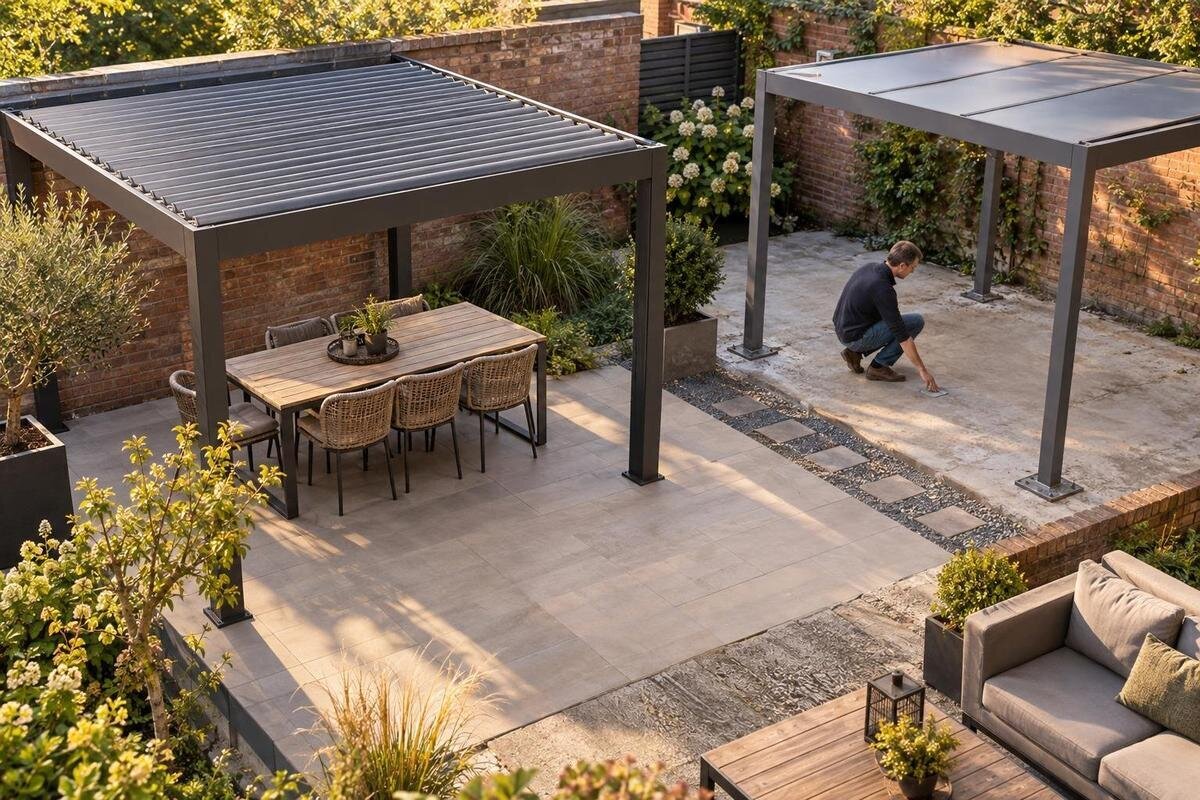
Pergola buying guide
Yes, an existing pergola foundation may be reusable, but matching the old footprint is not enough. A replacement must place its posts where the existing supports can serve them, allow a compatible anchoring method under its installation instructions, and suit the actual condition of the concrete, deck, or other base. The buying decision has two parts: compare the new pergola’s documented post layout and anchoring requirements with what is on site, then have any structural uncertainty assessed before ordering. If a measurement, support type, or condition is unknown, treat reuse as unconfirmed rather than counting on it as a guaranteed saving.

The three checks that determine whether reuse is possible
Treat reuse as a compatibility question, not as an automatic benefit of having concrete in place. Three checks have to agree: the existing base must be in suitable condition; the replacement’s posts must align with supports that can serve them; and the new anchoring method must be allowed by the model’s instructions and appropriate for the base. A pergola that looks similar, has a comparable outside size, or once stood in the same spot does not establish those facts. The previous structure may have used a different post pattern or attachment, and the base may have changed since it was installed. Keep reuse provisional until the layout, condition, and documentation line up.
Separate what you know from what still needs confirmation. An old manual, installation drawing, construction photos, or invoices may show where the original supports were and what hardware was used; memory or the outline of the old frame usually cannot. Request the dimensioned layout and anchoring instructions for the exact replacement model and configuration. A page such as the Bloomcabin pergola listing for initial comparison can identify a candidate to investigate, but its name alone cannot establish that its posts or anchors match yours. Until the product details and site conditions are clear, compare choices without treating foundation reuse as a promised saving.
Compare post locations, not just overall dimensions
Make a top-down sketch and mark every existing post location, not just the outside rectangle of the old pergola. Measure between post centers and from each center to a fixed reference, such as a slab edge or building wall. Note the reference and the pergola’s orientation so someone else can understand the measurements. Record whether a post sat on a separate pier or on a shared surface, and photograph the measuring points. If the old posts are still standing, their locations are useful evidence, but the finished frame can hide the base plates. Label any uncertain measurement rather than estimating it. A clearly marked sketch gives an installer and product support team something specific to compare.
A product’s advertised width and depth may describe the outside of the frame rather than the spacing between its posts. Use the dimensioned installation drawing for the exact model and configuration, not a gallery image or a rough visual estimate. Compare each post center with the existing support positions, and check whether the drawing identifies the base-plate footprint as well. If the required layout is not shown, ask for it before treating a candidate as compatible. The Bloomcabin pergola page to compare can help identify a product under consideration, but verify its exact dimensions and instructions separately rather than inferring them from the page name.
Identify the existing support and inspect its condition
Work out what is actually beneath each post. The old structure may have stood on a continuous concrete slab, separate piers, a framed deck, or a finished patio surface over another support. These are different starting points; the visible surface alone does not show how support is provided below it. Look for installation records, accessible edges, and exposed bases, and note if any support locations are concealed. Do not infer a footing’s dimensions or depth from a patch of concrete, or assume that pavers or decking are the structural element. If the records are missing, say so rather than filling gaps with estimates. That distinction helps a qualified installer decide what can be assessed from the available evidence.
Photograph each post location and any visible damage before removing old materials, if the pergola is still in place. Cracking, spalling, displacement, persistent standing water, loose hardware, corrosion, or a post that has shifted are reasons to pause and request a professional assessment; none is a stand-alone diagnosis, and a clean-looking surface does not prove that hidden supports are suitable. Keep these observations beside the documents for the candidate you are considering. For example, a product page for a Bloomcabin pergola can identify the product under review, but it cannot establish the condition of the base beneath it. Do not make a reuse decision from photographs alone.
Match the replacement’s anchoring instructions
Read the anchoring section of the installation instructions for the exact replacement model. It should tell you what attachment arrangement the product calls for and identify any stated conditions for installing it. Compare those requirements with the existing base and attachment points, including the position of the anchors and the shape of the post base. A familiar-looking plate or a bolt that appears to line up is not enough to establish a match. If the documentation does not explain the required arrangement, ask the seller or manufacturer for the exact instructions rather than relying on a product photo. This check is separate from measuring the overall pergola: correct outside dimensions cannot confirm that the anchor interface is compatible.
Old bolts are not automatically reusable just because they remain in the concrete or appear to fit. Their type, condition, and placement still need to match the replacement’s instructions. Do not assume you can enlarge existing holes, drill new ones, add spacers, or substitute hardware to make two patterns fit together. Those changes may depart from the model’s specified installation and should not be improvised. For a Bloomcabin pergola option under consideration, obtain the exact installation information and ask an installer to explain any mismatch. If the proposed arrangement is not addressed by the instructions, keep the foundation’s suitability unresolved until it has been reviewed by a qualified professional.

Account for changes at the site
The site may not be the same as when the original pergola was installed. Repaving can change the finished surface level; landscaping, excavation, or redirected drainage can alter the area around a support; and a base may have settled or become concealed over time. A new surface finish can also make it harder to see what is underneath. Note these changes and share them with the person assessing the site. The fact that the former pergola stood there does not establish the condition of the base today, nor does it show that the replacement has the same installation requirements. Keep site history separate from measurements so that neither is mistaken for proof of compatibility.
The replacement’s instructions may specify conditions for its installation or anchoring. Do not transfer assumptions from the old pergola if the new model or configuration is different. Tell the installer about notable wind exposure, snow accumulation, drainage issues, or other unusual site conditions; do not try to calculate foundation capacity yourself. Use a candidate page, such as a Bloomcabin pergola listing to review, to identify the exact product, then request its model-specific instructions and have a qualified professional relate them to the actual site. This is especially important when records are incomplete or the existing supports cannot be fully seen.
Check whether the new pergola uses the same support arrangement
A replacement can differ from the old pergola in more than its outside dimensions. One design may be freestanding while another relies on a building connection; post counts and positions can also vary. An existing footing below an old post does not answer whether a different support arrangement is appropriate. A wall attachment raises a separate question about the building connection, which is not confirmed by ground footings. Compare the exact installation drawing and identify every support the new design requires. Do not infer the arrangement from a product photograph or a general description; a clear view of the frame may not show how it is anchored.
If the replacement changes how it is supported, have the installer review the complete arrangement rather than checking only the old concrete. Ask for the drawing for the exact configuration and make sure it shows post locations and any building attachment. That gives you a basis for deciding whether existing supports can be part of the plan or whether the installation needs to change. For this listing for a Bloomcabin pergola, obtain the exact configuration’s installation information rather than assuming its support layout from the listing. If the documentation leaves the connection unclear, get an answer before ordering; an apparently convenient match at ground level does not settle the rest of the support question.
Fit the new frame around the fixed foundation
Existing foundations fix where some or all of the posts can go, so check whether the replacement will fit the space as well as the supports. Compare its documented frame dimensions and projections with doors, windows, walkways, and access points you need to keep clear. Consider where rainwater drains and whether the new arrangement would obstruct access to the area. Use the installation drawing to understand the structure’s full outline; the position of the posts may not describe the entire area occupied by the frame. These are practical layout checks, separate from the professional assessment of the foundation itself. A post pattern that aligns can still leave the pergola poorly placed for how you use the space.
Do not assume that two products with the same advertised footprint have the same post layout, or that a different outside size cannot align with the existing supports. The dimensioned drawings answer those questions. If a fixed foundation rules out your preferred layout, compare another model with a documented arrangement that fits, or include new foundation work in the project plan. Avoid moving a post off its support or using an unapproved offset just to preserve the old footprint. When comparing one Bloomcabin pergola option, use its exact drawings alongside your site sketch; the product name and outer dimensions are not a substitute for that comparison.
Resolve installation scope before placing the order
Before checkout, ask for two separate reviews: whether the candidate’s documented post and anchor layout can work with the existing base, and what installation work the site will require. Share your sketch, photographs, known support type, and any records with the installer. Ask what additional information is needed to assess reuse and which questions can be answered from the product instructions. A seller’s general product information is not a site-specific assessment, so keep those roles distinct. For the Bloomcabin pergola product listing under review, request the exact installation documents for the configuration you plan to buy; do not assume that a general listing contains every detail needed for your site.
Ask the installer to describe the scope and assumptions behind any estimate. It can be useful to compare the proposed work if existing supports are retained with alternatives involving repair or new support work, provided the installer has identified what each option includes. Clarify whether the assessment, removal of old hardware, foundation work, and pergola assembly are included or handled separately. The purchase price alone does not tell you whether reuse will reduce the total project cost. Review the seller’s delivery and return or exchange terms before ordering, and do not assume a change of model or plan will be cost-free or simple.

When to reuse, pause, or replace the foundation
Reuse is a reasonable option to consider when the post positions match the replacement’s documented layout, the anchoring instructions permit an arrangement compatible with the existing base, and a qualified site review supports using it. The decision should rest on those confirmations, not merely on an undamaged-looking surface or the fact that the old pergola remained standing. Pause if the footings are hidden, measurements are uncertain, visible movement or damage needs review, or the instructions do not cover the existing anchors. In those situations, the next decision is whether to get more information, arrange an assessment, or choose a plan that does not depend on reusing the base.
If the new post layout does not line up, you can compare a different pergola configuration or ask a qualified professional to plan new or altered supports. Do not try to make the existing foundation work by shifting posts or adapting anchors without confirmation that the arrangement is permitted. Reuse may also be possible for some supports but not others; do not treat a partial match as approval for the whole installation. Ask the installer to define what is being retained and what work remains. Comparing those clearly described options before purchase helps you weigh the product choice and installation scope together.
Information to gather before ordering
Put the existing and proposed installations side by side on paper. For the old pergola, gather its model information if known, any manual or installation records, photographs, measurements of post centers, and notes on the visible condition and type of supporting surface. For the replacement, obtain the exact model and configuration, dimensioned post layout, and anchoring instructions. Mark what you do not know, such as a concealed footing or missing measurement, instead of treating it as confirmed. A short, labeled sketch and a few clear photographs are often more useful for a first review than a long description of how the old frame looked.
Share that information with the installer and ask specific questions: Do the new post centers align with the existing supports? Do the instructions allow the existing type of base and anchoring arrangement? Is an on-site assessment needed before reuse can be considered? Ask for the proposed scope and any assumptions in writing so you can compare it with the product documentation and purchase terms. If the answer depends on an inspection, make that dependency clear before committing to a reuse plan. If you intend to install new supports instead, give the installer the same product documents and site layout so the new work can be planned around the exact pergola.
Frequently asked questions
Can any concrete footings be reused for a pergola?
Not just because they are concrete. The support locations, condition, and anchoring method all need to suit the replacement pergola. A qualified professional should assess concealed or damaged footings. Concrete alone does not make a different post layout compatible.
If the replacement is the same size, will the posts line up?
Not necessarily. Overall width and depth do not establish the distance between post centers, and a similar frame can have a different base-plate or anchoring arrangement. Compare the exact installation drawing and post measurements, not only advertised dimensions or photos.
Can I tell whether a foundation is sound by looking at it?
A visual check can flag concerns such as movement, cracking, spalling, standing water, or loose or corroded hardware. It cannot establish the condition of buried footings or confirm suitability for a different pergola. Record what you see and have a qualified professional assess anything uncertain.
Can I keep using the old anchor bolts?
Do not assume so. Reuse depends on the replacement’s instructions, the exact anchor type and condition, and the existing base. Have an installer confirm that the proposed arrangement is permitted. Do not drill, alter, or substitute parts simply to force a fit.
Should I order the pergola before checking the foundation?
If reusing the foundation affects which pergola you choose, resolve the post-layout and anchoring questions first. Get the exact model documents and an installer’s assessment. If you plan to build new supports regardless, still confirm the product’s installation requirements before scheduling the work, and check the seller’s return terms.
Replacing a pergola does not automatically make the old foundation reusable or unusable. The answer comes from comparing the measured positions and condition of the existing supports with the selected model’s exact post layout and anchoring instructions. If those details align and a qualified site review supports reuse, you can buy with a defined installation plan. If they do not, compare a different post layout or the scope of new support work before committing. That keeps an uncertain foundation from narrowing the purchase too soon.
