
Replacing Pergola Seals: Finding the Correct Profile
Pergola care and replacement parts
Replacing a pergola seal is a parts-identification job before it is a cutting job. The same visible gap can involve different seals, and strips that look alike may have different cross-sections or retention methods. Start by locating the exact run, recording the pergola model and version, and photographing the installed part in context. Then ask for a seal matched to that model and position. This guide explains what to collect and what to confirm before ordering; it does not treat generic weatherstripping as a safe substitute.
Why the exact seal profile matters
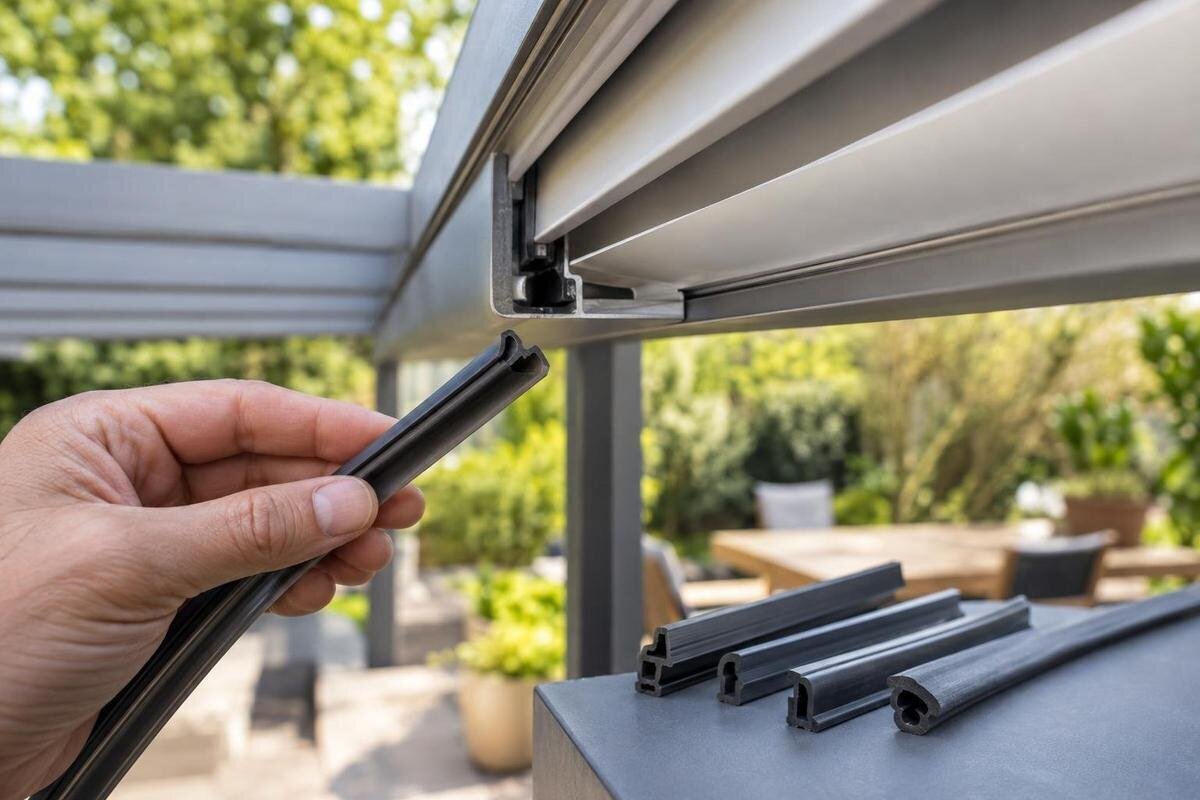
A pergola seal is not simply a decorative edge. Depending on the design, a profile may close a joint, cushion contact between parts, or help seal an opening; its shape and retention method matter. One seal may have a hollow bulb, lip, fin, or shaped base, while another may sit in a groove or separate carrier. Those descriptions identify broad shapes, not standard dimensions. A replacement with a similar color or width can still fail to seat, work loose, affect how adjoining pieces meet, or obstruct a moving part. The correct match is defined by the profile and its position in the assembly, not by appearance alone.
Separate what you observe from what you can conclude. A flattened, split, or loose edge may be a damaged seal, but it does not by itself identify the correct part. Water appearing nearby can also come from a neighboring joint or another part of the assembly, so note the precise location and conditions rather than assuming the first visible strip is the cause. Photograph where the symptom appears and what is directly beside it. If two components overlap or the seal disappears into a channel, describe that uncertainty in your request instead of naming a part with confidence.
Locate the seal on the pergola
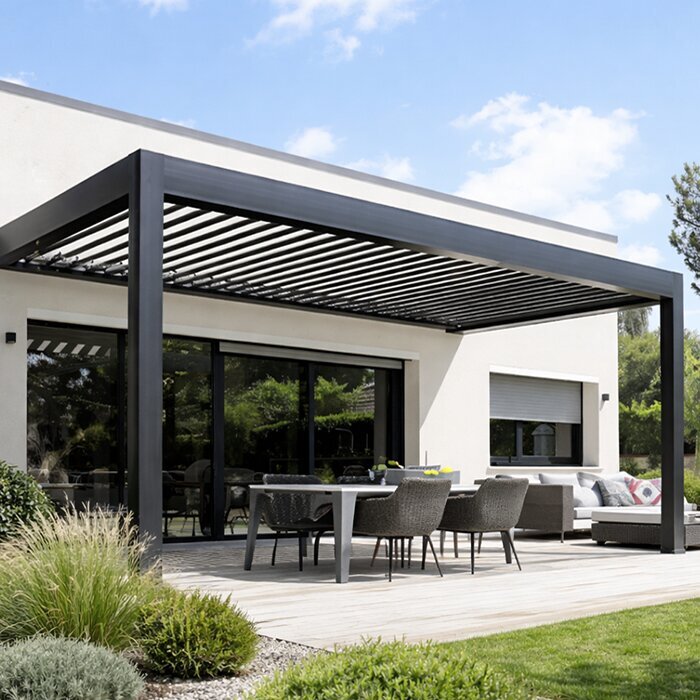
Take one photo that shows the whole pergola and another that locates the suspected seal on a particular edge, bay, or junction. Write down how you are orienting the view: for example, standing in the yard facing the house, the left roof edge, or the outside face of a post. Terms such as front and left can be ambiguous in a support exchange. Note whether the seal appears to be on a fixed part or beside a component that moves, and identify a wall-side or open edge only where relevant. Do not remove trim just to get a better view.
Include the nearest frame, channel, panel edge, or adjoining strip in a close-up so the location can be recognized; a crop of an isolated line often cannot. Mark the suspected piece with an arrow on a copy of the photo, and label multiple locations A, B, and C rather than relying on memory. Keep the unmarked original too, so the annotation does not cover the edge. Use the exact model name from your paperwork as another identifier. If it says Bloomcabin Lean-To Pergola, the Bloomcabin Lean-To Pergola listing can help you copy the catalog wording; it is not a seal compatibility chart.
Identify the model, version, and history
Check the order confirmation, invoice, manual, installation paperwork, or a visible identification label. Transcribe the model name as printed and record a serial, product code, or revision only if one is shown; do not guess a missing suffix. A photograph of a label is more reliable than a handwritten paraphrase, but do not remove covers or reach into a mechanism to look for it. Note the purchase or installation year if known, and whether an installer later replaced or modified any adjacent component. Those details help distinguish the original build from a changed configuration.
Keep the model family, size, and production version separate in your notes. A broad model name may not identify every revision, so use the manual or parts sheet supplied for the actual unit, not a document chosen only because the frame looks similar. If your records identify a Bloomcabin Pergola, copy that exact name from the Bloomcabin Pergola product listing and attach the paperwork that belongs to your unit. The listing is an identity reference; it cannot confirm that a particular profile fits. If no label or paperwork remains, say so and send photos instead of assuming a model year.
Photograph the seal without dismantling it
Make a small photo set rather than relying on one close-up: a full-unit view, a mid-range view showing the seal's location, and a focused detail of the edge or an exposed cross-section. Keep the camera square to the end of the profile when possible; an angled view can make a lip or groove appear wider or shorter. Put a ruler beside an exposed piece, in the same plane, if support asks for scale. Check that the image is sharp enough to show a hollow center, projecting fin, or retaining base, and preserve the original file at full resolution.
Only photograph an end face that is already visible or a sample removed in a way the manual permits. Do not pull a seal out just to create a cross-section if doing so could damage the channel or put you near moving components. If a loose offcut is already available, label where it came from and photograph it without stretching or flattening it. Save a separate picture of the whole run before moving anything. For a unit identified in your records as Bloomcabin Bioclimatic Aluminum Pergola, the catalog page for the bioclimatic aluminum model provides the full name for your photo labels. Include the location and view in each filename so support can connect the sample to the installed strip.

Measure only what you can reach safely
Take dimensions only when they can be reached safely and will help answer a support question. On an exposed sample, record the overall height and width of the cross-section, the width of its base, and any visible lip, bulb, or stem that defines its shape. Measure the channel separately if it is accessible without disassembly, and keep its measurements distinct from those of the seal. Record the seal's run length as a separate measurement; do not confuse a short cross-section with the total material needed. State the units and whether a figure is approximate. Use a ruler or caliper only where it fits without forcing or deforming the material.
An old part can be compressed, torn, or distorted, so measurements from it are clues rather than a specification. Do not estimate a hidden groove or turn a partial reading into a precise number; tell support what you could not measure. If the seal is missing, a gap measurement alone cannot reconstruct its original cross-section. For a unit identified as the model on the Bloomcabin Bioclimatic Aluminum Pergola page, keep a measurement sheet with the unit records. Label each dimension on a photo or simple sketch, distinguishing the retaining base from the flexible sealing portion. Record whether you measured an installed piece or a loose sample, since those readings may differ. Leave unavailable dimensions blank rather than calculating them from a photograph.
Distinguish the seal from nearby retainers
An exposed line in a pergola frame is not always the seal itself. It could be a cover, trim, retaining insert, carrier, brush, or part of a channel, and some designs keep the seal captive in a separate track. The visible piece may sit alongside the sealing element rather than perform the same job. Parts diagrams may name these pieces separately, so ordering a seal without a required retainer—or removing the retainer as if it were a gasket—can leave an incomplete repair. Treat each item as a possibility until a drawing or support contact identifies it.
On an annotated photo, point to the exact strip you mean and use cautious wording such as suspected seal or visible insert. Add a second arrow to a neighboring part if it touches or holds the strip. Ask whether the diagram shows one component or a seal-and-carrier assembly, and whether the visible piece is intended to come out separately. For a unit documented as the model on the regular Bloomcabin Pergola product page, list the requested components under that model name. Have support distinguish parts supplied with the seal from parts that must be ordered separately or retained from the existing assembly. This avoids an incomplete order without assuming that every neighboring piece needs replacement. A parts drawing identifies components; it is not a removal procedure.
Use the right manual or parts drawing
Look for the manual, parts list, or technical drawing associated with the exact model and version. In a drawing, check the callout for the relevant edge and note the part number, label, figure, and page. Search the document's own wording—such as seal, gasket, or weather strip—rather than assuming the manufacturer or installer uses the same term you do. A drawing may show a profile from one angle but omit its size or orientation, so use it to locate the component, not to infer specifications that are not printed.
If you do not have the right document, ask for the parts drawing or written identification of the seal for that exact position. For a unit documented as Bloomcabin Lean-To Pergola, include the name shown in the Lean-To Pergola catalog entry along with your unit records and context photos. Ask which document edition applies and whether the callout identifies the seal alone or a complete assembly. If two documents show different numbers, send both references and ask support to resolve the difference rather than choosing the newer-looking illustration. Record any confirmed superseding part number beside the original callout. Keep the relevant page and written response together so the basis for the replacement remains clear.
Prepare a complete replacement-parts request
Put the information in one labeled request so details stay connected to the correct pergola. Include the full model name, any visible serial or revision, the order or installation date if known, the seal's location, and a short description of what you see. Attach the unmarked overview, the marked location photo, close-ups, any relevant manual page, and measurements with units. If several seals need attention, label each photo and say whether you are asking about one position or several. State whether you have a loose sample and how it was obtained; an unlabeled piece cannot be tied reliably to its original location.
Keep the request specific: ask for the approved replacement profile for this model and location, not a strip with roughly the same width. For a unit documented as Bloomcabin Pergola, the Bloomcabin Pergola model page provides a catalog-name reference to include with the unit records. Explain the scope of the request: one damaged run, several positions, or identification of a missing strip. Give each position its own photo label and measured length so support can quote the correct quantities without treating different profiles as one item. Include your order reference if available, but avoid putting personal account details on annotated photos. Ask for a written parts recommendation and the applicable installation instructions, and mark missing information as unknown.

Confirm compatibility before ordering
Compare the written answer with your notes before ordering. Check that the part number is for the exact model family and version, the stated location matches your annotated photo, and the profile description or drawing matches the seal—not just a neighboring cover. Confirm whether the answer includes a separate retainer, end piece, corner, or other mating component. If the response is based only on a nominal width you supplied, ask what document or fit reference ties it to your pergola.
Clarify the quantity and format before anyone cuts the material: how much is supplied, whether the replacement is a continuous run or separate lengths, and whether the maker approves cutting or joining it on site. Ask how ends, corners, and joints are handled if your location includes them. Do not assume a long generic roll can be trimmed to become equivalent. For a unit identified as the model on the wall-mounted pergola listing, check that the quote uses the full model name and identifies each requested position. Distinguish the number of pieces from their individual lengths, and confirm the units used on the quote. Resolve any discrepancy between the quotation and the written compatibility response before placing the order.
Know when to use a service professional
If reaching the seal requires opening a cover, removing a structural-looking piece, accessing a motorized roof or screen mechanism, or working at height, stop at the information-gathering stage unless the exact manual gives a clear owner procedure. Do not put hands or tools into a moving assembly or assume a powered component is safe because it is still. Contact the manufacturer or a qualified service professional when removal or access goes beyond documented steps. A repair that seems minor can still create a fit or operating problem if a seal is placed in the wrong path.
Use only the replacement and method confirmed for the unit. A generic adhesive, caulk, screw, staple, splice, or stretched strip may hold the wrong profile in place without solving the mismatch; do not add one unless the applicable instructions call for it. If the approved part resists seating, protrudes, loosens, or changes how adjacent parts close or move, stop and ask for guidance rather than forcing it. Follow the manual for any post-installation check; do not invent a test that cycles or loads an unfamiliar mechanism.
Frequently asked questions
Can I use generic weatherstripping if the width looks right?
Only if the documentation for your pergola or a qualified support contact confirms that the profile, retention method, orientation, and intended position match. Width alone is not enough to establish fit. Do not cut or attach a generic strip on the assumption that it is interchangeable.
Which photos should I send with a parts request?
Send a full view of the pergola, a photo showing the seal's location, and a sharp close-up of the strip and neighboring parts. Include an exposed end or cross-section only if it is already visible or can be obtained safely under the manual. A ruler in the same plane can help show scale.
What should I measure on the old seal?
If it is safely accessible, note the cross-section's overall height and width, the base or stem, and the run length as separate measurements. Include units and say whether figures are approximate. A worn or compressed piece can be distorted, so measurements help with identification but do not prove compatibility.
Should I replace only the damaged section?
Follow the parts documentation or ask support whether that profile is intended to be replaced in sections. Confirm whether the replacement is supplied as a continuous run or separate lengths, and whether cutting or joining is approved. Do not assume that a splice or short replacement section will work.
What if I cannot find the pergola model or manual?
Check order records, installation paperwork, any visible product label, or documents kept by the installer. Do not remove covers or dismantle a moving assembly to search for identification. Tell support which details are unknown and send clear photos of the unit and the seal's location.
A reliable replacement begins with the seal's location and the pergola's exact identity, not a guess based on width. Context photos show how the part sits; records and drawings help establish which model and revision it belongs to; measurements add useful clues. Get the profile and position confirmed before cutting or removing anything, and keep the part number and written compatibility answer with the pergola's records. That gives a future repair a clear reference instead of another round of visual guesswork.
