
Rotating or Retractable Pergola Louvers: What’s the Difference?
Pergola roof guide
Rotating and retractable pergola louvers are often described as if they were two settings of one roof, but the terms refer to different movements. Rotating louvers pivot at their supports, changing angle while remaining in place. Retractable roof elements travel along a track or linkage and gather in a storage zone, exposing more of the roof plane. The distinction changes how much open sky is available, how shade shifts, and what must fit around the frame. Some designs may combine motions; the category name alone does not identify the mechanism on a particular model. These are mechanism descriptions, not a promise about which options a seller offers or what mechanism a named model uses.

The basic difference is tilt versus travel
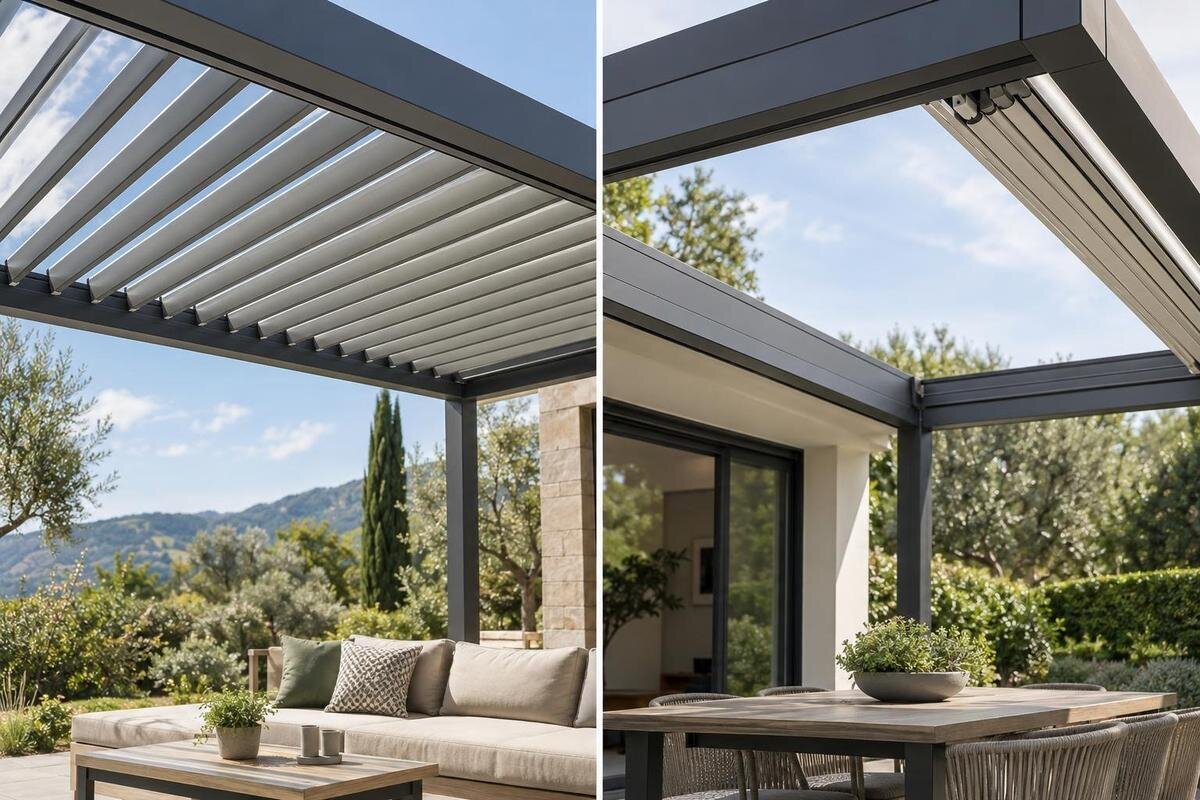
With a rotating system, each louver turns around a fixed axis, usually along its length. The blades keep their positions across the roof; what changes is their angle relative to the frame and the opening visible between them. Think of turning a set of slats rather than pulling them away. A blade still occupies its place overhead even when turned to admit more light. The actual tilt range, blade profile, and direction of rotation are design-specific, so do not assume that every product reaches the same positions. In a drawing, follow one blade relative to its supports: if its axis stays put as its angle changes, it is rotating. A side view can make that distinction easier to spot.
A retractable louver system changes the location of the blades: they travel toward a designated parking area rather than only pivoting at fixed supports. Depending on the design, they may collect into a stack or group at one end. Retraction can uncover an area that rotation alone cannot clear, although a stack, rail, frame, or fixed roof section may remain overhead. The opening may be partial or broad; the name does not promise a completely clear roof. Terms are sometimes used loosely in marketing, so check a movement diagram: does a blade pivot in place, move across the roof, or do both? A retractable fabric canopy is another roof type, not a retractable louver system.
Rotating louvers adjust shade while staying overhead
Rotating louvers are useful when the desired change is the direction and amount of overhead shade, not the removal of roof elements. Turning the blades alters how much direct sunlight can pass between them and where that light falls. A more closed setting generally provides more overhead coverage, while an angled setting can admit light between the blades. The result is a change in light and shade, not a guaranteed percentage or a fixed temperature effect. Blade profile, spacing, the sun's angle, and the user's position all matter. Narrow bands of light can shift as the angle changes, so the experience below may differ between a table near an edge and a seat nearer the center. As the sun changes position, the same setting may also cast a different pattern.
The available tilt range matters as much as the fact that the blades rotate. A system with several useful intermediate positions offers a different shade adjustment from one intended mainly for open and closed settings. If you are considering the Bloomcabin Bioclimatic Aluminum Pergola listing, ask for the documented blade positions rather than treating the product name as proof of a particular mechanism. For a confirmed rotating model, check whether you can choose intermediate angles freely or only at defined stops. Also consider which way the blades tilt: an angle that admits light from one direction may screen it from another. Low-angle sunlight entering through an open side remains a separate issue from overhead shade.
Retractable louvers move aside to uncover the roof
A retractable roof is chosen for a different change: moving roof elements aside to uncover some or all of the area they had covered. The amount of open sky depends on how far the elements travel and how much of the frame is fixed. Retraction may be partial, leaving some blades overhead, or extensive enough to create a broad opening; those outcomes cannot be assumed from the word retractable. A parking bay or stacked bundle can occupy a strip at one end or side, so an open plan view is not necessarily an entirely unobstructed view above. Some systems retract in sections, which can make the open area adjustable without changing a blade angle.
Look for the direction of travel, the position of collected elements, and whether the roof can stop partway. A side elevation or plan view is more informative than a photograph showing one operating position. When comparing the Bloomcabin Lean-To Pergola model page with other candidates, ask which roof mechanism is documented for that exact model; do not infer retraction from the listing name. For any confirmed retractable option, establish whether the entire roof retracts or only one section. That distinction matters if you want to uncover the seating area while keeping another part covered. A drawing of the fully parked blades should also show the location and extent of any fixed strip.
The two mechanisms create different views of the sky
With fixed-position rotating blades, a view upward still passes through or between blades, even at the most open angle shown for that system. The roof may look lighter and admit more direct sky than it does when closed, but the blades remain part of the view. A retractable roof can reveal a clearer patch of sky where elements have moved away, while a stack or structural members may still interrupt the view. Thus, a buyer who wants changing shade and a buyer who wants an open-sky aperture are comparing different results, not simply two versions of the same amount of light. Beams and posts remain part of either structure's sightlines, so focus on the part of the roof that actually moves.
Compare the view from the places where people will actually sit, not just the opening shown from above. A parked stack at the far edge may be unobtrusive from one chair but prominent from another, and a beam can cross the sightline even when the roof beneath it is uncovered. If the bioclimatic pergola product listing is one of your candidates, use its matching roof drawing to assess the view from your planned table or lounge area. A plan view shows where the opening is; a side view helps explain what remains visible from below. Sunlight changes direction over the day and year, so a clear view of the sky does not by itself establish which seats will receive sun or remain shaded.

Ventilation depends on openings and surrounding sides
Both movements can affect air exchange overhead, but neither tells you the whole ventilation story. Rotating blades change the size and direction of the gaps while remaining across the roof. Retracting the roof elements can remove a larger obstruction from above, yet the air path still depends on wind, nearby walls, screens, curtains, and other side closures. An open roof can feel different from an angled louver roof, but no mechanism guarantees a particular breeze or makes an enclosed room ventilated by itself. Wind direction can vary, too, so the amount of air that reaches a seat cannot be read from a roof label alone.
If airflow is one reason for choosing a roof, consider the setup with the sides in their usual positions. An open-sided patio has different air paths from a space bordered by walls or enclosed with screens. For a candidate such as the Bloomcabin Pergola listing, evaluate the documented roof configuration alongside your proposed side treatments, without assuming those treatments are included. Note where a breeze currently enters the patio and whether the planned layout would obstruct it. The relevant choice is whether you want an overhead opening while retaining some shade, or a more extensively uncovered area. Neither choice substitutes for assessing ventilation if you intend to enclose the space.
Rain performance depends on closed-roof details
Rain performance is not settled by whether louvers rotate or retract. On a rotating roof, the closed position may bring blades together or overlap them, but water behavior depends on blade shape, joints, perimeter, pitch, drainage channels, and where runoff is directed. A retractable system may have a different closed-roof arrangement, and an uncovered opening is not a rain barrier. Terms such as weather-resistant or rain protection need to be read in the exact model documentation, with limitations stated for the installed configuration rather than inferred from a mechanism label. The important comparison is what the roof is designed to do when closed, not merely what it can do when open.
Ask how water is collected and discharged, what happens at edges and corners, and whether the manual restricts roof movement during precipitation. For a wall-adjacent layout involving the Bloomcabin Lean-To Pergola listing, the important question is how the documented roof and drainage arrangement would interact with the house. The listing name does not establish that detail. Have a qualified installer assess runoff near doors, siding, a deck, or existing drains using the manufacturer's instructions and the actual site. An outlet that discharges near a walkway or seating area can affect usability even if the roof itself handles water as intended. Do not treat a roof that can close as automatically watertight; rely on the stated rain-protection capability and limitations for the installed configuration.
Controls and maintenance are separate from roof movement
Rotation and retraction do not tell you whether the roof is manual, motorized, or controlled in some other way. Those are separate specification choices. Check what moves, how the control is reached, whether the system has defined stop positions, and what the manufacturer says about operation. A motorized roof is not automatically an automated roof: sensors, weather response, remote access, and integration with other equipment must be explicitly included for the specific configuration. Do not infer a motor, switch, sensor, or control method from an image or from the word bioclimatic. If more than one person will operate it, confirm that the instructions and control location suit the people who use the space. Also distinguish a person-operated control from a sensor-triggered response.
Maintenance follows the movement path. Pivoting parts and linkages need the care set out in the manual; retracting systems may have tracks or a parking area where debris can interfere with movement. For the Bloomcabin Pergola model page, request the matching maintenance instructions to establish which components, if any, need routine attention. Useful questions concern inspection frequency, permitted cleaning methods, and access to wear parts or trapped debris. A parking area beneath an eave may be less accessible than it appears in a product photo. Avoid adding lubricant or adjusting stops unless the instructions call for it. Tasks requiring disassembly or unfamiliar adjustments belong with the manufacturer's support team or a qualified service provider.
Plan for each mechanism's movement and parking space
Every mechanism needs room to move, even if the roof does not extend beyond the posts. Rotating blades sweep through an arc; nearby beams, trim, lighting, fans, or other ceiling-mounted items must not interfere with the path specified by the manufacturer. Retractable elements travel to a parking zone, and the collected stack, drive parts, or guide rails may affect how the roof plane is used. Exact clearances and layout vary, so use the model drawing rather than estimating from a closed-roof photograph. A louver's travel may stay within the perimeter, but the moving parts still need the clearance their design requires.
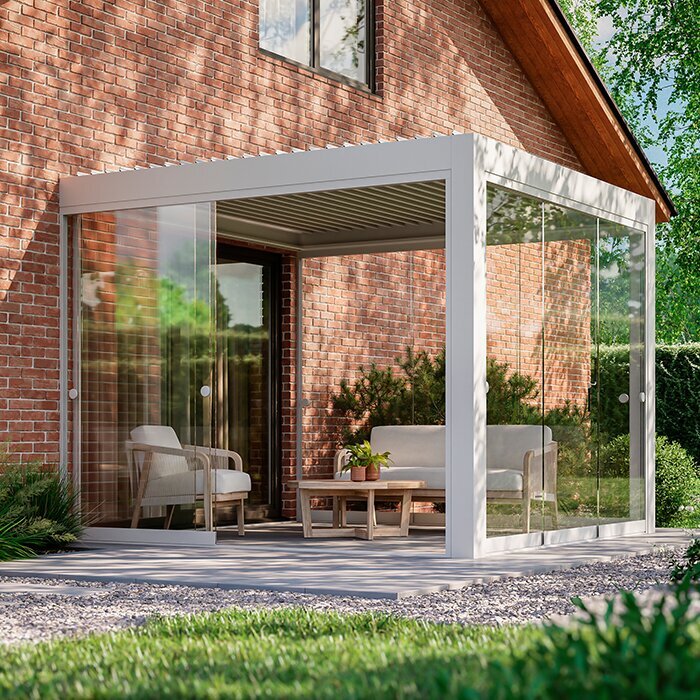
In a wall-adjacent layout, note doors, windows, eaves, downspouts, and access for servicing moving parts; in a freestanding layout, note trees and other overhead obstacles. If retractable blades collect at a particular end, check whether that location conflicts with your preferred opening or access route. When placing the Lean-To Pergola candidate in a layout, have the installer compare its documented roof movement with the surrounding building features. Include any proposed fan, heater, light, or shade accessory in the assessment rather than adding it afterward. The mechanism's movement clearance and an accessory's installation requirements are separate constraints, and both need to be satisfied in the final arrangement.
How to compare drawings and product documentation
Request documentation for the exact model and configuration, not just a general brochure for a product family. A useful diagram shows the roof from above and from the side, indicates which parts pivot or translate, and illustrates the positions available. Confirm whether the roof has a fixed center or perimeter section, where moving elements stop, and what area remains open at the maximum retraction position. Use the Bloomcabin Bioclimatic Aluminum Pergola page to identify the candidate while requesting the matching documentation; the catalog name itself should not be used to label the roof as rotating or retractable. If multiple sizes or arrangements appear, make sure the diagram corresponds to the one being considered.
To make comparisons fair, look at equivalent states for both mechanisms: roof closed, partly open, and at the furthest position the manual allows. Ask what that state changes overhead, what remains in place, and what restrictions apply during movement. Then compare operation, drainage, service needs, and any stated weather conditions using the same level of detail. If a seller's diagram and manual use different terms, ask which components move and request clarification in writing. A named feature is less useful than a clear drawing of the motion and a list of model-specific limitations. Keep those answers with the exact model information so they are not confused with a similar-looking version.
Which mechanism fits the roof position you want?
Choose rotating louvers when your priority is to alter shade and overhead light while the blades remain in the roof plane. Choose a retractable mechanism when making a larger open-sky area is the priority and the required travel and parking zone work in your layout. These are tendencies, not universal rankings: blade design, roof framing, operation, weather limits, and the amount of fixed roof can change what each particular system delivers. If you value both adjustable shade and an open roof, ask whether the exact model combines tilt and travel; do not assume one movement includes the other. A system's ability to stop at intermediate positions may be just as relevant as its maximum opening.
Test the choice against ordinary uses of the patio: do you mainly want partial shade over a table, or do you want to uncover the area for an open-air view? Would a parked stack occupy the end you most want to leave open? If different people use different parts of the patio, consider whether one roof position can meet their needs or whether independently moving sections would be useful. Give greater weight to the position you expect to use often than to a dramatic photo of the widest opening. A maximum opening is only one setting; a comfortable, practical intermediate position may be the more important feature for your daily use.
Frequently asked questions
What is the difference between rotating and retractable pergola louvers?
Rotating blades pivot in place, changing their angle and the gaps between them. Retractable blades travel toward a parking area, exposing more of the roof plane. Some systems combine the movements, so check the drawing for the exact model.
Can rotating louvers make a completely open roof?
Not by rotation alone: the blades remain across the roof even when tilted to admit more light. The view and open area depend on the blade design and tilt range. Clearing the blades from part of the roof requires a documented retracting mechanism.
Can retractable louvers also tilt?
Some mechanisms combine travel and pivoting, but the word retractable does not guarantee that the blades tilt. Look at a movement diagram or ask whether the blades change angle before, during, or independently of retraction.
Does a retractable pergola roof keep out more rain?
Not necessarily. Rain behavior depends on the closed-roof design, joints, perimeter, and drainage—not just whether elements can move. Review the exact model's documentation for its stated water handling and operating limits.
Which mechanism is better for a patio?
Neither is universally better. Rotating louvers may suit someone prioritizing adjustable overhead shade; retractable elements may suit someone prioritizing a larger open-sky area. Compare roof positions, travel space, operation, and weather guidance for a specific model.
A useful comparison follows the roof's actual movement. Note what remains overhead, what travels, where it parks, and which positions the model documentation allows. Those details reveal whether a pergola can provide the shade or open-sky view you want, without relying on a broad roof-system name to stand in for a mechanism.
