
Spider Mites in a Greenhouse.
Bloomcabin field guide 41 · United States
Spider Mites in a Greenhouse.
Identification, prevention and control begin with a close look at a leaf surface. The early signal is rarely a dramatic web. It is a quiet field of pale punctures, a stressed plant, and a population that has found a protected place to multiply.
The first inspection
Do not diagnose the damage alone.
Spider mites do not chew holes or leave a single obvious wound. They feed by piercing leaf cells and removing their contents, so the first injury reads as tiny pale or yellow dots: stippling. On a greenhouse bench, that pattern can look like dust, nutrition trouble, old foliage, sun stress or the work of thrips. The corrective move is not an immediate spray. It is a deliberate inspection at three scales.
Start with the whole plant. Spider-mite trouble often begins as a small pocket: a warm end of a cucumber row, a thirsty hanging basket, a plant pressed against glazing, or an older lower canopy that has become difficult to reach. Note whether the injury is concentrated near veins, on lower leaves, along one side of the plant, or on several neighboring pots. Then turn leaves over. Most common web-spinning spider mites colonize the underside, where their feeding, eggs and fine silk are easier to see.
Use a hand lens if possible. Without one, hold a white sheet of paper below a suspect leaf and tap or shake the leaf lightly. Tiny moving specks on the paper are not a final species identification, but they are a practical reason to inspect more carefully. A calm early diagnosis prevents the common greenhouse mistake of treating an entire room for a problem that is still localized.
Greenhouse architecture matters here. A thoughtful layout should allow you to walk around plants, lift a leaf, clean under staging and reach the inner face of a dense crop without knocking foliage together. When planning benches, access and ventilation in a new growing space, the practical principles in Bloomcabin’s greenhouse setup guide are as valuable for pest scouting as they are for planting.
01 · Plant posture
Read distribution.
02 · Leaf surface
Read pattern.
03 · Living evidence
Read colony.
Plant posture. Look for a tired gray-green cast, lower-leaf stippling and one stressed plant acting as a source. Mark its location instead of trusting memory.
Leaf surface. Pale pinpricks can merge into mottling, then a bronze or dull surface. Compare upper and lower surfaces and inspect several leaves, not one.
Living evidence. Look for moving dots, rounded eggs, pale shed skins and fine strands near veins or leaf junctions. Living evidence tells you whether damage is active.
Identification atlas
From pale stipples to bronzing.
Severity is useful for prioritizing work, but it is not a perfect measure of current population. A badly bronzed leaf may record an old outbreak after mites have been reduced; a plant with modest visible injury may hold fresh eggs and active colonies. Always inspect for living activity before declaring success or failure.
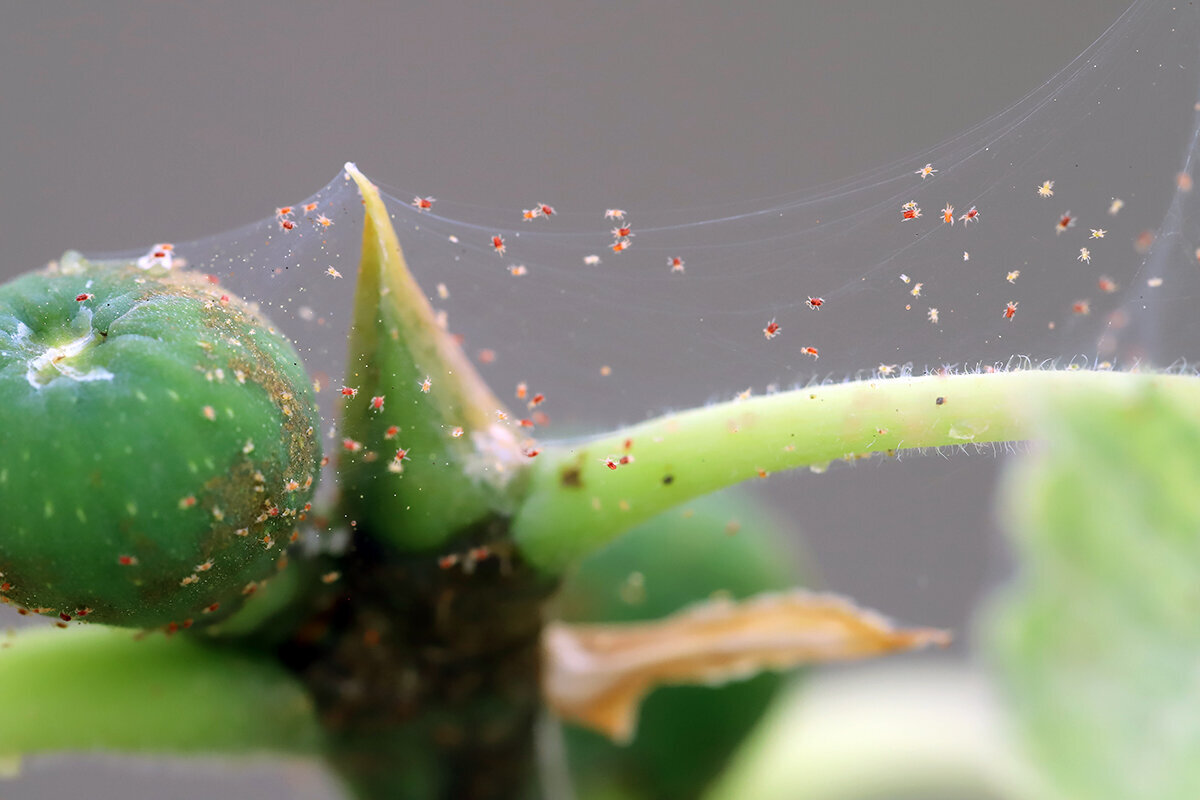
Spider mites are arachnids rather than insects. Adults are extremely small, often no more than moving points without magnification, and may appear greenish, yellowish, brown or reddish depending on the species and conditions. The two-spotted spider mite is a particularly common greenhouse and garden pest in the United States, but control decisions should begin with evidence on the plant rather than a color assumption.
Sparse stippling
Mottled field
Bronzing
Silk appears
Leaf decline
Evidence, not anxiety
Spider mites versus the usual lookalikes.
Stippling earns attention because it is visible, not because it belongs only to spider mites. A good diagnosis asks two questions: is the damage consistent with mites, and can you find the organism or its direct signs? Look at the leaf underside, the newest and oldest growth, the presence of dark fecal dots, the texture of the tissue, and whether symptoms are tied to a watering or fertilizer event.
Thrips can create pale or silvery injury that resembles mite stippling. Their clue is often black, varnish-like fecal specking and the presence of slender insects in flowers, tight growth or on leaf surfaces. Mineral residue sits on the surface and wipes or rinses away; mite injury is within the leaf tissue. Edema usually follows a water-uptake imbalance and can appear as corky, blistered or raised areas rather than a field of pinpricks. Ordinary aging is more likely to be orderly: an older lower leaf fades, rather than a colony pattern expanding through a favorable microclimate.
Broad mites and cyclamen mites are another reason not to overconfidently call every distorted leaf a spider-mite case. They are much harder to see and their injury often concentrates on tender new growth, producing thickened, brittle, cupped or stunted foliage. If new growth is deformed but you cannot find spider mites, webbing or classic underside stippling, pause and seek a local Extension diagnostic service or a trusted plant-health professional.
Why a small finding can become a greenhouse problem
Heat, dryness and delay create pressure.
Spider-mite development and reproduction are strongly shaped by temperature. Warm conditions can compress generations; dry, water-stressed plants are more vulnerable to injury; dusty foliage and disrupted natural enemies make the greenhouse easier to exploit. Exact timing is not universal. Crop, species, temperature and local conditions all matter, which is why inspection rhythm is more useful than a single promised day count.
Zone oneWarm leaf surfaces
Zone twoDry crop stress
Zone threeDense access
Zone fourLate detection
Warm leaf surfaces: glass-adjacent leaves, sun-facing hanging baskets and stagnant upper-canopy air can run hotter than a thermometer near the door suggests.
Dry crop stress: inconsistent root-zone moisture compounds the loss of functioning leaf area and weakens a plant’s ability to carry a modest infestation.
Dense access: plants touching one another create protected routes, while overcrowding makes underside inspection and wash-down coverage incomplete.
Late detection: eggs, juveniles and adults overlap. An application that reaches only exposed stages can be followed by new activity unless you return to assess.
This is why greenhouse prevention is not about chasing a permanently high humidity reading. It is about reducing avoidable plant stress, moderating heat, keeping foliage and pathways clean, and noticing a colony before the crop has become a webbed microclimate.
Prevention through conditions and access
Build a greenhouse that is easy to inspect.
Quarantine new plants before integrating them into a treasured collection. This is especially important for tender houseplants, herbs, annual flowers and vegetable starts that may arrive with a low-level infestation no casual glance will reveal. Keep a simple notebook or phone record with plant name, location, date, symptoms, live mites found and action taken. The record reveals recurring warm zones and recurring host plants faster than memory does.
Water for stable growth rather than crisis recovery. Spider mites are not solved by flooding a stressed root zone, and persistent wet foliage is not a substitute for irrigation management. Instead, check container weight or root-zone moisture, water thoroughly as the crop requires, and use mulch or suitable pot management to slow needless drying. Bloomcabin’s water-wise greenhouse gardening guide offers a useful framework for delivering water consistently while avoiding waste.
Vent and shade with the plant canopy in mind. Roof vents, open doors, shade systems and circulation fans can help temper dangerous hot pockets, but they should support rather than replace observation. The difference between a beautiful greenhouse and a resilient growing room is often the practical space to reach every plant. Explore planning options across the Bloomcabin greenhouse collection, then prioritize pathways, staging height and canopy clearance in the configuration.
Keep floors, bench undersides, pot rims and glazing clean. Dust can favor mite problems and debris can hide plant material that should have been removed. Remove heavily damaged leaves where this can be done without stripping a plant bare, bag the material and take it out of the greenhouse. Do not compost a heavily infested plant directly beside the structure.
- New arrivals: isolate, inspect undersides and recheck before placement.
- Crop spacing: keep plants from forming an uninterrupted bridge between pots.
- Watering: prevent repeated drought stress without overcorrecting into saturated roots.
- Heat: observe actual leaf-zone pressure during bright afternoons, not only the morning forecast.
- Scouting: inspect weekly at minimum and more often during hot spells or an active outbreak.
Treatment is a coverage problem
Reach the underside, then return to look.
Washing plants with a directed stream of water can physically dislodge mites, eggs and webbing, particularly on small or manageable plants. Horticultural oils and insecticidal soaps may also be useful when they are labeled for the crop and situation, but these are contact tools: a droplet that never reaches a protected colony cannot control it. The goal is deliberate coverage, not a heavier dose or a hurried cloud of spray.
Incomplete path
Top surface only
Methodical path
Access before application
Excessive path
More is not better
Top surface only. Upper leaf surfaces get wet while the underside colony stays mostly protected. The plant looks treated, yet active mites remain where feeding commonly occurs.
Access before application. Space pots, lift and support foliage, work from below where appropriate, and treat according to the product label. Then inspect again rather than assuming one pass settled every life stage.
More is not better. Overapplication, heat-stressed plants or a product not suited to the crop can injure foliage and interfere with beneficial organisms. Test a small area if the label allows and follow all restrictions.
For a small, isolated finding, washing and close follow-up may be enough. For a wider infestation, combine isolation, sanitation, stress reduction and a crop-appropriate control choice. Where biological control is part of the plan, consult the supplier or an Extension specialist about predator species, release timing and compatibility with any recent or planned pesticide use. Broad-spectrum insecticides can disrupt predators and sometimes worsen mite outbreaks.
United States legal note: pesticide labels set the permitted crop, site, rate, protective equipment, re-entry information and use directions. Never apply a product simply because it is marketed for gardens. Read the specific label, use it only as allowed, and account for edible crops, beneficials, temperature cautions and harvest intervals.
Recovery is a sequence, not a mood
Judge the next leaf, not the old scar.
Stippled tissue does not turn green again. A successful response is visible in reduced live activity, fewer fresh pale dots, no expanding webbing, and clean new growth that stays clean through repeated inspections. Leave some cosmetic damage in place as a record while you assess the plant; removing every marked leaf can make it harder to distinguish old injury from new feeding.
Day 0Confirm and contain.Mark affected plants, isolate where possible, inspect neighbors and record whether live mites, eggs or webbing were found.
First follow-upLook beneath the treatment story.Reinspect undersides, leaf junctions and dense centers. Check that coverage or washing reached the original colony zones.
Second follow-upSeparate old injury from fresh stippling.Compare tagged leaves with new foliage. New pinpricks, moving mites or fresh silk mean the population remains active.
ThereafterReturn to routine scouting.Keep the record, correct recurring heat or water stress, and maintain access around plants so a new pocket is found early.
A well-designed structure supports this routine. The Classic Aluminum Greenhouse can be configured as a composed growing room rather than a crowded storage zone: leave a clear inspection aisle, keep high-risk plants within reach, and use ventilation and shading options to respond to the particular pressure of your site. For more ideas on adapting equipment over time, see Bloomcabin’s guide to greenhouse accessories, ventilation and shading choices.
Frequently asked questions
Clear answers for close inspections.
Can spider mites be present without webbing?
Yes. Fine silk is often easier to see when populations are high, but early colonies may show only stippling, eggs and tiny moving mites on leaf undersides. Webbing is supporting evidence, not a requirement for diagnosis.
Should I throw away an infested greenhouse plant?
Not automatically. A lightly infested, valuable plant may be isolated, washed or treated appropriately and followed closely. A severely infested plant that cannot be thoroughly inspected or treated can become a continuing source for the whole greenhouse, so removal may be the most practical choice.
Will higher humidity eliminate spider mites?
No. Stable, plant-appropriate conditions can reduce drought stress and may be less favorable than hot, very dry conditions, but humidity alone is not a control program. Avoid creating persistently wet foliage or a disease-prone greenhouse just to pursue a mite response.
Can I use predatory mites after spraying?
Possibly, but compatibility is product-specific. Some treatments are disruptive or persist longer than expected. Check the pesticide label, ask the biological-control supplier for compatibility guidance, and provide the environmental conditions the beneficial organism needs.
How often should I scout during an outbreak?
Inspect more often than your ordinary weekly route. The correct interval depends on crop, temperature, what was found and the action taken. The important point is to recheck before a new generation or missed protected colony becomes a surprise.
Are spider mites spiders?
They are arachnids, related to spiders and ticks, but greenhouse spider mites are minute plant-feeding mites. Their silk is a colony feature on plant surfaces, not a large radial spider web.
Sources and further reading
A short, reliable reading shelf.
These resources informed the diagnostic and integrated-management approach in this guide. Product labels and local Extension guidance should always take priority for a specific crop and location.
- UC Statewide Integrated Pest Management: Spider Mites
- UC IPM: Twospotted Spider Mites in Floriculture and Ornamental Nurseries
- Colorado State University Extension: Spider Mites
- Penn State Extension: Planning for Biological Control in Greenhouses
- Penn State Extension: Greenhouse IPM with an Emphasis on Biocontrols
- US Environmental Protection Agency: Introduction to Pesticide Labels
- University of Maryland Extension: Using Biocontrol Organisms for Managing Thrips and Mites in Greenhouse Vegetables
- UC IPM: Thrips in Floriculture and Ornamental Nurseries
