
Buying a Second-Hand Pergola: Missing Parts and Reinstallation Risks
Pergola buying guide
A second-hand pergola can look complete while key hardware, controls, or drawings are missing. Even an assembled kit may not fit a different patio: its attachment points, dimensions, or site requirements can change with the move. Evaluate the used unit as a transfer project, not just a frame for sale. Before paying, establish exactly what is included, match it to original documentation, inspect its condition, verify compatibility with the new location, and cost the work from removal through reinstallation.

Secondhand pergola buyer checklist 1
Define exactly what the seller is including
Begin by defining what the seller means by “pergola.” The offer may be a complete kit, an assembled structure, or a bare frame after roof components or accessories were removed. Record whether it includes posts, beams, roof or louver elements, gutters, end caps, screens, shade components, motors, controls, brackets, base plates, fasteners, trim, and manuals. Do not count an item simply because it appears in an old listing photo. If you are also considering a new purchase, use the Bloomcabin Lean-To Pergola page to identify the product you want quoted, then compare the written inclusions with the seller’s inventory. Separate essential assembly components from optional accessories: an omitted accessory and a missing frame connector create very different purchase questions. Mark untested accessories as unverified rather than assuming they work, and ask which items the seller used most recently.
Have the seller mark each included piece on recent photos or an itemized list, and identify anything excluded, altered, damaged, or still attached to the home. Clarify whether the agreed amount includes dismantling, loading, transport, temporary storage, disposal of leftover material, or installer labor; none should be assumed from marketplace wording. Ask whether the structure can be viewed as it stands and whether all loose components will be available together for inspection. Keep the inventory with the sale correspondence so the kit remains identifiable when it is taken down. If anything remains connected to the property, list it separately and arrange qualified disconnection rather than treating it as a loose kit component.
Identify the exact model and its records
Ask for the maker, model, configuration, order or serial number if available, original dimensions, and approximate purchase or installation date. Photograph labels that are accessible without dismantling or damaging the structure, including labels on motors or controls if present. Record whether it was wall-mounted or supported separately, and whether its roof, posts, spans, finish, controls, or attachments have changed. A seller may use a generic term for a custom order. Keep the advertised name separate from the identity established by labels and records. For a new-product comparison, record the exact name from the Bloomcabin Pergola product page in your quote request. For the used kit, retain every identifying number, including numbers on individual components; these may help distinguish the original assembly from later replacements. If labels and paperwork conflict, ask the seller to explain the discrepancy before proceeding.
Request the invoice or order confirmation, purchase or installation drawing, parts schedule, service records, and details of replaced or modified components. Compare the seller’s account with the structure and documents rather than relying on age or appearance. If the maker or original supplier can be contacted, send clear photos and identifying details and ask what can be confirmed for that exact version. Ask specifically whether the correct manual, replacement parts, or professional support are available; do not assume they are. Treat an unanswered question or general product page as unresolved, not as evidence of interchangeability, and keep any written response with the records.
Secondhand pergola buyer checklist 2
Match the drawings to the actual configuration
Ask for the assembly manual, itemized parts list, order drawing, and installation drawings, not only a marketing brochure. Match each document’s model and revision to the identification you collected; diagrams can show part names and orientations that a photograph cannot confirm. General terms such as “aluminum,” “louvered,” or “wall-mounted” are not enough to select components. Check whether the order had configuration changes or custom dimensions that affect the parts list. If you are comparing the used offer with a Bloomcabin Bioclimatic Aluminum Pergola, ask for the proposed configuration to be identified in the new quote as well. Keep the two sets of documents separate so details from a current product do not get assigned to an older kit. Check that drawing pages are legible and complete, including any referenced details, amendments, or component schedules.
Work through the drawing and parts schedule line by line. Note the expected number of posts, beams, roof members, braces, connectors, drainage pieces, and fastener sets, then compare them with the offered configuration. Check whether a special span, finish, or mounting arrangement changed the standard list. Keep unknown entries marked as unknown rather than filling gaps with similar-looking pieces. If paperwork is incomplete, ask the seller for the correct copy or have a qualified installer or supplier verify the version before purchase. A kit’s previous assembly does not prove it can be reassembled from the parts currently offered.
Inventory the components before pickup
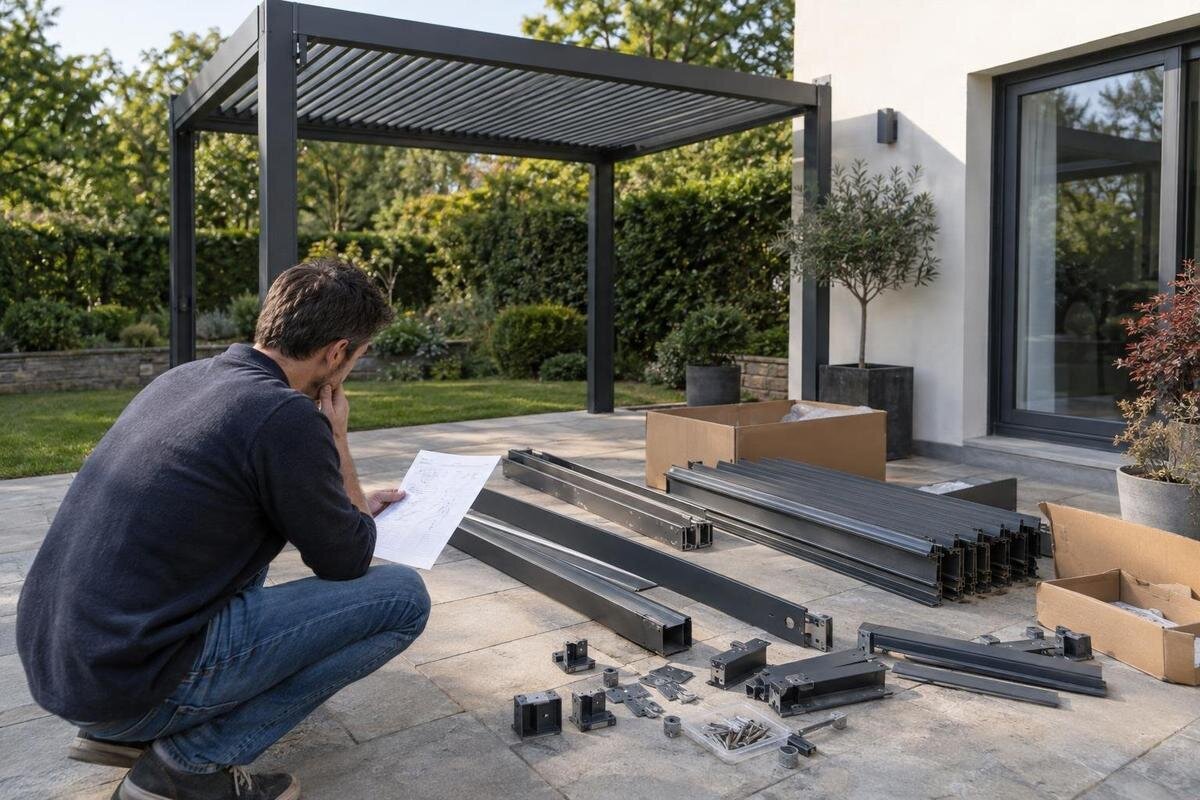
Make the physical inventory when every piece can be seen: before dismantling, or after a competent person has laid it out, but before loading. Compare each item with the correct parts schedule and count by part or drawing reference instead of treating similar-looking pieces as interchangeable. Include structural members, braces, connectors, roof elements, drainage parts, trim, brackets, screens, and controls where the original list calls for them. If the kit is still assembled, ask the seller to show hidden faces and connection points without forcing access. Write the expected and observed quantities side by side; a wide photo cannot prove concealed or loose parts are present.
Photograph parts groups and identification marks before they are separated; label each member by the manual’s part name or location, not just by where it was found. Keep small hardware in labeled bags with the matching assembly, and note mixed, corroded, damaged, or unidentified fasteners. List every control, remote, sensor, or accessory separately, with its condition and whether it is part of the sale. Ask the seller to retain overlooked pieces until the inventory is reconciled. This record can help an installer or supplier identify items later, but it does not establish that a missing part can be obtained.

Secondhand pergola buyer checklist 3
Inspect the frame for damage and alterations
Inspect each structural member for visible bends, twists, dents, cracks, corrosion, coating loss, enlarged holes, cuts, added drill holes, welds, or patches. Look closely at joints, base plates, beam ends, and connection areas; a clean outer face may not reveal damage elsewhere. Record defects with an overall photo and a close-up, and note which member is affected. Do not sand, straighten, or dismantle a questionable piece just to judge it, since that can hide its condition or introduce another risk. If an area is inaccessible while the structure is standing, arrange qualified help rather than climbing or forcing access.
Appearance alone cannot establish the structure’s remaining life, past loading, or suitability at a different location. Look for evidence of storage damage, mixed replacement members, missing labels, and inconsistent finishes, but treat these as questions to resolve rather than an engineering verdict. Ask a qualified installer or structural professional to assess deformed, repaired, or uncertain members against the original drawings before paying or planning reuse. A seller’s account of how the pergola performed at another property does not establish that the same structure is suitable for yours.
Check moving parts, controls, and drainage
If the unit has a moving roof, retractable cover, screens, or motorized parts, identify the mechanism actually installed and whether its related components are included. The word “bioclimatic” alone does not identify a drive, controller, remote, sensor, or compatible replacement. When requesting a comparison quote through the bioclimatic aluminum pergola listing, ask which operating components are included in the proposed configuration; compare that written scope with the used system’s inventory. Ask the seller to demonstrate operation only if it can be done safely and without forcing anything. Note uneven movement, unusual noise, missing parts, or a control that cannot be paired. Distinguish a demonstrated working function from one the seller merely says works. A video can document what happened during the demonstration, but it cannot establish the cause of a fault or the cost of repairing it.
If powered components or connections appear damaged or exposed, do not energize the system or attempt electrical repairs. Photograph labels and collect the manual, controller, remote, and other included components; ask a qualified technician to assess their condition and what may be needed for reinstallation. If the kit has drainage parts, check whether gutters, outlets, seals, or downspout pieces are included and visibly damaged or blocked. Confirm the intended water route from the original documents and the new-site plan. A part count is not a test of operation.
Secondhand pergola buyer checklist 4
Check whether the attachments suit the new site
Document the original mounting arrangement, not just the parts being sold. Find out whether posts sat on base plates, whether a side was attached to a building, and which brackets, anchors, or fasteners were supplied, removed, or left behind. Photograph the old attachment points and ask for the corresponding drawings. Distinguish removable kit components from supports that belong to the property, such as foundations or parts embedded in the wall. If plates, anchors, or instructions are missing, record the gap rather than assuming generic replacements will work. If you are considering a new Bloomcabin wall-mounted pergola as an alternative, describe your proposed wall and support arrangement in the quote request and ask what attachment information is needed. For either option, the important comparison is the specified connection at your property, not whether the two frames look alike.
Keep original fasteners and brackets identified with the parts they came from. Do not assume an anchor can be reused because it looks intact, or that a replacement can be selected by appearance alone. The new home’s wall, surface, foundation, and available fixing points may differ from those at the previous location. Have a qualified installer or structural professional review the original attachment information and proposed support, and ask who will supply any specified replacement pieces. Avoid cutting or drilling members to make mismatched parts fit; have the issue evaluated before purchase.
Measure the pergola and the new site
Measure the second-hand frame itself and record its overall width, depth, and height, post-center spacing, base-plate positions, and projection from any wall. Compare those measurements with the original drawing rather than relying on the seller’s approximate size or roof area. The Bloomcabin Pergola listing gives a 97–258 sq ft area range, which is useful when identifying a new-product comparison but does not establish the used unit’s dimensions. Record what each measurement describes: outside edges, post centers, and usable space between posts are different measurements. Include units and label the corresponding points on a sketch so an installer can interpret your notes. Take measurements at the actual installation points and note any differences between the structure and its paperwork. If a critical dimension cannot be measured safely, leave it unresolved for the site assessment rather than estimating it from a photograph.
Map the frame against the new site, including doors and windows, eaves, gutters, stairs, nearby utilities, drainage routes, access, and the space needed for inspection or maintenance. If the roof or screens move, check the space required for their movement in verified instructions; do not infer it from a similar model. Compare the new surface, wall, and foundation with the supports shown in the original drawings, and have a qualified installer review any difference. A footprint that fits can still have incompatible fixing points, height, or drainage.
Secondhand pergola buyer checklist 5
Confirm local requirements and plan removal
Before removal, check with the relevant local building department whether any review, permit, or submission applies at the new address. Ask the property owner or association about its approval process if relevant, and discuss the planned structure with your insurer. Verify requirements for the specific property and project rather than relying on the seller’s experience or paperwork from the old location. If the property is shared or leased, establish who can authorize the work and who is responsible for common areas before transport is booked. Keep any local guidance and the project drawing together.
Agree on removal responsibilities before paying to move the kit. Identify who will dismantle it, confirm what remains at the seller’s property, and decide who is responsible for damage during removal. Have the person handling transport check the longest members, access route, loading arrangements, and storage space before scheduling pickup. Photograph joints and mark orientation before pieces are separated; keep small hardware with its matching assembly. Use the inventory to record both what was collected and any new damage noticed during removal. If a new purchase is your alternative, ask about delivery and unloading responsibilities when requesting a quote for the Bloomcabin lean-to model, so those costs are included in the comparison. For the used kit, arrange qualified help for uncertain building connections and protect identified parts during transport and storage.
Price the complete reinstallation before agreeing
Build a project budget rather than comparing purchase price alone. Include inspection, dismantling, loading, transport, storage, missing or damaged parts, reconditioning, site work, and installation. Add a qualified assessment of structural concerns and, where relevant, the cost of evaluating controls or other powered components. Ask for estimates against a defined inventory and scope; unknown parts or repairs should remain visible in the calculation, not be assigned a zero cost. If the structure cannot be assessed until it is moved, account for that uncertainty before making a commitment that cannot easily be reversed.
Compare the total with a like-for-like new configuration and its quoted scope. Use the Bloomcabin Pergola model page to identify a product for a quote based on the dimensions, attachment type, components, and work you actually need. Compare written inclusions, such as accessories and installation, rather than a headline price alone. Keep confirmed costs separate from estimates and unresolved items so you can see what would change the result. For the used purchase, put the components, known defects, excluded items, inspection access, removal responsibility, and payment timing in writing. Agree on how any discrepancy found during the final count will be handled before loading begins. If manuals, condition, site fit, or essential parts remain unresolved, pause rather than treating uncertainty as a bargain.
Frequently asked questions
Can I tell whether a used pergola is complete from a photo?
Not reliably. Photos can hide missing fasteners, brackets, labels, connectors, and controls, or show accessories that are not part of the sale. Compare an itemized inventory with the exact parts list, ask for recent photos of loose components, and count them before removal or payment.
Can I use a similar-looking part from another pergola?
Do not assume it will fit or work. Similar appearance does not prove that a part matches the model, revision, attachment, or mechanism. Use the original parts information and ask the manufacturer, supplier, or a qualified installer to confirm any substitution before buying it.
Should I reuse the old anchors?
Do not assume the old anchors suit the new site, even if they look intact. The wall, foundation, and attachment points may differ. Have a qualified installer or structural professional review the original drawings and proposed support, and confirm which hardware is appropriate.
What if the seller does not have the manual?
Ask for the maker, model, revision, order records, and clear photos of identification labels. The manufacturer or original supplier may be able to identify the correct documents, but do not assume that support or replacement parts are available. Treat missing documentation as an unresolved risk until the exact kit is identified.
How do I decide whether a second-hand pergola is worth buying?
Compare the full cost of inspection, missing or damaged parts, removal, transport, site work, and reinstallation with a quote for a comparable new configuration. A low asking price is not enough if the kit’s identity, condition, site fit, or essential components remain uncertain.
A used pergola is a realistic option only when its identity, components, condition, attachment, and new-site fit can be evaluated together. If important drawings, parts, or structural details remain unknown, include that uncertainty in the budget or pause the purchase. The useful comparison is the cost of a verified, installable structure against a new project with a clearly defined scope—not the used asking price against a product headline.
