
Why Does Water Drip When Pergola Louvers Open After Rain?
Pergola rainwater guide
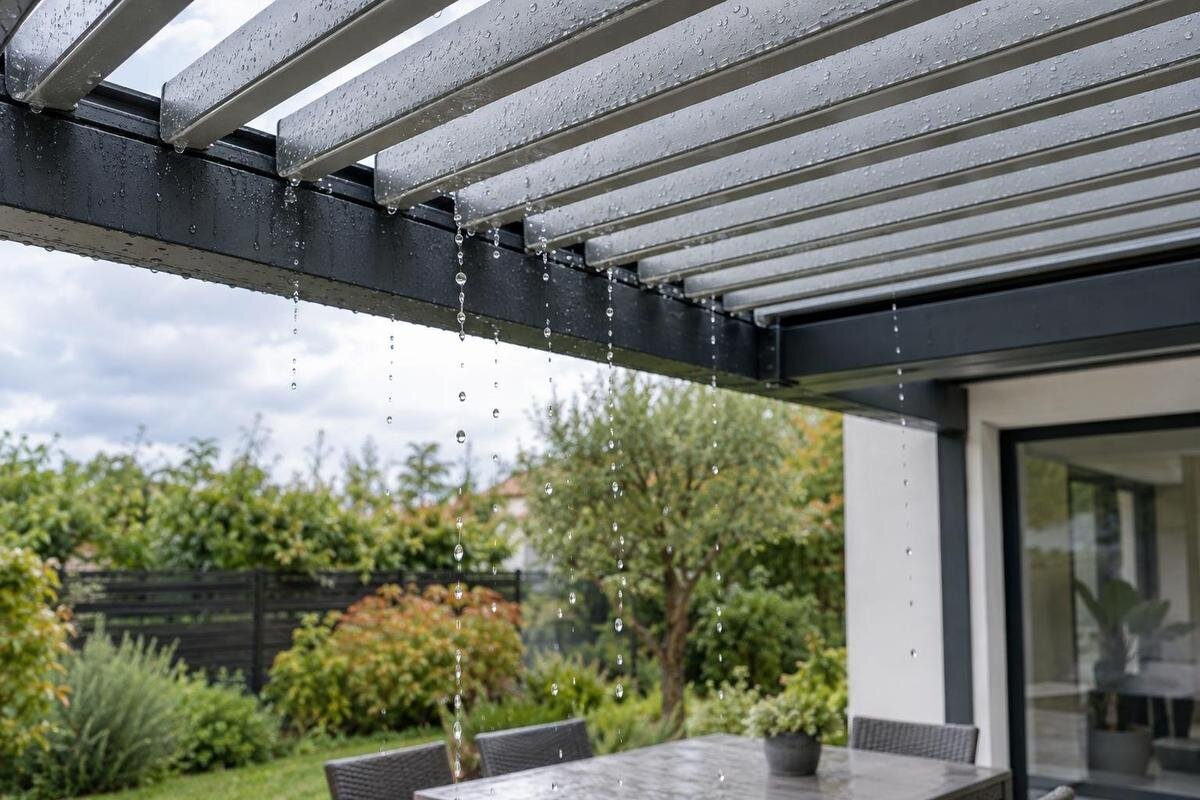
When pergola louvers begin to open after rain, a few drops can fall because movement redirects water that was still on a blade, edge, joint or drainage surface. The louver changes angle, so the water’s route and release point change too. That timing can be consistent with retained rainwater, but it does not establish that every drip is expected—or that the roof has failed. The useful clues are where the water emerges, when it starts, how long it continues and what the exact roof design says about drainage and operation.
Before you buy 1
Why opening the louvers can release water
Rainwater can remain on a louver after the rain stops. Some sits as beads at an edge; some clings as a film or stays where adjacent blades meet. When a louver pivots, its upper and lower surfaces change orientation. A bead can move toward the newly lowered edge, and a seam that was tucked beneath another blade may become exposed. Gravity then carries the water to a drip point. This is why the first movement—not necessarily the moment the rain ends—can trigger a release. The amount depends on the roof profile and conditions, so whether a drip is expected depends on the exact design and its instructions.
Water can also take a longer route before it becomes visible. A bead may travel along a louver or frame and fall from a corner some distance from where it landed. A drip at the perimeter after opening therefore does not automatically identify a leak directly above it. Note whether drops begin while the blades move, whether one or several points release water, and whether dripping stops when movement ends. Those details help distinguish a brief release of retained water from a recurring drainage or sealing concern. They are clues to compare with the model’s water path, not a stand-alone diagnosis of roof performance.
Where rainwater may remain on the roof
Potential holding points vary with roof geometry. A louver’s lip, overlapping edges, end pieces, areas near pivots and junctions with the surrounding frame can all affect how a film breaks into drops. Some systems guide water into defined channels; others may shed it differently at particular louver positions. Do not assume that a visible seam is a drain or that every roof has the same places where water can linger. The manufacturer’s drainage diagram should show the intended path and any components that carry water. A diagram is more informative than a lifestyle photo, which cannot show what happens inside a channel or during movement.
For a product such as the Bloomcabin Bioclimatic Aluminum Pergola, request a roof drawing that identifies the blade edges, collection channels and outlets, if those components are part of the selected design. Ask which surfaces move and which remain fixed: that distinction helps explain how opening could change a drip point. For an existing installation, include the product identifier and any roof options in your request. A drawing for a similar-looking roof may show different overlaps or outlet locations, so match its labels to your own configuration before using it to interpret the water you see.
Before you buy 2
Read the timing and location together
Notice the timing and location together. A drop that appears as one part of the roof turns, then stops, is consistent with water being carried to a new edge or released from a wet overlap. A steady drip from one seam while the louvers remain still calls for a different look at the roof and its water path. Drops that appear only at an outlet may be runoff completing its route rather than a leak from the blade above it. None of these patterns proves a cause on its own, but they help you decide what to document and where to compare the drainage drawing.
Write down whether rain was still falling, how long ago it stopped, where the first drops appeared and whether dripping stopped when the roof stopped moving. Note which section moved first and whether the drops came from a louver, a fixed frame or an outlet. If safe, take a short video from ground level; do not climb onto the frame to trace a wet seam. For an installation identified through the Bloomcabin Pergola listing, include the order or model information with that record. A wider view followed by a closer ground-level view can help the installer locate the drip without losing its position relative to the rest of the roof.
Follow the roof’s drainage route
On systems that route rain through the roof, the intended path should be traceable from the roof surface to a channel or collection area and then to an outlet. The arrangement is not identical across designs: a blade may feed a side member, a frame may direct water onward, or a channel may carry runoff toward an exit. Use the product drawing to verify which description applies. It should help you follow the water all the way to its exit, not just identify a gutter-like edge. The Bloomcabin Lean-To Pergola product name identifies a wall-mounted listing, but does not answer how its selected roof configuration routes water.
As louvers move, water left on them may reach a channel or fall from a newly exposed edge, depending on the design. Water already in a fixed channel can also continue draining after rain; delayed discharge alone does not show that louver movement caused it. A different pattern—water repeatedly escaping at a joint or appearing outside the route shown in the drawing—deserves closer review. From a safe position, look for obvious debris at an accessible outlet only as the manual allows; do not dismantle covers or reach into moving parts. If an outlet is difficult to see, ask the installer to show you where runoff is intended to exit.

Before you buy 3
Why there is no universal waiting time
The time between rain and opening does not tell the whole story. A brief shower may leave little water, while prolonged rain can wet more of the roof; wind can also change which edges and overlaps receive water. Drying varies with shade, airflow and the roof’s geometry. Water sheltered at an edge or inside a channel may remain after the exposed surface looks dry. For that reason, neither elapsed minutes nor a quick glance at the top is a reliable universal test that all retained water has gone. Conditions can vary even between separate rain events at the same home.
Do not use a fixed wait time, opening angle or weather rule borrowed from another pergola. Guidance may specify whether the louvers can move during or after rain, or only under certain conditions; follow the instructions for your exact roof. If rain is continuing, movement may expose different surfaces to new water, so a drip cannot necessarily be attributed to water left behind. When the guidance is unclear, ask the manufacturer or installer instead of repeatedly changing positions to see what happens. A generic online demonstration may not show the same roof profile or operating limits.
Observe a post-rain opening safely
For a useful observation, choose a time when normal operation is permitted and watch from a position where released water will not hit you. Use the supplied control or method as directed, keep hands out of the moving roof and do not climb onto the structure. Do not deliberately operate it in severe weather just to reproduce the drip. If the roof is iced, stuck or behaving differently from its instructions, stop rather than forcing it. These precautions let you note ordinary post-rain behavior without turning a simple observation into an improvised mechanical test.
Record the starting position, the first point where water appears, whether it comes from a moving louver or a fixed frame, and when it stops. If the manual allows more than one normal position, note what happens during ordinary operation without inventing a special angle or repeatedly cycling the mechanism. A short ground-level video can help an installer see timing that is difficult to describe. Before ordering from the bioclimatic aluminum pergola listing, ask how the supplied controls and instructions address post-rain opening. Knowing the approved operating sequence in advance is more useful than trying to develop your own method after the first wet-weather use.
Before you buy 4
When a drip deserves a closer look
A small release that begins with movement and fades as the roof settles can be consistent with residual water, especially if the documented route explains where it appears. Still, brief dripping is not a universal pass-or-fail test: one drop, a steady trickle and a stream are different observations, and acceptable behavior depends on the design. Note whether it happens after every rain, only after a particular operation or only at one corner. Repetition at the same location is more useful to report than a general statement that the pergola drips.
Arrange a model-specific review if water keeps emerging after the louvers stop, repeatedly appears at the same joint, enters an area that should remain protected under the documented conditions, or comes from a place not shown in the drainage drawing. Possible explanations include an obstructed or altered path, a seal or alignment issue, or operation outside the stated limits; observation alone cannot distinguish them. If your installation corresponds to the Bloomcabin lean-to pergola page, identify the affected corner relative to the attached wall and the outer edge. Include whether the pattern is new or has occurred since installation, so the reviewer has a useful history as well as a location.
Use instructions for the exact roof
Look for instructions tied to your exact model and configuration rather than a generic louvered-pergola guide. Useful documents may include a drainage diagram, a description of permitted louver positions, operating limits and inspection or maintenance guidance. If a drawing shows the roof closed but not moving, it may not explain what happens as the blades open after rain; ask for clarification on that transition. Read any weather-performance statements in the conditions they describe, not as a guarantee that no water will ever drip during movement.
When reviewing the Bloomcabin Pergola product page, ask the seller which operating manual and drainage drawing accompany the selected roof. Check that the document's model identifier matches the quotation, and retain its revision date or version number with your order records. Then clarify any gap between the drawing and the operating instructions: does water remain at an overlap, where can it be released during opening, and what pattern warrants service? A written response tied to those documents gives you a reference for later observations and helps avoid confusing guidance for two variants within the same product family.

Before you buy 5
Account for walls and enclosure panels
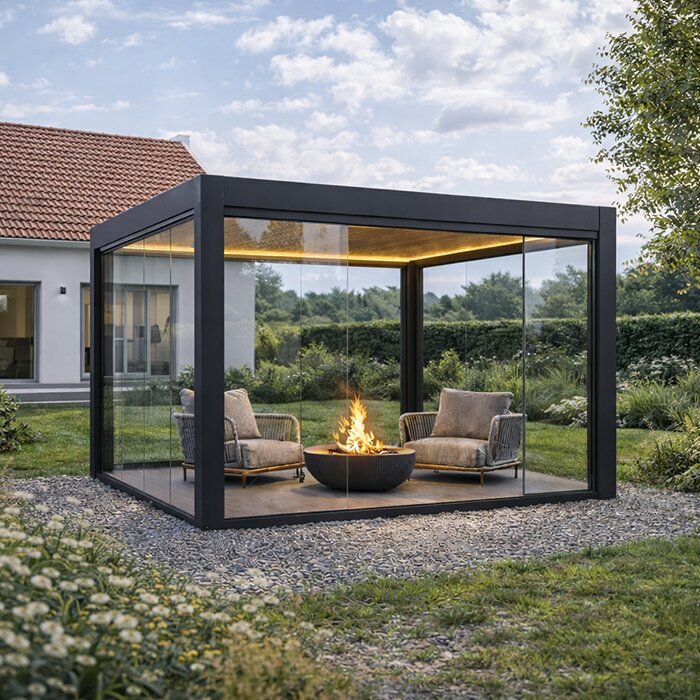
Where side panels, screens, glazing or a nearby wall are part of the setup, note where the drop first leaves the roof, not just where it lands. A frame or enclosure can hide the origin or redirect runoff along a member, making water appear to come from another joint. That makes tracing the visible path important, but it does not mean an enclosure will stop drips or that every enclosure works with every roof. Use documents that describe the combined configuration and relevant drainage route. Focus on water released as the louvers move rather than assuming that an enclosed space is sealed.
With a wall-mounted design, do not infer roof-to-wall drainage from a product title or photo. The Bloomcabin wall-mounted pergola listing identifies the category; ask whether instructions cover the selected roof and any planned enclosure together, including post-rain operation. If a drop appears at a wall-side joint, record whether it begins only as the louvers move or continues while they are still. Have a qualified installer assess a persistent junction leak rather than removing trim or changing the attachment yourself.
Questions to ask before you buy
Before buying, ask how post-rain dripping could affect the way you plan to use the space. If a table or seating area will sit beneath the moving roof, request an explanation of any documented release points and whether the instructions call for precautions before opening. For Bloomcabin’s bioclimatic pergola product page, use the selected configuration as the basis for that discussion. Request weather-performance material and a drainage drawing that distinguish closed-roof behavior during rain from behavior during movement afterward. Those are separate questions; an answer about rain protection while closed does not, by itself, explain what happens when wet louvers open.
Confirm that the documentation describes the configuration you intend to use, including the selected roof size or any compatible enclosure, rather than a different variant in the same product family. If controlled observations are available, check the roof position and conditions under which they were made; a test in one setup does not establish how every exposure will behave. The goal is a clear expectation for normal operation and a way to diagnose persistent dripping—not a promise that no water can ever leave a moving louver.
Frequently asked questions
Can a pergola drip briefly every time I open it after rain?
It can if water remains on a louver or along the roof’s drainage path, but repeated dripping is not automatically normal. Compare where and when it happens with the instructions for your exact roof. If it continues after movement stops or recurs at one joint, document the pattern and request a model-specific review.
How long should I wait before opening the louvers?
There is no universal waiting time that applies to every louvered roof. Use the operating guidance for your exact model and configuration. A dry-looking surface does not prove that water has cleared from edges or channels, and a fixed wait borrowed from another design may not apply.
Should I leave the louvers closed until the roof looks dry?
Do not assume that a visual check or a particular roof position tells you whether all water has drained. Follow the model’s instructions for when and how to operate the louvers after rain. If those instructions do not address post-rain operation, ask the manufacturer or installer rather than guessing.
Why do drops fall from a different place than where rain landed?
Water can travel along a louver, frame or intended drainage route before it reaches an edge or outlet. As the louvers move, the route can change and water may be released somewhere other than its original landing point. Record where the drops first appear and compare that location with the roof’s drainage diagram.
Does dripping after opening mean the roof is leaking?
Not by itself. A brief release during movement may be retained rainwater, while persistent dripping or water repeatedly escaping at the same joint may need investigation. The timing, location, duration and exact model’s drainage guidance all matter; a product photo or a few drops alone cannot confirm the cause.
A drip that begins as the louvers move can mean that water remained on the roof or somewhere along its drainage path, but timing alone does not establish whether the system is operating as intended. The clearest assessment combines the first point of release, how long dripping continues, and the exact model’s drainage and operating guidance. Observe only as directed, record any recurring pattern, and request a model-specific review if water persists or appears at a joint not shown in the intended route.
