
ZIP Screens or Outdoor Curtains for a Pergola?
PERGOLA BUYING GUIDE
An outdoor side treatment changes more than a pergola’s appearance. It affects how freely air and people move through an opening, how much of a view is screened, and what care the fabric needs. A ZIP screen travels in side guides as it is deployed; curtains hang from a rod or track and gather or slide aside. But the category name does not establish privacy, wind tolerance, fit, or what is included. Compare the exact fabric and attachment instructions against the pergola model and the way you use each side.

How ZIP screens and curtains behave when deployed
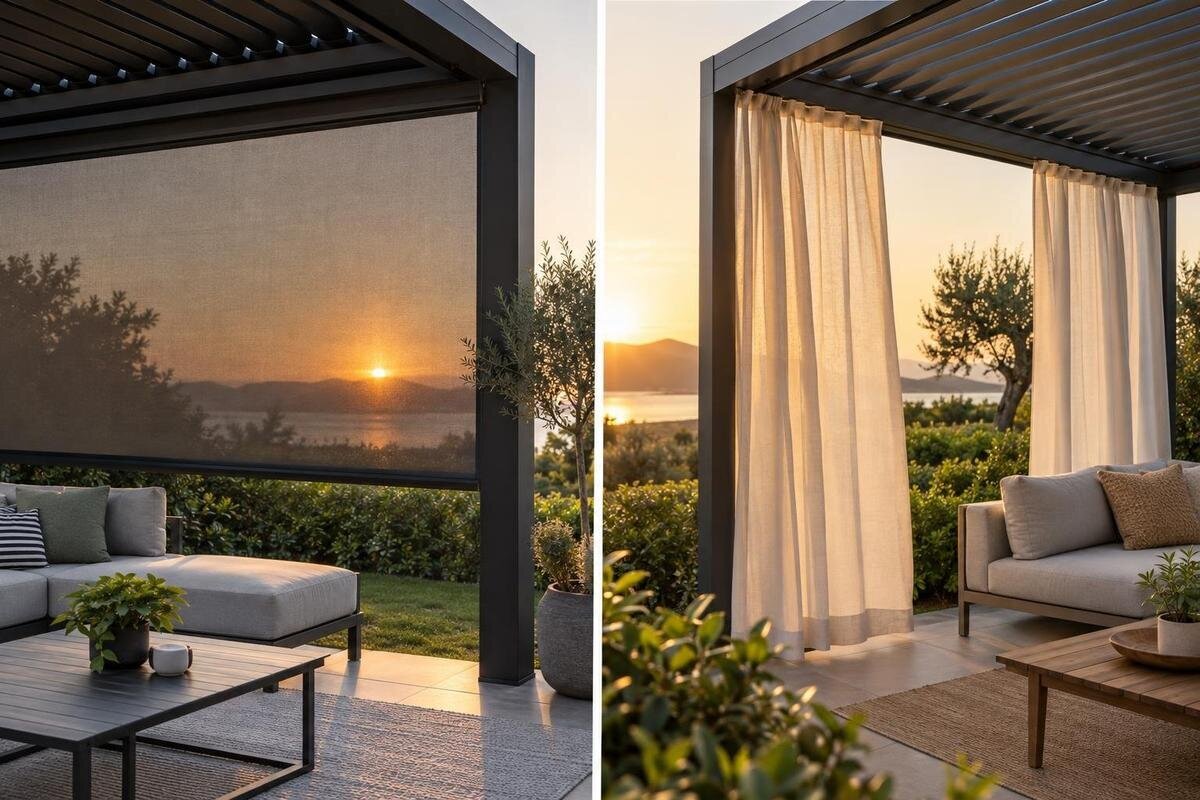
A ZIP screen is a retractable mesh or fabric panel whose edges are retained in side guides; as it lowers from the top, it follows a defined plane. The exact edge system, operating method, and fabric vary. An outdoor curtain hangs in folds from a rod or track. Depending on its hardware, it may draw across the opening, overlap at the center, or gather at one side. A closed screen usually presents a flatter surface than a curtain, which keeps its folds and may shift. These are structural tendencies, not performance guarantees: ZIP describes an edge-retention approach, not an airtight seal, a privacy promise, or a wind rating.
The panels also move differently. A screen generally lowers from a housing and retracts toward it; a curtain slides along its support or gathers at an edge. Their open positions can leave different kinds of clearance, even when they cover the same opening. Neither arrangement automatically makes a sealed room: side gaps, bottom clearance, fabric weave, and overlap all affect what passes through. Do not infer insect exclusion, rain protection, or blackout from the category alone. If people regularly pass between patio and yard, assess the route with the treatment both deployed and open, including room around posts, doors, chairs, and walkways.
Privacy depends on fabric, light, and sightlines
Privacy is about what someone can see from a particular angle, not whether a panel looks opaque from inside. An open-weave screen may soften direct views while preserving some outward visibility, but results depend on weave, openness, distance, and light. In bright daylight, occupants may see out more readily than people outside see in; after dark, interior lighting can weaken or reverse that effect. Do not treat a screen as one-way glass. Compare a real fabric sample from both sides at the times you use the pergola. A small swatch can look more private than a large, backlit panel.
Curtains can offer more complete coverage when the cloth is sufficiently opaque and panels overlap, yet gaps at the sides, top, and center still matter. Sheer fabric may show silhouettes when backlit; a dense panel can reduce the outward view. Sketch the sightline from a neighbor’s window, sidewalk, or yard at seated and standing height, then check the fabric in daylight and with your lights on after dusk. If you are considering Bloomcabin’s pergola listing, include that model in your request for compatible privacy options. Ask for samples of the actual offered fabrics rather than choosing opacity from a photograph.
Airflow depends on mesh and coverage
Air movement depends on both material and layout. Mesh admits some air through its weave, but the amount varies with fabric openness and the area covered. If a maker gives an openness percentage, confirm what it measures; visible openness alone is not a guaranteed airflow rate. A screen across one side may affect a cross-breeze differently from screens on several sides. The same label can describe fabrics with noticeably different light and air passage, so ask for the exact fabric specification rather than judging from a product photo. When comparing side options for the Bloomcabin Bioclimatic Aluminum Pergola, ask which mesh choices, if any, are available for the proposed opening.
Curtains pass air according to their fabric, fullness, and position. Sheer or lighter cloth may admit more air than a dense panel, while a closed curtain can interrupt a breeze; moving fabric can also billow and tug at its support. Drawing it aside restores a larger opening, although the gathered cloth still takes up edge space. Note which side tends to catch the breeze, which route you want clear, and whether you prefer air through mesh or an unobstructed gap. A gap left for ventilation also changes privacy and sightlines, so weigh those goals together.
Access and opening space in daily use
Access can favor a curtain if you often want to change the opening by hand. A track or rod may let you draw the fabric together, part it, or gather it at one edge, but movement depends on the hardware and panel arrangement. Ask whether tiebacks or holdbacks are included or required. If the opening is the main route from the patio to the yard, check where the fabric sits when open: a walkway may look clear but still be narrowed by folds, fasteners, or a support. Try the layout against door swings and the way people actually walk, rather than assessing it only when fully closed. If several people share the space, check the operation from each regular entry point.
A guided ZIP screen follows its side channels when raised or lowered, which can make deployed positions more repeatable; the control and any intermediate stops depend on the system. Confirm whether operation is manual or motorized, where the controls sit, and what site provisions are required rather than assuming a mechanism is included. Consider who will use the screen and whether its handle or controls are reachable from the usual approach. If you are considering the Bloomcabin Lean-To Pergola listing, include the adjacent house door in your layout sketch. Ask whether a proposed side treatment would have to open before anyone could use that route.

Wind limits must match the installed system
Do not use ZIP or curtain as a substitute for a documented wind limit. A guided edge describes how a screen is retained; it does not prove that a particular panel can remain deployed at a given wind speed. Fabric, panel size, retention details, supporting frame, and installation all affect which guidance applies. A curtain system may have no published wind limit, and fabrics and fasteners differ. A tieback or heavier cloth is not evidence of testing. One side down can behave differently from several sides closed, so ask for instructions for the exact combination, not just the screen brand or material.
Request written manufacturer guidance naming the screen or curtain, its permitted dimensions, and the pergola model. Check whether a stated limit applies while operating, while left deployed, or only when retracted, and whether gusts or site exposure change the instructions. If no document covers your proposed setup, treat its limit as unknown rather than assuming it is unrestricted. Follow the maker’s directions for operating or securing the treatment as conditions change. If you are considering the Bioclimatic Aluminum Pergola product page, use its model name in that request. The supplied listing does not establish a side-screen wind rating, and a rating for the frame alone would not establish one either.
Cleaning and storage requirements
Outdoor dust, pollen, and debris collect on either choice, but a guided screen adds areas to keep accessible. Mesh can snag if scrubbed roughly, while dirt in side guides may affect movement. Use the manufacturer’s care instructions; do not force the panel, open the housing, or apply lubricant or a pressure washer unless the instructions permit it. Where directions allow, begin with a soft brush and gentle water, using only an approved cleaner. Ask whether a damp panel can be retracted and how it should dry. Do not assume that a cassette or fabric tolerates long-term damp storage.
Curtains are removable only if their attachment is designed for removal. The care label should determine whether a panel can be machine washed, spot cleaned, or needs another method; outdoor finishes, hems, and sewn details may have different requirements. Check whether hardware needs separate care and how the fabric should dry before it is rehung or stored. Compare the routine handling you are willing to do: a screen is not necessarily maintenance-free, and a curtain is not automatically washable or replaceable. If you are considering the Bloomcabin Lean-To product page, ask about removal access for any proposed curtain system, including whether nearby walls or doors would make reaching its attachments difficult.
Pergola fit and included hardware
Treat the side treatment as a separate specification until the exact combination is confirmed. Posts, beams, clear openings, and existing fittings affect where a panel might attach, but only the pergola maker or accessory supplier can confirm an approved arrangement. Ask for the screen or curtain model, the pergola model it is approved for, the opening dimensions it covers, and its mounting position. Request a list of included and separate parts. A shared brand name or similar-looking installation is not proof of fit, and a staged photo does not establish what comes with the base pergola.
Check whether the proposed system needs top support, side guides, a bottom fixing point, tiebacks, or room for a rolled housing, then compare those needs with the frame drawings. Ask how the treatment interacts with nearby doors, lights, or other fitted accessories. Do not drill into a post, add a track, or adapt third-party hardware on assumption; have the supplier or a qualified installer confirm the attachment. Request a drawing that shows the closed and open positions, including clearance taken up by rails or gathered fabric. Bloomcabin’s regular pergola page identifies the base model, but the available product details do not verify that a separate ZIP screen or curtain fits it.
Sun exposure and sightlines by side
Use the times you occupy the pergola to decide which side needs coverage. Mark the footprint, seating, doors, and views, then note where low sun reaches the opening in the morning or late afternoon. A panel can intercept light from its own side, but it will not block a beam coming from another angle; mesh may still transmit light. A side chosen for noon comfort may leave late-day glare untouched. Covering every side can also limit the breeze and make access harder. Prioritize the side that presents the most consistent problem, then see whether another side can remain open. Observing the actual space at the time you use it can be more informative than choosing by compass direction alone.
Draw sightlines from the places that matter: a seat, standing position, sidewalk, yard, or upstairs window. Show the screen lowered and retracted, or the curtain drawn and gathered, so the sketch captures both privacy and the space the open treatment occupies. If the pergola is wall-mounted, evaluate the free sides individually rather than treating the wall as a screened opening. For a layout inquiry about the Bloomcabin bioclimatic model listing, label each proposed treatment on the sketch. Show whether the unwanted view passes through the side opening or above it; neither curtains nor a side screen automatically address an elevated view over the panel.

Questions to ask before ordering
Use a written question list so answers refer to your exact setup. Ask for the screen or curtain model and whether that combination is approved for your pergola and opening size. Which fabric is offered, and what do any stated openness, opacity, or privacy terms mean in daylight and after dark? What hardware is included, and what needs a separate order? Ask whether the exact fabric, panel size, and mounting arrangement are currently available for your model; a generic image or base-pergola page cannot confirm availability. Request a drawing or installation guide for your side, not only a photo of another installation.
Then request care directions and written wind guidance for the installed configuration, including instructions for changing or retracting it when needed. Ask how the fabric or hardware can be serviced or replaced if it is damaged, without assuming parts are offered. For a wall-mounted base model, the Bloomcabin Lean-To Pergola page gives the model name to include in your inquiry. Have the quote identify the proposed accessory, fabric, controls, mounting hardware, and installation work separately so you can compare like-for-like proposals. Keep the supplier’s response with the order details, and resolve any difference between the approved drawing and the quoted parts before ordering.
Which option fits your routine?
Choose a guided ZIP screen when you want a defined retractable panel and the supplier documents the fit, fabric, operation, and wind guidance for your pergola. Its form can suit people who expect to cover the same side repeatedly and prefer a flatter surface to hanging folds. That benefit matters only if the mesh openness meets your airflow and view priorities, the controls work in the proposed location, and the frame is approved for the attachment. A tidy edge or zip-style retention is not a replacement for wind documentation. If you cannot verify these points, the category name alone is not enough to choose.
Choose curtains when gathering fabric aside, changing the look, or selecting visual coverage matters more than keeping a panel in a guided plane. Confirm that the support and fasteners are approved, the fabric care suits your routine, and there is space for the gathered panels. If airflow and privacy pull in opposite directions, compare available samples or ask for exact fabric information rather than expecting one cloth to solve both. A partial-side layout may be worth comparing if one panel would meet the main need and keep other openings free. Combine systems only when the relevant suppliers approve every component and attachment.
Frequently asked questions
Do ZIP screens provide complete privacy at night?
Not necessarily. Open-weave fabric may soften views, but interior lighting can make the space more visible from outside. The result depends on the fabric, viewing angle, gaps, and light levels. Check the exact material after dark; do not assume a screen is one-way or blackout.
Can I leave a ZIP screen down in high winds?
Only if the manufacturer’s guidance permits it for that specific screen, pergola, and installation. A zip-guided edge is not a universal wind rating. Ask for written instructions covering operation and deployed use. If the documentation does not cover your setup, do not assume it is safe to leave down.
Do screens or curtains allow more airflow?
It depends on the mesh or curtain fabric, the area covered, and how many sides are closed. Mesh generally passes some air; dense cloth can interrupt it. Gaps around a curtain may admit air but also reduce privacy. Compare the exact fabric information and plan the other openings.
Are outdoor curtains easier to maintain than ZIP screens?
Not always. Curtains can be washed only if their care instructions allow it, while screens need gentle mesh cleaning and clear guides. Neither option is automatically maintenance-free. Compare the care directions, hardware upkeep, and any storage requirements for the products you are considering.
Can any ZIP screen or outdoor curtain fit my pergola?
No. Attachment points, opening size, supports, and compatibility vary. Get confirmation for the exact pergola and side-treatment models, ask what is included, and verify availability. A photograph or a listing for the base pergola does not establish that an accessory is approved.
ZIP screens and curtains solve different everyday problems. Guided screens keep a panel in a defined track, while curtains offer fabric that can gather or slide aside. Privacy and airflow still depend on the precise material, light, gaps, and number of sides covered; safe operation depends on the manufacturer’s instructions for the exact assembly. Compare the open and closed layout, verify compatibility and availability, and let documented wind guidance—not the product label—settle any exposure question.
