
Greenhouse or cold frame: two ways to extend your growing season
Bloomcabin gardening guide / Longer harvest windows
Cold frame or greenhouse: choosing a route to a longer growing season
Each structure gathers sunlight, but in a different way. A cold frame keeps heat near the earth; a greenhouse provides standing-height space for crops, people and extended cultivation. Size alone does not decide the issue. Consider how much protected gardening you intend to manage.
Cold frameWarmth close to soil
GreenhouseWalk-in growing space
The real questionHow much season?
01 / The starting point
Start by deciding how much control the crops require.
Both cold frames and greenhouses can add time to the gardening year, without offering immunity from weather. They collect sunshine, reduce wind exposure and create a gentler boundary between outdoor conditions and cultivation. Scale changes how they work: air heats and cools at different rates, crop choice changes, watering differs, and climate monitoring demands a different level of attention.
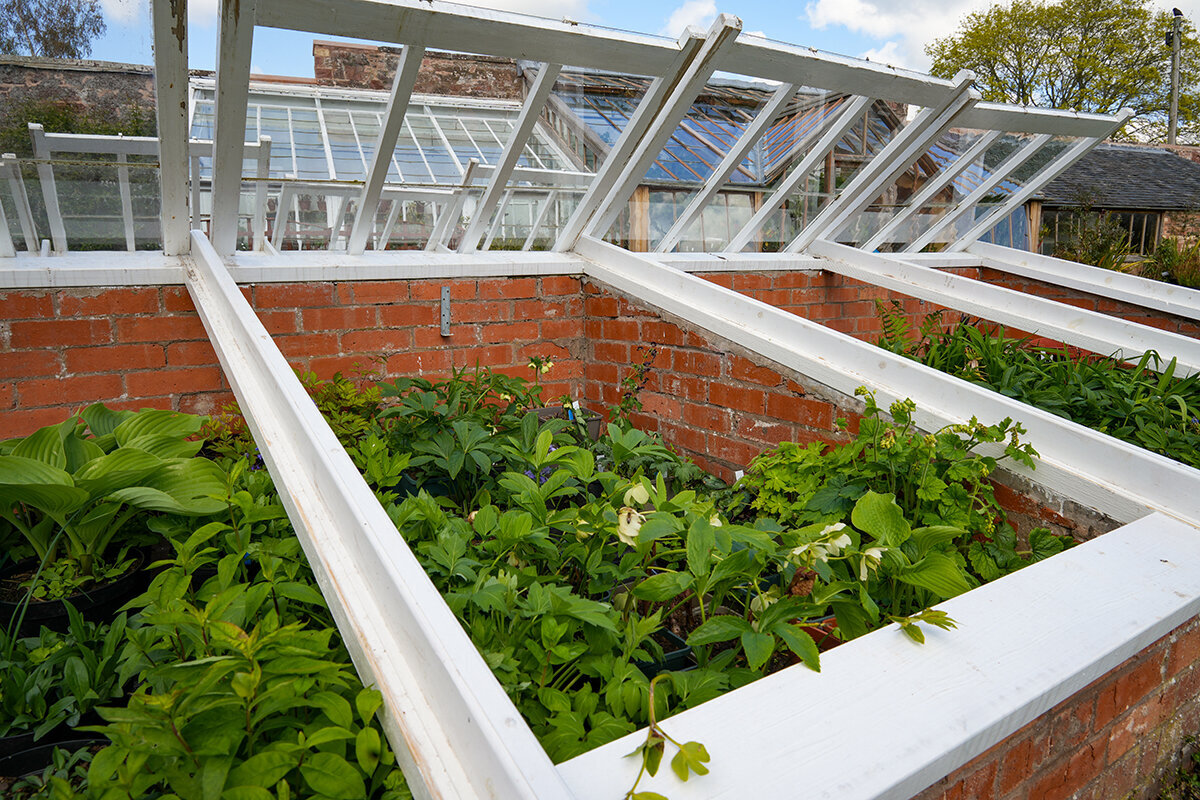
Think of a cold frame as a clear lid placed over a defined patch of garden. Low, generally unheated and close to the soil, it suits cool-season produce, seedling acclimatisation and brief periods of shelter. By contrast, you enter a greenhouse. Height and extra airspace make room for benches, propagation trays, tall plants, equipment, circulation and an organised workflow.
A cold frame is an exact tool for spring or autumn lettuce, radishes and spinach, and for moving seedlings gently from an indoor sill to an outdoor bed. A greenhouse offers broader infrastructure when you raise numerous seedlings, tend tomatoes or cucumbers over many months, or need access among the plants during unsettled weather.
Greenhouse / the tall format
A clear enclosure with sufficient height for people to work and regulate conditions.
A garden greenhouse encloses a transparent growing area that people can enter, with a door and generally vents in the roof. It may have no heating, receive occasional heat or use technical climate systems. Usable interior volume, rather than the choice between glass and plastic alone, defines it. Rising warmth has space above the crops, while benches, shelves, irrigation, tall plants and human movement can be organised efficiently.
Cold frame / the low format
A shallow box with a transparent, usually lift-up cover.
A cold frame may sit on bare ground, cover an existing bed or form the top of a raised bed. Timber, masonry, metal or durable sheet material can form the sides beneath its clear lid. Most have no heating; ventilation comes from lifting the cover by hand or using an automatic opener. The shallow enclosure gathers solar heat around the soil and seedlings. Bavarian LWG guidance on small greenhouses provides further information about location, foundations, ventilation and sensible working access.
Product terminology is not always consistent. Traditionally, a heated cold frame may be described as a hotbed, whereas a polytunnel covers a row or a broader ground area. A practical distinction is how you use it: lift an exterior lid and it follows the cold-frame idea; pass through a door to tend plants inside and it functions as a greenhouse.
Enclosed does not automatically mean frost-free. Without heating, both structures rely on sunshine, heat held in the ground, insulation, airflow, venting and how cold the night becomes. Extra protection is essential if either is to shelter frost-sensitive plants through winter; an enclosure alone is not a dependable guarantee.
02 / Conditions inside a cold frame
GROUND-LEVEL
Heat gathers immediately above the bed.
The bed below is an active part of a cold frame. Daylight crossing the cover warms plants, pots, air and earth, while the enclosure slows the wind. Its limited airspace responds rapidly. Venting may be needed on a sunny but cool spring day, yet much of the stored heat can disappear quickly under a clear night sky.
Tasks that suit a cold frame best
Its value lies in several defined uses: earlier sowing of hardy leaves, carrying salad crops further into autumn, sheltering selected plants from cold wind, and gradually exposing indoor-grown seedlings to stronger sun and variable outdoor temperatures. Plants may occupy the soil itself or remain in pots and trays. Open the cover promptly on warm, bright days.Bavarian LWG notes on mini greenhouses and raised-bed covers describe compact shelters and the ergonomic benefit of placing a cover above a raised bed.
- Well suited to Cut-and-come-again lettuce, spinach, rocket, Asian leaves, radishes, early kohlrabi, hardy herbs, brassica seedlings and hardening-off trays.
- Daily routine Read the forecast, vent before trapped heat rises, test the growing medium for moisture and replace the cover ahead of the evening chill.
- Structural limit Reach and crop height are restricted. Plants requiring permanent vertical training, tying or frequent picking will soon exceed the useful dimensions.
- Design value With restrained edging, a cold frame can merge visually with a vegetable plot or raised bed instead of appearing as a separate garden building.
03 / The atmosphere within a greenhouse
More height gives crops and gardeners scope to grow.
Height has practical value, not merely architectural appeal. More air separates foliage from the roof and lets warmth rise towards upper vents. It also supports a complete cultivation layout: raised propagation tables, accessory shelving, an uninterrupted path, climbing supports for cucumbers and tomatoes, and a doorway wide enough for pots, soil and harvest baskets.
That added capacity does not remove the work. A broad transparent surface collects considerable solar energy in bright weather and also presents more area for overnight heat loss. Venting, shade, irrigation, cleanliness and seasonal rearrangement remain routine tasks. Direct sun may overheat the interior while the air outdoors is cold, making consistent ventilation more important than retaining every trace of warmth.Bavarian LWG advice on successful seedling propagation helps gardeners judge the temperature and light demands of sensitive species realistically.
Versatility is the main benefit for an enthusiastic home gardener. In the right position, a greenhouse assists propagation, shelters tender crops during erratic spring weather, carries summer tomatoes and cucumbers when regularly vented, and keeps herbs or leafy vegetables productive later into autumn. The Classic aluminium greenhouse provides this usable workspace in durable aluminium, with a choice of dimensions, ventilation arrangements and glazing selected for the intended purpose.
04 / Understanding warmth without guarantees
Sun powers both structures, but moves through each differently.
Do not base the decision on a promised temperature gain. Follow instead the movement of sunlight, air, ground heat, moisture and ventilation, then consider how rapidly cloud, wind and nightfall can undo the conditions created during the day.
Cold-frame side
Sun-warmed zone close to ground
Greenhouse side
Standing-height airspace over the beds
Sunlight passes throughGround retains heatCover releases heat
Sunlight crosses glazingWarm air moves upwardHigh vents discharge heat
The cold frame in operation
A small clear cover admits light, which heats the bed, crops and enclosed air. Much of that usable warmth stays just above the soil. Propping or lifting the lid releases heat directly—an uncomplicated response, but one requiring attention and sometimes producing an abrupt change. The small air reserve cools rapidly after sunset. Earth, stone or containers of water can moderate fluctuations, but cannot remove the risk of damaging cold.
The greenhouse in operation
Its larger transparent envelope admits light across plants, tables, containers, floors and air. Warmth generally moves upwards, while the wider interior allows circulation and spacing between crops. Conditions can be adjusted through high vents, the door, opposing openings and shade. Even so, daytime heat ebbs after dark. An unheated greenhouse offers shelter, not sufficient warmth for every plant in every Australian climate.
Take readings beside the crops Measure temperature beside crops with a reliable thermometer. Heat, cold nights, humidity or dry media can damage plants before brief visits reveal problems. The Bavarian Garden Academy prioritises ventilation over heating and notes reduced growth and yield above 25 °C.Bavarian LWG guidance on the gardening year and cold-frame ventilation places active climate management alongside the seasonal tasks involved in vegetable production.
05 / Matching crops with time
Let plant type and cultivation period guide the choice.
Low-growing crops and brief transitions favour a cold frame. A greenhouse justifies its footprint where height, larger quantities, succession sowing or extended cultivation matter. Open beds remain essential, but either form of shelter may add productive weeks around their usual season.
- — Cold-frame role: A sheltered stop for lettuce, radishes, spinach, rocket, hardy seedlings and trays moving by stages from indoors to the garden.
- — Cold-frame role: A thoughtful final stage for autumn leaves approaching harvest, rather than somewhere to force vigorous fresh growth through the least luminous weeks.
- — Greenhouse role: Room for several propagation trays, with pricking out, labelling, watering, repotting and temporary holding undertaken at a convenient height.
- — Greenhouse role: A stronger choice for staked tomatoes, cucumbers, eggplants and substantial potted plants, so long as their individual light, warmth, irrigation and airflow needs are met.
- — Shared role: Shelter where seedlings can adjust by degrees to sunshine, wind and unstable spring weather before going into their final positions.
- — What neither replaces: Appropriate varieties, planting dates suited to the location and ongoing observation of crop condition.German guidance on greenhouse whitefly uses this pest to connect ventilation, shade and crop health. In Australia, verify any chemical through APVMA product and permit searches, then follow the destination state or territory's use rules.
06 / Access becomes routine
The way you move each day changes with the structure.
Using a cold frame means kneeling, leaning across a low side, raising the lid and reaching towards the rear of the bed. For a compact plot and quick visits, this closeness may be pleasant. Still, assess mobility, back comfort, lifting safety and repeated handling of trays. Wind can make a heavy clear lid difficult to control, while uninterrupted sunshine may leave it very hot to touch.
Greenhouse tasks are generally performed upright. Tables limit repeated bending, a central aisle helps when carrying crates or watering cans, and upper vents shed warmth without uncovering every crop. In return, the routine expands: adjust doors and windows, check water, provide shade, wash glazing, tie up plants and inspect the enclosed collection carefully for disease or pests.
↘AccessStep inside, or tend it from beyond the edge.
↑Working reachAcross a bench or to the bed's rear.
⌒Release heatUse an upper vent or raised cover.
≋IrrigateFollow a system or check individual spots.
□Maintain orderCare for an interior or a bed.
What this means in practice: A greenhouse layout can account for upright work, carrying, setting items down and turning with a crate. For a cold frame, choose a width reachable from the side, reliable support for the raised lid and clear space for opening it. Mounting the cover on a raised bed may improve working height. If lifting or kneeling causes discomfort, this operational difference can matter more than purchase price alone.
07 / Site area, wind, anchorage and longevity
Design around sunlight, secure access and the weather your property receives.
Position a cold frame beside the vegetable plot or over a raised bed. It requires seasonal sunshine, a level and stable base, unobstructed drainage and safe clearance for the lid. During the important spring and autumn hours, buildings, tall hedges and trees should not cast heavy shade across it. Test whether the cover remains controllable in wind and whether every part of the planting area is within comfortable reach.
A greenhouse site warrants longer observation. Measure beyond the footprint to include the doorway, paths, water access, roof runoff, nearby trees and room to manoeuvre a wheelbarrow. Watch the sun and dominant winds over time. Exposed coasts, sheltered urban plots, snowy highlands and cyclone-prone tropical districts pose very different demands. For a permanent structure, follow the manufacturer's foundation, anchoring and assembly instructions rather than treating them as optional details.
For a durable premium structure, match both model and anchorage to the property. Establish assembly instructions and local requirements at an early stage. The Classic aluminium greenhouse offers a practical place to review dimensions, configurations and the space available in your garden.
08 / The cycle of a local gardening year
Treat this as seasonal staging, not guaranteed tomatoes in every month.
Tropical, temperate, alpine, coastal and inland parts of Australia follow markedly different rhythms. The sequence below is therefore a task guide rather than a rigid timetable. Frost at the site, daylight, cultivar selection and immediate weather can move every stage.
Late winterStart and protect
Early springHarden off and ventilate
Late springPlant out and train
SummerShade and water
Autumn / early winterHarvest and protect
In late winter, a greenhouse can organise propagation where light, warmth and airflow are adequate. On suitable days, a cold frame may start hardy leaves or house cold-tolerant seedlings. During early spring, expose young plants gradually and vent generously in sunshine. Meanwhile, greenhouse space accommodates pricking out, repotting and temporary shelter for sensitive plants on unsettled nights.
Through summer, a cold frame left fully open may function as a growing bed or temporary nursery. Greenhouse crops need close attention to ventilation, shade and even watering. In autumn, the low enclosure helps finishing lettuces and hardy leaves through cool nights. The greenhouse can prolong herbs and vegetables, shelter selected pots and receive another round of trays. Combining the structures often works well: propagate under shelter, cultivate outside and return late crops to low-level protection.
09 / The commitments behind the price
Budget for upkeep as well as the structure.
A cold frame may be a modest yet exceptionally useful project. It uses less material, has a restrained visual presence and asks for limited maintenance. The greater obligation is timely attention when conditions change quickly. During bright spring weather, performance depends on someone venting it early enough and replacing the cover before evening cooling.
A greenhouse involves greater advance planning and expense, but consolidates numerous gardening activities. Long-term care, accessories and services become important: gutters, clean glazing, automatic openers, shelves, shade, drip irrigation and any heating or air circulation should all reflect how the structure will actually be used.
- Maintaining a cold frame Check glazing, hinges, supports and seals; clear snow and leaves safely; keep the opening hardware free-moving; refresh the growing medium and promptly discard diseased material.
- Maintaining a greenhouse Wash the glazing and drainage channels, inspect seals and mechanisms, service vents and irrigation, monitor condensation and sanitise work areas between successive crops.
- Set realistic energy expectations Without heating, a greenhouse is not a warm room for winter. Before adding heat, define the crop goal and assess energy demand and operating expense, then choose plants and equipment.
- Options for later growth As demand increases, additional cold frames can serve separate beds. Greenhouse capacity expands mainly inside, where tables, storage, drip lines, shade and better-organised propagation can be introduced in stages.
10 / Reaching a decision
Fit the structure to everyday gardening rather than an imagined ideal.
Read this as a selection tool, not a league table. A cold frame is a specialised response to a compact task, not a lesser greenhouse. Nor is a greenhouse inherently the superior choice. Its lasting transparent enclosure makes sense only when upright working, crop diversity, longer cultivation and frequent use warrant the space.
| Point to consider | A cold frame is likely to fit when … | A greenhouse is likely to fit when … |
|---|---|---|
| Crop purpose | Your priorities are lettuces, radishes, sturdy seedlings and a compact place for acclimatisation. | You intend to propagate in quantity, train tall crops, accommodate pots or manage several crop groups simultaneously. |
| Space on hand | A bed-sized area is available, but another structure you can walk into would be unwelcome. | There is room for the enclosure, approaches and working zone, with worthwhile sun in spring and autumn. |
| Movement and posture | Short visits involving bending, kneeling and controlled lifting of a cover remain comfortable. | You prefer upright work, need to carry boxes and want access to tables or several sides of a crop. |
| Managing conditions | For a compact area, you favour straightforward checks using the cover, a thermometer and moisture readings. | You can routinely regulate air exchange, irrigation, humidity, shade and spacing throughout a larger enclosure. |
| Long-term role | A low garden feature that can be modified or moved comparatively easily suits your plans. | You seek an enduring focal structure and a permanent base for cultivation. |
| Plans for expansion | If demand grows, you would rather place another box beside a different bed. | You expect broader gardening interests and want the original layout to accommodate that development. |
Select the cold-frame approach
For protection concentrated on specific crops.
The main requirement is a sheltered area immediately above the soil for salads, seedlings and seasonal changeovers, occupying little ground and remaining directly connected to the bed.
Select the greenhouse approach
For gardeners who enjoy the enclosed cultivation space itself.
Your plans call for upright work, orderly propagation surfaces, tall crops, greater capacity and a structure able to develop with serious gardening ambitions. Consider the Classic aluminium greenhouse as a premium foundation for an enduring growing room that you can enter.
Use the two together
Give each form of shelter a distinct purpose.
Let the greenhouse handle propagation, vertically trained summer crops and organised work. Beside the vegetable plot, the cold frame can acclimatise seedlings, support cool-season leaves and provide precise shelter at seasonal changeovers.
11 / Common questions answered
Brief questions can shape an entire season.
Is a cold frame simply a miniature greenhouse?
That shorthand is understandable because both admit sunlight through transparent material and retain some solar warmth. Their practical roles are nevertheless quite different. A cold frame is shallow, low and operated from outside. A greenhouse encloses a much larger volume that you can enter, accommodates taller plants and supports a wider range of gardening work.
Will a cold frame keep plants safe during frost?
It may shelter cold-tolerant crops from wind, precipitation and a brief cold spell, but cannot ensure frost-free conditions. Outcomes vary with the species, how tightly the lid closes, sunlight, wind, soil moisture, the night's minimum temperature and any supplementary cover. Even in cool outdoor weather, sunshine can demand ventilation to prevent harmful overheating.
Can an unheated greenhouse lengthen the cultivation year?
Yes. It supplies shelter, an orderly area for propagation and more usable time through the spring and autumn transitions. Outdoor temperatures and available daylight still govern it. Keeping sensitive crops through winter may call for heat, supplementary light and careful ventilation, together with an honest assessment of ongoing expense.
Which task makes a sensible introduction to cold-frame gardening?
Begin by hardening seedlings, a useful task with a manageable scope. Try hardy lettuces or young brassicas, monitor how venting affects conditions and place a thermometer inside. After learning how the frame responds to sunshine, wind and cloudless nights, introduce early and late salad plantings.
Which factors matter when selecting a greenhouse?
Define the proposed site and crops first, then allocate working space for paths, tables, watering and airflow. Floor area tells only part of the story: entry clearance, upper vents, glazing, anchorage, drainage, local wind or snow and convenient daily access affect long-term use. Before ordering a permanent greenhouse, ask the relevant state, territory and council authorities which requirements apply to the property. The aluminium greenhouse range illustrates how the same walk-in principle can extend from compact models to more generous garden structures.
References and additional reading
Specialist material to inform careful planning.
German horticultural publications underpin the discussion of ventilation, propagation, crop management and plant health. Apply their general principles to the weather, site and current requirements where you garden. For Australian chemical use, search APVMA products and permits and confirm the rules in the relevant state or territory.
More from Bloomcabin: Greenhouses and conservatories · Bloomcabin blog · Classic aluminium greenhouse
- Bavarian LWG – Guidance for small garden greenhouses
- Bavarian LWG – Urban gardening with a mini greenhouse or raised-bed cover
- Bavarian LWG – Deciding whether to raise or purchase seedlings
- Bavarian LWG – Seasonal vegetable work, the gardening year and cold frames
- North Rhine-Westphalia Chamber of Agriculture – Managing whitefly in small greenhouses
- Australian Pesticides and Veterinary Medicines Authority – registered product and permit searches
compact aluminium mini greenhousescompact aluminium mini greenhouses
Classic aluminium greenhouseClassic aluminium greenhouse
Bloomcabin / garden with clear intent
Decide how much of your cultivation year should happen under cover.
Before creating another protected area, weigh its dimensions, position, construction and the crops that will genuinely define how you use the garden.
