
Growing Grapes in a Greenhouse
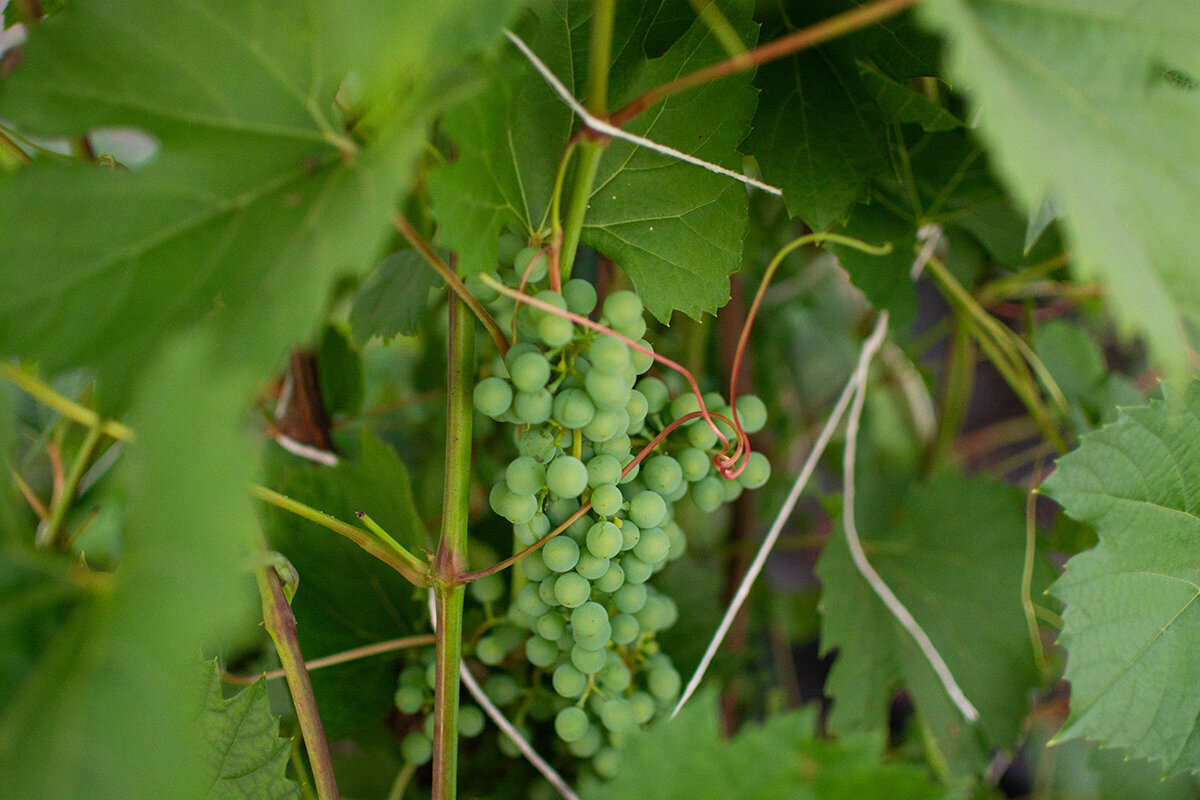
Protected growing · Perennial harvest · Trained vine
How to raise grapes beneath greenhouse cover
Growing a vine beneath a roof is a long-term commitment rather than a single-season project. Deep roots support permanent timber, new fruiting growth each year and a light, well-aired leaf layer overhead.
What makes covered table grapes worthwhile
Design the vine’s architecture before thinking about berries.
A greenhouse lets a home grower regulate rainfall exposure, warmth, access and the arrangement of foliage. The plant still demands regular work, although its shape can be managed more precisely and cropping may become steadier.
Prolonged outdoor rain wets leaves and bunches; cool summers and weak autumn sun delay ripening. Glass provides earlier warmth and rain protection, but heat and humidity can build rapidly. Dense roof foliage is not necessarily healthy: vines need airflow, orderly shoots and annual decisions about retained and removed wood.
Treat the vine as a permanent edge planting, not as another pot among the tomatoes. It needs ample soil, an unobstructed route upwards and a passage that remains usable when foliage is at its fullest. Before settling on a model, inspect the Classic aluminium greenhouse and make the vine part of the initial layout rather than a later addition.
Planning before planting
Match flavour and vigour with the intended pruning system.
Choose aromatic table grapes for more than colour or seedlessness: cultivars differ in ripening, vigour, foliage health, bunch structure and pruning. Germany's Bavarian State Institute for Viticulture and Horticulture lists robust garden examples including ‘Birstaler Muskat’ and ‘Muscat bleu’. Vigorous, seedless ‘Venus’ needs extra space.
Eating fresh
Choosing a table grape
Seek appealing flavour, manageable growth and resilient foliage. Early or mid-early cultivars can be dependable in an unheated structure, especially in cooler Australian districts; confirm that the variety suits local conditions.
- Where vines are grafted, select a rootstock appropriate to the soil, site and intended garden use.
- Favour cultivars with regional experience behind them, rather than choosing for novelty.
- Reserve enough space for broad leaves and energetic lateral growth.
Deciding how to prune
Spurs or canes?
The crop develops on green growth made this season from buds carried on last year’s wood. Certain cultivars bear well on short spurs positioned along permanent cordons. Others respond better to longer fruiting canes that are replaced annually. Variety and available room should determine the method, rather than visual preference.
Cordon and spur training keep greenhouse frameworks clear. Guyot with annually renewed fruiting canes also works when variety, wires and pruning skills suit. Build supports for the chosen method from the start.
Where to plant and how far apart
Give roots priority
Prepare deep, freely draining soil and make certain surplus water has an outlet. The hole can be approximately 30 to 40 cm deep. On a grafted plant, position the union about 5 cm above soil level. Do not place concentrated compost or mineral fertiliser against tender roots.
- If planting more than one vine, allow roughly 1.50 to 2.00 m between them as a practical guide.
- Apply water around the roots instead of wetting the leaves.
- Leave the trunk and cropping zone easy to reach for inspection and pruning.
Protection is especially useful where conditions are cool or rainy, although it does not eliminate the vine’s dormant winter period. Account for local frost exposure and cultivar hardiness. Keep soil consistently moist, but never saturated, through the first year. Once deep roots are established, the plant tolerates brief dry spells more readily.
Training layout · install supports ahead of budburst
Build a framework capable of serving the vine for decades.
Choose tensioned corrosion-resistant wire, sound terminal fixings and cross-members capable of carrying the load. Do not transfer weight to glass, vent mechanisms or lightweight shelving. An old vine supports permanent arms, heavy foliage and numerous bunches, while tying and pruning add lateral pulling forces. Parallel wires beneath the roof keep shoots in defined lanes with air between them.
Side elevation · vine framework
Lasting trunkMain upright axis
Structural armsPermanent cordons
Crop-bearing woodCanes and new-season shoots
Develop the trunk progressively during the early years. Under spur pruning, the cordon arms form part of the permanent skeleton. A cane-pruned vine instead receives selected replacement canes from one-year-old wood. Leaves and bunches are borne on the current season’s green shoots.
Recognising vine wood during dormancy
Determine each piece of timber’s age before making a cut.
One principle unlocks winter pruning: next season’s grapes will form on fresh shoots emerging from buds on wood produced the year before. Pruning therefore reshapes the vine annually. Preserve the intended permanent skeleton, nominate suitable one-year fruiting material and clear away confusing surplus growth. This maintains a workable balance among light, yield and replacement wood.
I
Lasting wood
II
Previous-season cane
III
Current green shoot
IV
Wood to remove
Lasting wood: The trunk and, where the method uses them, cordon arms create the vine’s enduring skeleton. Keep these elements sound and deliberately positioned instead of allowing old, unproductive wood to accumulate into a knot.
Previous-season cane: Smooth timber formed in the preceding season holds the buds for this year’s growth. It may be retained as a long fruiting cane or cut into short spurs.
Current green shoot: Retained buds open in spring and extend into shoots bearing foliage, tendrils and flower clusters. During the same season, those shoots produce timber that may be selected at the following winter pruning.
What is removed: Dormant pruning takes away most unwanted growth from the previous season. The resulting vine may appear surprisingly sparse, yet that open shape often indicates correct work rather than excessive cutting.
Do not copy a fixed bud count or pruning formula until you know the cultivar and training style. Spur and cane pruning take different routes towards the same goal: productive buds in proportion to the plant, enough foliage to mature the crop, and open gaps that permit quick drying and easy access.
From spring into early summer
Set the shoot pattern before managing fruit.
Budburst rapidly transforms the space. Rather than waiting until bunches become obvious, decide while growth is small which shoots will construct the canopy. Rub out weak doubles, inward-facing growth and shoots emerging in poor positions on the trunk. Loosely secure the well-placed ones before their tendrils lock everything together.
Stage 01Choose shoots
Stage 02Flowering
Stage 03Berry set
Stage 04Crop thinning
Stage 05Berry enlargement
Choosing shoots: Remove unwanted growth while it is small, leaving a spacious pattern that channels vigour into the intended structural and cropping shoots.
Flowering: Prevent water stress, sudden temperature changes and severe stripping of foliage. Most grapevines fertilise themselves, while regular ventilation helps keep flowering conditions even.
After set: The emerging berries reveal how much fruit the vine is carrying. On young plants, take off surplus or badly positioned bunches before they divert energy from framework formation.
When to reduce the crop: Where a strong vine is carrying heavily, remove fruit selectively. Evenly spaced bunches of good quality matter more than retaining the highest possible count.
As berries enlarge: Continue securing shoots and arranging laterals. Keep fruit visible and accessible, but avoid leaving it completely without leaf protection.
Flowering and berry-set guidance
Grapes grown beneath a roof seldom require hand pollination. Concentrate instead on environmental stability: open vents before excessive heat develops, prevent persistently high humidity and retain spaces through the foliage. If poor set recurs over several seasons, examine cultivar suitability, temperature peaks, moisture stress and the balance of growth. An unsuitable pruning method or surplus nitrogen may favour leaves over fruit.
Protected climate · keeping the cropping area orderly
Air circulation is part of canopy management beneath a roof.
Although luxuriant foliage looks appealing, trouble follows when leaves overlap, bunches press together and moist air remains trapped near the ridge. If possible, operate roof vents in conjunction with a door or side opening. Heated air then leaves at the top as cooler air enters lower down. Do not let foliage obstruct this route; leaves and grapes should dry promptly following condensation or irrigation.
Overhead view · cropping bay
Access path
Usable clear width
Usable clear width
Leaf layer
Separated shoot plane
Separated shoot plane
Cropping area
Bunches hanging clear
Bunches hanging clear
Soak the root area accurately. Water establishing vines consistently; mature ones usually need less frequent irrigation, but dry soil and ripening fruit still require attention. Prefer morning watering at root level, keeping leaves dry. Use root-depth moisture, weather, crop load and plant response instead of fixed schedules. Avoid waterlogging and extreme wet–dry swings.
Following berries from green to ripe
Let flavour decide the picking date.
As berries soften and colour, continue maintaining an open canopy without abruptly placing previously shaded fruit in intense sun. Harvest timing varies with the cultivar. Consider sweetness, acidity, flesh, aroma and characteristic flavour alongside skin colour. Taste from several positions within a bunch. Cut mature bunches with clean secateurs and, whenever practical, carry them by the stalk.
Sound foliage remains valuable after picking because it rebuilds reserves in the perennial vine for the following season. Clearing fruit does not complete the year’s care. Leave functional leaves in place until natural fall and dormancy signal the main period for cleaning and pruning.
While berries remain greenMaintain steady moisture and limit sharp wet-to-dry changes, particularly for cultivars susceptible to splitting.
Softening · veraisonKeep watching the crop. Thin laterals carefully if they have engulfed the fruit, while preserving sufficient leaf cover against sunburn.
Taste for maturitySample fruit from upper and lower parts of several bunches over successive days. Ripeness near the shoulder can conceal berries that are less advanced farther down.
Pick, then keep coolClear damaged berries and dropped fruit without delay. Store cut bunches somewhere cool and dry, postponing washing until they are needed.
Troubleshooting corner
Investigate conditions before reaching for fertiliser.
The key diagnostic check
A productive-looking canopy can simply be too dense.
When abundant foliage accompanies weak colour, splitting or decay, extra watering or feeding can seem like the answer. Examine vine structure first. Are all bunches visible and within reach? Do shoots lie in several layers? Does moisture remain after morning light reaches the greenhouse? How quickly does fruit dry following irrigation? Has the plant retained more crop than its roots, leaves and available sunshine can sustain?
- Fruit colours poorly: The causes often combine excessive shade, an overloaded crop and a cultivar that matures too late for local conditions.
- Berries split: Assess inconsistent root-zone moisture, abrupt uptake of water, disease and whether the bunches are exceptionally tight.
- Mites and other small pests: Inspect beneath leaves early and remove badly affected growth. If treatment is needed, use only an APVMA-registered product or valid permit covering grapevines, the identified pest and intended use, and follow the destination state or territory’s use controls.
- Growth lacks vigour: Check drainage, rooting volume, nutrition and light, and consider whether the immature vine is carrying an excessive crop.
Seasonal plan · align each task with regional conditions and cultivar stage
A complete cycle for the greenhouse vine.
| Phase | Primary task | Checks to make | When to hold back |
|---|---|---|---|
| Dormant winter period | Apply the chosen cane- or spur-pruning method, cutting out dead, crossed and unnecessary wood. | Inspect trunk condition, wire tension, ties, old fruit and contact with vents, glazing or roofing. | Do not preserve surplus buds merely because the correctly pruned plant appears severe. |
| Approach to spring | Secure the selected trunk and watch for the first movement of buds. | Monitor budburst, late frost exposure, drainage and initial pest activity. | Avoid heavy watering while the cool root area continues to dry slowly. |
| Late spring | Remove surplus shoots, secure new growth and operate ventilation proactively. | Review leaf density, flowering progress and sharp daytime rises in temperature. | Prevent tendrils from knitting inaccessible growth together beneath the roof. |
| Summer | Control laterals, retained fruit, ventilation and moisture around the roots. | Look for condensation, shaded fruit, foliage disease, mites and uneven berry progress. | Do not stimulate already lush growth with fertiliser rich in nitrogen. |
| Picking · autumn | Use flavour to judge harvest, remove dropped fruit and preserve healthy leaves afterwards. | Check for splitting, decay, uneven maturity and the post-harvest condition of the canopy. | Do not strip useful leaves as soon as the final bunch has been harvested. |
The layout should also account for irrigation access, paths, beds, benches and maintenance space. One suitable starting point is the Classic aluminium greenhouse. A perennial vine is easiest to manage when the surrounding interior has been designed from the outset around its trunk, supports and accessible cropping area.
FAQ
Answers from beneath the canopy.
Observation of vine stage is more useful than following dates rigidly, particularly across Australia’s varied climates. Use these answers as a foundation, then adjust cultivar choice, pruning and plant-health measures to the site and current regional advice.
Will grapes fit in a compact greenhouse?
Yes, provided one vine is planted along an edge and trained with discipline. A small structure can house a grapevine, but it offers no room for uncontrolled foliage. Select moderate growth, put wires in place first and retain an unobstructed passage for inspection, pruning and harvest.
What is the right number of vines?
A single, carefully shaped vine suits many domestic greenhouses. It may eventually occupy much of the roof and gives a beginner time to master one pruning system. Add another only if there is adequate wire length, independent rooting space and clear access to both cropping zones. Allow 1.50 to 2.00 m as an approximate spacing.
Is hand pollination necessary under cover?
Usually it is unnecessary because most grapevines are self-fertile, and opening the greenhouse supplies useful movement of air around the flowers. Focus on avoiding extreme temperatures, moisture stress and humid stagnation. Persistent poor set calls for a review of cultivar, climate, pruning and growth balance.
Can the vine remain in a container?
A very large permanent container is an option where direct planting cannot be done. Even so, deeply loosened greenhouse soil normally provides more root volume and a wider margin for error. Pot-grown vines demand closer management of water and nutrients, and their roots experience greater winter temperature fluctuation.
Why is there abundant foliage but little worthwhile fruit?
Possible causes include retaining excess buds, applying too much nitrogen, allowing foliage to crowd the fruit, insufficient light or asking too much of an immature plant. The cultivar may also be incompatible with the pruning style. Before adding feed or making drastic changes, begin with purposeful dormant pruning, prompt shoot selection and improved ventilation.
References and further reading
Technical sources for deeper guidance.
These specialist references underpin the planting, cultivar selection, training, pruning, canopy and disease-prevention guidance above. Confirm cultivar and plant-health recommendations against current Australian regional information, while also accounting for the particular conditions inside your greenhouse.
Explore more from Bloomcabin: automatic window openers for greenhouses · Classic greenhouse in aluminium · Bloomcabin aluminium greenhouse questions and answers
- Bavarian State Institute for Viticulture and Horticulture —Table grapes for the house and garden
- Bavarian State Institute for Viticulture and Horticulture —Grape cultivars for domestic and allotment gardens
- Bavarian State Institute for Viticulture and Horticulture —Powdery mildew affecting home vines and table grapes
- Bavarian State Institute for Viticulture and Horticulture —Downy mildew on domestic grapevines
- Royal Horticultural Society —How to train and prune grapevines
- Royal Horticultural Society —Cultivating grapes beneath glass
- Bavarian State Institute for Viticulture and Horticulture —Planting and caring for table grapes
The grower’s harvest table
Let the permanent vine shape the greenhouse plan.
Before planting, allocate room for the trunk, long-lived framework, overhead wires, an uncluttered cropping area and the grower who must prune every winter. View the Classic aluminium greenhouse and use the Classic aluminium greenhouse to create a productive interior that remains practical and accessible from the first day over the long term.
Classic greenhouse in aluminium