
Growing orchids successfully in a greenhouse
Bloomcabin Australia / Growing under glass
Raising greenhouse orchids with confidence
A successful orchid house is a controlled growing space: light is softened, air keeps circulating, water stays clean, and roots regain oxygen after each soaking.
How epiphytes live
For orchid growing, the spaces around the roots matter more than any choice based on flower colour.
Many familiar greenhouse orchids are epiphytes. In nature they use branches, bark or rocks for support without taking nutrients from the host. Rain, dew and organic deposits supply moisture, while air surrounds the roots between wet periods. Under glazing, a grower can deliberately combine strong filtered light, humidity that never becomes stagnant, and gentle temperature variation from day to night.
A greenhouse can also magnify mistakes. Small structures may heat rapidly through an Australian summer, crowded pots can remain damp long after watering, and one new specimen may introduce pests. The aim is not a permanently steamy jungle scene, but a stable, observable environment where compatible orchids can follow their own pattern of wetting, drying, growth and dormancy.
Good labels should come first. Record the genus, species or hybrid and keep the breeder’s growing notes; these are more useful than a blanket rule such as “water weekly”. Drying time changes with light, bench position, container size, medium, season, growth phase and weather. Arrange plants with comparable needs together, leaving roots and pots easy to inspect without repeated moving.
Adaptable hybrids with dependable labels make a sounder starting collection than difficult rarities. An orderly framework of reachable benches, clear air passages and accessible growing zones—for example, in a Classic aluminium greenhouse—will support orchids better than a bigger but poorly organised assortment.
An important distinctionEpiphyte refers to a plant’s habit of living on a surface, rather than parasitising it. Branches, bark and mounts provide physical support only.Terrestrial orchids occupy soil-like media and commonly follow another moisture cycle. Always let the named species or hybrid determine the final approach.
01 / Set a climate you can maintain
Choose by habitat, growth form and your experience
Treat temperature categories as a way to organise plants, not as a promise of success. Requirements can vary substantially even within one genus. A trustworthy plant label, known provenance and specialist breeder guidance should override a general category.
Warm
Sheltered warmth in winterIntermediate
Measured day-to-night changeCool
Protection from summer heatPlanning a warm-growing zone
Heat-loving types suit a house where winter nights remain reliably mild and cold glazing cannot chill their foliage. This group includes many Phalaenopsis hybrids, vandas and dendrobiums grown warm, although their preferred light levels differ. As broad guidance, days are often kept around 20–29 °C and nights should not remain well below 18 °C. Keep air exchanging even in a warm house: trapped warmth and moisture increase disease risk instead of creating a healthy tropical habitat.
Planning an intermediate zone
An intermediate area is often the most workable foundation for a varied Australian greenhouse collection. Many Cattleya hybrids, Oncidium relatives, Brassia and selected dendrobiums appreciate bright days, moving air and a clear but moderate night cooling. Depending on the orchid, about 18–26 °C by day and 13–18 °C overnight may suit. Those limits allow both brighter sites and more sheltered positions on one bench.
Planning a cool-growing zone
Highland and cloud-forest orchids can be remarkable, yet summer conditions often determine whether they thrive. Some Masdevallia, Coelogyne and former Odontoglossum types require good light, substantial humidity, constantly fresh air and genuinely cool temperatures. Extended heat can also trouble cymbidiums. Avoid choosing a cool grower for its flower alone if temperatures beside the plants regularly soar in January.
For Australian conditions, first create a reliable warm or intermediate section. Consider cool specialists only after logging the hottest readings at bench height through summer. A roof-mounted thermometer does not describe the same microclimate as a sensor beside the foliage.
02 / Place plants according to light
Glazing, shade and bench height form distinct light layers
Section through the greenhouseSeasonal sun
HighFiltered, high light
At the benchModerate light level
LowSheltered partial shade
Airflow pathIntake air moving towards the roof vent
Planning shade through the seasons
Watch conditions, add shade, then reassess.
One greenhouse can be dim through winter and fiercely bright in summer. Use a light meter where practical, but read the orchid as well. Weak growth with soft, unusually dark green leaves may suggest too little light. Yellowed, bleached or abnormally red-stressed areas, particularly on hot foliage, more often suggest too much. Leaf colour contributes evidence but cannot establish a diagnosis by itself.
Conditions near the roof are generally both warmer and brighter. Reserve that level for orchids with greater light demand, and acclimatise them slowly. Intermediate collections often perform well around the middle benches. Lower or recessed positions can protect shade-tolerant plants, provided moisture-laden air does not collect there. A shaded orchid still needs visibility and air movement.
Shade installed outside, or held clear of the glazing, blocks part of the sun’s energy before it enters. Interior cloth is useful too, though it reduces heat gain less effectively. Adjustable seasonal screening offers more control than dense permanent cover. The aluminium greenhouses range also illustrates why ventilation, plant levels and shade need to be designed together.
Move each new orchid into brighter conditions in stages. A specimen raised beneath lamps or nursery shade should not be placed immediately under a glazed roof on the first clear spring weekend. Shift it gradually and monitor its response for several days. Even with cool outside air, strong spring sunlight can lift leaf temperatures sharply beside the glazing.
03 / Treat roots as your guide
Soak completely, then restore air around the roots.
For epiphytes, learn how quickly each specimen dries instead of making every pot follow a fixed schedule.
Understanding each wet-to-dry transition
Visible healthy roots are commonly pale or silvery green while dry, then deepen in green after wetting. Velamen—the layered covering around many orchid roots—helps produce this change. It is a helpful clue, but not a universal test. Opaque containers, decomposed media and terrestrial orchids require other observations. Assess the roots together with pot weight, medium condition, weather and current growth.
Velamen moisture cycle
Dry
Wet
Absorb
Drain
Aerate
Morning is usually the best time to irrigate, because foliage, crowns and greenhouse surfaces can dry before the coldest night period. Wet the entire medium until excess water leaves the drainage holes; a light surface sprinkle is not enough. Empty decorative outer pots and trays, keep water from pooling beneath bench grating, and clear it from vulnerable leaf rosettes. In hot weather, a small mounted plant might need water every day, while a large shaded bark-filled pot may dry far more slowly. Either pattern can be appropriate.
Consider irrigation water separately from atmospheric moisture
Rainwater appeals to many growers because dissolved mineral levels are usually low, provided collection and storage are hygienic. If you rely on mains or bore water, find out its composition. Alkalinity, hardness and dissolved salts can accumulate through bark and around roots; pale crusts on a pot can reveal the problem. Use suitable water for periodic thorough flushing, apply fertiliser conservatively, and monitor leaf and root tips before minor mineral stress becomes persistent.
Moist air benefits orchids, but roots still need direct watering. Many tropical groups are commonly associated with roughly 40 to 70 percent relative humidity, although individual requirements vary. The surrounding conditions must remain balanced. Still, humid air can cause condensation and disease during cool nights, while excessive fan speed strips moisture from plants. Aim for circulation that barely stirs leaves, disperses damp pockets and avoids either a drying blast or a cold draught.
Side openings, roof vents and circulation fans work together against overheating, excess moisture and disease. A useful structural base could be a Classic aluminium greenhouse combined with information about aluminium greenhouses so that the complete setup is planned as one system.
04 / Design the root environment
Fit the vessel to the roots, conditions and routine
Orchid medium is unlike garden soil. Its temporary framework must provide modest moisture storage, structural support, open air spaces and practical access for root checks.
Pot
Basket
Mount
Pot
Pots provide support and a moisture reserve that is comparatively easy to regulate. For some orchids, clear nursery pots reveal root and moisture conditions, but direct sun can overheat exposed containers. Slots increase airflow through the root area. Select bark size and water-holding capacity for the root thickness, local microclimate and your watering habits—not merely for appearance.
Basket
Baskets drain swiftly and accommodate strong, spreading roots. They can work well for vigorous or pendulous orchids in warm areas with adequate humidity, but they also demand reliable moisture and more frequent attention. The choice is not automatically superior to a pot; it establishes a quicker drying cycle that must fit both the orchid and your routine.
Mount
Fixing an orchid to cork or appropriate timber exposes the roots and creates an airy display close to its natural growth habit. These plants can look impressive and remain healthy, but moisture disappears quickly. Use mounts only where greenhouse conditions and daily care can support frequent, accurately directed watering.
In a moist greenhouse, coarse bark often performs well because frequent irrigation and humid air already delay drying. Fine material or a high proportion of sphagnum may remain saturated for too long under the wrong conditions. By contrast, fine-rooted orchids or plants in warmer, drier sites may need extra moisture retention. Coarseness alone does not indicate quality. Choose a medium that drains, preserves air spaces and dries at a pace suited to the plant.
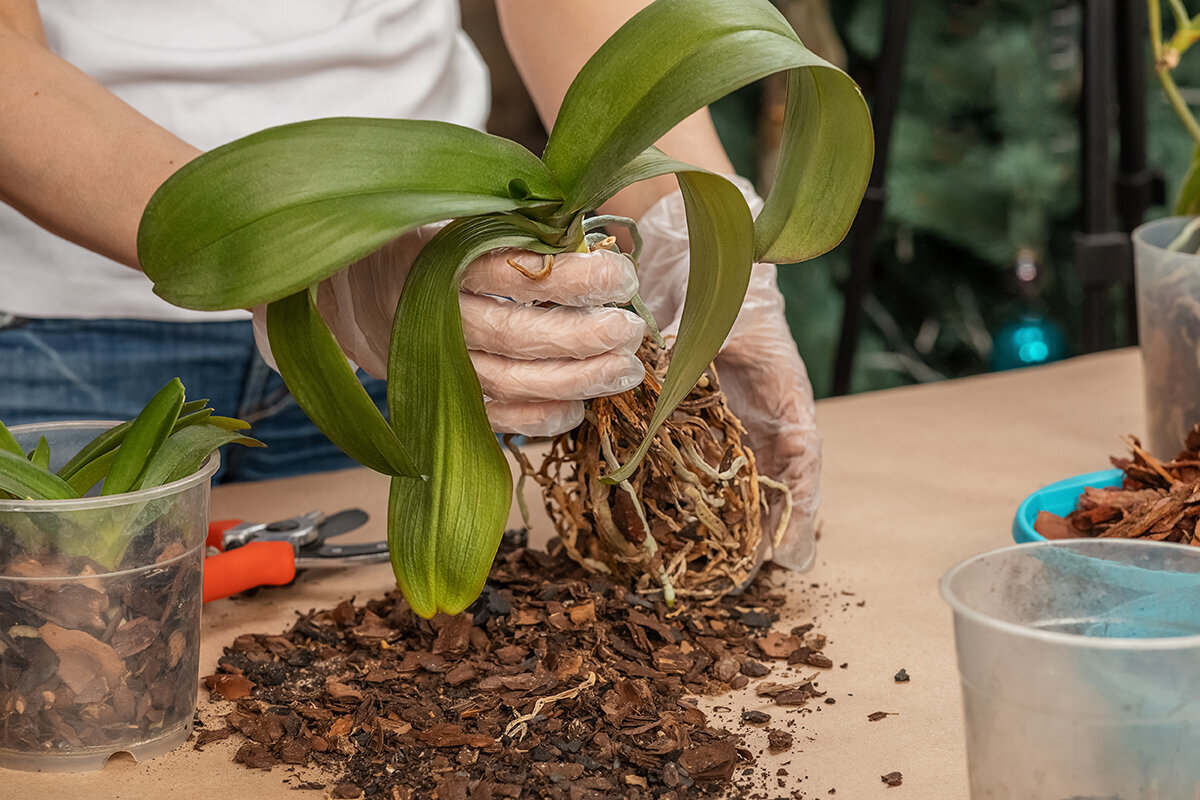
Repot when bark is visibly breaking down, the centre has compacted, drainage is poor, salts have accumulated or roots are forcing the container apart. Many sympodial orchids recover most readily when new roots are beginning. Use clean tools, remove only roots that are clearly dead or rotten, and secure the plant so it cannot wobble. Increase the pot size only slightly; an oversized volume may stay wet in cool conditions and weaken the root system.
05 / Let active growth set the timing
Repot and feed during active development
Water and nutrient demand changes as an orchid extends roots, produces foliage, develops pseudobulbs, rests or prepares to bloom.
Roots
Leaves
Pseudobulbs
Flower spikes
Rest
Emerging root tips indicate a good opportunity for establishment after repotting and for active nutrient uptake.
Monopodial orchids extend along a continuing central axis. Prevent moisture from sitting for prolonged periods in the vulnerable crown.
Swollen stems serve as water and energy stores in many sympodial orchids. Retain older pseudobulbs because they may continue supporting new growth.
Depending on the orchid, flowering stems may form from nodes, leaf axils, mature new shoots, other growths or near the main axis. One pruning method cannot suit them all.
Certain orchids enter periods requiring less water, lower temperatures or fewer nutrients. A seasonal pause may be normal rather than evidence of neglect.
Fertilising: dilute, consistent and flushed
Choose a completely soluble orchid fertiliser and observe its manufacturer’s instructions. During active growth, provide suitable plants with modest but regular feeding. Cut back or pause when growth, light and temperature decline, or when the species enters dormancy. Controlled weak solutions are generally easier to manage than infrequent concentrated applications. First moisten any medium that has become very dry. About once a month, rinse it thoroughly with clean water to limit fertiliser-salt accumulation.
No flowers? Assess the surroundings first
When a healthy-looking orchid fails to bloom, confirm its identity and available light before reviewing day-to-night temperature change, seasonal rest, root health, maturity and nutrition. Mature Cattleya hybrids can need much brighter positions than Phalaenopsis. Particular dendrobiums and cymbidiums may depend on a cooler or drier stage. Do not apply extra fertiliser, severe pruning or arbitrary cold merely because such advice suits another kind of orchid.
06 / Maintain a separate quarantine zone
Protect a valuable collection at its point of entry
Pests and plant diseases can spread quickly in warm, moist conditions. Give every incoming orchid a period of close observation before allowing it onto the established bench.
Handling incoming orchids
- Place the arrival away from established specimens, preferably in another growing space or within an unmistakably isolated section.
- Inspect beneath leaves, inside axils, around new shoots, among roots, along pot rims and across flowers for scale insects, mealybugs, thrips, mites, snails or unusual lesions.
- Discard dead material, sanitise tools and the bench, and stop drainage from an incoming specimen flowing towards established plants.
- Allow enough observation time to reveal problems, especially following hot days. Note when the plant was purchased and record anything unusual; photographs help compare later developments.
Reading warning signs
- Soft, dark roots or collapsed medium: review drainage, watering frequency and medium condition, then separate the orchid promptly if decay continues.
- Sunken or expanding marks: isolate the specimen, improve cleanliness and airflow, and obtain a defensible diagnosis before choosing any treatment.
- Sticky deposits or cottony nests: check nearby orchids for sap-sucking insects, remove visible pests physically and repeat the required control method consistently.
- Wrinkled leaves: resist adding water automatically. Decayed roots, overheating, compacted medium or salt injury may block uptake while the container remains wet.
Do not apply chemicals routinely without identifying the problem. Physical removal, correction of growing conditions and a properly identified treatment used exactly as labelled are safer than indiscriminate spraying inside an enclosed greenhouse. Keep tools separate when plants show suspicious rings, streaks or abnormal patterns. For persistent damage or a suspected virus, consult an experienced orchid grower, local orchid society or qualified horticultural adviser. Before applying any agricultural chemical, verify the current APVMA registration or permit, follow the label, and check use rules in your state or territory.
07 / Arrange the collection for easy care
Organise around climate rather than flower colour
Watering, shading and inspection become simpler when adjacent orchids follow comparable environmental cycles.
Keep moisture-demanding orchids with lower light needs in positions that are easy to check and still receive airflow. Give brighter, quicker-drying types a higher or more exposed site. Group mounts together so their frequent watering does not dictate the schedule for every pot. Leave a compact, accessible workspace for arrivals, weakened specimens and current maintenance.
Use the structure’s height. Hanging orchids can occupy the brighter, warmer upper space, while lower benches may offer gentler conditions. Never sacrifice access: each plant, label and root area should remain within reach and view. Space between specimens is productive, because it helps you detect a change before it moves through the collection.
A Classic aluminium greenhouse can become a deliberately filtered orchid habitat instead of general storage. Preserve a central work route and open airflow corridor, begin with one warm or intermediate bench, then introduce screening, circulation and extra levels in response to observed conditions. As a structural reference, a Classic aluminium greenhouse brings glazing, overall scale and usable growing surfaces together for an Australian garden.
Bright levelHanging orchids
Middle benchRobust hybrids
Lower zoneProtected shade
ThresholdQuarantine
Regard the layout as an initial framework, not a permanent rule. Where each group ultimately belongs will be revealed by the greenhouse’s real light levels, airflow and drying behaviour.
Frequently asked questions
Questions that commonly arise after a first growing season
What temperature range suits an orchid greenhouse?
Orchids do not share one ideal temperature. For broad planning, many Phalaenopsis hybrids and other warm types suit days near 20–29 °C, with overnight conditions not remaining far below 18 °C. Intermediate groups can accept cooler nights, while cool growers need meaningful protection from summer heat. Follow information for the exact species or hybrid and take both day and night readings beside the leaves.
How humid should an orchid greenhouse be?
Moderate to high humidity benefits many orchids, and guidance for tropical groups often cites about 40 to 70 percent. No single reading is sufficient, however. Damp, motionless air can encourage night condensation and disease; an excessively powerful fan causes dehydration. Combine gentle ongoing circulation with foliage that dries appropriately and watering matched to the roots.
When do orchids under glass need watering?
Let the drying condition appropriate to each orchid determine timing rather than using a weekly roster. The interval shifts with container size, bark grade, root quantity, light, heat, atmospheric moisture, season and active growth. Inspect plants daily when necessary, but irrigate only when their condition calls for it. Pot weight, visible roots and the feel of the medium provide stronger evidence when considered together.
Is tap water suitable for orchids?
For many robust hybrids, tap water can work well. Its chemistry still matters: high hardness or dissolved-mineral content may leave deposits in the medium and make feeding more difficult. Check the analysis for your local supply and watch for pale crusting. Sensitive orchids may benefit from hygienically collected rainwater or suitably treated low-mineral water. Water softened by salt-based systems can carry an unsuitable salt load.
Why can leaves wrinkle while the medium remains wet?
Wrinkling indicates that the water balance has failed; it does not prove that irrigation is lacking. Rot-damaged roots, compacted old medium, excess salts, severe heat or pests may stop absorption even in a wet container. Examine the roots, drainage, medium and greenhouse temperature before acting. Additional watering could intensify the original problem.
Will cool-growing orchids cope in an ordinary garden greenhouse?
Only where suitable conditions continue through the hottest part of the year. Across many Australian locations, accumulated summer heat beneath glazing is a greater obstacle than winter cold. Air circulation by itself cannot turn an overheated structure into a cloud-forest environment. Substantial ventilation, effective shade and favourable siting are essential, and some specialist orchids may remain impractical.
Technical foundations
Sources and
further reading
Requirements differ among genera, species and hybrids. The references below support the broad information about epiphytic growth, root function, greenhouse environments and recurring problems. For rare specimens, give priority to documented provenance and up-to-date guidance from specialist growers. Editorial material reviewed in August 2026.
More from Bloomcabin: Curtains and premium shade for greenhouses · Summer greenhouse care · Bloomcabin greenhouse and conservatory options
- German Orchid Society – orchid-growing expertise
- University of Göttingen – rainforest house and epiphytes
- Iowa State University Extension – indoor orchid growing
- Iowa State University Extension – identifying orchid disorders
- University of Alaska Fairbanks – managing greenhouse conditions and airflow
- University of Illinois Extension – roots of epiphytic orchids
