
Hot Tub Delivery: Gates, Access Routes and Lifting
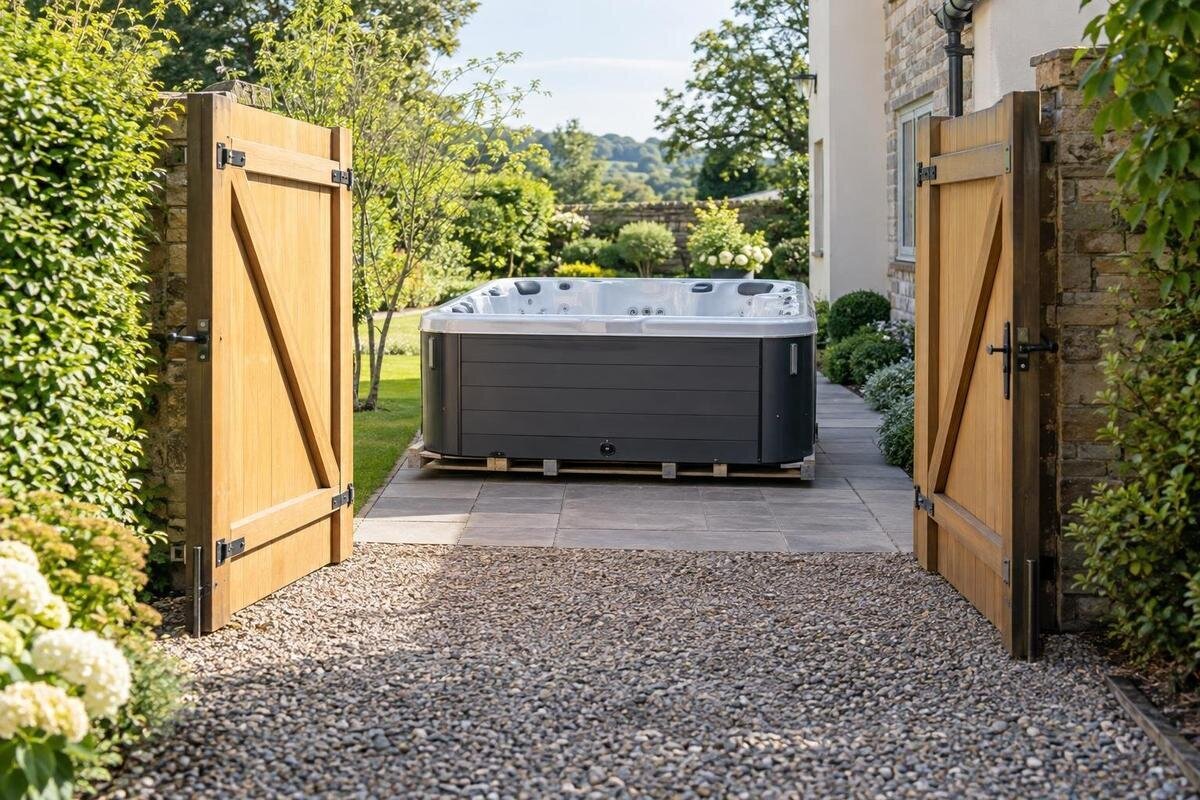
Hot tub delivery planning
Delivery access is easy to underestimate when the driveway looks clear. The carrier has to move the hot tub from the vehicle’s actual stopping point, through every opening and turn, and to the intended position using an approved handling method. Before ordering, make a route record with measurements, photos and notes about fixed obstacles. Then ask the supplier and delivery provider to compare it with the exact model’s transport dimensions, packaging, weight and handling instructions. If ordinary access is uncertain, ask about a site assessment and specialist lifting before delivery arrangements are confirmed.
01
Map the route from the delivery vehicle to the final position
Begin at the point where the delivery vehicle can realistically stop, not at your front gate. A large vehicle may be unable to reach the end of a driveway or a narrow street, so include any distance from a kerbside stop, shared access or driveway entrance. Ask the carrier where it expects to unload and what access it needs for the vehicle itself. A delivery area shown on a retailer’s website does not establish that a particular vehicle can reach your property or that it will bring the tub to the backyard. If there are several possible stopping places, mark each one and note which is normally available.
Sketch a continuous route from that stopping point to the exact place where you want the hot tub positioned. Mark gates, paths, corners, level changes and the destination, then add distances between key obstacles and label each photo to match. If the path passes around a house, through a carport or along a shared driveway, show how it connects to the vehicle’s stopping point rather than sending an isolated garden photo. Note any space needed for the vehicle to approach, stop or unload, and tell the carrier if access is shared or time-restricted. Simple labels such as Gate A and Turn B make it easier to discuss a specific point.
Get the exact transport details for your chosen model
Ask for transport details for the exact model you are considering, rather than relying on dimensions when it is assembled or in use. The supplier or manufacturer should confirm the dimensions and weight in the delivery configuration, packaging, permitted handling orientation and any specified lifting points or method. Those details may differ from a bare product measurement. When enquiring about Bloomcabin hot tub Cove 2, ask for the information the delivery provider will use to assess your route, not an estimate based on a catalogue image or model number.
Clarify whether the stated dimensions include protective wrapping, a crate or another transport arrangement, and whether any parts are removed before delivery. Ask for the outside height as well as the width and length: an opening can be wide enough but too low. Have the supplier and carrier confirm that they are assessing the same delivery configuration, and ask the provider to specify any clearance it needs for handling equipment. Don’t create your own safety margin or assume that the tub can be turned or tilted to gain room unless the manufacturer and carrier confirm that method. Written details tied to the exact model and delivery arrangement are more useful than general advice that most tubs should fit.
02
Measure every gate and narrow access point
Measure each gate and pinch point at the narrowest clear opening, not from post centres or the nominal width of the gate leaf. Open the gate as far as it will go in the planned delivery arrangement, then measure between the nearest obstacles, including its latch, hinges, stop, handle and adjacent wall or fence. Record usable height beneath any arch, lintel or overhanging feature as well. Write down exactly where each measurement was taken; ‘side gate: latch to wall’ is more useful than ‘gate about a metre’. If the opening changes with the gate angle, state the position used for the measurement.
Repeat the check at side passages and wherever a wall return, downpipe, meter box, tap, built-in ledge or other projection reduces the gap. Include raised tracks or thresholds if they affect passage. Take one photo square-on and another showing the approach and both sides of the opening. A tape measure in the frame can help, but write the value beside a numbered photo rather than expecting the carrier to read it. If Bloomcabin Hot Tub Haven 6 is on your shortlist, label the route notes with that model and ask the supplier to assess the actual clear opening, not a rounded figure.
Check corners and tight turns
One clear doorway does not settle the question if the path turns immediately afterwards. Record every corner, change in direction, landing and narrow corridor, including the clear distance before and after each turn. Photograph the approach from both ends and note any wall, fence return or projecting post that makes the manoeuvring area smaller than it appears from above. Mark whether the route takes a sharp corner or a sweeping bend, and include any wider patch where the item might be turned. The delivery team needs to assess the complete manoeuvre, not just the width of the gate.
Do not assume a tub can be moved diagonally, pivoted in place, stood upright or tilted to get around a corner. The delivery configuration, approved orientation and equipment used affect the space required, and the carrier must assess the actual route. A simple plan with arrows and numbered turns is more useful than trying to prove a turn with a diagonal measurement. For Bloomcabin Hot Tub Fjord 8, as with any shortlisted model, ask whether the exact packed item and handling method can negotiate each turn.
03
Check overhead obstacles and clear space
Check above the route as carefully as you check its width. Note the lowest clear height along the path and near where the delivery vehicle will unload, looking for eaves, balcony edges, pergolas, tree branches, pipes, lights and clotheslines. Include low points on the vehicle approach, not just the garden path; overhead clearance may affect access before the tub is unloaded. Record whether each obstruction is fixed or can be moved with permission, and note features that change, such as a retractable awning or seasonal branches. Do not assume something can be shifted simply because it is movable.
Take a wide photo to show where an obstruction sits relative to a gate or turn, then a closer view that makes its position clearer. If a lift is being considered, show the space above the intended position and any structure between the vehicle and that point; a clear landing area does not prove that a lifting route is available. Flag powerlines or uncertain structures to the delivery or lifting professional rather than asking a crew to work around an unassessed hazard. For Bloomcabin hot tub Aurora 10, obtain confirmed delivery height and handling information before comparing them with your measurements.
Note steps, slopes and surface changes
List every change in level: kerbs, thresholds, steps, ramps, sloping sections and landings. Note the number of steps, handrails, narrow stair turns, the direction of each slope and where the surface changes. A photo from above and another from the foot of a stair can make the sequence clearer. These details help the provider decide whether its equipment and handling method are appropriate; they do not establish that a route is safe for moving a heavy item. Don’t calculate a carrying plan or assume several people can simply lift the tub over steps.
Describe the surfaces along the route too: paving, concrete, decking, lawn, loose gravel or narrow drain covers, including any cracks, soft patches, grates or uneven edges that could affect movement. Use a wide image to show the full stretch and a close-up of a doubtful area. Ask the carrier or lifting specialist what equipment can travel over it and whether a site visit is needed. If you propose a temporary ramp or cover, describe it and ask the provider to assess it rather than treating it as an approved solution. This is access information, not an assessment of the final base or the structural capacity of a deck.
04
Identify barriers that can be moved
Separate obstacles into fixed items and those that might be moved before delivery. A gate leaf, removable fence panel, planter, outdoor furniture, parked vehicle or loose storage may look easy to shift, but each has an owner, a removal method and a deadline. Check who has authority to remove it, who will do the work and who will reinstall or repair it afterwards. Seek permission from a landlord, neighbour or body corporate where relevant. Visible screws or hinges do not prove that a fence can safely be dismantled. If a tradesperson needs to do the work, include that in the plan well before delivery is booked.
Mark any proposed changes on your route sketch and provide updated photos once the agreed barriers have been removed. Measure the opening again after a gate or panel is taken out. A temporary gap helps only if the tub and any handling equipment can pass through it, and the route must remain clear for the full move. For a delivery involving Cove 2, or another shortlisted model, ask the supplier to review the route that will actually be available. Put responsibility for removal, reinstatement and any damage in writing, and confirm who would cover an extra visit if the opening is not ready.
Use confirmed access information when choosing a model
Include confirmed transport details in your model comparison. A product page identifies a catalogue model, but does not establish its packed dimensions, delivery weight, permitted orientation or the space needed to manoeuvre it through your property. Ask for those details for each model you are genuinely considering, then send the same route sketch, measurements and photos for each assessment. Ask the supplier to identify the narrow points it has considered and any clearance it needs, so you can spot missing information. If requirements differ, compare the written responses from the supplier and delivery provider rather than guessing from a name, photograph or apparent size.
Possible responses might include choosing a different model, opening an alternate route, arranging authorised barrier removal or using a specialist lift. Which option, if any, is practical depends on the confirmed transport details, site conditions and provider’s handling method. Don’t commit on the assumption that a last-minute tilt, partial disassembly or extra crew will solve a tight point. For Haven 6, keep the model-specific delivery information with your route plan. Before placing or amending an order, ask how a change of model or delivery method would affect the agreed service and who needs to approve it.
05
Ask whether a site assessment or specialist lift is needed
Request a site assessment when measurements are close to the supplied transport dimensions, the route includes complex turns or steps, the vehicle cannot stop near the entrance, or photos leave an important uncertainty. Ask early if the only apparent option is to lift over a fence, roofline or other obstruction. The supplier or carrier can tell you whether its standard service covers the route or whether a separate lifting contractor needs to assess it. Ask whether the assessment can be done from your information or needs an in-person visit, and request a written record of the route assumptions. A visit can resolve questions that photos alone cannot.
Give the lifting provider the address, route sketch, measured restrictions and broad photos from the street and garden. Identify overhead services, nearby buildings, shared driveways, restricted vehicle access and the intended landing point. The specialist must assess the equipment, setup, lifting points, orientation, ground conditions and safe working method against the manufacturer’s instructions; these are not decisions to make by estimating reach or load yourself. For Fjord 8, have the provider use the confirmed transport data when assessing the proposed lift. Ask whether the assessment fee and any proposed lifting work are included in the quote.
Confirm delivery scope and local arrangements
Before paying or setting a delivery date, get the delivery scope in writing. Confirm where the carrier expects to stop, whether unloading is included, how far the item will be brought and whether placement at your intended position is part of the service. Ask who books a lift if needed, who provides information to that contractor, who arranges access changes and who coordinates the delivery and lifting teams. Confirm what happens if the route differs from your photos or is not clear on arrival, including any rebooking, return-trip or cancellation terms. Don’t assume that delivery means the tub will be moved to its final position.
If a truck, crane or other lifting operation may use a road, footpath, shared driveway or another person’s land, ask the provider what permissions or traffic arrangements may apply at that location. Depending on the site, the relevant council, road authority, landowner or body corporate may need to be consulted. Requirements are not the same at every address, so don’t assume approval is always required or never required; confirm what applies with the provider and relevant local authority. When requesting a delivery quote for Aurora 10, supply the confirmed transport details and ask for any site visit, equipment, crew, access work and traffic management to be itemised, along with conditions that could change the charge.
Frequently asked questions
Are the dimensions on a product page enough to confirm access?
No. They may describe the tub rather than its packaged delivery configuration, and they do not necessarily state its permitted handling orientation. Ask the supplier or manufacturer for the transport dimensions, weight and handling requirements, then have the delivery provider compare them with your measured route.
Which measurements and photos should I send?
Send the clear width and height of each gate and narrow point, plus measurements of turns, overhead clearance, steps, slopes and the area where the tub will be placed. Number the photos and match them to a simple route sketch so the supplier and carrier can see where each measurement applies.
Does standard delivery include placing the tub at my chosen spot?
It depends on the delivery arrangement. Confirm where the vehicle will stop, whether unloading is included, how far the tub will be moved and whether placement at your intended position is part of the service. Ask who arranges any extra handling or lifting.
When should I ask about a specialist lift?
Raise it before ordering if there is no clear route, access involves difficult turns or steps, the vehicle cannot stop near the property, or a lift over an obstacle seems necessary. Give the lifting provider the exact transport details and site information so it can decide whether an assessment is needed.
Do I need council or road approval for a lift?
There is no single answer for every site. If a vehicle or lifting operation may use a road, footpath or other shared or public space, ask the delivery or lifting provider what local permissions or traffic arrangements may apply. Confirm any site-specific requirements with the relevant authority or property owner.
A workable delivery plan joins three things: a measured route, transport details for the exact model and a clear agreement about who handles unloading or any specialist lift. Confirming those points before committing lets you compare realistic delivery options and address access barriers while there is still time to plan them. The model name alone cannot tell you whether the route will work.
