
How to Pollinate Greenhouse Plants
Protected cropping / moving pollen
A Greenhouse Grower’s Guide to Pollination
Shelter from a greenhouse also removes some of the motion flowers experience outdoors. Supply only the kind of pollen movement required by that particular crop.
An outdoor bloom is rarely still. Breezes move its stem, bees touch down and leave, and repeated brief encounters carry pollen where it is needed. Beneath glass, much of this motion disappears, occasionally leaving the grower to imitate it.
Yet this is no reason to use brushes, powered devices or managed bumblebees on every crop. The flower’s construction should dictate the approach. A tomato keeps its pollen-bearing and receptive parts together; it generally needs only slight movement to shake ripe pollen free. Pumpkins and many ordinary cucumber cultivars separate the sexes into different flowers, requiring pollen to travel between them. Although strawberries are self-fertile, distributing pollen widely across each flower’s centre promotes more uniform development.
Consider the growing environment before choosing a manual task. During bloom, roof vents, well-timed shade and a clear planting plan help restrain heat, maintain workable pollen conditions and make inspection easier. A well-designed classic aluminium greenhouse gives home growers durable, practical surroundings where access, ventilation and crop care function together. Browse configurations and design details in the classic aluminium greenhouse range, or visit the individual page for this classic aluminium greenhouse.
The key sequence
Fruit set comes only after pollination and fertilisation; these are three distinct events.
Because each event follows the previous one, naming them accurately helps prevent needless repeated hand work when the true limitation is heat, erratic moisture, nutrition or poor cultivar choice.
01
Pollen release
Mature grains leave the anther02
Movement
Grains arrive on receptive tissue03
Germination
The pollen tube begins extending04
Initial fruit set
Ovary tissue starts to expandRelease
Usable pollen appears only after the anthers finish maturing. Chilly nights, extreme warmth, saturated air or general plant strain may interfere before movement is even possible.
Transfer
Air movement, vibration, insect activity, a gentle brush or flower-to-flower contact may deliver pollen to a stigma when it is receptive. Crop biology tells you which route to use.
Reception
Once deposited, pollen forms a tube that extends towards the ovary. This hidden link between pollination and fertilisation can fail when the growing environment is unfavourable.
Set
Fertilisation allows the ovules to continue developing as their surrounding ovary expands. Later stress can still cause the plant to stop feeding or shed this immature fruit.
Let the flower guide your first diagnosis. When a bloom falls and its ovary never expands, failed transfer is one explanation. Excess heat, unsuitable overnight conditions, abrupt moisture stress or surplus nitrogen can do the same. Transfer alone cannot promise a mature crop.
Read the bloom before intervening
One greenhouse, several flower designs.
Choose by anatomy, not merely by the vegetable’s name. Tomato, capsicum and eggplant flowers are largely self-fertile, though motion helps release their pollen. In most cucurbits, the grains must be carried between separate male and female blooms. A strawberry flower contains numerous prospective fruit sections, so gaps in pollen coverage may later produce an irregular berry.
Greenhouse cucumbers include an important exception: selected cultivars develop fruit parthenocarpically, with no pollination. Stray pollen may then lead to seeds and distorted produce. Before inviting insects or working by hand, consult the cultivar description on the packet, tag or supplier information.
How pollen gets there
Reproductive parts together
→
Nightshade crops: add a light tremor
Sexes in separate blooms
→
Cucurbits: carry grains between blooms
Multiple receptive sites
→
Strawberries: support visiting pollinators
Fruit forms without fertilisation
→
Parthenocarpic types: optimise conditions
For tomatoes, capsicums and eggplants: Both pollen-producing anthers and the receptive stigma share a single bloom. Measured movement frees the pollen, making a mild shake or restrained airflow preferable to using a brush flower by flower.
Pumpkins, melons and standard cucumbers: Use pollen from a male bloom that has only just opened on a similarly fresh female bloom. Their brief opening makes close observation and timely action far more important than pressure.
Strawberries: Numerous tiny fruit sections occur in every flower. Several insect visits distribute pollen more completely through its centre, helping the berry fill and develop a balanced shape.
Parthenocarpic varieties: Here the task is different: do not increase pollen movement. Instead, maintain regular irrigation, sound roots, ventilation and suitable temperatures while following the cultivar guidance supplied with seed or seedlings.
One flower holds both organs
Tomato-family bloom
Pollen-bearing anthers encircle its stigma.
Blooms of separate sexes
Pumpkin-family bloom
Grains travel from male to female tissue.
Numerous receptive sites
Bloom of a strawberry
A single berry develops from many fruitlets.
For tomato-type flowers, tap the support string briefly or vibrate a flower truss gently to release pollen. This protects delicate flowers from being squeezed.
A female cucurbit bloom is easiest to recognise by the tiny undeveloped fruit directly behind it. Successful hand transfer requires a fresh male flower to be open at the same time.
Poor pollen coverage is one possible cause of distorted strawberries, but insects, frost, disease, crowding and root stress may create much the same result.
Hands-on method lab
Use the least intrusive effective method.
Protect fragile blooms by keeping tools clean, hands dry and contact delicate. More effort is not better: crushing petals, breaking trusses or repeatedly disturbing flowers cannot raise productivity.
≈
Tomatoes, capsicums and eggplants: vibration
These three crops ordinarily move pollen within each bloom, although a motionless structure may not release enough. On a mild, dry day, gently flick the support cord or stem carrying the truss. Brief vibration from a purpose-made pollinator or an electric toothbrush is another option. Apply it only against the base of the stalk with minimal pressure, never against the bloom itself.
- Treat flowers after they open; leave buds and newly forming fruit untouched.
- One controlled tremor is sufficient; vigorous shaking risks damaged stems and shed blooms.
- A light dusting of yellow tomato pollen sometimes appears when conditions suit release, although visible dust is not required for success.
- Exchange the air without directing a hard draught at crops, which may harm blooms and remove moisture too rapidly.
↔
Pumpkin, melon and conventional cucumber: move pollen by hand
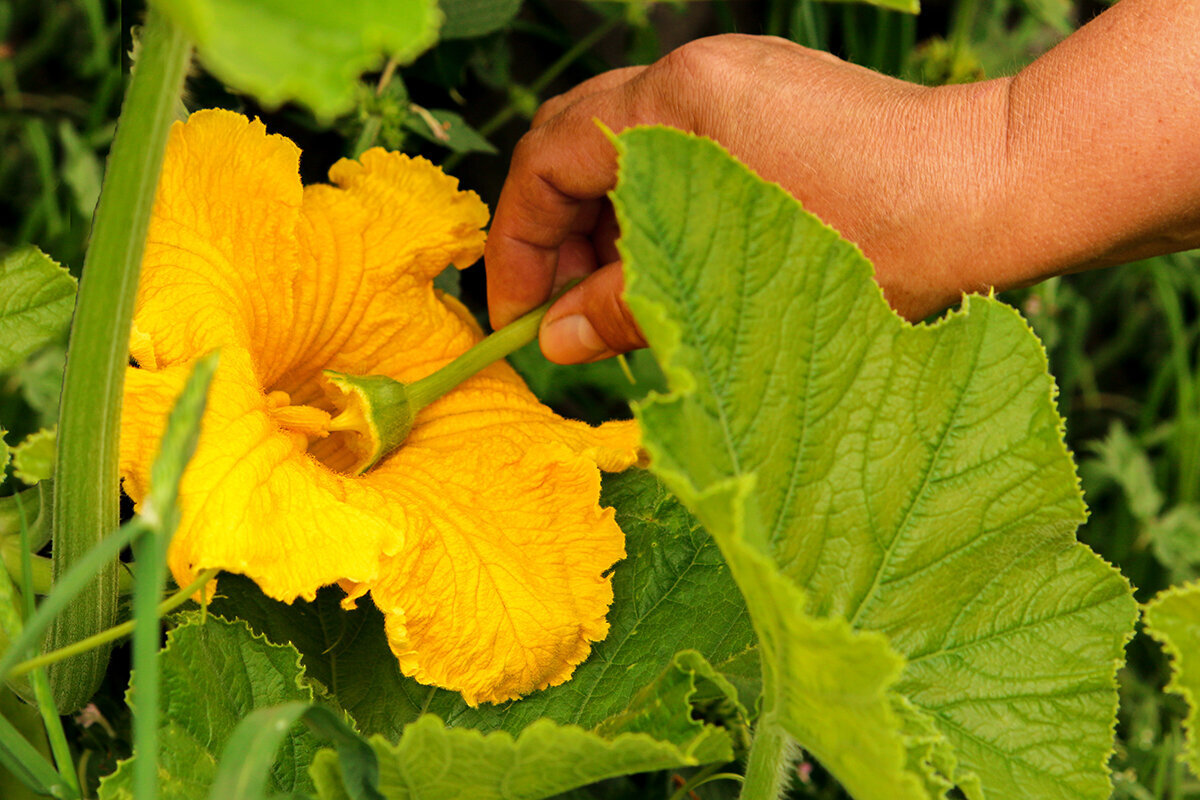
Find a newly opened male bloom with pollen showing on its anther. Carefully fold away or take off the petals; otherwise, lift the grains with a clean artist’s brush with soft bristles. Dab them lightly over the receptive surface of a female bloom that has just opened. The immature ovary immediately behind it identifies the female.
- Choose the morning period, with male and female blooms fully unfolded and both pollen and stigma still fresh.
- One male flower can serve several female flowers while it still carries sufficient pollen.
- If you plan to record development, attach a loose marker to the bloom you treated.
- Leave any cucumber identified as parthenocarpic unpollinated.
✦
Strawberries: spread pollen, not just contact
Strawberries need pollen distributed across more than one point. Each flower carries many fruitlets, and patchy coverage can contribute to undersized or uneven berries. When weather, access and crop management allow, repeated natural insect visits are normally more effective than brushing every flower once.
- Open access only where weather, pest pressure and crop management make this sensible.
- During flowering, avoid treatments harmful to bees; confirm the proposed crop, use and location against the current Australian label or permit.
- Reserve brushes for small plant numbers, planned crosses or short spells when few insects are visiting.
- For misshapen berries, investigate insect damage, frost injury and broader growth stress as well as pollination.
○
Herbs and seed: choose the harvest purpose
Leaf harvests from basil, coriander, dill and numerous other herbs do not depend on pollinated blooms. Seed collection changes the objective, bringing flower behaviour and potential crossing into consideration. If longer leaf production is wanted, separating flowering herbs from the main leafy crop can direct more of the plant’s resources towards foliage rather than seed.
- Before saving seed, find out whether that species mainly self-fertilises or readily crosses with neighbours.
- For controlled propagation, use suitable separation, isolation or deliberate hand pollination.
- Flowering in a leafy herb often signals bolting, rather than evidence that pollination has failed.
A durable home for mixed planting is available in the classic aluminium greenhouse whose accessible interior supports tending, irrigation and deliberate air management.
Work within a window, not by the clock
Begin in the morning, guided by crop and weather.
Each newly opened cucurbit bloom remains usable for only a short part of the day, commonly early on. Tomato trusses may respond better towards late morning, after surface moisture has dried and pollen is loose. Observe the plants rather than following an hour on the clock: cool, humid conditions differ sharply from a bright, fast-warming day in a dry Australian summer.
At first lightInspect condensation and pumpkin blooms.
Early morningHand-transfer pollen while fresh.
Late morningGive tomato trusses a slight vibration.
Later in the dayManage airflow, shade and crop response.
EveningReview root moisture and internal temperature.
Attend to cucurbit blooms soon after they unfold. For tomato relatives, late morning may be better for mild vibration because lower humidity lets pollen move readily. If blooms remain wet, plants already show heat strain, or ventilation is poor, prioritise the internal environment. Return to the pollination task when conditions become more favourable.
- Humidity Pollen may stick together instead of shedding when the surrounding air is both damp and still. Keep sprays off blooms, increase ventilation, and direct irrigation low around the roots whenever practical.
- Heat Sudden high temperatures may compromise blooms and early fruit. Operate doors and roof vents before heat builds, adding suitable shade where required. During flowering, managing warmth and fresh air is just as important as moving pollen.
- Cool nights Cold overnight conditions may hinder pollen production, fertilisation and subsequent growth. Extra shaking will not remedy an unsuitable thermal pattern, so compare multiple flower trusses across several days.
- Water balance Plant processes are steadier when root moisture remains consistent. Repeated swings from dryness to saturation may trigger bloom loss or later fruit disorders despite earlier successful pollen placement.
Steady, anticipatory climate control pays off as the season progresses. The classic aluminium greenhouse gives ventilation, shading and irrigation a manageable framework as Australian spring and summer conditions shift by region.
Reading the signs
Assessing fruit set: pollen is not behind every misshapen result.
A bloom is brief, while the fruit shows the crop’s later history. Watch for flowers dropping before any swelling, young fruit that begins then stops growing, and whether deformities occur sporadically or throughout the planting. Compare the pattern with hot spells, dry conditions, pests and abrupt fertiliser changes.
Transfer succeedsOvary growth stays even.
Bloom detachesReview both conditions and pollen movement.
Distorted growthConsider incomplete pollination and crop stress.
Immature fruit stallsLook for stress after setting.
Reading those stages: Petals that fade while the ovary beneath them expands steadily are reassuring, although care must continue. If a bloom detaches cleanly, ineffective movement or stressful temperatures could be involved. Patchy pollination can distort a strawberry, cucumber or pumpkin, but feeding damage, irregular moisture and other growth disruptions should also be investigated. Fruit that starts enlarging and then stalls points more strongly to later heat, irrigation or vigour trouble.
Where visiting insects can help
Create entry deliberately, then keep conditions under control.
Their buzz vibration makes bumblebees valuable around tomato flowers. Recurring visits also help strawberries and cucurbits whose fruit depends on pollen. For a modest backyard greenhouse, opening vents and the door in dry, mild conditions may admit local pollinators, provided the change neither undermines temperature management nor creates unacceptable pest pressure.
Using a managed bumblebee colony is specialist crop management, never a routine backyard step. In Australia, first ask the relevant biosecurity or environmental authority whether the species and movement are suitable for the site; this article does not establish local availability. Placement, supplier advice and compatible crop protection would then need specialist planning. Never collect wild bees for indoor release. For any crop-protection treatment, follow the current Australian label or permit and avoid open blooms or pollinator flight periods unless its directions confirm that use is appropriate.
Pollinator access begins in the surrounding garden. Diverse flowers and restrained treatment provide food across the season; keep internal paths open and leave suitable entry points available when weather permits. The classic aluminium greenhouse is a premium framework suited to varied garden settings. The carefully considered layout of the classic aluminium greenhouse helps keep plantings orderly while allowing deliberate adjustments to airflow and entry during bloom.
A routine you can repeat during bloom
Set aside ten unhurried minutes on three days each week.
Regular small checks work better in a greenhouse containing several crops than one intensive session. Provide each species with its specific transfer, then shift attention back to moisture, growing conditions and overall plant health.
- Inspect while flowers are receptive. Look for crops carrying blooms that have just unfolded. Cucurbits commonly suit an early visit, whereas dry tomato blooms may respond to movement towards late morning.
- Classify the flower arrangement. Decide whether the bloom is self-fertile, belongs to a male–female pair, contains the many receptive parts of a strawberry, or comes from a parthenocarpic cultivar for which pollen is unnecessary.
- Use the corresponding technique. Give tomato-family trusses a mild tap or vibration; directly treat ordinary cucurbits, admit visitors for strawberries, and avoid intervening with parthenocarpic cucumber flowers.
- Before you finish, review conditions. Note the temperature, feel the moisture around roots and alter ventilation if needed. Successful pollination depends on keeping both grains and receptive tissue functional in their surroundings.
- Review fruit later. Revisit ovaries to see whether they expand, flowers repeatedly fall, or fruit develops a consistent distortion. Wait for a pattern across several observations before revising crop care.
Questions growers often ask
Straight answers on pollination beneath cover.
Will one brush work for every crop under cover?
No. With cucurbits, soft bristles can carry grains from a male bloom to a separate female one; they can also assist a small number of strawberry flowers if necessary. Brushing is less efficient for tomato, capsicum and eggplant flowers, whose structure responds better to light truss vibration. It is inappropriate for parthenocarpic cucumber cultivars because their fruit develops without fertilisation.
At what interval should tomato blooms be vibrated?
While flowers are opening, use a measured schedule rather than constant attention. Briefly vibrate fresh trusses a few times each week. Neither stronger nor more frequent shaking ensures extra yield. If setting remains poor, examine heat, moisture in the air, ventilation, irrigation, feeding and cultivar suitability before applying more mechanical force.
Should flowers be sprayed to improve pollination?
Generally not. Water can bind grains together, and foliage kept wet for long periods is more prone to disease. Where humidity is high, improve ventilation rather than watering from overhead while plants flower. Deliver moisture near the root zone so unfolded blooms remain dry.
What explains flowering greenhouse cucumbers that fail to set?
Begin by identifying whether the cultivar needs pollen or forms fruit parthenocarpically. A conventional cucumber usually relies on grains being carried between separate male and female blooms, while a parthenocarpic greenhouse type does not. Where the latter fails to develop fruit, investigate light, temperature, roots, moisture stress and general vitality rather than assuming pollen is absent.
May I keep the structure shut while crops are flowering?
Yes, if another technique supplies whatever transfer the crops require. You can vibrate tomato trusses and manually treat dependent cucurbits. The closed structure still needs enough ventilation to manage heat and humidity. If insects are doing the work, provide an obvious safe route both in and out.
References and next steps
The horticultural evidence informing these methods.
Continue exploring with Bloomcabin: Premium aluminium greenhouse designs for gardens across Australia · Classic aluminium greenhouse · Answers to common questions about aluminium greenhouses
- North Rhine-Westphalia Chamber of Agriculture — advice on poor tomato cropping, airflow, humidity and setting fruit in compact greenhouses:Poor tomato harvests in a small greenhouse
- North Rhine-Westphalia Chamber of Agriculture — background on tomato flowering, mechanical movement and the effects of growing conditions:A guide to tomatoes
- University of Minnesota Extension — which crops rely on pollination, including guidance about parthenocarpic cucumber types:Which Fruits and Vegetables Need Pollination?
- University of Minnesota Extension — recognising cucumber flowers of each sex and caring for the crop:Home-garden cucumber growing guide
- Royal Horticultural Society — additional material on tomato care and pollination in protected growing:How to Grow Tomatoes
- North Rhine-Westphalia Chamber of Agriculture — hands-on troubleshooting for tomato crops in a compact greenhouse:Troubleshooting a small tomato greenhouse
- North Rhine-Westphalia Chamber of Agriculture — information on tomato blooms, fruit development, irrigation and environmental control:A guide to tomatoes
Bringing pollen to its destination
Shelter comes from the greenhouse; the precise motion comes from you.
First identify the flower structure, then apply no more movement than necessary and observe the developing ovary before adjusting your approach. A measured routine repeated over time is the basis of a productive crop under cover.
01
Recognise the flower
Recognise the flower
02
Choose the transfer
Choose the transfer
03
Reassess later fruit development
Reassess later fruit development
