
Is a Greenhouse Worth Having in Shade or Part Shade?
Assessing your garden site
Is a Greenhouse Worth Having in Shade or Part Shade?
Shade does not necessarily make a greenhouse impractical. Its value depends on whether the intended crops, everyday use and expected results fit the light reaching that spot. Study the timing of sunlight, the objects casting shadows and how readily your planting plans can change.
In brief: part shade often works; permanent shade needs a specific purpose
Part shade can support lettuces, herbs, seedlings and numerous leafy vegetables. Tomatoes, capsicums and eggplants generally perform better with dependable direct sunshine because they seek greater warmth and light. Understand how illumination changes through the seasons before settling on a greenhouse.
Heavy shade need not end the idea, although it rarely favours a traditional summer-vegetable setup. Such a greenhouse may be more useful for protected tasks, raising plants or gathering produce. Ventilation, careful watering and control of lingering moisture will also require closer attention.
01
Promising conditions
Part shade with several bright periods can work, especially when sunshine is not limited to cool early mornings.
02
Challenging position
Long shadows from buildings or thick vegetation reduce light and warmth, making demanding fruiting crops harder to manage.
03
Purchase planning
Observe the position first; only then select dimensions, structure and fittings, with the intended use based on the light realistically available.
Practical guidance for dimmer garden positions.
Continuous sunshine is uncommon in many gardens. Walls, mature trees, tall hedges and neighbouring buildings shift the pattern of light from morning to evening and between seasons. A greenhouse may still be viable, but the position needs honest appraisal. Compared with an exposed sunny setting, reduced direct radiation more strongly affects warming, plant development, moisture and crop suitability.
There is an important difference between part shade and unbroken deep shade. Morning or afternoon sunshine may make a position useful for many plants. Beneath a broad canopy or beside a consistently shaded southern wall, summer crops that seek strong light become harder to manage. Watching the garden closely provides a sounder basis for comparing likely rewards with the work involved.
Here, the central question is whether the available shade can support your plans. The sections below show how to read the light, recognise difficult shadow patterns and define a suitable role for the structure. That turns a broad buying question into a considered choice grounded in your property and gardening priorities.
Inspection 01 · Checkpoint 01
Assess light patterns, not snapshots
Do not rely on how bright the garden appears during a single inspection. Across several days, watch the proposed position in the morning, near midday and through the afternoon, noting the arrival and departure of direct sunshine. Repeat the assessment seasonally: a welcoming midsummer spot can behave differently in spring because of the lower sun or changing vegetation around neighbouring features.
Record direct sunshine separately from bright ambient light. Although ambient light benefits certain plants, it contributes less heat inside the structure. Map the house, fences, sheds and individual trees as separate shadow sources. The result should reveal brief interruptions, regular periods of partial cover or shade that persists for much of the day—an essential distinction for later choices.
Examine the visible sky, not merely the ground where the greenhouse would stand. A slim shaft of sunshine may travel during the day without covering every bed. Plot the moving boundaries of shadow on your sketch. This helps you allocate growing areas, shelving and a workbench before the layout becomes fixed.
- Keep a light diary across different weekdays, recording both cloudy and sunny conditions.
- Check the site particularly in spring, when early sowing and propagation benefit from adequate light.
After evaluating the proposed position, the standard Classic greenhouse can provide a straightforward framework for a site-specific growing plan.
Inspection 02 · Checkpoint 02
Classify the shade source
Buildings and trees cast shade in different ways. A wall tends to produce a distinct, predictable boundary whose duration follows the sun’s path. Tree cover moves and changes as the year progresses. New foliage reduces incoming light, while roots, leaf litter and water dripping from the canopy introduce additional practical considerations for the site.
A position beneath a dense canopy deserves particular caution. Limited light and slow drying may coincide with falling leaves or branches that complicate upkeep. Space beside a wall may be workable if its exposed side remains bright enough. Confirm access, foundation space and permanent clearance for paths, windows and doors.
Pale walls and paving may reflect enough light to change your impression of a location. That brightness can soften a gloomy appearance, but it is not a substitute for sunshine falling directly on the greenhouse. Revisit the area under varied weather rather than judging it on an unusually bright summer day; the repeated pattern is the useful measure.
Trace water coming from roofs and tree canopies as well. Regular drips can alter path conditions, maintenance needs and moisture levels beside the greenhouse.
- Around trees, allow for summer foliage, root and branch care, and the continuing task of clearing fallen leaves.
- Assess each wall-side position individually, considering orientation, separation from the wall and the amount of visible sky.
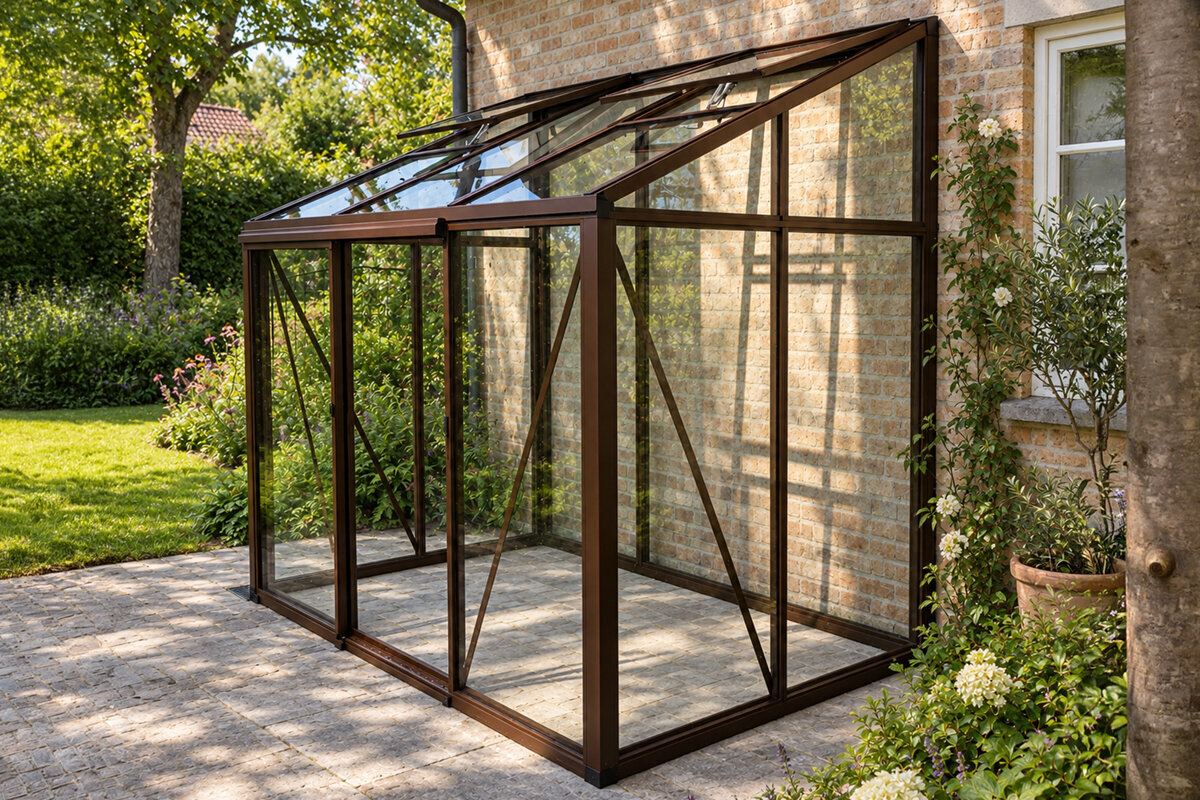
Where an unobstructed wall section receives suitable light, a full-size lean-to greenhouse may organise that part of the outdoor area efficiently.
Inspection 03 · Checkpoint 03
Match part shade with the right use
The usefulness of part shade grows when the greenhouse is assigned tasks that suit it. Herbs, leafy vegetables, young plants and crops preferring cooler conditions generally ask for less heat and light than Mediterranean fruiting vegetables. The structure may instead shelter delicate pots, provide room for pricking out or lengthen the growing period, without being planned around intense summer warmth.
Let the planting schedule respond to the time of year as well as the crop. Bright intervals are particularly valuable in spring; by high summer, softer light may help temper conditions. Autumn brings another marked reduction in intensity, magnifying an already dim site. Rotating crops to suit each season keeps the demands placed on the greenhouse realistic.
Arrange the interior in tiers of light demand. Give the brightest sections to plants that need them most, using darker positions for herbs, propagation or storage. Check whether tall growth throws new shadows across nearby beds. Movable containers and a layout that can be rearranged make seasonal changes easier to accommodate.
- Give the sunniest section to light-demanding fruiting plants, with hardier leafy vegetables and herbs towards the edges.
- Revise the layout each season rather than repeating one rotation despite changing light.
For mixed planting in an open part of the garden, a standard Classic greenhouse offers accessible space that can be rearranged for successive crops.
Inspection 04 · Checkpoint 04
Include warmth, moisture and airflow
Reduced sunshine commonly means slower warming. While that can be welcome during hot weather, plants and growing media may remain wet longer in cooler periods. Damp leaves or surfaces do not automatically disqualify the location, but they do demand attentive management. Match watering to actual need, prevent water from pooling and watch how air circulates inside.
Ventilation remains important even in a cooler, shaded greenhouse. Use temperature, humidity and current weather—not a preset calendar—to decide when openings should be adjusted. A narrow position between a wall and thick hedge may escape wind while receiving little air movement. Retain working space and avoid crowding the interior in ways that prolong damp conditions.
A lack of sunshine is only one contributor to moisture. Crowded planting, saturated paths and nearby structures can all slow evaporation. Maintain clear spacing and inspect the lower walls and ground-level areas regularly. An orderly interior makes condensation, persistent wet patches and emerging maintenance needs easier to identify.
- Check condensation, wet foliage and growing-media moisture regularly each morning before establishing a fixed watering routine.
- Leave the exterior around vents and doors unobstructed by hedges, containers or stored equipment so air can move freely.
If conditions beside the house are suitable, a full-size wall-side lean-to greenhouse places a manageable growing area close at hand for regular attention.
Inspection 05 · Checkpoint 05
Choose crops without false expectations
Tomatoes, cucumbers, capsicums and eggplants often motivate a greenhouse purchase, yet their usual demand for warmth and strong light makes shade a disadvantage. Growth may slow and ripening become uncertain. If these harvests matter most, reserve the brightest available position for them; glazing cannot compensate for sunlight that never reaches the site.
A milder microclimate may be much more compatible with lettuces, spinach, Asian greens, parsley, chives and young plants, depending on variety and season. Trial a small selection before filling every bed. Results from your own position will show what succeeds there and give you practical evidence for adjusting future crop sequences.
Your weekly routine should influence the crop mix too. If gardening time is mostly limited to weekends, a simple, resilient scheme may prove more rewarding than numerous demanding plants. Record which crops were manageable during the first season. Those notes will guide the following year more reliably than a generic planting list.
Include convenience in the assessment. A nearby entrance encourages frequent observation, whereas awkward access can undermine use even if that location receives better light.
- Before buying, define your key crops and assign each a realistic light requirement.
- In the first season, test different areas instead of placing sensitive crops only in a dark corner.
For experimental crops and beds that change over time, the standard Classic greenhouse provides a practical base for an adaptable planting arrangement.
Inspection 06 · Checkpoint 06
Fit the structure to the property
Appearance is only one consideration when choosing the structure; available space, access and light should shape the decision. A freestanding design can occupy the area with the broadest view of the sky. Also account for paths, water access and future vegetation. Planned screening, shrubs and maturing trees may eventually darken a position that appears open today.
Building against a wall can shorten everyday trips and use a narrow area effectively, but its success in part shade depends on orientation and nearby obstructions. Measure the footprint, door movement, maintenance clearance and foundation carefully. Review the installation information, then seek project-specific advice from the relevant state, territory or council authority before placing the order.
Give circulation routes the same attention as the greenhouse form. Convenient entry simplifies harvesting, routine inspections and carrying water or growing media. Keep adjoining ground available for tools, open doors and upkeep. When planning against a house, include existing plants, windows and downpipes in the drawing rather than treating the wall as an empty surface.
- Add the footprint, door clearance, working route and reachable beds to a garden plan drawn to scale.
- Allow for proposed screening and future planting so new growth does not soon remove the available light.
Where the orientation and access of a house wall are suitable, review a full-size lean-to greenhouse with sufficient working clearance around its structure.
Inspection 07 · Checkpoint 07
Trial the location before purchase
A temporary layout offers firmer evidence than guesswork. Mark the intended footprint with pots or simple markers and leave it in place for several weeks. Watch the shadows travel, test whether the route past it stays comfortable and note where rainwater settles. Taking photographs at matching times on different days makes comparisons more objective.
During the trial, define the work the greenhouse must support. Will it hold frequently picked herbs, serve mainly for raising plants or contain larger growing beds? Easy access may make a moderately bright location more useful than an isolated sunny patch. Rank those practical needs before deciding which compromise is acceptable.
Repeat the exercise after the weather changes if possible. Rain may expose pooling water, soft ground or an inconvenient approach. Check simultaneously whether furniture, fences or hedges intrude on the proposed workspace. By testing a realistic outline now, you can identify and resolve conflicts before the greenhouse has been assembled.
- Use string or stakes to show the footprint and entrance, making clearances, sightlines and moving shadows easier to judge.
- After rain, promptly note standing water, roof or canopy drips, and any narrow sections that impede garden work.
Once the footprint has proved practical, position a freestanding Classic greenhouse where the available light complements your normal way of working.
Inspection 08 · Checkpoint 08
Plan for lasting value
Part shade can justify a greenhouse when its role includes more than maximising summer produce. Weigh the benefits of propagation, a sheltered workspace, seasonal planting and gardening enjoyment together. Compare versions against the measured area, intended foundation and proposed activities. For current specifications and choices, make an individual enquiry instead of relying on general price assumptions.
Review the latest product details, assembly instructions and written terms before committing. Establish what site preparation is needed and, if anything is unclear, consult the authority responsible for the location. Ask your insurer about the specific greenhouse if you wish to include it under building or contents cover. These checks keep the practical and administrative planning aligned.
Summarise the investigation in a compact list covering changing light, usable space, preferred crops, ease of entry and likely upkeep. It will expose compromises and make product comparisons more purposeful. A position intended for a limited range of uses can still be successful, provided your planting scheme and expectations acknowledge those limits.
- Do not prioritise a purchase until you have measured the area, logged its light and defined the main crops.
- Seek authoritative, project-specific answers about foundations, boundary requirements and insurance treatment from the appropriate contacts.
For a clearly defined plan beside the house, consider a full-size lean-to greenhouse for a house wall against the latest product documentation.
Comparison
Comparing site types
This overview cannot replace watching your own garden. It can, however, help align likely crops and maintenance with each setting. Base the final judgement on when light arrives, how long it lasts and its quality across the exact footprint.
| Site type | Light pattern | Suitable focus |
|---|---|---|
| Open sunny site | Long direct sunshine, usually good warming. | Wide crop range, including warmth-loving fruiting vegetables. |
| Bright part shade | Direct sun in distinct daily windows. | Lettuces, herbs, propagation and selected fruiting crops. |
| Part shade by a wall | Sun periods depend on orientation and building shade. | Short routes; assess light and access carefully. |
| Dense tree shade | Variable light, often greater moisture. | Better for specialist use, resilient leafy crops and propagation. |
| Permanent building shade | Little direct sun, slow drying. | Plan only with very modest harvest expectations. |
A five-step plan
Follow these steps to decide whether shade and your gardening plans are compatible before choosing the greenhouse dimensions or structural form.
01
Map the light
Track the position at different times of day and, if practical, during more than one season. Distinguish sunshine falling directly on it from ambient brightness and persistent shade.
02
Identify shade causes
Link every shadow with its source—perhaps a building, tree, hedge or planned vegetation—then consider how predictable it is and whether it changes seasonally.
03
Set use priorities
Choose whether seedlings, herbs, leafy produce or fruiting plants that seek warmth matter most. Stating that priority reveals where compromise will be required.
04
Simulate the area
Set out the footprint, entrance and working routes. Recheck them after wet weather and during ordinary garden tasks to confirm that drainage, access and maintenance remain workable.
05
Check documentation
Verify the dimensions and proposed setup against current product documents. Address location-specific authority questions and any relevant insurance arrangements before committing to the purchase.
Checklist for shaded sites
Complete these checks before choosing a greenhouse for an area of garden that receives part shade or heavier shade.
01. You have watched direct sunshine at several points in the day, rather than judging one fine-weather visit.
02. The source of shade is identified and its seasonal or growth-related changes are included.
03. Your key crops suit the assessed light, rather than wishful expectations alone.
04. Ventilation, watering according to need and the drying of persistently wet areas have all been planned.
05. The footprint, door opening, work routes and maintenance access are realistically marked on site.
06. The practical effects of trees, hedges, drainage routes and recurring drips have been assessed across the proposed area.
07. Current product documents are guiding preparation of the foundation and installation area.
08. Local requirements and possible insurance treatment will be clarified individually where needed.
Common questions about greenhouses in shaded gardens
Is part shade suitable for a greenhouse?
It can be, especially when useful sunlight or bright intervals return consistently during the day. Herbs, seedlings, lettuces and other leafy crops are plausible choices. Observe the seasonal pattern first and avoid basing the purchase entirely on summer fruiting plants that demand substantial warmth and light.
What level of sunshine does a greenhouse require?
No single duration answers this well: the crop, season and character of the shade all influence the result. The brightest available position favours a diverse selection of warmth- and light-seeking plants. For herbs, seedlings and leafy vegetables, good part shade may suffice. Map the sunshine reaching your actual garden before deciding.
Does tree cover cause more difficulty than building shade?
Not in every case. Tree cover is usually less stable because foliage varies with the season, and falling material or canopy drips can add maintenance. Shadows from buildings tend to be easier to predict, although they may remain deep for many hours. Compare each site by timing, duration and the visible sky overhead.
What can be grown in a greenhouse with less light?
Begin by trialling seedlings, herbs, spinach and lettuces. The right varieties will depend on the season and the precise pattern of light, so distribute small test plantings around the interior. Place fruiting vegetables that seek warmth in the brightest zone, while accepting that a shaded position is unlikely to produce the same results as full sunshine.
Does greenhouse glazing compensate for inadequate sunshine?
No. The enclosure provides shelter, but it cannot create direct solar energy that does not reach the position. With less sunshine, the soil and internal air commonly warm at a slower rate, while plants remain limited by available light. Success therefore comes from realistic use, attentive care and compatible crop selection.
Could a garden greenhouse require approval?
There is no useful Australia-wide yes or no. For a NSW project, exempt development avoids planning and building approval only when every applicable standard is met. Elsewhere, ask the relevant state, territory and council authorities. Check early, particularly where boundaries, foundations or attachment beside a wall may affect the proposal.
Refine the site plan
Conclusion: let actual light determine the plan
The case for a shaded greenhouse rests on how well the structure answers the conditions in your garden—not on a universal promise. Bright part shade may serve seedlings, herbs and leafy vegetables very effectively. Where illumination remains consistently low, narrow the crop range and moderate the harvest goals from the outset.
Keep a light record and test the proposed footprint before committing. Together, those observations should show whether a freestanding position or space beside a wall better supports your intended routine. Rather than pursuing an idealised sunny setup, choose the arrangement that remains useful and enjoyable in the way you actually garden.
Explore greenhouse options once you have assessed the light, measured the site and identified your priority crops.
