
Greenhouse powdery mildew: stop it spreading to new surfaces
Greenhouse health · Growing guide
Greenhouse powdery mildew: stop it spreading to new surfaces
From a distance, pale powder on foliage may look inconsequential. On a living leaf, respond methodically: establish what coats it, halt further transfer, and create healthier conditions for the clean growth that follows.
+
Diagnosis note White marks have several causes, while removing visible powder cannot restore infected tissue. Reliable action depends on careful identification, isolation, canopy changes and measures specifically approved for that crop.
First response
Contain the outbreak, then trace its likely cause
Because powdery mildew is familiar, spotting white on a leaf often sends gardeners straight to a spray bottle. Hold off. The immediate task is to keep any live colony from establishing across more greenhouse surfaces without destroying the evidence needed to identify it. These fungi depend on living hosts; their spores can travel in air currents or hitchhike on hands, clothes and tools during plant care. Even so, host relationships differ. An outbreak on zucchini cannot, by itself, explain pale material found on cucumber, mint, rose or zinnia.
That distinction becomes crucial when a greenhouse contains food plants, ornamentals, seedlings and mature potted specimens with contrasting susceptibilities. Neither a treatment nor a cultural response suitable for one species is necessarily appropriate, or authorised, for the next. Investigate the plant that is actually affected, where its symptoms occur and the immediate growing conditions. Avoid beginning with an all-purpose homemade mixture.
01
Limit movement Move affected trays or pots apart only if you can avoid touching unaffected leaves. Break contact between neighbouring foliage and use an easily observed quarantine position.
02
Document upper and lower surfaces Take detailed images of the deposit, plus a wider view showing the plant’s location. Record effects on young shoots, mature leaves, shaded growth, stems, flower buds and blooms.
03
Check nearby plants Continue inspecting through the adjacent row. Pay particular attention to crowded crowns and spaces beside glazing, walls or benches, including anything that blocks moving air.
04
Reconstruct conditions A pattern of hot days, cool evenings, shut vents, crowded leaves, late irrigation or condensation reveals more than a single humidity measurement taken in mid-house.
Look-alikes
Read the coating, not only its colour
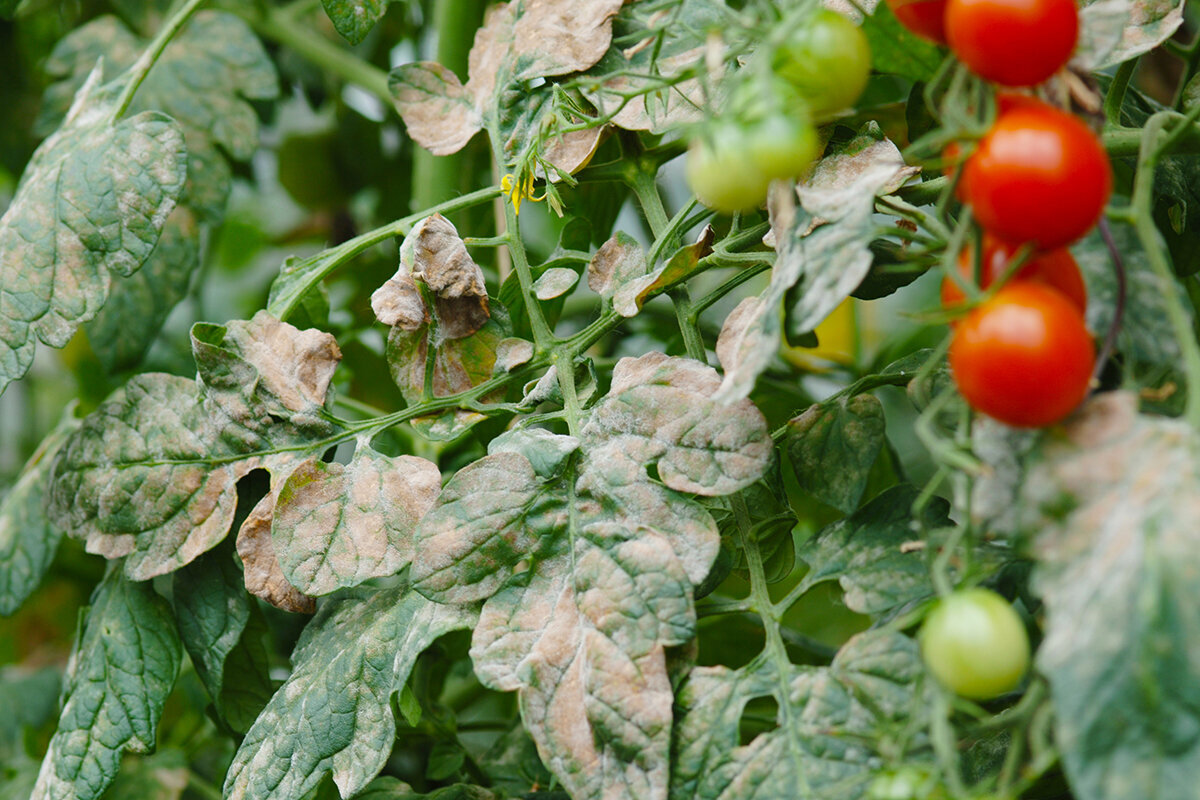
Typical powdery mildew resembles white or grey-white dust, sometimes with a fine felted texture. Small islands can enlarge until they coalesce. Yet pale traces also arise from dried treatment spray, hard-water minerals, natural plant waxes and unrelated foliage diseases. Use close viewing to form a preliminary judgement, not to claim laboratory certainty. Repeated rubbing risks carrying spores between leaves and damaging soft tissue.
Fuzzy growth Drying-ring pattern Protective plant bloom Damaged leaf tissue
| Area examined | Usual visual signs | Pattern across surfaces | Low-impact check | What it cannot establish |
|---|---|---|---|---|
| Powdery mildew | Colonies may be white, creamy or grey and soft in texture; rounded spots sometimes unite as a dusty sheet. | Leaves and tender shoots are common sites. The host and fungus determine whether growth appears on upper faces, undersides, stems, buds or flowers. | On a dark, dry cloth, part of a small patch may transfer. Affected foliage might turn dull or yellow, distort, then develop brown or cork-like tissue. | Removing some surface dust does not detach all fungal growth from the living host beneath. |
| Dried spray residue | Usually an even coating, spots, rings or streaking, sometimes glossy rather than downy. | Its layout commonly mirrors the spray path and recurs across exposed leaves, containers, tags, glazing and adjacent objects. | Relate the marks to recent spraying, nozzle direction and the water used, then compare sheltered undersides that received little or no spray. | An infected plant previously sprayed may show mildew and treatment residue at the same time. |
| Hard-water minerals | Firm rings or chalk-like marks remain after separate droplets evaporate. | Often found after overhead irrigation or misting with mineral-heavy water, especially on upper leaves, panes and dark container rims. | Compare inert surfaces nearby; mineral traces commonly outline the former droplet. | Because water spotting may mask early infection, monitor how the leaf tissue changes and inspect emerging foliage as well. |
| Plant wax or natural hairs | A uniform blue-white or silvery finish integrated into the surface, unlike discrete colonies with irregular expanding margins. | It generally appears consistently across healthy leaves, stems or fruit belonging to that species or cultivar. | It behaves as part of the plant itself, rather than enlarging through separate, cloud-like patches. | Avoid vigorous rubbing. These waxes may be protective, with appearance influenced by species, cultivar and cultivation. |
| Unrelated foliar diseases | Pale beginnings may later become angular lesions, grey fungal growth, water-soaked areas or necrotic tissue. | Distribution may correspond with prolonged wetness, splashing, wounds, or susceptibility within a crop or botanical family. | Check for dead centres, yellow margins, unusual spore colours, stem damage, angular edges or sudden collapse. | Where identification remains uncertain, especially on a valuable edible crop, seek plant-health expertise instead of relying on appearance. |
Use the table only for an initial practical judgement. Wiping offers no confirmation, and appearance varies among powdery mildews and host plants.
The hidden space around each leaf
Healthy readings may hide stagnant foliage
Conditions measured in the greenhouse do not necessarily describe conditions at leaf level. Airspeed, temperature and moisture shift inside crowded foliage, behind containers, under benches and deep in the shade of tall crops. This narrow layer beside each leaf may favour powdery mildew even when the wider house appears well managed.
Tight spacing blocks circulation
Leaf overlap changes more than light exposure: it impedes circulation, slows drying after irrigation or overnight condensation, and hides young colonies. Space plants for the spread they will reach at maturity, rather than judging only by pot size when they enter the house.
Cooling activates trapped moisture nearby
Plants and substrate leave moisture behind after a warm day. Falling temperatures raise relative humidity, and condensation can develop on cooler surfaces. If the crop and weather permit, timely venting and modest warming late in the afternoon may help reduce humidity before night. Select the approach according to plant requirements, outdoor temperatures and energy use.
Shade alters local climate as well as light
Overgrown centres, permanently shaded bench corners and foliage pressed against walls tend to be cooler with poorer circulation. Many powdery mildews thrive in moderate warmth, shade and humid air, but individual species react differently to liquid water. One universal moisture rule is therefore misleading.
Stagnation differs from damaging fan blast
Directing a fan at one crop may desiccate or stress exposed leaves while air remains motionless elsewhere. Instead, establish mild circulation throughout the foliage, and provide an unobstructed exit for used air with an intake for air from outdoors.
Why the host plant matters
Powdery mildew varies by host
Powdery mildew fungi commonly favour particular plant species or related groups. Consequently, symptom placement and shape, seasonal risk and suitable controls vary with both crop and pathogen. Use these categories to guide inspection, never as a diagnosis by themselves. When selecting seed or seedlings, look for tolerance or lower susceptibility documented for the exact variety and species.
I
Cucumber-family crops
Powdery pale growth can become conspicuous across the foliage of cucumbers, melons, zucchinis and pumpkins. Vigorous vines soon produce dense shade and make inspection awkward, particularly when training leaves too little space between stems.
- Inspect mature foliage and growth inside the canopy.
- Arrange climbing stems with space and ready access.
- Verify resistance information for the named crop and cultivar.
II
Culinary herbs and leafy edibles
Mint, sage, rosemary and other herbs host different powdery mildews. Crowded containers and harvesting only the outer foliage can nevertheless leave hidden pockets. On food plants, confirm that the product’s registration, label, withholding period and approved use cover the situation.
- Never apply an ornamental-only treatment to an edible crop.
- Use cleaned tools whenever harvesting.
- Keep separate pots from merging overhead.
III
Ornamental flowers and display plants
Susceptibility occurs in roses, zinnias, petunias and verbenas, though their symptoms need not match. Besides dusty growth, look for distorted shoots or dry, cork-like and scabbed areas where little white material is evident.
- Examine flower buds, fresh shoots and leaves near the base.
- Quarantine incoming plants before adding them.
- Keep cultivar notes over successive growing seasons.
IV
Plants retained through winter or year-round
For certain host–pathogen pairings, overwintering specimens, surviving host material and crops retained year-round carry infection between seasons. Even when a greenhouse looks clean after summer, living hosts may remain inside and need scheduled checks.
- Check retained winter plants before restocking in spring.
- Discard any diseased material that remains.
- Where practical, separate propagation areas from established plants.
Base diagnosis and action on the crop showing symptoms. Its cultivation, product registration and expert guidance need to fit that plant, rather than powdery mildew as a broad label.
Designing the airflow
Plan a passage for air and room around leaves
Ventilation replaces greenhouse air, allowing moist warmth out and outside air in. Circulation describes movement around the interior. Each process is valuable, yet packed benches and obstructing foliage can defeat both. Evaluate airflow with plants at their present mature size, rather than recalling the open layout used for small seedlings.
Configured with selectable glazing, roof vents and accessories, the Classic aluminium greenhouse provides a clearly defined growing area. Its page lists available sizes, openings and design details for the Classic aluminium greenhouse.
High-level exhaust
Warm air rises ↑
Vent in roof
Fan for internal movement
Spaced foliage
Still-air pocket
Low-level intake
Unblocked flow →
Clear the blockage
Early morning: Inspect leaves and overnight condensation early, before rising warmth erases the clues. This is when misted panes, cool foliage inside the canopy, drip locations and routinely stagnant corners show most clearly.
Middle of day: Release excess heat with roof vents, shade and internal air movement, while keeping foliage ventilated. Fans should produce a mild flow along each row instead of blasting one specimen continuously.
Towards evening: Avoid carrying surplus humidity into the cooler night. Adjust venting and, if suitable, slight heating for both weather and crop needs; make sure openings, circulation paths and fans are clear.
Treatment sequence
Address disease and the conditions supporting it
No spray can keep an overcrowded, damp, poorly ventilated canopy healthy indefinitely. Conversely, improving cultivation alone may not halt established colonies moving through a vulnerable crop. Proceed in order: lower the amount of infectious material, repair the microclimate, choose treatments strictly for the labelled crop and use, then look for unblemished new leaves rather than expecting old ones to recover their appearance.
Step 01 / discard
Choose what should be removed
Where an outbreak is small and sharply defined, taking out heavily affected leaves, stems or the whole specimen may meaningfully reduce spores. Cut with clean secateurs reserved for the task if possible. Put waste straight into a bag or lidded container; never carry it uncovered past unaffected foliage. Complete disposal may be preferable when a badly weakened, replaceable plant stands among susceptible neighbours and would otherwise remain a continuing infection source.
Avoid sudden, severe leaf removal that stresses the plant or leaves it vulnerable to harsh sun. Seek to reduce live colonies and restore airflow, not to make damaged plants look flawless.
Step 02 / improve
Ease stress on the crop
Increase plant spacing, prune selectively and organise pots and benches to create gaps through the canopy. Water the root zone in the morning where possible, so foliage is not cool and damp overnight. Limit avoidable leaf wetness, especially when other diseases threaten, and avoid heavy feeding that produces soft, congested regrowth.
Clean your hands and sanitise tools when moving between plants. Collect dropped foliage, then remove dead matter, pooled water and other slow-drying debris from the greenhouse.
Step 03 / choose
Match any product to crop and label
As an outbreak advances, a plant-protection product or biological preparation may be considered only when its Australian registration or permit covers the plant and proposed use. Availability, efficacy and the risk of crop injury vary substantially. Sulphur formulations, oils, biologicals and other fungicides may restrict timing, temperature, mixtures or application because of phytotoxicity. General household recipes are no substitute for checking the actual crop.
Review every part of the current label, including the crop and pest, place of use, application rate and interval, maximum applications, safety steps and withholding period. If plant tolerance is unknown, any small test on unobtrusive specimens must still remain within all label directions.
Step 04 / rotate, then reassess
Avoid relying repeatedly on one mode of action
Repeated fungicide programs should rotate modes of action only as directed by labels and qualified advice. Neither shortening intervals nor applying above the authorised rate overcomes resistance. Keep a log of the formulation, active constituent or group, crop, date, conditions and result; it will expose accidental repetition and improve later review.
Once fresh growth is visible, assess the crop again. Leaves already colonised before treatment may stay blemished. The meaningful result is clean new foliage and no newly formed colonies on surrounding plants.
Australian product-use check
Before applying a plant-protection product in Australia, confirm its current APVMA registration or permit and read the complete label for the crop, target problem, setting and user. For edible plants, check the withholding period as well as rates, intervals, application limits, protective directions, temperature guidance and compatibility. An ornamental use does not automatically cover cucumber, tomato or herbs. State or territory controls on use may also apply.
Verifying control
Use the following leaf to assess recovery
Existing damage records what happened; it does not alone show whether control has succeeded. Scars, yellow areas, misshapen growth and dull tissue may persist after the disease stops advancing. Instead of waiting for affected leaves to become pristine, examine the crop as a whole. Success means healthy emerging tissue, no new powder on neighbouring plants and no return to close, stagnant conditions around the foliage.
Choose a defined monitoring period and follow the same inspection path each time. This prevents two mistakes: calling a stable, older mark a failed treatment, or assuming one unaffected leaf means all nearby plants are clear.
After 48 hours
Look again at quarantined specimens and plants closest to them. Track any expansion of powder, crop injury after treatment, and whether a light, uniform current reaches the foliage.
After 7 days
Reassess fresh symptoms, sanitation, irrigation timing and venting habits. Observe every label-mandated interval precisely rather than adding an improvised application.
When foliage emerges
Date the earliest unaffected leaves in your crop journal. If powder returns on emerging foliage, revisit identification, host vulnerability, treatment choice and the changes made around leaves.
Existing injury
Growing mildew
Post-treatment leaf
Unaffected new foliage
- Existing injury Old markings can persist once progress has ended; returning perfect appearance is not the objective.
- Growing mildew New powder expands, moves onto young tissue or becomes visible on plants nearby.
- Post-treatment leaf Monitor for crop damage and other responses, allowing enough time before drawing conclusions.
- Unaffected new foliage Best evidence that isolation and environmental changes are succeeding.
FAQ
Questions to ask before treating again
Will powdery mildew advance on dry leaves?
Yes. Unlike numerous foliar diseases, powdery mildew can infect without a film of liquid sitting on the leaf. An outbreak may be encouraged by mild temperatures, shade, humid nights and poor circulation. Watering practice still deserves attention because dew, condensation and foliage that stays wet can assist other harmful diseases.
Is rinsing or spraying affected foliage worthwhile?
Rinsing is not a general cure. The visible powder may lessen while the infected leaf remains affected, and both water and handling can distribute spores or other disease organisms. In a mixed hobby greenhouse, first concentrate on a careful diagnosis, adequate spacing, selective removal of badly affected material and gentle air movement rather than random washing.
Will a fan stop powdery mildew by itself?
No. Air movement can disrupt stagnant pockets, but it cannot clear established disease or take the place of sanitation, adequate spacing and exchange with outside air. Check the lee of containers, benches and tall specimens for still zones, then pair mild circulation with venting and morning irrigation suited to the crop.
Can one mildew treatment cover ornamentals and vegetables?
Not by default. Permitted crops and settings, application rates, withholding periods and plant tolerance differ among products. A registration limited to ornamental plants does not establish an approved use on food crops. Verify the exact crop and use on the current label, consult APVMA registration or permit records, and follow destination state or territory controls.
Does every host develop the same powdery mildew?
No. The term describes a group of fungi, many adapted to particular plants or related hosts. Their signs and management can therefore differ. Diagnose the affected species itself; a cucumber infection does not explain all pale material elsewhere under cover.
References and additional reading
Investigate the affected crop precisely
This guide draws on German horticultural references and an international university source for diagnosis and disease biology. Australian registrations, permits and labels may change, so search the current APVMA records before applying anything. If identification remains doubtful, consult a suitably qualified plant-health or horticultural adviser.
Explore Bloomcabin: Made-to-measure aluminium greenhouse · Classic greenhouse in aluminium · Premium aluminium greenhouse range for Australia
- LWG Bavaria — greenhouse vegetable damage symptoms
- Chamber of Agriculture NRW — cucumber downy mildew
- Hortipendium — crop protection for greenhouse cucumber
- APVMA — search registered products and permits
- DAFF — how agricultural chemicals are regulated
- Cornell University Greenhouse Horticulture – Powdery Mildew
Protect each new leaf
Greenhouse health comes from practical choices you can see
Make space within foliage.
Confirm what is present.
Keep emerging leaves clear.
Good equipment makes these tasks easier. The Classic aluminium greenhouse demonstrates how ventilation, glazing, easy access and selectable features can shape a well-ordered growing area; compare it with the broader range page for the Classic aluminium greenhouse.
