
Which Greenhouse Colour Suits Your Home and Garden?
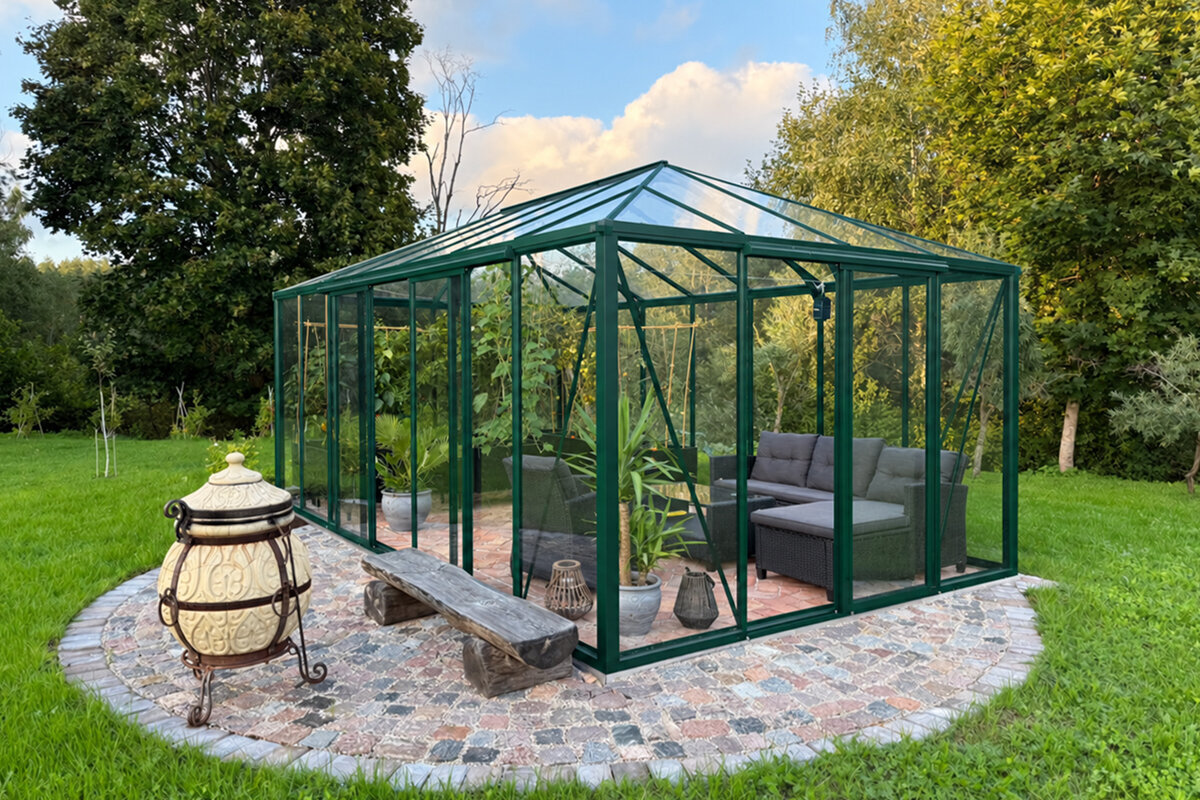
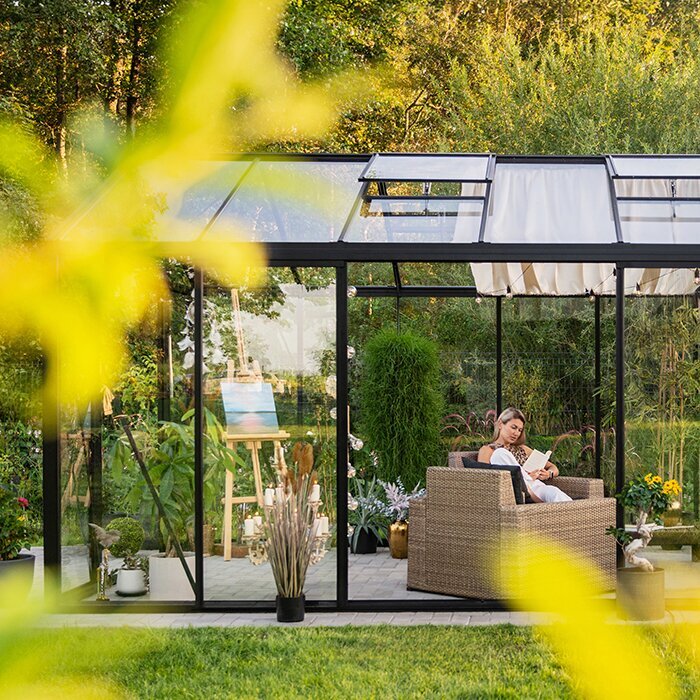
Planning greenhouse colour within the garden
How can greenhouse colour connect the house, garden and your personal style?
Frame colour does not change what a greenhouse can do, yet it has a major influence on its place in the landscape. A lasting choice considers the façade, paths, patio, plants and available light as one composition.
Because a greenhouse remains on view through the year, colour merits the same care as siting, shape and glazing. Its frame might settle into the existing scheme, introduce deliberate contrast or trace a subtle boundary between architecture and planting. The deciding factor is the particular setting, not whichever finish is currently fashionable.
Inspect each finish under several conditions: morning light, midday sun, cloud cover and the view that matters most. Context changes what you see. Frames register differently against thick hedging, pale render, an open lawn or stone paving. Use physical samples and photographs, and remember to assess the outlook through the house windows.
Begin with the job the colour should perform. A greenhouse intended as a feature may benefit from a strongly expressed outline; one meant to sit quietly can relate to nearby windows, roof details or foliage. Thoughtful colour cannot rescue poor planning, but it can make a sound design read as a unified whole.
01 · Understanding colour
How frame colour shapes the structure
A greenhouse is composed largely of glazing crossed by narrow structural lines, so the finish on those lines carries surprising visual weight. Dark framing outlines each transparent plane; paler framing tends to recede. Green provides a transition from engineered structure to living vegetation. The best effect is simply the one that delivers the level of presence you want.
Viewing distance changes the emphasis. Close by, you notice fittings, junctions and the precise profile finish; from the house or across the garden, the overall outline takes over. Bold framing may anchor a freestanding greenhouse, yet introduce clutter in a compact garden already full of detail. Let colour clarify the proportions rather than fight them. Pay particular attention to corners and crossing points, where several profiles visually accumulate. An orderly finish can make these lines look finer, while high contrast can give them extra prominence.
- From farther away, dark framing strengthens the edges and makes the greenhouse geometry more immediately apparent.
- Pale and green profiles carry less visual weight, leaving greater emphasis on the glazing, plants and wider setting.
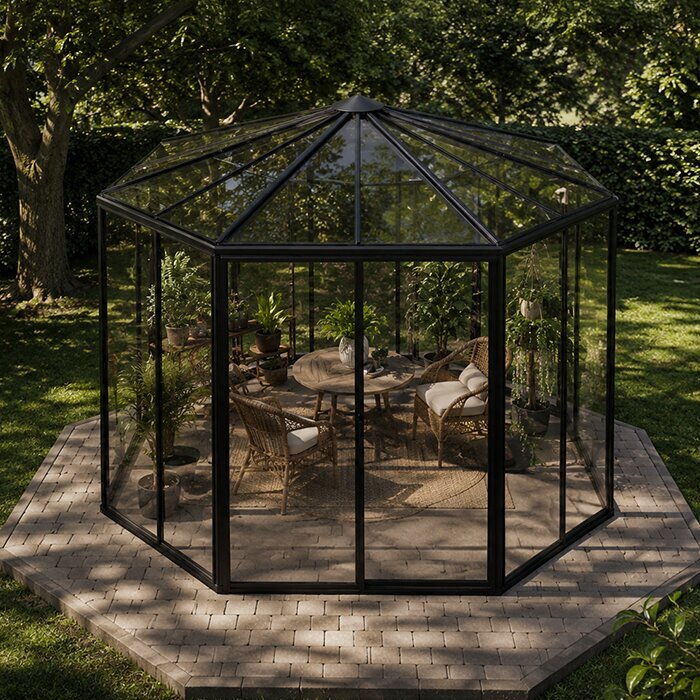
For a freestanding design with a clearly drawn outline, explore a standard Classic greenhouse defined by its crisp frame to give the surrounding garden a stronger architectural rhythm.
02 · Black frames
Using black for definition
Black makes a greenhouse appear deliberately composed. Against clear glazing, it picks out the glazing bars, doors and roof geometry. The finish can echo charcoal window frames, dark eaves, black lighting or steel furniture. It also stands crisply beside pale render, gravel and restrained beds, so it should be treated as an expressive design choice rather than a background neutral.
A densely planted garden can also carry black when stronger structure is wanted. The profiles remain distinct in front of deep foliage, and pale flowers or terracotta provide lively counterpoints. First account for dark sheds, fences and walls nearby; too many visually heavy surfaces can make the setting feel cramped. Open sightlines, lighter paving and loose planting can restore space. Black looks intentional when its linear character has a few echoes elsewhere. Those references need not be numerous or exactly colour-matched.
- Use a few dark references—perhaps light fittings, planter pots or furniture legs—so the black frame belongs without overwhelming the scheme.
- Include a cloudy-day inspection, because black framing may command more attention then than it does in bright promotional photography.
Where the home has a dark or strongly ordered elevation, a full-size regular Lean-To greenhouse finished in black can extend those architectural lines with measured clarity.
03 · Green frames
Green grows with the garden
Select green when the greenhouse should belong within the planting rather than appear staged as a separate object. It relates readily to lawn, hedges, shrubs and perennial beds without copying one precise leaf colour. This approach is particularly comfortable in country, romantic and mature gardens. The frame remains legible but usually yields attention to the planting as it changes through the year.
Green still needs to be tested against its surroundings. Evergreen hedging, silver foliage, brick and stone each shift how the finish reads. Study the particular greens already present instead of relying on the broad label of ‘garden green’; very cool or dark vegetation may create unexpected contrast. Leaving some space beside a hedge helps preserve daylight, maintenance access and the outline. Wider separation makes the silhouette clearer, while closer foliage draws the frame into the planting, allowing you to choose which should lead visually.
- This finish is especially useful where beds and shrubs already enclose the site and visual integration is the priority.
- Let timber, brick or gravel accompany the green frame naturally; there is no need to force every garden element into a matching palette.
Among established garden planting, a standard Classic greenhouse fitted with a green frame retains a readable shape without feeling detached from its setting.
04 · Natural aluminium
Aluminium feels light and understated
Natural aluminium introduces a clean, bright note without the graphic force of black or the botanical association of green. That makes it useful in quietly composed gardens. It can connect well with pale walls, concrete, natural stone, galvanised details and crisp patio surfaces. The greenhouse remains visually light while reflections and changing vegetation animate the glazing.
A neutral finish is not the same as an invisible one. Strong sunlight can make aluminium gleam, while warm timber beside it may emphasise the metal’s cool tone. Compare the whole group of nearby surfaces, including gutters, sills, rails, containers and hardware. Exact agreement between different metals is unnecessary; the aim is a deliberate material family rather than a chance addition. Silver-toned downpipes, fittings or balustrades can create continuity. Where metal finishes vary widely, an obviously considered selection is usually more convincing than an imperfect attempt at exact matching.
- For gardens led by stone, concrete and glass, natural aluminium reinforces a bright, minimal and materials-focused character.
- Remember that reflections move with the daylight, so a finished frame may look quieter or brighter than its sample.
Against a pale wall with simple lines, a full-size regular Lean-To greenhouse in aluminium can continue the existing materials without visually weighing down the house.
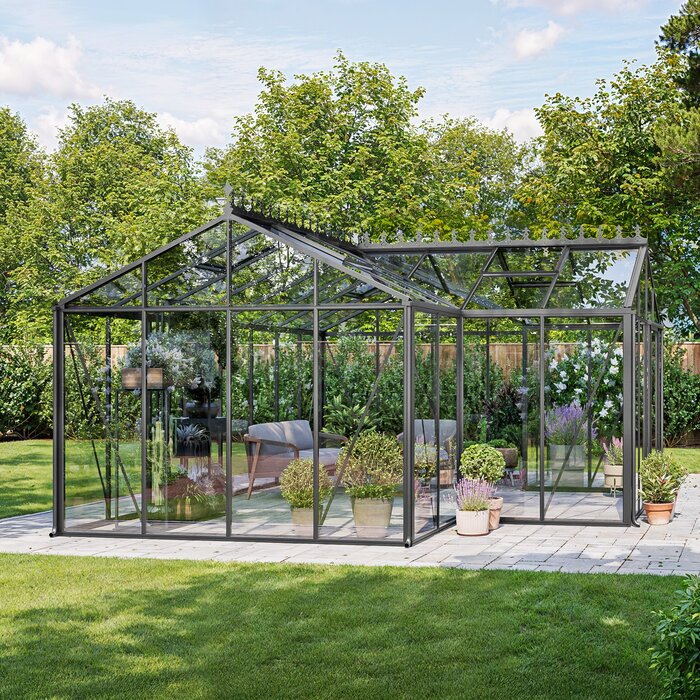
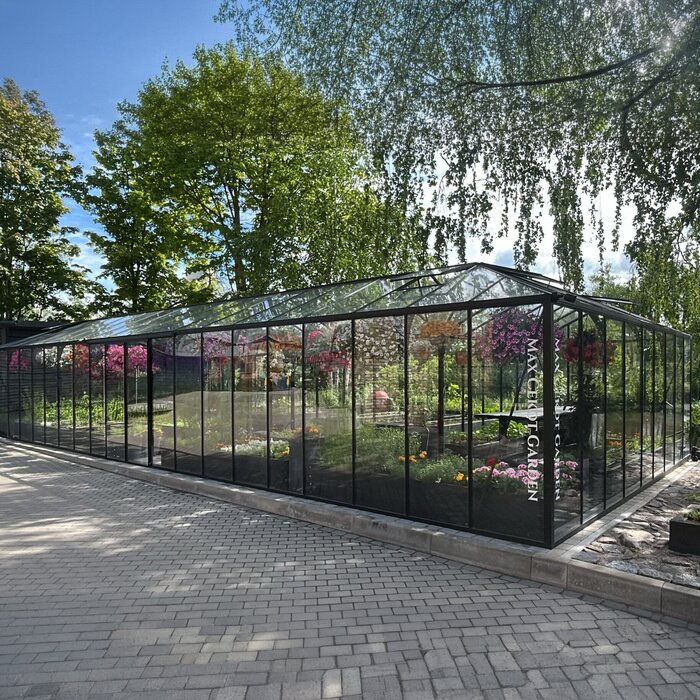
05 · House and patio
Take colour cues from the house
The house elevation is often the strongest source of colour direction. Rather than looking only at wall render, note the recurring details—window frames, entry door, eaves, downpipes, rails and shade structures. Black may repeat dark joinery, aluminium can answer silver-toned metalwork, and green can ease the movement from building to planting. One or two such references usually establish enough connection.
The patio provides another important reference because it is often where the greenhouse is viewed at close range. Timber decking, ceramic paving, brick and upholstery each contribute a distinct palette. Contrast can frame a seating zone and increase its sense of depth; where many finishes already compete, a quieter frame may be more successful. Put samples directly against the paving rather than judging them on a screen. Also stand indoors and inspect the framed garden view. A finish that seems discreet outside may form a much stronger line when seen through a living-room window.
- Identify smaller repeated details around the house instead of trying to copy the colour of an entire wall.
- Give priority to views from the patio and living areas, where the greenhouse will become part of the everyday outlook.
For a distinct building positioned where patio meets garden, a standard Classic greenhouse designed for the garden provides an easily read form with flexibility in its placement.
06 · Garden style and seasons
Planting reshapes the colour story
The garden palette never stays fixed. In temperate areas, spring brings fresh foliage and flowers, summer builds density, autumn introduces warmth and winter exposes structure. Green framing may merge most readily with summer growth, while black is pronounced against bare branches; aluminium shifts with weather and light. Tropical and subtropical gardens follow different growth and rainfall rhythms, so assess the periods when your own garden is most used and seen.
Garden character offers another clue. Formal layouts can carry disciplined contrast and repeated lines, while naturalistic planting generally favours finishes that do not dominate. Either green or black may suit a cottage garden, depending on its brick, paths and edging. Establish the hierarchy first: is the greenhouse a backdrop, a focal point or the link between different areas? Its seasonal presence also depends on flowers, foliage and exposed ground nearby. Treat that changing vegetation as a flexible frame so the structure retains a coherent role throughout the year.
- If timing allows, photograph the proposed position in different seasons before settling on the finish.
- Make nearby planting part of the palette, while reserving practical clearance for access, cleaning and garden care.
To link indoor living with planting that changes through the year, a full-size regular Lean-To greenhouse adjoining the house can provide a sound starting point for the composition.
07 · Proportion and position
Colour can alter perceived size
Scale changes the behaviour of every finish. Dark profiles can organise a broad area of glass and give a large structure definition, but they make a compact greenhouse especially conspicuous. Pale framing reduces visual mass, while green may withdraw against a planted boundary. Size and colour should therefore be assessed as a single decision.
Backgrounds alter apparent scale as well. Black is sharply drawn against a pale wall, while aluminium can brighten in front of dark hedging. An open lawn exposes the silhouette from many directions; a position between the house and a screen offers tighter control of the view. Mark out the footprint and walk the usual routes to reveal sightlines or unwanted dominance. Viewpoint height also matters: an upper window or raised patio reveals more roof framing than a path at ground level. Test dark profiles particularly carefully from each of these heights.
- High contrast makes the frame divisions more obvious, whereas a quieter finish can reduce the apparent weight of the glazing.
- Before judging the front elevation alone, account for viewing distance, direction and the background on every important side.
When an open site needs a deliberate focal point, a standard Classic greenhouse in a bold frame colour can help establish a visible organising feature in the garden.
08 · Decide with confidence
Test each finish where it will stand
Treat colour selection as a site exercise rather than an instant reaction. Photograph the house under changing light, then compare those images with real finish and material samples. Think about the full network of profiles, not one small chip. Invite everyone who regularly uses the garden to assess the options. Their responses can clarify whether the preferred result is a greenhouse that settles quietly into its surroundings or one that makes a purposeful architectural contribution.
Practical use belongs in the assessment as well. The greenhouse will be planted, cleaned and approached from several directions, so observe how pollen, dust and water spotting might register at that particular location without assuming any finish has universal care benefits. Confirm the currently offered surfaces and product presentation before ordering. Ask the relevant council or property manager about the proposal if it involves attachment to the house, a nearby boundary or site-specific controls. When two colours remain, define the priority simply—bold, integrated, or light and functional. That description helps resolve smaller details and prevents one tiny sample from dictating the choice.
- Assemble a compact comparison board using an actual paving piece, a house photo, furniture tones and images of the surrounding plants.
- Ask the local council or property manager early whether any site or design review applies to the proposed greenhouse.
For a house-side addition coordinated with its surroundings, consider a full-size regular Lean-To greenhouse design and review the complete composition before confirming your selection.
Comparison
Black, green or aluminium compared
Each of these three finishes gives the frame a different design function. Use the table as a starting point, then verify the choice against the actual site, materials and daylight.
| Colour | Effect | Often suits |
|---|---|---|
| Black | Graphic, precise and deliberately visible | Dark profiles, clear architecture and contrast |
| Green | Plant-led, calm and integrated | Hedges, perennials, brick and established gardens |
| Natural aluminium | Light, neutral and material-led | Pale façades, stone, concrete and silvery accents |
| Black against a pale background | Clearly outlined and striking | Open sites and deliberately framed views |
| Natural aluminium in dense greenery | Light with restrained reflection | Open garden areas with glass and clean materials |
Five steps to a harmonious colour
A structured process prevents the frame finish from being considered on its own. A handful of direct observations will quickly identify which options genuinely belong with the house and garden.
01
Set viewing points
Record the outlook from the kitchen, living area, patio, driveway and garden paths, then rank the views encountered most often.
02
Collect materials
Lay out the wall colour, joinery, paving, roof details and outdoor furniture, looking for recurring notes rather than perfect sameness.
03
Observe light
Inspect the position in sunshine and under cloud. Changing daylight alters reflections from both glass and metal over the course of the day.
04
Define the garden role
Choose whether the greenhouse will serve as a feature, a quiet background or a visual link. That purpose helps direct the choice towards black, green or aluminium.
05
Test the choice
Set the leading option against site photographs and current product details, considering the shape, position and neighbouring plants as one arrangement.
A checklist for choosing your colour
Use the following prompts during a site inspection or while assessing samples. Clear answers will make the final design choice easier to defend.
01. I have identified the main views from the house, patio and garden and observed each under changing light.
02. My comparison includes the home’s windows, eaves, downpipes and other metal details that remain visible from the site.
03. I have decided whether the greenhouse should command attention or sit quietly among the plants.
04. I have studied the actual backdrop, whether it is a pale wall, hedge, fence, open lawn or a mixture of materials.
05. My assessment combines the finish with glazing reflections, paths, the base and patio paving rather than relying on an onscreen image.
06. My decision accounts for dense summer growth, autumn tones and the more exposed framework of the winter garden.
07. The layout leaves practical space around the greenhouse for planting, cleaning and ongoing care.
08. Before ordering, I will confirm the finishes currently offered and ask about any applicable local review.
Greenhouse frame colour questions
Does a black greenhouse always look contemporary?
Although black is closely associated with contemporary buildings, it can also sit convincingly alongside traditional brickwork, natural stone and established garden forms. Success depends on the intended emphasis and whether dark notes recur nearby. If none are present, black may still provide a purposeful contrast, but it could also become more dominant than planned.
Is green reserved for naturalistic gardens?
Not at all. Green also belongs in disciplined schemes shaped by clipped hedges, formal planting or vegetated screens. Against a highly minimal setting, it generally reads more softly than either black or aluminium. Base the decision on the intended relationship: the structure can visually join the foliage or stand apart as a defined architectural element.
Does natural aluminium always recede?
Natural aluminium is restrained rather than invisible. Its pale metallic surface may contrast noticeably with warm timber or dark walls, while concrete, light render and silver-toned details often create an easy connection. Compare it directly with the materials already used outdoors rather than assuming it will act as a universal neutral.
Must the frame copy the window colour?
Matching the windows precisely is unnecessary. The greenhouse can instead echo one smaller accent or extend the home’s broader family of materials. Where a building already carries several colours, a deliberately quiet frame may simplify the overall view more successfully than an attempt to reproduce every existing shade.
What works around abundant planting?
Green can withdraw into thick foliage, black keeps the structural lines conspicuous, and aluminium introduces a lighter note among leaves and glass. Allow for both distance and backdrop: a frame directly in front of hedging reads differently from one separated by paving, a path or an open bed.
Should local requirements influence the colour choice?
Before deciding, ask the relevant council and any property manager whether the proposed colour or greenhouse needs review at the particular address. This is especially useful for a site near a house or boundary, or where special design controls may apply. Avoid relying on a general assumption in place of project-specific guidance.
Make colour part of the complete setting
Bring the site together through colour
A successful frame finish responds to the building, surrounding vegetation, daylight and personal preference. Black lends definition, green creates a botanical connection, and natural aluminium maintains a bright, orderly character. Decide first whether the greenhouse should lead, blend or connect; the most suitable colour then becomes easier to recognise.
Study the proposed position carefully and place material samples in the real surroundings. This turns the greenhouse into both a useful growing space and a visually coherent part of the home and garden. Bloomcabin offers varied design directions to support that planning process.
Browse greenhouse shapes and frame finishes suited to your home, garden character and most important views.
