
Greenhouse beneficials need a managed plan.
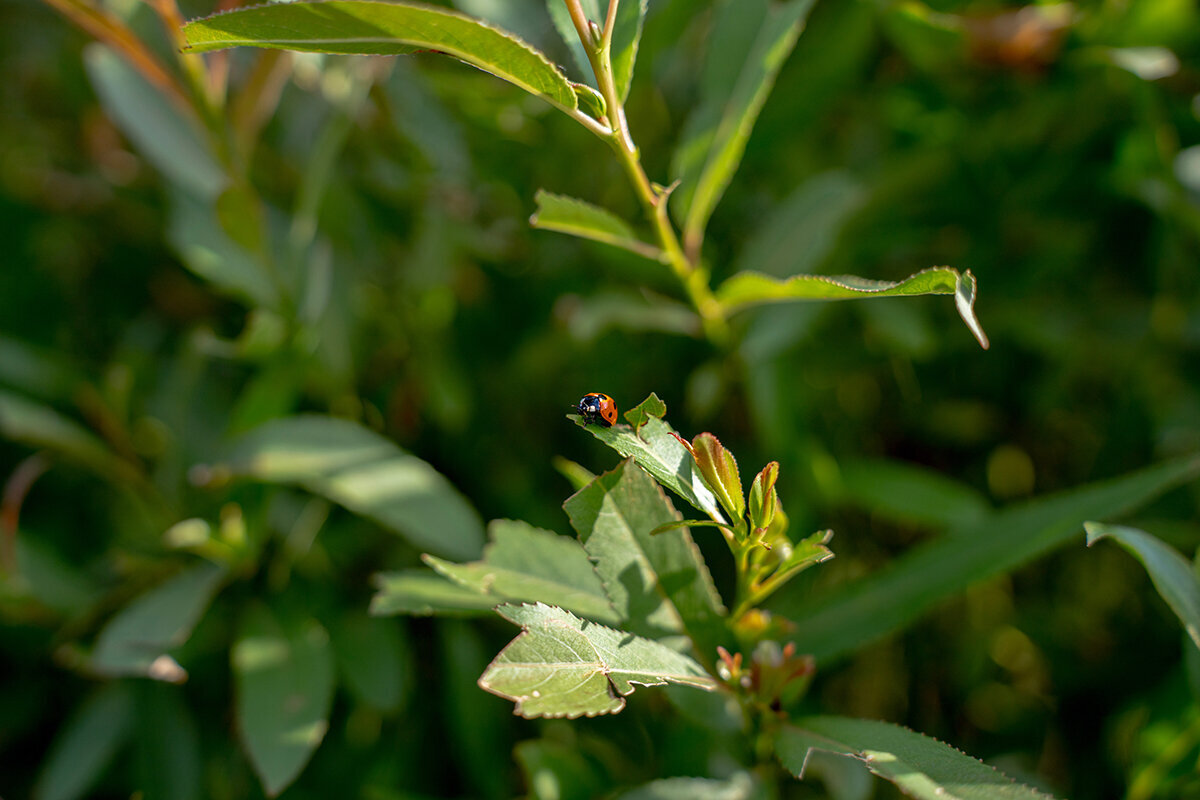
A working ecosystem · Biological control in the greenhouse
Greenhouse beneficials need a managed plan.
Natural enemies can shift greenhouse care away from recurring emergency treatments and toward steady observation. A release links several moving parts: the pest, its predator or parasitoid, the crop, the growing environment and the gardener. Regular checks reveal whether those parts are working together.
A shipment is only the beginning
The goal is not to fill the greenhouse with insects. The goal is to give an appropriate natural enemy enough opportunity to find and reduce the identified pest before plant injury expands.
Use biological control as one component of an integrated pest-management routine. Prevention, early discovery, sound identification and carefully selected living controls come first; another focused measure may be needed when those steps are insufficient. Protected growing helps attentive home gardeners notice patterns sooner. Weekly rounds with a hand lens and yellow sticky cards used as trend indicators can expose a developing problem while biological controls still have time to respond.
Ordering beneficials should not be the automatic response to every damaged leaf. Inspect incoming plants, allow useful spacing, remove weeds, water appropriately and keep paths tidy to reduce pest pressure. One suitable setting is the Classic Aluminium Greenhouse which provides accessible growing space, adjustable ventilation and clear routes for recurring inspections.
For gardeners building a plant-health routine that can develop over time, the Classic Aluminium Greenhouse has enough flexibility to organize circulation, planting rows and ventilation zones without turning routine scouting into an obstacle course.
Three kinds of biological helpers
Each group does a different job.
The phrase “beneficial insects” is useful but incomplete. Greenhouse programs may also involve predatory mites, parasitoid wasps, helpful nematodes and microbial pest-control products. One group cannot simply stand in for another.
These hunters feed directly on pests.
This group includes lacewing larvae, lady beetles, predatory bugs and numerous predatory mites. Many search actively, although their usefulness changes with pest identity, crop structure, prey abundance, greenhouse conditions and release timing.
- Lacewing larvae consume aphids, but they do not solve every pest problem.
- The mite species determines whether young thrips or spider mites are the intended prey.
- A generalist can contribute early, then move elsewhere if food becomes limited.
Their young develop on or within another organism.
These very small wasps are often narrowly specialized, making them most useful as a preventive measure or soon after a pest appears. Look for what they leave behind rather than trying to spot every adult: aphid mummies, altered immature whiteflies and clean, rounded emergence holes can all provide clues.
- Encarsia and Eretmocerus are considered for specific whitefly problems.
- Aphidiusspecies must be matched to the aphid that is present.
- Suitable host stages must be available, and even a good match will not clear heavy pressure immediately.
Their work is biological even when it is difficult to see.
Helpful nematodes can be applied through damp growing media to reach fungus gnat larvae. Microbial controls have their own requirements for pest stage, placement, coverage and environmental conditions. Select an option only when its registered use fits both the crop and the intended application.
- Although they are not insects, they still have a place in biological pest management.
- Moisture, light, application coverage and pest development can all influence the outcome.
- Treat the current label and the supplier’s latest directions as essential working documents.
Identify first; select the control afterward
Do the diagnostic work before ordering.
Yellow leaves, pale speckling and sticky deposits narrow the possibilities but do not name the culprit. Aphids, thrips, whiteflies and spider mites produce different evidence, occupy different parts of a plant and become vulnerable at different points in development. Take photographs, use a hand lens beneath the leaves and compare affected and unaffected plants before choosing a living control.
1
Interpret the symptom
Begin with fresh injury.
2
Locate the culprit
Note where it is feeding.
3
Name its life stage
Follow development from egg through adult.
4
Chart the infestation
Is it isolated or spread through the crop?
Symptoms: Honeydew accompanied by sooty mould points toward sap feeders. Fine pale marks and silk-like webbing suggest spider mites, while silvery damage with dark droppings may be evidence of thrips.
Where to inspect: Examine tender shoots, flowers, the undersides of leaves, older foliage near the base and the damp top layer of the growing medium. A control cannot work well if it never reaches the place occupied by the pest.
Development: Eggs, younger and older nymphs, larvae, pupae and adults do not share identical vulnerabilities. The easiest form to notice may therefore be the wrong one to target.
Extent of the problem: Separate one cluster beside an entrance from a pattern found throughout the planting. Mark and isolate concentrated areas where practical, then provide the supplier with the complete observations.
Following this sequence helps avoid buying a visually appealing generalist that cannot reach a pest concealed in potting media, protected by curled foliage or no longer at a susceptible stage. For a growing area designed around regular access, explore Bloomcabin’s aluminium greenhouse collection.
Profile I · The nearly invisible patrol
Predatory mites
Their small size makes predatory mites easy to overlook, but that does not make them unimportant. Certain species are selected for spider mites; others consume early thrips and may supplement their diet with pollen or another food. Define the assignment before purchase because the mite used for one pest may be ineffective against the other.
Place the carrier through the planting in the manner specified by the supplier rather than emptying it at one point. Plants already covered in webbing generally require isolation and a coordinated recovery response, not a casual mite release. Performance can change with temperature, relative humidity, crop density and residues from earlier treatments.
Useful evidence: Across repeated checks, count fewer active pest stages; do not expect everything to vanish when the release occurs.
Profile II · A carefully chosen host
Parasitoid wasps
Parasitoids are specialized working organisms, not miniature decorative wasps. The adult finds an appropriate host stage and deposits an egg on or inside it; the developing parasitoid ultimately kills that host. Their ability to search through foliage and leave identifiable traces makes them useful in a greenhouse.
One parasitoid offered by commercial suppliers, Encarsia formosa is used in programs for greenhouse whitefly and generally belongs at the very-low-pressure stage. Long-lasting insecticide residues from an earlier treatment may interfere with it. Parasitoids intended for other whiteflies or aphids must be chosen according to the pest, crop and environmental conditions. Greenhouse whitefly and Bemisiaspecies require separate consideration.
Useful evidence: Search for aphid mummies and altered immature whiteflies bearing a tidy circular emergence opening.
Profile III · Hunters you may notice
Lacewings, lady beetles and predatory bugs
Lacewing larvae feed on aphids and other small prey with soft bodies. Adult lady beetles may fly out of an open greenhouse or leave when food is limited. Predatory bugs included in some thrips programs may also use pollen, though they require enough time and suitable crop and climate conditions to become established.
Choose these organisms for their function, not their visual appeal. Ask whether the confirmed pest has an abundant, exposed life stage that a particular predator can actually reach. In a household greenhouse, thoughtful placement followed by recurring checks is generally more useful than releasing a colourful mixture of species.
Useful evidence: Look for hunting activity where prey is concentrated and for pest counts that decline over time, rather than relying on one memorable encounter.
Profile IV · Work below the foliage
Nematodes and microorganisms
Some greenhouse pests spend their vulnerable period away from the leaves. Fungus gnat larvae occupy damp growing media, where nematodes such as Steinernema feltiae can sometimes be delivered as a drench. Keep the medium moist for the period directed by the supplier and time the application carefully. The underlying causes of algae, decaying debris or continual overwatering still need attention.
Microbial pest-control products also demand accurate application. Pest stage, temperature, moisture, light and thorough coverage may alter performance. Use a product registered for the crop, site and intended purpose, follow its current Canadian label and confirm its compatibility with the rest of the program.
Useful evidence: After treating the susceptible stage, check for reduced larval numbers in the medium or a decline in fresh feeding injury.
Pairing the organism with the opportunity
Target the stage that can be reached.
Use this overview to frame a decision rather than fill a shopping cart. The crop, confirmed diagnosis, greenhouse environment, pest pressure and supplier guidance determine the species, package, amount and release technique.
Pest confirmed
Aphids Tender shoots
Whiteflies Undersides of leaves
Thrips Blooms and foliage
Spider mites Before webs appear
Fungus gnats Damp growing medium
Mealybugs Isolated colonies
Control group to discuss
Parasitoids or lacewing larvae
Encarsia/Eretmocerus
Predatory mites or Orius
Mites selected for spider mites
Steinernema feltiae
Parasitoids chosen by species
Begin with the pest column. The aphid species determines which aphid parasitoid to consider. Whitefly identity and crop conditions shape that decision as well. Mites used for thrips focus mainly on early stages, whereas a spider-mite problem calls for a different selected species.
Then use the control column to prepare your questions. Give the supplier clear photographs plus the crop name, recent conditions, treatment history and life stage observed. With that information, the supplier can identify an available organism and provide up-to-date instructions for delivery, handling and distribution.
A mismatch that cannot work: Visual appeal is not a substitute for identification. A predator that attacks early thrips cannot reach fungus gnat larvae below the surface. A drench cannot control adult whiteflies feeding beneath foliage. Parasitoids also cannot immediately reverse an outbreak after incompatible residues have disrupted the growing area.
Planning the release
Three moments with different goals.
Timing should reflect the level of pest activity. The following categories describe approaches rather than standard quantities. Always defer to current instructions for the selected organism, shipment, crop and greenhouse environment.
Preventive placement
Before a pest is found
Early response
At the first confirmed sign
High-pressure response
When an outbreak is established
Preventive placement: Consider this when your records show that a pest returns and the selected organism can persist or be added again as directed. It is planned readiness, not an instant rescue.
Early response: Flag the first affected area, follow directions for that zone and nearby plants, and schedule a return visit. Biological controls often have their strongest opportunity before pressure expands.
Established outbreak: Separate or discard severely affected plants, obtain expert advice and determine whether a selective intervention is required before restarting the biological routine.
Before the shipment arrives
When it is delivered
3–7 days later
During subsequent weeks
Verify the pest, review everything previously applied and map an accessible route that is protected from direct sun.
Open the package without delay, check its condition and apply the supplier’s requirements for placement, temperature and timing.
Return to the first affected area and to selected plants elsewhere. Note pest development, signs of the beneficial, recent environmental conditions and the crop’s response.
Compare several inspection records. Add organisms, alter the approach or seek more help only when the accumulated findings justify that step.
Conditions are part of the method
A release cannot be separated from its environment.
Conditions that favour tomatoes, peppers, orchids or seedlings may still be poor for the chosen beneficial. Establishment is shaped by temperature, relative humidity, available prey, illumination and air movement. A single operating range would be misleading because organisms, packaging, crops and local growing conditions vary.
Ask the supplier what the exact organism requires before placing an order. Canadian greenhouses can face cold shoulder-season nights, sharp solar heating and either dry or humid summer conditions depending on the region. Use the answer when planning shade, ventilation and irrigation, not solely when choosing a release time.
Banker plants require deliberate supervision
A banker plant is maintained to carry appropriate alternative prey or hosts for a particular natural enemy. Professional growers use documented combinations. That does not make an arbitrary flowering plant or an unmanaged aphid colony appropriate for a household greenhouse.
Without a clearly understood system, banker plants can introduce pests, disease or identification errors. Select a combination documented for the crop, beneficial and target pest, label it clearly and inspect it often. A small greenhouse may be better served by disciplined monitoring and releases planned with a specialist supplier.
When an earlier treatment interferes
Residues can disrupt the entire plan.
Words such as “natural” or “organic” do not show that a soap, oil or home remedy is compatible with every beneficial organism. Direct exposure, coated foliage, systemic activity and loss of prey can all cause harm. What looks like a failed release may actually trace back to a previous application.
If a pest-control product is being considered, use only its current Canadian registered use and label directions. Give both the manufacturer and beneficial supplier the active ingredient, formulation, crop, application site and proposed release interval. Search Health Canada’s current pesticide and label records, then check any applicable provincial or municipal restrictions; an old list or discussion post is not enough.
Compatibility questions
Answer these before proceeding.
- What is the complete product name, active ingredient and formulation?
- Does the current Canadian registration cover this crop, site and intended purpose?
- Is its action based on contact, ingestion, systemic movement or a combination?
- What separation period is specified for this organism by the label or supplier?
- Was anything applied to the crop, surrounding plants, medium, paths or weeds?
- Could the worst affected plants be separated instead of exposing the full greenhouse?
Reading the results
Base the next move on records.
Successful biological control is usually gradual rather than dramatic. New colonies become less frequent, recent injury slows, trap counts weaken and signs of the natural enemy increase. Allow enough time to detect that pattern, but respond if the infestation is clearly accelerating between checks.
Repeat the routeRevisit selected representative plants, the first affected area and crops near entrances, vents or recent additions.
Keep a logWrite down the pest, observed stages, approximate abundance, symptoms, beneficial activity, notable environmental events, date and every action taken.
Read the patternCompare findings from multiple dates. A single leaf or sticky card is one clue; the direction of change across the growing area is more useful.
Seek more helpWhen injury and pest density keep rising, or no beneficial activity becomes visible, investigate the cause before purchasing the same organism again.
Observation 01
Immature whiteflies change
Parasitized whitefly stages beneath a leaf may alter in colour or shape. A neat round exit opening is different from the uneven opening made by the emerging pest.
Observation 02
Aphid mummies become visible
An aphid attacked by a parasitoid may swell and develop a dry, papery appearance. Continue examining new shoots for living aphids because parasitoid activity and an active infestation can be present at the same time.
Observation 03
The trend stops climbing
Counts of active pests, trap catches and fresh feeding injury first stabilize and then fall. That repeated measurement is more informative than spotting one beneficial organism.
Practices that support the program
Living controls still depend on sound greenhouse care.
Limit entry
Examine incoming plants before adding them to the collection. Use appropriate screens at openings and inspect crops beside entrances, vents and plant-moving routes with extra care.
Maintain sanitation
Remove badly affected material without scattering pests. Clear away weeds and crop debris, clean tools and correct algae or constantly wet areas that may favour fungus gnats.
Manage growth
Avoid persistently wet conditions and excessively dense, soft growth. Leave enough room for air movement, visibility and physical access to every plant.
For a greenhouse intended to remain orderly and useful over many seasons, the Classic Aluminium Greenhouse can combine circulation routes, shading, ventilation, watering and crop rows in a layout that makes leaf inspection part of ordinary care.
Canadian greenhouse questions
What to ask before arranging a release.
If the pest is unknown, the crop is commercial or the outbreak is severe, contact a qualified plant-health adviser or an experienced supplier of biological controls.
Are lady beetles a good choice for a household greenhouse?
They are sold for aphid control, but that does not make them the best fit in every case. Adults may leave, and the pest, its stage, the environmental conditions and delivery format all matter. A crop-care change, selected mite or specialized parasitoid may be more appropriate.
Can living controls be used on food crops?
Biological controls are used in edible crops, but the exact crop and application still matter. Purchase from a reputable supplier and follow its handling, placement and release directions. Any pest-control product used with the program must follow its current Canadian registration and label.
How quickly should the pest count change?
Look for movement in the right direction rather than immediate eradication. The pest’s development, initial abundance, greenhouse environment and biology of the chosen control affect timing. Use the supplier’s monitoring interval, inspect consistently and revise the approach if pressure continues to increase.
Can soap or oil be used in the same program?
It may be possible, but compatibility must be checked for the exact products and organisms. Contact exposure and residues can injure natural enemies, with effects varying by formulation, crop and application. Confirm the current Canadian label and registration, then ask the supplier how long to wait.
Can purchased beneficial organisms simply be released?
Choose an established supplier and follow all directions for the crop, destination, handling and intended setting. Ask the supplier to verify that the organism and shipment are appropriate for your Canadian destination. Do not release an unidentified or unsuitable species outside its intended setting, and consider whether it could escape from either a greenhouse or garden.
Canadian sources and additional technical reading
Check current local requirements as well as biological guidance.
Supply formats, availability, registrations and directions can change because these controls are living organisms and regulated products may be involved. Use the current supplier information and product label together with Health Canada’s pesticide registry. The remaining German institutional links provide clearly attributed technical background, not Canadian authorization.
More from Bloomcabin: Bloomcabin greenhouse curtains · Growing tomatoes in a greenhouse · View all greenhouses and conservatories
- Health Canada – Pesticide public registry and label databases
- Julius Kühn Institute –Beneficial-organism information on plant-protection product effects on beneficials
- German Environment Agency – Gardening with beneficial organisms
- North Rhine-Westphalia Chamber of Agriculture – Beneficial organisms against greenhouse pests
- North Rhine-Westphalia Chamber of Agriculture – Biological whitefly control
Continue the working plan
Prepare the greenhouse for its smallest workers.
Set a recurring inspection time and bring a notebook and hand lens. A durable greenhouse is more productive when its layout, climate management and care routine make close observation easy. Begin beneath the leaves rather than with an order form.
- Confirm the pest before deciding which living control to use.
- Ask the supplier to verify the organism, vulnerable stage and handling method.
- Put the follow-up inspection on the calendar before the shipment comes.
Begin with an observable layout
Make recurring inspection easy.
Accessible rows, adjustable ventilation and an organized crop area help reveal small changes before pest pressure becomes difficult to manage.
