
Growing Broccoli in a Greenhouse
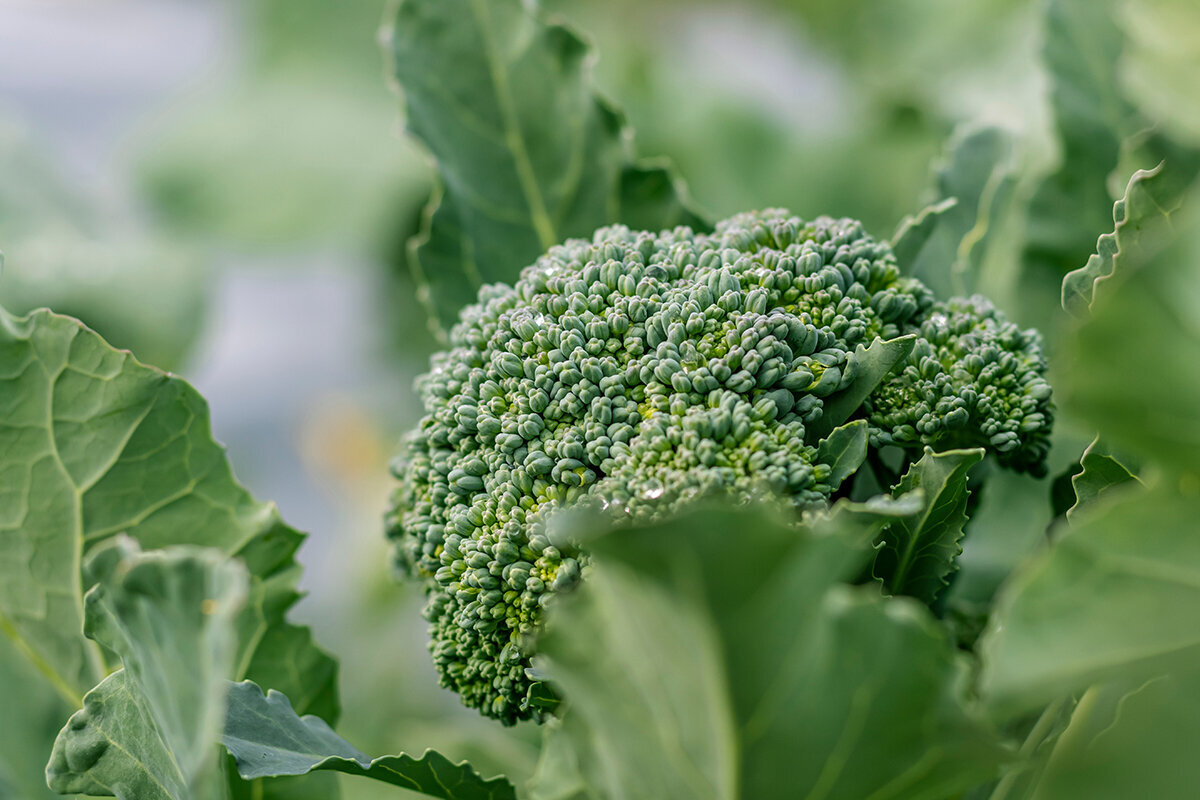
The crown reflects its climate
Growing Broccoli in a Greenhouse
Firm, dark-green florets tell a season-long story. Dry spells, sudden heat, crowded roots or waiting too long to cut the head can all alter the finished crown.
Broccoli can make excellent use of a greenhouse during the cooler portions of the growing year. Treat the structure as adjustable weather protection rather than a heated room: start sturdy plants, reserve space for their full spread and vent damp air promptly.
Best seasonCool spring and autumn
Plant spacing50–60 cm per plant
Useful temperature rangeAbout 18–21 °C for starting seedlings
Main riskWarm, humid head development
01 · Managed coolness
Broccoli benefits from shelter, not from extra heat.
The growing principle
Glazing, roof vents, doors, temporary shade and careful watering can buffer abrupt shifts in weather. Before a crown develops, build a strong plant at an even pace instead of encouraging soft leaves with excessive greenhouse heat.
This brassica performs best when growth remains moderate and uninterrupted. Reliable moisture, transplants at the right stage and cooler conditions during crown development support tightly packed buds. The greenhouse offers useful controls, but the crop still needs a temperate environment.
02 · Choose the growth habit
Match the broccoli type to your greenhouse bed.
Maturity information is prominent on most seed packets, but it is only part of the greenhouse decision. Also compare the finished crown, the space occupied by mature leaves and whether the variety continues producing side shoots.
Compact heading
Earlier harvest
Shorter window · smaller footprint
Sprouting
Many pickings
Small shoots · extended harvest
Calabrese
Large main head
Broad leaves · generous spacing
Early heading varieties
Choose an early heading form when the spring slot is brief and tomatoes or cucumbers will use the bed next. Most of the crop arrives as a central crown. Cut while its buds are compact and unopened; later side-shoot production depends on the variety.
Sprouting varieties
Instead of one dominant crown, sprouting broccoli supplies a succession of smaller shoots. That suits households wanting modest amounts at a time. Its branching habit can crowd the bed, so preserve air channels and inspect the plants regularly.
Large Calabrese varieties
Blue-green Calabrese plants commonly carry a sizeable main crown and then a later crop of smaller shoots. Their broad leaves demand ample room. A summer planting can place crown development in cooler autumn conditions, provided the chosen variety matches the intended harvest period.
For an uncomplicated first attempt, select a dependable heading variety whose packet identifies an appropriate season. Add a small number of sprouting plants at one end if an extended picking period matters. Keep every label until the crop is cut; the name and seasonal notes help explain unusual timing or crown form.
03 · The transplant sets the standard
Raise young, resilient plants rather than overgrown starts.
A broccoli start may still appear neat after its roots have occupied the entire cell. Do not delay potting or transplanting simply to suit the calendar. Plants that are old, stressed or tightly root-bound have a greater tendency to produce undersized crowns prematurely; growers call this buttoning.
Sow one seed into a loose seed-starting mix and cover it by only a few millimetres of mix. Maintain gentle, uniform moisture without soaking the medium. Give emerging seedlings bright light at once and move them into cooler conditions. After the first true leaf appears, restrained feeding is preferable to a strong fertilizer push that produces rapid, soft growth.
Begin gradual hardening once several true leaves have formed and the rootball holds together securely. Although greenhouse cover eases the move outdoors, it can mask sharp contrasts between a warm, sunny afternoon and a very cold, clear night.
From seedling to head
01
SowClean growing medium; shallow cover.
02
EmergenceBright light; gentle air movement.
03
Pot onGive roots room.
04
Harden offIncrease exposure gradually.
05
TransplantWater in well at final spacing.
Before germination, maintain consistent moisture without leaving the medium sodden. Provide bright light as soon as shoots appear. Mild air circulation supports compact stems and shortens the time that moisture remains on foliage.
Move each plant to a larger pot before its roots coil densely. Lift young seedlings by a leaf whenever practical. During several days of hardening, introduce stronger light, greater air movement and wider temperature changes in stages while keeping each small rootball hydrated.
The number of weeks since sowing is only one consideration. Set out firm, actively growing transplants with several true leaves, a compact rootball and no sign of premature crown development. Canadian planting times differ widely with regional frost patterns, available light and the conditions inside each greenhouse. Begin with the desired harvest period and count back using the variety packet’s maturity information.
04 · Spacing is climate control
Plan for the leaf canopy of the mature plant.
Overcrowding often begins innocently because newly planted starts occupy so little room. As their broad, blue-green leaves expand and overlap, humidity remains near the crowns, inspection becomes awkward and competition for light, moisture and fertility intensifies at the critical stage of head development.
In a row with good air exchange, give compact plants a practical minimum of 50 cm and increase the clearance to as much as 60 cm for bigger varieties, extended autumn crops or structures where humidity clears slowly. Allow roughly 60 cm between rows as well. Include walkways and vent corridors in the layout; what looks like surplus room around a start becomes valuable once its leaves reach full size.
Provide access from either end. The layout should let you examine lower leaf surfaces, test moisture in the root zone and remove the central crown without reaching through the neighbouring plant.
Layout for airflow and access
Incoming air
Clear ventilation route
Clear ventilation route
Broccoli row
Open leaf structure
Open leaf structure
Harvest path
Dry access
Dry access
Keep tall plants away from the route linking the door with the roof vents. A narrow structure will often function better with one roomy row accessible from either side than with two cramped beds pressed against the glazing and walkway.
Container production is possible, but assign each plant its own deep, roomy pot filled with fertile medium that retains its structure. Maintain about 50 cm of separation. Because sunshine warms pots and depletes their moisture faster than an in-ground bed, inspect them more frequently.
05 · Climate chamber
Crown quality depends on a stable pattern, not a single thermometer reading.
Cool weather generally suits broccoli, yet a forming crown is vulnerable to accumulated warmth and swings in soil moisture. Seek bright conditions, circulating air and moderate temperatures. For propagation, a workable range is 18–21 °C while heads are best kept as cool as seasonal conditions permit. On clear days, start venting before the foliage shows signs of wilting.
Prolonged temperatures above roughly 20–22 °C, particularly when watering is erratic, may lead to coarse, loose or early-maturing crowns. A small glazed structure can cross that range while the air outdoors still feels comfortable. Record peaks with a min-max thermometer positioned at leaf level. As foreign planning guidance, the Bavarian Garden Academy advises that ventilation openings in a small greenhouse should equal at least one quarter of its floor area; actual Canadian ventilation needs will also depend on the structure and local weather.
Stress ↑Development →
High
Stalled
Loose
Open
Medium
Water
Vent
Harvest
Low
Steady
Set
Tight
A daily venting check
- Morning
- Before direct sunlight builds heat, open the door and roof vents. Look for movement through the crop itself rather than assuming that one narrow opening is providing sufficient exchange in a full greenhouse.
- Midday
- Reserve temporary shade for exceptionally bright, hot conditions and use it sparingly. The crop requires abundant light, while excess crown heat and sluggish roots are undesirable. Good scheduling and active ventilation usually do more than keeping the glazing darkened.
- Evening
- Ahead of a cold night, adjust the openings early enough to prevent an abrupt chill, but avoid sealing wet foliage inside. Let leaves dry before darkness when conditions permit, and do not direct a sudden stream of cold air across the plants.
- After watering
- Release surplus humidity through adequate venting. Saturated leaves, persistent condensation and a wet walkway should not be used as cooling techniques.
06A · Water flow
Keep the root zone evenly moist.
Repeated drying followed by soaking disrupts broccoli growth. From transplanting until cutting, provide a consistently moist root zone that still contains oxygen. Apply enough water to reach below the surface, then schedule the next irrigation according to a soil check, current weather and crop development rather than a preset weekday.
Because rainfall cannot reach the covered bed, demand is governed by sunlight, air exchange, soil texture and pot volume. Test where the roots are active with a finger or trowel. A drip line or a slow application near the soil wets fewer leaves and crowns than routine overhead spraying, while morning irrigation leaves more time for humidity to disperse.
06B · Nutrient flow
Feed steadily, not in bursts.
Broccoli has substantial nutrient needs, yet extra nitrogen cannot compensate for weak roots, inadequate light, poor watering or unsuitable temperatures. Where practical, test the soil and prepare a mature bed with sound structure. Finished compost helps both aggregation and moisture retention; keep fresh manure away from the current crop. Match additions to existing soil conditions rather than following one maximum rate everywhere.Start with a soil test Use the findings and the crop’s visible response to decide whether more fertilizer is warranted.
A restrained application after establishment may be useful. Once the main crown has been removed, another light application can assist side shoots if the plant remains vigorous and the soil plan supports it. Large, sudden nitrogen inputs can combine with fast growth and broad spacing to encourage hollow stems. Test first rather than guessing at individual micronutrient deficiencies.
Moisture and fertility have their greatest shared influence as the crown develops. Plants that have grown without repeated pauses from thirst or inadequate nutrition enter this stage with a better chance of producing firm, uniform buds.
07 · Reading the crown
How a dense broccoli head develops.
The edible crown is made from numerous flower buds that have not yet opened. Its eventual condition is determined well before it looks ready to cut. First, the crop must create a broad leaf canopy and roots capable of steady uptake. When the variety reaches the appropriate stage under suitable conditions, the central growing point reorganizes into a compact cluster.
Visible crown defects can therefore trace back to much earlier events. A tiny crown on an undersized plant often follows prolonged time in a small pot, temperature stress, dryness or transplant disturbance. Large separating buds or yellow flowers usually point to a later episode involving excess warmth, irregular moisture or delayed cutting.
Before initiationBuild leaf area briskly without pushing soft growth. Supply young plants with root oxygen, room, regular moisture and measured nutrition.
At head initiationReduce swings inside the structure. Prevent accumulated heat, lapses in watering and sudden shifts in fertilizer strength.
As heads maturePreserve an air channel around each crown. Check development frequently and cut while all buds are firmly shut; gaining a few centimetres of diameter is not worth sacrificing texture.
08 · Diagnosis desk
Crown symptoms reveal where the growing routine lost balance.
Avoid reaching for one remedy whenever a crown is imperfect. Interpret the symptom alongside transplant age, root health, recorded temperatures, irrigation and air movement. What appears at harvest may have started weeks before.
Early head
Buttoning
Small plant.
Coarse buds
Loose head
Heat or drought.
Yellow buds
Flowering
Harvest now.
Hollow stem
Growth stress
Reassess the growing routine.
Small, early crown
Buttoning
Likely causes: An interruption held back the young plant. Possible triggers include remaining in its pot too long, temperature stress, dryness, inconsistent nutrition or disturbance at transplanting. Crown development began before the plant had produced enough foliage.
Gentlest response: Cut and use the small crown. For the following sowing, adjust transplant timing, potting and root development. Heavy fertilizer will not reliably return the present plant to its earlier vegetative stage.
Open or coarse buds
Coarse, loose buds
Likely causes: Possible contributors include excessive warmth as the crown forms, humid air, irregular irrigation, a sudden growth surge or harvesting too late. The individual buds become prominent as the previously fine, compact surface opens.
Gentlest response: Increase ventilation sooner on bright days, maintain consistent root moisture and avoid abrupt fertilizer increases. When the crown has reached harvest stage, remove it before any flower opens.
Yellow flowers or yellowing
Opening crown
Likely causes: The crown matured more quickly than the inspection schedule anticipated. Warm conditions can take closed green buds to an open stage in a short period. This usually indicates late harvesting rather than proving the presence of disease.
Gentlest response: Remove the crown at once. Its sound stems, buds and flowers can still be eaten, although appearance and texture are preferable before bloom. During warm conditions, inspect maturing plants every day.
Brown areas or hollow stem
Internal stress
Likely causes: Several factors can interact: fluctuating moisture, unusually rapid growth, excess fertilizer, broad spacing, varietal susceptibility or uneven micronutrient availability. A cavity in otherwise firm stem tissue is generally a quality defect and does not by itself establish a food-safety problem. Discard soft, rotten or discoloured portions generously.
Gentlest response: Arrange a test of the soil or growing medium before supplying a specific micronutrient. Bring irrigation and feeding back to an even pattern. At harvest, cut away damaged or decayed tissue and clean the knife or other tools afterward.
09 · A quiet scouting circuit
Moisture trouble, aphids and caterpillars are easiest to address early.
Cover excludes much of the weather, not every insect. Cabbage-white and moth larvae may enter through an open door or vent, then shelter in folded leaves near the crown. Aphids favour tender shoots, while flea beetles pepper young foliage with small holes. Scout no less than twice each week and increase the frequency in warm conditions or while crowns are forming.
Choose a targeted, low-disruption response first. Pick off isolated caterpillars, wipe away a small aphid group or use a directed stream of water on sturdy foliage. Take heavily affected material and old brassica debris out of the structure. Insect netting is useful only when it does not impede ventilation. If pesticide control is required, consult Health Canada’s current label database and use only a product registered for broccoli and the intended application. Follow every label direction, including the pre-harvest interval.
Managing humidity also limits conditions that favour disease. Preserve plant separation, direct irrigation to the soil and clear dead foliage. Cool outdoor air is not a reason to seal the greenhouse immediately after watering.
A five-minute crop check
- Inspect the backs of leaves for eggs, larvae and groups of aphids.+
- Ease the foliage apart, confirming that it is dry and that air can reach the plant’s centre.+
- Test moisture several centimetres down before irrigating; the dry-looking crust at the top does not tell the whole story.+
- Examine the young crown for widening buds, yellow patches and caterpillar droppings.+
- Carry damaged foliage out rather than dropping it along the walkway or beneath the propagation bench.+
Leave a break of several years before returning broccoli or another brassica to the same soil. Longer rotation reduces the build-up of persistent pests and soil-borne diseases in permanent greenhouse beds as well as outdoor vegetable plots.
Where to make the harvest cut
Main head
Tight green buds
Tight green buds
Cut line
Above lower leaf axils
Above lower leaf axils
Leaf junctions
Leave intact
Leave intact
Side shoots
Preserve axillary buds
Preserve axillary buds
Cutting guide: Cut when the central crown has reached a useful size but every bud is still closed. Work in the morning with a clean, sharp knife and retain a good length of stem. Place the cut above strong lower leaf axils, leaving the healthy roots and foliage in the bed.
After the main cut: Calabrese and many sprouting varieties can develop smaller shoots from the leaf axils left behind. Maintain regular watering. If soil conditions and the existing nutrient plan justify it, a light fertilizer application may help support this follow-up crop.
10 · Cut at the right moment
Take the central crown and keep the plant for later shoots.
A supermarket-sized crown is not the goal once its surface begins to separate. Closed buds, firmness and tenderness are better guides than maximum width. The ideal stage has passed when buds lengthen or show yellow. During warm weather, inspect daily because flowering can follow quickly.
Small side shoots are a particularly useful greenhouse crop because they are tender and easy to gather in meal-sized amounts. After removing the central crown, keep watering steadily, remove only diseased foliage and maintain circulation. Continue cutting shoots while their buds remain compact.
Lower the crop’s temperature soon after cutting instead of leaving it in a warm room. Refrigerate it in humid conditions without allowing it to remain dripping wet, and use it promptly because warmth quickly reduces freshness and tenderness.
For an orderly structure with practical aisles, effective roof venting and room for cool-weather crops, consider the Classic Aluminium Greenhouse from Bloomcabin. Its adaptable interior can accommodate successive plantings of broccoli, leafy vegetables and early transplants while keeping routine care accessible.
11 · Finding the Canadian growing window
Time crown development for the coolest dependable portion of your local season.
Coastal, maritime and higher-elevation settings
These locations may offer a longer cool spring, although low light can slow early seedlings. Protected establishment benefits an early planting, but frost protection may still be necessary. Autumn broccoli can also suit places where temperatures decline gradually.
Continental interiors
Use both sides of summer where local conditions permit. The first crop can leave before tomatoes or peppers need the bed, while a later sowing can mature as summer heat retreats. Spring sunshine can raise the temperature under glass quickly, so begin venting early even on a cool day.
Milder pockets and heat-retaining urban gardens
Place broccoli chiefly at the beginning or end of the local growing year so crowns do not develop during peak summer heat. Sheltered city lots and sunny enclosed sites may warm rapidly under glazing despite moderate outdoor air. Schedule the autumn crop so its key development occurs as nights cool and daylight shortens.
Begin with the preferred cutting period, count back by the variety’s transplant-to-maturity guidance and include the time needed to raise sturdy starts. A Classic Aluminium Greenhouse positioned with its sun exposure in mind and equipped with accessible doors, clear walkways and roof vents makes that schedule easier to manage. Automatic openers can assist when nobody is available to vent the structure early in the day.
12 · Greenhouse broccoli questions
Small, well-timed changes are usually more useful than a drastic response.
Before adding fertilizer, shade or a crop-protection treatment, investigate the growing record. Excess heat, erratic irrigation, confined roots, poor spacing or a delayed cut may be the underlying cause.
Will broccoli grow in a greenhouse without heat?+
Yes. An unheated structure can suit the cool transition seasons in many parts of Canada. It moderates wind, heavy rain and unstable weather; it does not create tropical conditions or guarantee freedom from frost during prolonged cold. Protect young plants when necessary and provide ventilation whenever sunshine raises the interior temperature.
What is a realistic broccoli count for a small greenhouse?+
Base the count on full-sized leaves, not newly planted starts. With 50–60 cm between plants, a row accommodates only a limited number of large specimens. Later side shoots can make that modest count productive. Trays, lettuce or short herbs may temporarily occupy the margins if they do not obstruct air circulation.
What causes undersized broccoli crowns?+
Some varieties are naturally compact. Other possibilities include aged or stressed transplants, drought, unsuitable temperatures and interrupted nutrition. When a very small plant develops a crown unusually early, buttoning is a likely explanation. The crown remains edible; the next crop benefits from younger starts and a steadier seasonal window.
When is greenhouse shade useful for broccoli?+
Short-term shade can moderate an exceptional burst of sun, but it is not a substitute for timely planting and active venting. Broccoli still requires strong light to create enough foliage for its crown. Open the vents and door, correct moisture supply and add shade only if the temperature around the plants continues climbing too rapidly.
Is container-grown broccoli practical?+
Yes. Give each plant a deep, roomy container with fertile medium that drains freely, and maintain about 50 cm between plants. Pots gain heat quickly in sunshine and store less water than a bed. Check them frequently and irrigate thoroughly without leaving the roots waterlogged.
References and further reading
Horticultural sources used to develop this growing plan.
More from Bloomcabin: Custom aluminium greenhouse · Smart greenhouses from Bloomcabin · Read more about long-term greenhouse planning
- Bavarian Garden Academy — Planning and using small greenhouses
- Bavarian Garden Academy — Raising or buying transplants
- Bundessortenamt — Guidelines for vegetable value testing and variety trials
- University of Minnesota Extension — Growing broccoli in home gardens
- University of Minnesota Extension — Irrigation strategies for vegetable crops
- University of Maryland Extension — Growing broccoli in a home garden
- University of Massachusetts Extension — Head quality and physiological disorders in broccoli
Plan around the crown
Make the cooler portion of the gardening year productive.
A greenhouse can do far more than shelter heat-loving tomatoes. For broccoli, it becomes an adjustable buffer that combines bright light with protection during cooler weather. Allocate a deliberate row, allow the leaves to reach mature size, preserve an uncluttered harvest route and vent before warmth and humidity collect around the crowns.
Use the Classic Aluminium Greenhouse as a starting point for a cool-season sequence of broccoli, lettuce, brassica starts and early spring herbs. Dimensions, roof vents and pathways can be arranged so tending and air management support each other. Review the Classic Aluminium Greenhouse layout, then compare configurations for the Classic Aluminium Greenhouse to organize a growing space intended for many seasons.
Classic Aluminium GreenhouseDecision 01 Identify the coolest suitable harvest period.
Decision 02 Lay out the bed using mature broccoli dimensions.
Decision 03 Reserve a dry, unobstructed route for scouting and cutting.
