
Greenhouse Strawberries: A Canadian Growing Guide
Bloomcabin crop notebook / Canada
Growing strawberries
under glassin a greenhouse
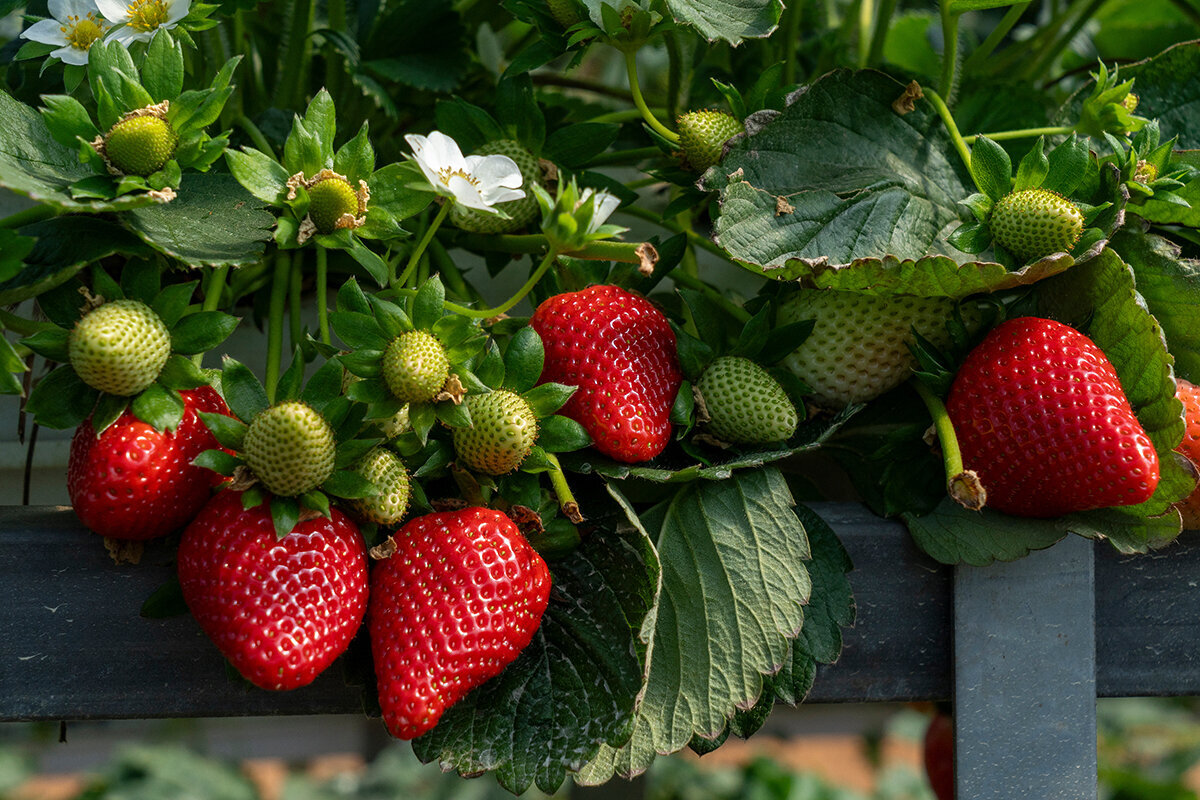
Growing strawberries under cover is an exercise in balance. Good fruit depends on how light, airflow, root moisture and picking time work together.
01What protection changes
Close observation makes the difference.
Strawberries signal lapses in care quickly. Set the crown too low and dampness can lead to rot. Leave a closed greenhouse unventilated and humid air may favour grey mould around the flowers. Let a container dry out and berry size may fall before the foliage looks wilted. These problems can be harder to notice outdoors; under cover, a brief daily check usually reveals them early enough to respond.
Earlier fruit is only part of the appeal. The roof shields flowers and berries from persistent rain, irrigation can be aimed at the root zone, and containers can sit at a convenient height for picking. It is also easier to inspect leaf undersides and remove damaged fruit. Even so, strawberries remain seasonal. A well-run greenhouse supports the transition into spring and can carry healthy plants later into autumn, but it does not turn them into year-round indoor plants.
Plan the strawberry section as a small climate of its own. Provide strong light, an unobstructed route for tending the crop, nearby water and room around the leaves. Avoid lining every container tightly against the glazing, where temperature swings are sharper and pots may lose moisture quickly. Before permanently arranging irrigation, containers or benches, consult Bloomcabin’sguide to the Classic Aluminium Greenhousefor layout ideas.
A dedicated fruiting area can use the balanced proportions and selectable ventilation of theClassic Aluminium Greenhouseto keep a bright side for strawberries while leaving space for potting, propagation and other crops through the season.
02Match the plant type to your plans
Start with the desired harvest pattern, then select named cultivars.
Protected growing space should be used deliberately. Think about whether you want a concentrated crop or smaller pickings over a longer period, and choose the plant type accordingly. Buy vigorous, accurately labelled stock from a dependable nursery. Starting with clean, healthy plants reduces avoidable disease pressure and makes later inspection simpler.
The cultivar still matters, but first decide which fruiting group fits your routine. Heat response, texture and flavour can vary with the site and greenhouse. Begin with 2 cultivars in modest quantities rather than filling a bench immediately. Retain the labels and note harvest timing, flavour and upkeep. Plants that perform well in your own conditions are the best candidates for another season.
Everbearing and day-neutral plants usually make practical long-season choices for a home greenhouse. June-bearing plants can be added when the aim is a concentrated early-summer harvest.
A concentrated harvest window
June-bearing
June-bearing strawberries initiate their flower buds during the previous year, then provide a substantial main crop in late spring or early summer. That pattern is useful for preserving, freezing or setting aside a harvest weekend. Runners form a larger part of their growth cycle, making a narrow in-ground or raised-bed row suitable where plants can be renewed after cropping.
These plants can perform well under cover, although their brief production peak occupies greenhouse space differently from a container crop that fruits repeatedly. Use them where there is room to manage runners, replace older plants and maintain an open row.
A flexible protected-crop option
Day-neutral
Day-neutral strawberries are less governed by day length and may continue flowering and setting fruit while conditions remain favourable. Retailers sometimes group them with everbearing plants. Choose on flavour, then observe how each cultivar responds to greenhouse warmth, light, ventilation and your picking routine. A small on-site trial is more useful than relying on a broad cultivar promise.
Clip off runners when fruit production is the priority. This lets the plant devote more resources to flowers and berries. Regular small pickings are convenient in a home greenhouse because fruit can be inspected, eaten or chilled promptly. Consistent root moisture and effective pollination are more valuable than pushing the plants into rapid, soft growth.
2 harvest waves
Everbearing
Everbearing plants flower and fruit more than once, commonly producing an early-summer flush followed by further cropping toward autumn. Containers suit them well, provided watering, harvesting and sanitation remain consistent. A familiar cultivar that already performs well for you is worth considering. In a confined greenhouse, a few carefully managed plants are usually preferable to an overcrowded collection.
03Seasonal work under cover
Let plant development and actual greenhouse conditions determine the timing.
Canadian growing conditions vary widely, so a single monthly schedule will not suit every region or greenhouse. Watch daylight, temperatures inside the structure and the plants themselves, especially where no heat is provided. Use the calendar as a sequence of tasks: prepare the space, plant, support flowering, manage moisture, pick fruit and renew the crop.
Late winterPrepareInspect containers and ventilation
Early springPlantKeep crowns level with the surface
Late springFlowerProvide fresh air and pollinator access
SummerHarvestMaintain moisture and feed with restraint
AutumnRenewChoose plants to retain, then clean
Late winter is a useful time to wash containers, clear old leaves and inspect glazing, drains, doors and vents. Plant during a bright, cool part of spring, protecting roots in containers if severe frost reaches an unheated greenhouse. Once flowers open, ventilate early, avoid wetting the foliage and give insects access when conditions permit. Through summer, pick regularly, keep moisture steady and remove runners that are not needed. In autumn, retain only healthy, well-spaced plants and clean the growing area before winter.
04Planting crowns without burying them
The crown should meet the surface—not sit above or below it.
The crown is the compact centre of the plant where leaves, flower stalks, roots and runners originate. Unlike a bulb, it should never be covered by compost or potting medium. Bury all roots, keep the growing point exposed and align the crown with the finished surface.
Crown position in profile
Too deep
Correct
Too high
Too deep: moisture lingers around the crown and raises the risk of rot. Correct: roots remain covered while the crown meets the surface. Too high: exposed roots lose moisture quickly and cannot anchor the plant securely.
Bare-root plants may be given a brief soak in clean water before planting. Open a hole wide enough for the roots to descend naturally rather than bending upward or bunching together. Settle the medium gently around them, water thoroughly and reassess the crown position once everything has settled. Lift the plant slightly if the crown has sunk.
Allow approximately 25 to 30 cm between crowns in troughs or individual pots. This gives access to each root ball, leaves room to pick without crushing foliage and helps moisture evaporate after cool nights. Long planters should remain narrow enough to examine comfortably from either side.
- Fill containers with a high-quality, open-textured growing medium that keeps its structure; heavy garden soil is unsuitable for pots.✦
- Keep developing berries away from wet medium, pooled water and decaying plant material.✦
- Record the cultivar and planting date, because labels are more dependable than midsummer memory.✦
- After watering, promptly reset any plant whose roots are exposed or whose crown has sunk.✦
05Managing the shallow root zone
Aim for even moisture, free drainage and plenty of air.
Most strawberry roots occupy the upper part of the growing medium. Consequently, lush leaves can hide a stressed root system and undersized berries may follow repeated cycles of drying and soaking. Pots in a greenhouse lose water more quickly than outdoor beds, particularly beside the glazing or on elevated benches.
Choose a peat-free or peat-reduced medium that retains useful moisture without becoming waterlogged. Larger pots and deeper troughs buffer changes better than very small containers. Every vessel needs unobstructed drainage holes, and runoff should not remain around the root ball in a saucer. Raised beds likewise need a reliable route for surplus water.
Drip lines can deliver moisture close to the roots without routinely wetting fruit and foliage. Decide when to irrigate by combining the weight of the pot, the temperature and a finger check below the surface. Apply water slowly so the complete root ball is moistened, stopping after a small amount begins to drain.
| Observe | Interpret | Adjust |
|---|---|---|
| Dry surface and unusually light container | Moisture is needed before the plant wilts | Apply water gradually until slight drainage appears, then empty any standing runoff. |
| Medium remains soaked for several days and foliage loses vigour | Irrigation frequency or drainage needs attention | Review emitter run time, container openings and whether the medium has compacted. |
| Abundant foliage with little flowering | Possible excess nitrogen or inadequate light | Follow the fertilizer label and avoid adding extra product simply to accelerate growth. |
| Berries remain small during hot conditions | Check for root stress and overheated air | Irrigate and ventilate earlier in the day; reserve shading for the hottest midday period. |
Approach to feeding:Base the feeding routine on the condition of the growing medium and the labelled directions for an appropriate berry fertilizer. Because everbearing plants crop for an extended period, they benefit from dependable but restrained nutrition. Extra nitrogen tends to produce soft, dark foliage rather than better fruit, and a crowded canopy dries slowly. Be equally cautious with compost and supplemental nutrients in beds.
Before fixing pipework or benches in place, consult theAluminium Greenhouse FAQfor practical considerations around access, drainage and irrigation.
06Helping flowers become well-filled fruit
Even berry development depends on pollen reaching the whole flower.
Use ventilation to support both crop health and pollination.
Strawberries are self-fertile, so no companion cultivar is required for compatible pollen. Each flower contains many stigmas, however, and broad pollen coverage helps the berry develop evenly. In suitable weather, open the doors and roof vents while the crop is in bloom. Visiting insects can then reach the flowers, while moving air reduces lingering moisture around the foliage.
Cold spells, prolonged rain or fine insect mesh may temporarily limit natural pollination. On a dry morning, move a soft brush lightly among several open flowers or gently tap their stalks. Only a delicate transfer is needed. A berry that narrows to a point or develops unevenly may indicate incomplete pollination, although heat or damaged blossoms can produce similar symptoms.
Temperature control also matters. Both cold and excessive warmth slow or disrupt growth, and solar gain can make a spring greenhouse much hotter than the outdoor forecast suggests. Begin ventilating before heat accumulates and thin any canopy that traps damp air. For ideas about glazing and airflow, Bloomcabin’sarticle on custom Aluminium Greenhousesprovides further planning context for a fruiting area.
07Choosing what to do with runners
A runner can renew the crop or compete with it.
A runner, or stolon, extends from the parent crown and carries a young daughter plant. Selected daughters can renew a row of June-bearing strawberries. On everbearing plants being kept for fruit, unwanted runners divert space, moisture, light and plant energy. Remove them while they are still small.
To reproduce a healthy favourite, pin a suitably placed daughter into a small container of fresh medium without severing it from the parent. Wait until it has developed a sound root system, then cut the connection and tend the new plant separately. Do not propagate from unhealthy stock, since pests and pathogens can be carried into the next generation along with the desired cultivar traits.
From parent crown to replacement plant
Mother
crown
crown
Runner
Stolon
Stolon
Remove
for fruit
for fruit
Root daughter plant
for renewal
for renewal
For fruiting everbearing plants, remove unnecessary runners early. From healthy June-bearing parents, retain only vigorous daughters; root, separate and label them carefully.
08Arrange the crop for easy care
Good access keeps fruit cleaner and morning checks simpler.
Choose a layout that allows every plant to be watered, examined and picked without reaching through tangled foliage. Raised containers improve access and air movement, although they lose moisture quickly. In-ground beds offer a larger moisture reserve but call for wider paths and diligent sanitation. A useful compromise is to keep everbearing plants in bench pots or troughs and reserve a modest bed for June-bearing plants.
Make the aisle wide enough to carry water or a harvest bowl without rubbing against leaves. Put frequently picked containers near the entrance and clear fallen leaves and spoiled fruit from the floor. For additional planning information, Bloomcabin’sClassic Aluminium Greenhouseoutlines the available sizes, glazing choices and ventilation features relevant to the planting layout.
Bench pots
Easy to rearrange and keep clean
Raised bed
More stable moisture around roots
Trough or planter
Picking at a convenient height
In-ground bed
Space for managing runners
Pots on benches are easy to replace and pair naturally with drip lines. Raised beds hold a substantial volume of growing medium but must drain properly. Troughs and planters bring berries within comfortable reach, provided their supports are secure and moisture is checked often. In-ground rows suit June-bearing plants where runner growth is controlled and the planting stays open enough to renew.
09A practical symptom check
Early observation often permits a modest response.
Grey fuzz on fruit
Fine pale speckling
Curled leaves, pale coating
Uneven or knobbly fruit
Grey fuzz on fruit: Grey mould often starts in spent flower material or around the calyx before spreading over ripening berries. Promptly remove affected fruit and dead blossoms, reduce splashing and improve circulation. Cool, moist air, plant debris and crowded foliage all favour the disease.
Fine pale speckling: Examine the undersides of leaves for spider mites during warm, dry weather. Fine spotting, scarring or a bronze cast can be early evidence. Move badly affected containers away from healthy plants and choose the least disruptive suitable response.
Curled leaves, pale coating: Powdery mildew may turn leaf margins upward and leave a light, flour-like growth, frequently on the underside. It can spread in humid air even without visibly wet leaves. Remove severely affected tissue, open the canopy and maintain regular ventilation.
Uneven or knobbly fruit: Begin by reviewing pollination. Improve insect entry or transfer pollen gently by hand, then assess heat exposure, inconsistent moisture and possible pest injury to the flowers.
10Recognizing the best picking stage
Harvest once colour reaches the top of the berry and the fruit is cool, firm and aromatic.
A strawberry does not develop additional sweetness once detached. Wait until its colour extends to the shoulder and its aroma is evident. Dry berries picked during the cool part of the morning are usually firmest. Although the colour may deepen slightly in storage, sugar content will not meaningfully increase.
Cradle the berry and detach the short stem just above the calyx rather than tugging on the flesh. During peak production, check the crop every 1–2 days and pick daily in hot weather. This routine removes overripe fruit and creates a regular opportunity to inspect irrigation, flowers and leaves.
Not yetWhite shoulder
At its peakEven colour with a clear aroma
Past its peakSoft or dull
White shoulder: leave the berry attached because little sweetness develops afterward. Even colour and fragrance: harvest while the fruit remains firm enough to carry. Soft, dull or leaking berries should be used immediately, or discarded if they are collapsing or mouldy.
Handling fruit after harvest
Chill promptly and delay washing.
Arrange berries loosely in a shallow container, preferably without stacking them. Bruised areas retain moisture and spoil sooner. Let field heat dissipate briefly in shade, then refrigerate the fruit unwashed. Rinse only when it is about to be eaten. Fully ripe greenhouse berries are at their best that day, though careful chilling may preserve them for several days.
Yield expectation:A universal kilogram figure per plant would not be credible. Results change with cultivar, plant age, available light, pollination, root volume, temperature, irrigation and picking frequency. The more useful reward from a healthy group of everbearing plants is a succession of fragrant harvests rather than a fixed annual total.
11Common questions, clearly answered
FAQ for greenhouse strawberry growers
Can strawberries grow in an unheated greenhouse?
Yes. An unheated greenhouse keeps prolonged rain off the crop and can extend the useful growing periods in spring and autumn. It does not remove winter risk. Monitor overnight conditions, protect roots in containers during severe frost and provide only enough water to prevent the medium from drying completely. A cool rest is generally preferable to warm conditions combined with inadequate winter light.
How many strawberry plants fit in a home greenhouse?
Design around working access and air movement rather than trying to fit the largest possible number. Allow roughly 25 to 30 cm between plants in pots or troughs, plus room to water and pick. In general, 10 accessible plants with dependable moisture and airflow will perform better than 20 crowded plants whose leaves remain damp.
Should I remove the first flowers?
For newly installed everbearing plants, removing the earliest flowers for a few weeks may help the roots and crown establish before carrying fruit. June-bearing plants also benefit from cautious management while becoming established because later cropping depends on a strong crown. With vigorous plants already in bloom, assess their condition rather than following this practice automatically.
Why are greenhouse strawberries small but sweet?
Small berries may simply reflect the cultivar. Other causes include incomplete pollination, root-zone drought, high temperatures, low light, crowding or too much fruit on a young plant. Review pollen transfer first, followed by moisture consistency and ventilation. Extra fertilizer is not the automatic solution.
How long do greenhouse strawberry plants remain productive?
Renew the crop when berry size, plant health or productivity declines noticeably. For protected home growing, replacement with healthy stock is often safer and easier than retaining exhausted plants indefinitely. Replace individual plants sooner if crowns weaken, disease repeatedly returns or crowding makes routine cleaning and examination difficult.
12References and additional reading
Background from German horticultural practice and plant-health guidance.
The following German horticultural and plant-protection references informed this article’s cultivation advice. They are retained as attributed foreign sources; for product use and local growing questions in Canada, consult current Canadian federal, provincial, territorial and municipal guidance as applicable.
- German Chamber of Agriculture: strawberry-growing guidance
General information on planting, crop management and harvesting for home growers. - Bavarian State Research Centre: home-garden strawberries
Practical material covering plant groups, care and pollination. - Bavarian State Research Centre: plant protection in small gardens
Background on prevention, diagnosis and responsible crop protection. - German Chamber of Agriculture: grey mould in strawberries
Information about Botrytis, humidity management and sanitation. - Berlin Plant Protection Office: garden bulletin
Plant-health guidance published for recreational gardeners in Berlin. - German Chamber of Agriculture: fertilizing strawberry crops
Nutrient management and a restrained approach to fertilizer. - German Chamber of Agriculture: concise strawberry-production notes
Further reading on healthy plants and day-to-day crop management.
Create a dedicated Bloomcabin fruiting area
Set aside a bright bench for strawberries.
A well-organized strawberry corner can become one of the greenhouse’s most useful seasonal spaces. Combine fragrant everbearing plants with an uncluttered aisle, a simple irrigation run and roof vents that operate freely before bloom begins. Flowers are easy to inspect, ripe berries are close at hand and tending the crop becomes part of the daily garden routine.
View the Classic Aluminium GreenhouseFor further help with layout, materials and equipment, consult theAluminium Greenhouse FAQ.
