
Growing Onions in a Greenhouse
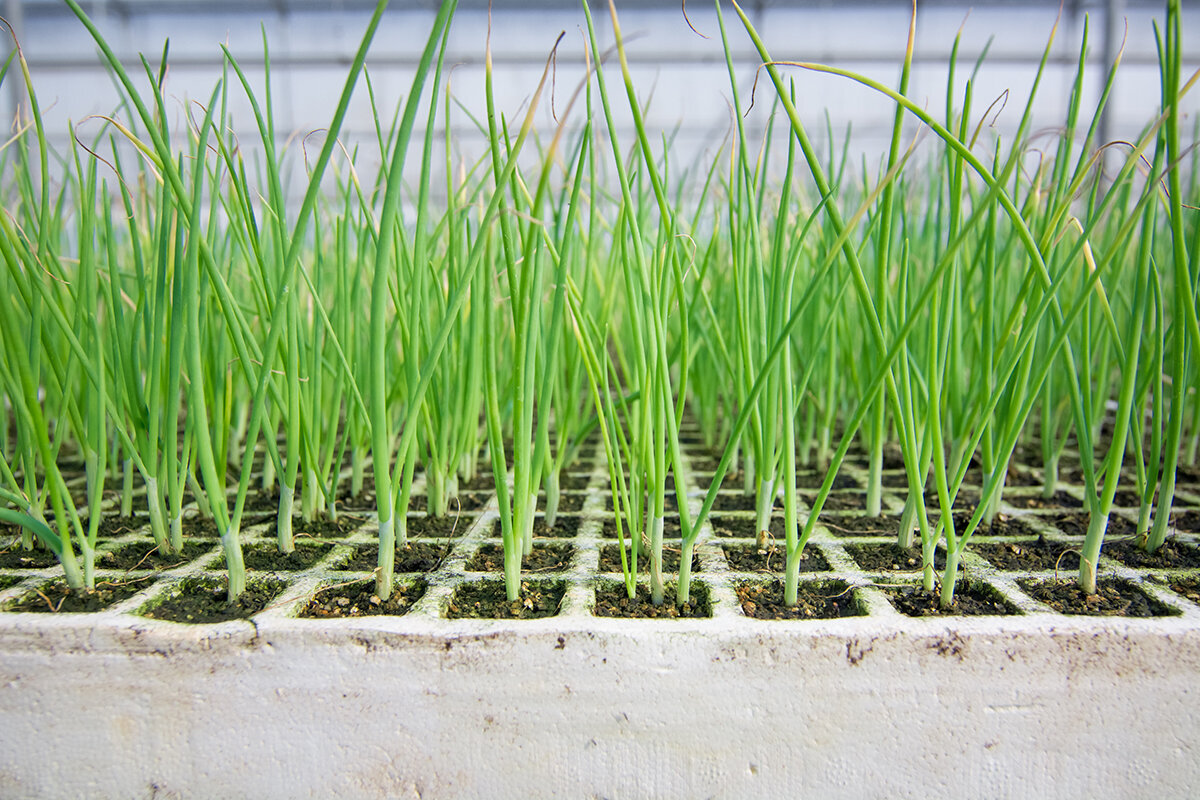
Why grow onions under glass?
Sheltered growth, not an artificial summer
The bulb takes shape one leaf layer at a time, well before any swelling is obvious. The plant must first develop a healthy canopy ahead of its variety-specific daylight cue.
What a greenhouse changes
Protected space makes difficult spring weather easier to manage, whether the challenge is prolonged cold rain, waterlogged ground, a sealed soil surface or a sudden change in conditions. Seedlings can establish more consistently, prepared soil may be usable sooner and lifted bulbs have shelter for drying. Daily control of water, airflow and cleanliness also benefits shallow-rooted onions, which struggle with drought as well as humid, motionless air.
What a greenhouse cannot change
Photoperiod remains decisive even beneath glazing. Long-day onions require the appropriate seasonal daylight, whereas short-day types can begin swelling while the plants are still undersized in many parts of Canada. Most household crops do not need supplemental lighting. A variety recommended for the gardener’s latitude and region is the more dependable choice.
A practical approach
In many Canadian gardens, protected space is most valuable while the season is getting started. Sow onions suited to the region, or set out healthy sets and sturdy transplants once the soil is workable. The crop can remain in an airy side bed until harvest. If tomatoes or cucumbers occupy the structure later, preserve adequate light and airflow and give crops separate watering zones.
This sequence fits a well-organized Classic Aluminium Greenhouse where trays receive bright shelter at first and accessible low beds accommodate upright leaves, irrigation at soil level and an unobstructed path.
Starting material
Seed, sets or transplants?
Each route can produce onions, but each needs a different schedule, offers a different range of varieties and makes different demands on greenhouse space.
For selection and control
Starting from seed offers the broadest control over day-length response, colour, form, maturity and storage performance. It is a strong option when the crop must match a particular Canadian region. Use clean, fine-textured growing medium that drains freely. Multi-cell trays or small soil blocks support even development while limiting competition from early weeds.
Seed needs planning, yet it can produce a healthy, uniform stand under cover before the garden season gets underway.
For speed and an easy beginning
Sets are small onions grown in an earlier season. They are simple to plant in spring and can mature comparatively early. Select only firm, dry, healthy sets. Soft, spotted or mouldy sets may carry disease into the bed and do not belong in either the planting row or storage basket.
Choose sets when a quick, straightforward crop matters more than a broad choice of varieties.
For consistent early establishment
Bought-in plugs and transplants raised at home both reduce the time required in the permanent bed. They pair deliberate variety selection with quick establishment, which is useful when covered growing space is limited. Select upright, fresh plants with compact, healthy root balls, and reject any that are soft, decaying or visibly stressed.
For household quantities intended for storage, transplants combine precise spacing with a reliable head start.
Bloomcabin recommendation. Choose seed when colour, storage performance or access to a particular variety is important. Transplants make it easier to establish an even, predictable stand. Healthy sets often offer the simplest first-season route, but their convenience cannot compensate for the wrong day-length response.
Light sets the schedule
Choose onions by day length
Day length quietly directs bulb formation. The greenhouse protects the plant, but the variety’s genetic response determines when its fleshy leaf bases begin forming a visible bulb.
Propagation and planting time
Prioritize leaf growth before bulbs need space
Place onion seed shallowly in clean, fine-textured propagation medium with good drainage. Maintain even moisture through germination without saturating the mix, then provide abundant light and relatively cool air. Use a greenhouse bench only where nights offer adequate protection and sunny-day ventilation is reliable; otherwise, begin the trays at a bright indoor site.
Once seedlings emerge, provide adequate room for roots, either individually or in modest clusters. Too much heat combined with weak light produces elongated, unstable growth instead of compact plants. Moisten the root ball before transplanting without soaking it, acclimatize the plants gradually and handle roots and leaf bases carefully.
Establish onions in their final covered bed ahead of the normal bulbing period for the chosen variety. Local weather, the greenhouse design and regional conditions determine the appropriate date. Soil must drain reliably and be firm enough to work. An early start can add useful growing time, but it also calls for prompt ventilation in bright weather and a plan for brief hard frosts.
For a small property, the Classic Aluminium Greenhouse can act as an orderly nursery for a modest onion planting. Set adequately deep trays on stable staging, then transfer vigorous plants to prepared soil rather than confining storage onions in containers that are too small.
Anatomy beneath the skin
The edible bulb is modified foliage, not a root
An onion is formed from enlarged leaf bases positioned over a compact basal plate; its fine roots originate beneath that plate. Knowing this structure helps explain why burying plants deeply, piling soil around them or growing in compacted, continually wet ground can restrict clean bulb expansion.
Set transplants at about the depth they occupied in the propagation container. The white transition to the leaf should sit only lightly in the soil. Plant sets very shallowly, with their tips visible or barely covered. As the bulb swells, its shoulder should develop at the surface and dry quickly after watering. Every healthy green leaf contributes to eventual storage capacity.
Prepare loose, level soil with dependable drainage. Well-aged compost applied earlier is more useful than fresh, nitrogen-rich fertilizer. Remove hard clods and compaction without disturbing the structure more deeply than necessary. Where vegetables are grown continually under cover, a soil test is a better guide than routine extra feeding.
Designing the bed for routine care
Spacing, water, nutrients and air
Begin with rows roughly 25 cm apart. Within each row, allow 7 to 10 cm for medium storage onions, increasing this to 10 to 12 cm for larger bulbs or where greenhouse humidity tends to linger. Crowding does not guarantee a better stored crop because tightly packed onions dry slowly and are difficult to inspect. A dedicated walkway preserves access while preventing compaction over the shallow roots.
Because onion roots occupy mostly the upper soil, repeated swings from drought to saturation are damaging. During establishment, leaf production and bulb expansion, irrigate thoroughly with water directed onto the ground. Test moisture 2 to 3 cm below the surface rather than relying on appearance alone. Drip lines are helpful beneath glazing because they avoid wetting the foliage. Taper the water supply as bulbs mature and their necks begin softening naturally.
Diagnosing an underperforming onion crop
Identify the underlying cause before changing the routine
Healthy tops, undersized bulbs
The daylight cue may have arrived while plants were still undersized, or establishment may have occurred behind schedule. Review the variety’s day-length response and the planting window before changing nutrition. Fertilizer applied late cannot remedy a photoperiod mismatch.
Thick necks, poor storage
Late nitrogen, abundant irrigation during ripening, tight spacing or premature lifting can prevent the neck from curing promptly. Taper water and nutrients at the appropriate stage, then finish drying the crop where air circulates freely.
Yellow, wilting young plants
Onion fly larvae can cause feeding tunnels and damage at the leaf base; affected plants may pull out easily. Remove suspect plants and inspect the crop. Open doors and vents are not a complete barrier to flying pests.
Spots, collapse or grey mould
Fungal diseases benefit from wet leaves, crowded planting and still air. Increase spacing if needed, ventilate consistently and water the soil only. Remove badly affected plants. Do not grow onions and other alliums in the same area year after year.
Protected growing does not eliminate disease. Its real advantage is visibility: condensation, crowding and weakening leaves can be noticed promptly. Generous doors, effective roof vents and a sensible interior plan are practical details to review on the Classic Aluminium Greenhouse.
Natural neck fall, lifting and final curing
Let onions mature to a papery finish
Keeping quality is determined partly while the crop is still in the bed. Allow many necks to soften, bend and begin drying without assistance. Never force upright green leaves down by twisting or folding them. Artificial damage does not reproduce natural maturity and can interfere with clean curing.
Choose dry weather for lifting when conditions permit. Loosen bulbs from below with a garden fork, remove only loose soil and protect both the neck and outer skin from damage. Storage onions should remain unwashed.
Arrange bulbs in one layer on mesh or slatted shelving whenever possible. Avoid closed plastic containers and do not heap the harvest where greenhouse humidity collects. An otherwise empty structure is suitable for curing only when it stays well ventilated through both day and night and the onions are shielded from strong direct sun.
Mild onions are often best used first. Designated storage onions generally keep longer, provided their necks and outer skins are fully dry and the bulbs are uninjured.
After curing
Only inspected onions go into storage
Inspect every bulb after curing. If necessary, shorten dry foliage to a few centimetres while preserving the protective skins. Keep firm onions in darkness with cool, dry conditions and free air circulation, using nets, shallow open crates or slatted racks. Examine the supply regularly during autumn and winter. Remove damaged, sprouting or soft bulbs promptly and set them aside for early use.
Avoid damp locations and places with large environmental swings, and separate stored onions from potatoes. Although a greenhouse can work well during curing, it may be unreliable for winter storage. The chosen space needs dry air, cool conditions and protection from frost. Depending on the property, a suitable basement, sheltered garage or airy utility room may offer steadier conditions.
Best candidates Firm bulbs with dry skins, closed necks and no bruising.
Use first Thick-necked, nicked, soft, split or incompletely cured onions.
Avoid completely Storing whole onions while wet or keeping them in sealed plastic bags without airflow.
End-of-season cleanup Clear away roots and plant residue, clean the growing space and choose another location for future alliums where disease has affected the crop.
Frequently asked questions
Answers for growing onions under glass
Is it practical to keep onions in the greenhouse for their whole crop cycle?
Yes, when the structure provides a deep, loose and freely draining soil bed together with strong natural light and reliable airflow. Success depends chiefly on choosing the correct day-length response, not simply on having a roof. During summer, manage overheating and stagnant humidity and prevent thirstier companion crops from dictating the onion watering schedule.
Will artificial light reliably make every onion variety bulb?
Not usefully for the typical home garden. Photoperiod controls the start of bulbing, but technically extending the day does not replace a variety suited to the region. Extra light can help raise compact transplants. For the later crop, clean glazing, a bright position and an appropriate day-length variety matter far more.
Why is my covered onion crop producing foliage but very little bulb growth?
Possible causes include the wrong photoperiod category, late establishment or insufficient plant growth when the daylight trigger occurs. Bulb size can also be reduced by crowding, shade, early foliage damage or a shortage of water. Investigate those factors before resorting to a heavy late fertilizer application.
What determines the watering interval for greenhouse onions?
Use the condition of the soil, current weather, crop stage and soil texture rather than a fixed schedule. During establishment and bulb expansion, keep the root area consistently moist without saturating it. Test the earth 2 to 3 cm below the surface. A thorough morning irrigation directed onto the soil is preferable to frequent light sprinkling over the leaves.
Should I bend foliage to speed maturity?
No. Wait for neck tissue to soften and for the foliage to settle naturally. Folding green leaves does not produce dependable storage maturity and may injure the plant. Lift once the crop has largely ripened by itself, then cure the bulbs in a shaded, sheltered place with abundant airflow.
Horticultural references
Further resources for onion growers
More from Bloomcabin: Classic Aluminium Greenhouse · Custom Aluminium Greenhouses · Premium Aluminium Greenhouses
- LWG Bavaria – Guide to organic gardening
- Bavarian Garden Academy – Sowing and planting dates at a glance
- North Rhine-Westphalia Chamber of Agriculture – Onion fly on bulb onions
- Hortipendium – Commercial onion production
- FiBL, Bioland, KÖN and Bio Austria – Organic onion production
- FiBL factsheet – Organic onion cultivation
- LWG Bavaria – Plant health and natural maturity guidance
- Bavarian Garden Academy – Onion timing and row spacing
