
Growing Orchids Successfully in a Greenhouse
Bloomcabin Canada / greenhouse growing knowledge
Growing Orchids Successfully in a Greenhouse
A successful orchid house depends on deliberate balance: softened light, steady air movement, suitable water and enough drying time for oxygen to return around the roots.
Why epiphytic growth matters
Plan the collection around the root environment and its changing moisture, rather than arranging plants by flower colour.
A large share of familiar greenhouse orchids are epiphytes. In their natural habitats they use branches, bark or rock as an anchor without feeding on that support. Rain, dew and decomposing material supply moisture, while air reaches the roots between wet periods. Under glazing, a grower can recreate the essentials: filtered brightness, moisture in the atmosphere without stagnant pockets, and modest temperature shifts from day to night.
The enclosure also makes poor decisions more consequential. Compact greenhouses may gain heat rapidly, tightly packed pots can remain damp after irrigation, and an unchecked arrival may introduce pests. Instead of trying to maintain a theatrical jungle, aim for conditions that are stable and easy to monitor. Compatible plants can then move through wet, dry, active and resting phases at their own pace.
Reliable identification is the best starting tool. Record the genus and species or hybrid name, then retain the grower’s specific care notes. That information is more useful than a blanket instruction to water once a week. Drying changes with light, staging height, container size, medium, weather, season and the plant’s growth phase. Grouping comparable orchids while keeping pots and roots visible makes routine care much simpler.
New growers will usually learn more from adaptable, accurately labelled hybrids than from exacting rarities. Accessible benches, unobstructed air routes and clearly defined growing areas matter more than collection size. A layout inspired by a Classic Aluminium Greenhouse can provide that practical framework without letting the greenhouse become crowded and difficult to read.
Keep these growth habits separateEpiphyte means that the plant uses another surface for support; it does not make the orchid a parasite. Bark, a branch or a mounting slab serves only as an anchor.Terrestrial orchids occupy ground-like media and commonly follow a different pattern of wetting and drying. In either case, the named species or hybrid determines the appropriate care.
01 / Work within a climate you can sustain
Let habitat, growth form and your experience guide plant selection
Warm, intermediate and cool categories help organize a collection, but they do not guarantee success. Requirements may vary considerably even among related orchids. Treat a trustworthy plant label, known provenance and current advice from a specialist grower as the deciding information.
Warm
Reliable warmth through winterIntermediate
A measured difference between days and nightsCool
Protection during hot summer periodsPlanning a warm-growing area
Heat-loving orchids belong in a greenhouse where winter nights stay dependably mild and leaves are protected from cold glazing. This group includes many Phalaenopsis hybrids, vandas and warm-growing dendrobiums, although each may require a different light position. As a broad reference, daytime conditions are often 20–29 °C, with nights that do not remain substantially below 18 °C. Ventilation is still essential: trapped warmth and moisture increase disease pressure instead of producing a healthy tropical environment.
Planning an intermediate area
For many Canadian growers, an intermediate bench offers a manageable base for a mixed collection. Cattleya hybrids and Oncidium relatives, including Brassia , along with selected dendrobiums, often respond well to bright conditions, circulating air and moderate cooling overnight. Depending on the named plant, approximately 18–26 °C during the day and 13–18 °C at night may work. Different bench positions within that span can accommodate orchids needing more exposure or shelter.
Planning a cool-growing area
The challenge with highland and cloud-forest orchids is often keeping them comfortable through summer. Certain masdevallias, coelogynes and former odontoglossum types call for brightness, abundant atmospheric moisture, continually refreshed air and truly cooler conditions. Cymbidiums may also react poorly to extended heat. Before buying a cool grower for its display, check whether the bench where it will live remains hot in July.
A sensible approach across Canada’s varied climates is to make one warm or intermediate area dependable before adding demanding cool growers. Record summer peaks beside the foliage first. A sensor high in the structure may report conditions quite unlike those experienced on the bench.
02 / Give each orchid a place in the light
Use glazing, staging height and movable shade to build several exposures
Section through the greenhouseSun through the seasons
Upper levelStrong light softened by screening
Bench levelA moderate position for the main bench
Lower levelSheltered light below the bench line
Air routeLow intake moving toward the roof vent
A seasonal approach to shade
Watch the plants, introduce shade, then reassess.
Conditions under the same Canadian glazing can shift from limited January light to fierce July exposure. A meter is useful when available, but plant responses also provide evidence. Weak growth with very dark, soft foliage may indicate insufficient light. Bleaching, yellowing, unusual reddish stress or leaves that feel excessively warm can point toward overexposure. Leaf colour should inform a diagnosis, not determine it by itself.
Space near the roof generally receives more light and heat. Place an orchid there only after gradual acclimatization and only if the plant benefits from that exposure. Intermediate collections often centre on the middle staging. Recessed or lower positions may protect shade-tolerant plants, provided moist air does not become trapped. A sheltered orchid must still be visible and reached by moving air.
Shade mounted outside the glazing, or held away from it, blocks part of the sun’s energy before that heat enters. Interior cloth remains useful but has less effect on heat gain. Adjustable seasonal screening gives finer control than keeping the entire structure dark throughout the year. The aluminium greenhouses collection illustrates why ventilation, plant levels and shading need to be considered together.
Move a newly acquired orchid into brighter light in stages. A specimen raised under artificial lighting or nursery shade should not go straight beneath clear roof glazing on its first sunny spring day. Shift it gradually and examine the foliage over the following days. Strong spring sun can heat leaves beside the glazing even while the outdoor air remains cold.
03 / Learn what the roots are reporting
Saturate the medium, drain it well and restore air around the roots.
With epiphytic orchids, good watering comes from recognizing how each container dries rather than obeying a fixed timetable.
Following the transition from wet to dry
Exposed healthy roots may appear pale or silvery green before watering and deepen in colour as they absorb moisture. The changing appearance is partly produced by velamen, the layered covering around the root. It is a helpful clue, but it cannot be applied to every orchid. Opaque containers, degraded medium and terrestrial growth all obscure or change the signal. Assess the roots together with container weight, medium texture, current weather and active growth.
Velamen moisture sequence
Dry
Moisten
Take up water
Release excess water
Restore airflow
Morning is generally the best time to irrigate because foliage, crowns and interior surfaces then have an opportunity to dry before night reaches its coolest point. Wet the medium throughout and continue until water exits freely; a small splash at the surface can leave the centre dry. Empty decorative pots and trays, keep drainage away from the bench base, and remove pooled water from vulnerable leaf rosettes. In hot weather, a small mounted orchid may need attention every day, while a large shaded pot filled with bark may hold moisture far longer. Either interval can be appropriate.
Treat irrigation water and atmospheric moisture as different variables
Many orchid growers favour rainwater because its dissolved-mineral content is often low, but the collection and storage system must remain clean. Learn the characteristics of municipal or well water before relying on it. Hardness, alkalinity and dissolved salts may accumulate on roots and within bark; pale crusts on a pot rim are an early warning. Appropriate flushing, restrained fertilizer strength and regular inspection of root and leaf tips can keep a minor water-quality issue from becoming persistent damage.
Moist air can support an orchid, but the roots still need direct watering. For numerous tropical groups, guidance often mentions relative humidity of about 40 to 70 percent, although a particular species may fall outside that range. The relationship with airflow is more important than chasing one reading. Cool, motionless, humid air encourages condensation and disease, while a forceful fan may desiccate plants. Gentle circulation should disturb leaves only slightly, clear damp pockets and avoid both cold drafts and drying wind.
Side openings, roof vents and circulation fans should operate as a coordinated response to excess heat, moisture and disease pressure. A Classic Aluminium Greenhouse can serve as the structural starting point, while the aluminium greenhouses overview can help organize these elements into one workable plan.
04 / Build the root environment with the medium
Select a vessel that suits the roots, microclimate and your routine
Orchid medium does not function like garden soil. Its temporary framework must hold a measured amount of moisture, retain open air spaces, anchor the plant and still allow the root zone to be examined and managed.
Pot
Basket
Mount
Pot
Pots provide support and a predictable reserve of moisture. For some orchids, a clear nursery pot makes roots and dampness easier to inspect, but it should not be left exposed to direct sun. Slotted sides increase gas exchange. Match bark size and moisture retention to the roots, local greenhouse conditions and watering habits instead of choosing by appearance.
Basket
Baskets offer fast drainage and space for vigorous roots, making them useful for some trailing plants in warm, sufficiently humid areas. Their openness also means more frequent watering and dependable atmospheric moisture. They are not automatically superior to pots; they simply create a shorter drying cycle that must fit both the orchid and the grower.
Mount
Cork or suitable wood can support an orchid while leaving the roots visible and well aerated. The result can look natural and grow well, but exposed roots lose moisture quickly. Choose mounting only when the greenhouse climate and daily care routine can provide precise, frequent wetting.
A coarse bark mix often works in humid greenhouse conditions because frequent irrigation and moist surrounding air slow the overall drying process. Fine material or a large proportion of sphagnum may remain saturated for too long when conditions are unsuitable. By contrast, fine-rooted orchids or plants in warmer, drier positions may require additional moisture retention. Coarseness alone is not a mark of quality. A suitable mix drains, retains air and reaches the next watering point at a pace appropriate to the plant.
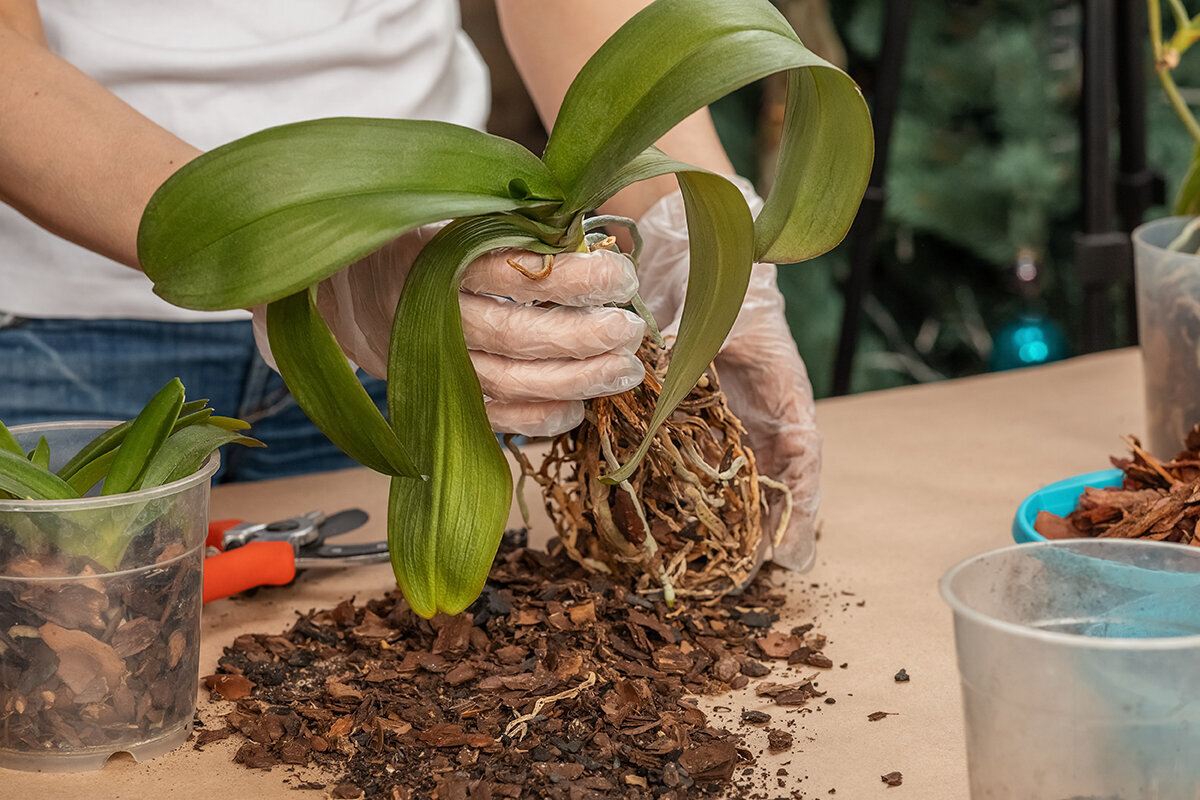
Replace the medium when bark is visibly decaying, the centre has compressed, drainage has slowed, salts have built up or roots are forcing the container apart. Many sympodial orchids establish more readily when repotted as new roots start. Work with clean tools, remove only roots that are unmistakably dead or rotten, and secure the plant firmly. Increase pot size only slightly; excess wet medium around a small root system may dry very slowly during low-light winter conditions.
05 / Let active growth set the schedule
Time feeding and repotting to the plant’s growth cycle
An orchid’s demand for moisture and nutrients changes as it produces roots, leaves and pseudobulbs, enters rest or directs energy toward flowers.
Roots
Leaves
Pseudobulbs
Developing flower stems
Rest
Newly extending root tips often mark a useful window for repotting because the orchid can settle into fresh medium and make active use of nutrients.
A monopodial orchid continues upward from one central axis. Avoid allowing water to sit for an extended period in its sensitive crown.
Sympodial orchids commonly hold reserves of moisture and energy in swollen shoots. Older pseudobulbs may continue to support emerging growth and should therefore be retained.
Depending on the orchid, a flower stem may originate at a leaf axil, node, mature new shoot, cane or close to the main axis. One universal pruning instruction cannot cover all of these growth forms.
Documented care for some orchids includes a cooler, drier or less heavily fed interval. Such seasonal rest is part of the cycle, not necessarily evidence of neglect.
Feeding strategy: dilute, steady and periodically flushed
Choose a fully soluble orchid fertilizer and use it as directed by its manufacturer. Apply modest feedings at regular intervals while the particular orchid is growing. Reduce or stop when declining light and temperature slow growth, or when the species requires a rest. Controlled low concentrations are easier to manage than infrequent heavy applications. If the medium is extremely dry, wet it first. About once a month, rinse through with clear water to limit fertilizer-salt accumulation.
No flowers? Investigate the growing conditions first
When a healthy-looking orchid does not bloom, verify its identity and exposure to light before changing anything else. Then consider its day-to-night temperature change, expected rest, root health, maturity and feeding pattern. A mature Cattleya hybrid may call for substantially brighter conditions than a Phalaenopsis. Particular dendrobiums or cymbidiums may depend on a cooler or drier seasonal interval. Extra fertilizer, severe cutting or arbitrary chilling can cause harm when the advice belongs to a different orchid.
06 / Maintain a separate intake zone
Protect an established collection at the point of entry
Pests and disease can advance quickly in a warm, moist enclosure. Observe every incoming orchid away from the principal staging before it joins established plants.
An intake routine for new orchids
- Place each arrival apart from the collection, preferably in a different growing room or, when that is not possible, a distinctly isolated section.
- Examine the undersides of leaves, axils, new shoots, roots, pot edges and flowers for scale insects, mealybugs, thrips, mites, slugs or snails, as well as unexplained spotting.
- Clear away dead tissue, clean tools and staging, and make sure runoff from the incoming plant cannot flow toward established orchids.
- Continue observation long enough to reveal a developing problem, including checks after warm days. Note when the plant was purchased and what you see; dated photographs make later changes easier to compare.
Use symptoms to guide the next check
- Dark, soft roots or medium that is collapsing: review drainage, deterioration of the mix and watering intervals; move the plant into isolation immediately if decay continues to advance.
- Spots that sink or increase in size: separate the orchid, improve cleanliness and circulation, and obtain a dependable diagnosis before applying a treatment.
- Cotton-like material or sticky deposits: check adjacent orchids for insects that feed on sap, remove pests physically where suitable and repeat the required response consistently.
- Leaves that have become wrinkled: resist adding water automatically. Damaged roots, excessive heat, mineral injury or compressed medium can block uptake even while the container remains wet.
Do not spray routinely as a precaution. Identify the problem first, correct the growing conditions and use physical removal where appropriate. Before applying a pest-control product, verify that it is registered in Canada for the intended use and follow its label. Avoid sharing tools when rings, streaks or other unusual patterns suggest a transmissible problem. A specialist grower, orchid society or qualified horticultural adviser can help with persistent symptoms or suspected viruses.
07 / Organize the collection for calm, repeatable care
Place orchids together by environmental rhythm rather than bloom colour
Watering, shading and inspection become more straightforward when neighbouring orchids respond to similar conditions.
Keep moisture-demanding, lower-light plants in an accessible position where circulation still reaches them. Orchids that favour greater exposure and dry rapidly can occupy higher or more open locations. Put mounted plants together so their frequent irrigation does not dictate care for every pot. Reserve a convenient section for new arrivals, recovering specimens and current tasks.
Use the greenhouse’s full height thoughtfully. Hanging orchids may benefit from the brighter, warmer upper volume, while staging below can provide gentler conditions. Convenience cannot be sacrificed: labels, foliage and roots all need to remain reachable and visible. Open space between plants gives you a chance to notice change before a problem travels through the collection.
A Classic Aluminium Greenhouse can become a purpose-built orchid environment rather than a general storage area. Preserve a central aisle and a clear route for air, begin with one dependable warm or intermediate bench, and add screening, fans and levels in response to observations. As a design reference, the Classic Aluminium Greenhouse brings together glazing, overall size and usable growing space for a garden in Canada.
Upper growing levelHanging orchids
Main stagingAdaptable hybrids
Sheltered lower areaFiltered, protected light
Intake boundaryQuarantine
Treat the diagram as an initial arrangement rather than a permanent prescription. Measured light, actual circulation and the way each container loses moisture should decide where the groups remain.
Questions from orchid greenhouse growers
Common points to revisit after observing a collection through its first season
What temperature range works for greenhouse orchids?
Orchids do not share one ideal temperature. For broad planning, many Phalaenopsis hybrids and other warm growers favour days near 20–29 °C, with nights that do not stay far below 18 °C. Intermediate orchids accept cooler nights, whereas cool-growing plants require real relief during hot weather. Follow the requirements of the named species or hybrid and take both daytime and overnight readings beside the foliage.
How humid should an orchid greenhouse be?
Moderate or elevated atmospheric moisture benefits many orchids, and guidance commonly refers to about 40 to 70 percent for numerous groups. A target reading is less useful without suitable circulation. Still, humid air can promote disease and overnight condensation; excessive fan speed can remove moisture too quickly. Aim for soft continuous air movement, foliage that dries appropriately and roots watered for the plant’s needs.
When is it time to water an orchid?
Irrigate according to the dryness required by that orchid rather than assigning every pot a weekly day. The interval changes with container size, bark grade, root quantity, exposure, heat, humidity, season and active growth. Inspect as often as necessary, but act on the condition you find. Container weight, visible roots and the texture of the medium are most informative when considered together.
Is local tap water suitable for orchids?
It often is, particularly for adaptable hybrids, but the water chemistry should be understood. High hardness or dissolved-mineral content may leave deposits and make feeding harder to manage. Consult local water information and watch for pale crusting. Sanitarily collected rainwater or suitably treated low-mineral water may benefit sensitive plants. Water from a softener can introduce unwanted salts and is not suitable.
What causes wrinkled leaves when the medium is still wet?
Wrinkling signals that water supply and uptake are out of balance; it does not automatically mean the orchid needs another drink. Rot-damaged roots, degraded compacted medium, salt injury, high heat or pests may prevent absorption from a damp pot. Examine the roots, drainage, medium and temperature before changing irrigation, since additional water may intensify the real problem.
Will cool-growing orchids succeed in an ordinary garden greenhouse?
Only where the structure can provide their required conditions during the hottest part of the year. Even in Canadian regions with severe winters, summer heat under glazing can limit cloud-forest orchids unless the house is managed carefully. Fans move air but do not by themselves create a cool habitat. Effective screening, ample ventilation and a favourable site are necessary, and some specialist orchids may remain impractical.
Basis for the growing guidance
References and
additional resources
Care varies across genera, species and hybrids. The resources below underpin the general discussion of epiphytic growth, roots, greenhouse conditions and frequent problems. For uncommon orchids, give precedence to current specialist guidance and known provenance. Editorial review completed in August 2026.
Continue exploring with Bloomcabin: curtains and premium shade systems for greenhouses · managing a greenhouse through summer · Bloomcabin options for greenhouses and conservatories
- German Orchid Society — specialist resources on orchid culture
- University of Göttingen — epiphytes in the rainforest house
- Iowa State University Extension — guidance for growing orchids
- Iowa State University Extension — identifying common orchid problems
- University of Alaska Fairbanks — managing ventilation and greenhouse conditions
- University of Illinois Extension — understanding epiphytic orchid roots
