
Hot Tub Covers: What to Check Before Buying
Hot tub buying guide
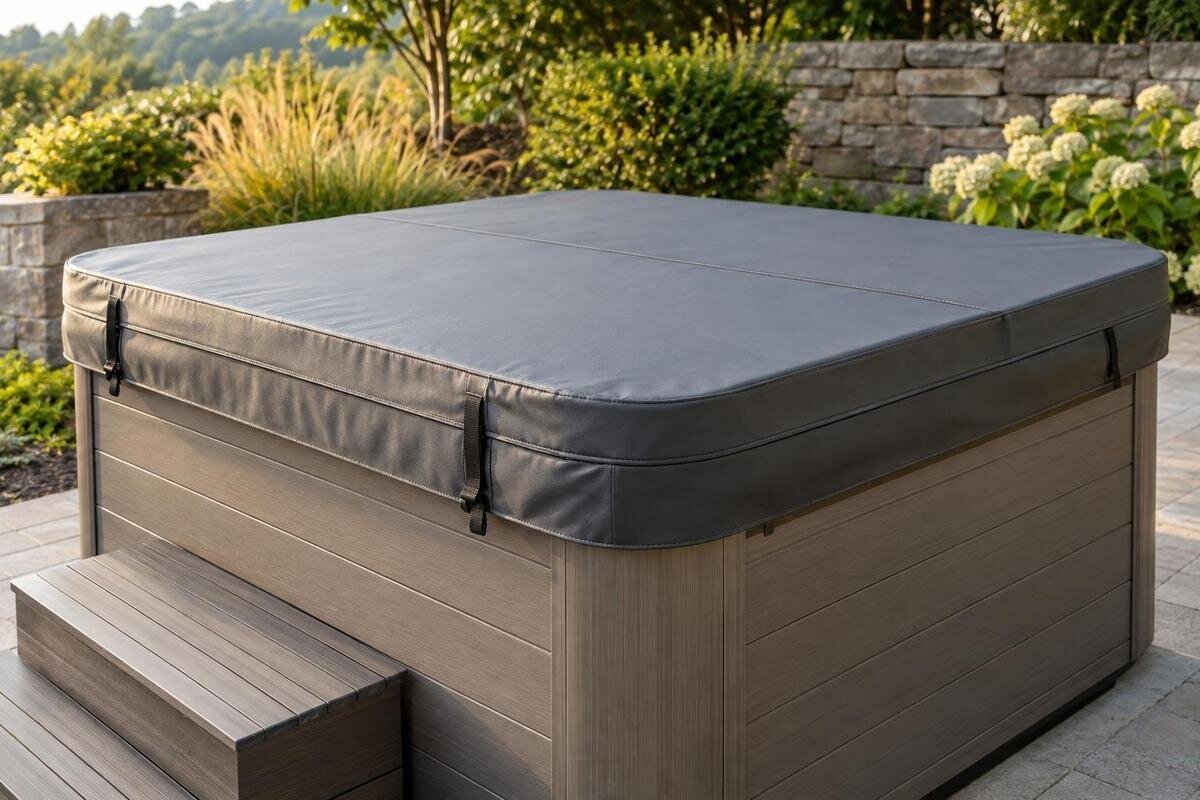
Hot tub covers can look alike yet differ in the details that decide whether one fits: the measured outline, corner profile, hinge position and skirt. A rough width or familiar model name is not enough to order confidently. Construction claims, weight, fastening and care also matter once the cover is on the tub. For an outdoor Canadian setting, ask the cover maker to state the conditions its product is intended to handle; a broad weather label is not a site-specific promise. This guide helps you gather the right facts before comparing options.
Before you buy 1
Confirm compatibility with the exact hot tub model
Start with the identification on the hot tub itself, not a guess based on appearance or a marketing number. Record the manufacturer, full model name and any serial, revision or production details the manufacturer requests; an original invoice or label can help. Similar-looking shells may have different outlines or hinge locations. The listing for Bloomcabin Hot Tub Cove 2 names a catalogue model, but it does not establish that a cover is included or that a replacement cover fits. Treat the listing as a name to give the supplier, then ask the tub maker or cover maker to check the exact unit. If paperwork is missing, a clear photo of the identification label may help the manufacturer identify it.
Ask the supplier what supports its compatibility answer: a current fit chart, an exact cover part number or written confirmation from the manufacturer. Check whether the information applies to your unit’s production revision, particularly if the model has been sold for several years or the cover design has changed. A phrase such as fits a square spa is too broad unless the maker also confirms the corner profile, hinge and required overlap. Confirm package contents separately when buying a new tub; the model page alone cannot tell you whether a cover is included. Keep the answer and cover code with your purchase records, and ask which company stands behind the compatibility confirmation.
Measure the tub opening and cover outline
If no exact cover code is available, ask the manufacturer for its measurement drawing before taking a tape to the spa. Record dimensions from the reference points shown—such as the shell edge or another specified line—rather than choosing your own convention. When requesting a cover for a Haven 6 hot tub, specify the exact tub version so the supplier can provide the corresponding measurement drawing. Write down every side, keep the units beside each number, and add diagonals or corner measurements only when the maker requests them. This gives the seller information it can compare with the right drawing instead of asking it to guess from one width.
Do not assume the cover size is identical to the shell’s advertised dimensions: the specified cover may need an overhang, skirt or other allowance, and makers may define the measuring points differently. Ask whether the supplier needs the opening, outside rim or finished cover dimensions, and whether the tub should be measured in a particular way. Use an old cover as a reference only; damage or a mismatched replacement can make it an unreliable template. Repeat your measurements to catch transcription errors and label what each figure describes. Photos can supplement measurements, but should not replace them. Do not cut or alter a cover unless its maker explicitly permits it.
Before you buy 2
Check the shape, hinge and skirt
Overall length and width do not describe the whole outline. Confirm whether the cover is square, rectangular, round or another shape, then check the specified corner radius, bevels, cut-offs and any section that changes the perimeter. A small-looking difference at a corner can affect how the cover sits, so do not select by a catalogue photograph. If the tub is listed as Bloomcabin Hot Tub Fjord 8, use the name to request the manufacturer’s drawing; neither the name nor its numeral confirms a shape or cover size. Ask the seller to state the matching outline in writing.
Confirm hinge orientation as carefully as shape. Ask which side the hinge runs along and how that relates to a fixed reference on the tub, such as its controls, rather than describing it only as left or right. If the cover has a centre fold or separate panels, verify how they align with the tub and any planned lifter. Some covers have a perimeter skirt; if yours requires one, check its specified depth and which parts of the rim it covers. Confirm that the hinge, skirt and handles are shown in the drawing, and ask whether opening the cover in the specified direction would bring it into contact with a nearby wall, raised control panel or other obstruction.
Compare documented construction and insulation
Compare construction using specifications for the actual cover being offered. Ask for details of the outer covering, core or panel construction, reinforcement at the hinge and edges, and how seams are finished. Not every seller will publish every detail, so separate documented facts from sales wording. If you are buying a cover for an Aurora 10 hot tub, ask the supplier to identify the proposed cover before comparing its materials with another option. A cover maker’s specification sheet or written response is the relevant evidence. Keep that information tied to the exact cover code and shape you are considering.
Treat insulation statements the same way. Ask what a stated insulation figure or rating measures, what method was used and whether it applies to that cover’s size and construction. Without a defined basis, phrases such as premium insulation do not let you compare one cover with another. Thickness alone is not a complete comparison: panel design, hinge and edge details, fit and weight may also differ. Ask the maker to define weather-resistance claims rather than assuming that a material name means the finished cover is waterproof or suited to every outdoor exposure. Precise, written specifications are more useful than general adjectives, especially when comparing covers from different suppliers.
Before you buy 3
Plan for lifting and everyday handling
A cover that is awkward to lift can make a correct fit inconvenient in everyday use. Ask for the finished cover’s weight and, if it folds into panels, whether the figure applies to the whole cover or each section. Check handle locations and the motion needed to open it. When choosing a cover for a Cove 2 hot tub, have the supplier confirm both the cover’s weight and its compatibility with any proposed lifter. If the cover may be difficult for the person who will use it, compare a compatible lifter or another manufacturer-approved handling option before ordering.
Check the space around the tub for opening, movement and storage: a raised cover can occupy a different footprint from the closed one, and a wall, fence or walkway may limit its movement. Ask how much clearance the chosen lifter needs and where the cover rests when open. Confirm whether the cover requires a particular lifter and whether its hinge, skirt and fastening layout suit that device; do not assume a generic lifter fits every cover. Consider who will operate the arrangement regularly, not just how it looks in a product photo. If the maker specifies a support or storage position when the cover is open, include that in your space check.
Understand fastening and security features
Ask what fastening hardware comes with the cover, what attaches to the tub, and whether straps or clips are adjustable or replaceable. Their positions need to agree with both the spa body and the cover’s layout; a mismatch can make hardware unusable or interfere with a skirt or lifter. For a cover intended for the Haven 6, ask the supplier to confirm the fastening arrangement for your exact tub version. Request the cover maker’s parts list and a drawing or written compatibility check, and confirm which pieces are included and which, if any, must be ordered separately.
Keep a fastening feature distinct from a safety certification. A buckle, strap, clip or lockable-looking part does not by itself prove that a cover meets a particular safety standard or requirement. If a seller makes a safety claim, ask for the exact supporting documentation and the scope to which it applies; do not treat a marketing description as evidence of compliance. If you need to meet a specified requirement for your property, check with the appropriate local authority or a qualified professional. When comparing ordinary usability, consider how easy fasteners are to operate and replace without assuming they provide a guaranteed level of security.
Before you buy 4
Check suitability for your site’s weather
Ask the cover maker whether the exact cover is intended for the conditions at your outdoor site. Describe relevant exposure, including wind, rain, snow accumulation and temperature changes, and ask which conditions are covered by its declaration and which are excluded. If you are selecting a cover for a Fjord 8 hot tub, include the exact tub and cover identification in that request so the answer refers to the combination you intend to buy. Request the specification for the cover itself and any limits or care instructions that accompany it. A general outdoor-use description may not answer every site-specific question.
Use precise terms when comparing labels. Water-resistant, waterproof, wind-resistant and snow-rated can mean different things, so ask the seller to define each claim and whether it applies to seams, fasteners and the complete assembled cover. Ask whether any stated rating applies to the cover alone or to a particular cover-and-tub combination. Do not infer a load limit from a general snow claim, or assume that a cover can support a person or stored objects. If exposure is severe or the suitability statement is unclear, ask the manufacturer and, where necessary, a qualified local professional rather than estimating a safe limit yourself. No single description automatically applies to every Canadian setting.
Understand the care routine
Request care instructions before choosing a cover. Ask how the outer surface, seams, hinge, handles and fasteners should be cleaned, whether any treatment is permitted or recommended, and what products should be avoided. When comparing covers for the Aurora 10, keep each set of instructions with the corresponding cover specification so you can compare the care each option requires. This matters if upkeep includes periodic treatment or special storage, because the work involved should suit your routine. Do not assume a household cleaner is appropriate simply because the cover looks like vinyl or fabric.
Ask what the maker recommends inspecting and what signs call for service or replacement. Visible tears, loose seams, damaged fasteners or a faulty hinge are reasons to consult the cover supplier rather than improvise a repair; a material that works on one outer surface may not suit another. Ask whether straps, handles or hinge components are available separately and whether the maker authorizes user replacement. Keep the instructions and cover code accessible. A clear care plan helps distinguish routine cleaning from a repair issue, and makes it easier to find out whether the relevant part can be matched.
Before you buy 5
Review replacement availability and warranty terms
Ask whether replacement covers and individual parts are available through the tub maker, cover manufacturer or seller, and what identifying code you would need to reorder. Find out whether a replacement is sold as a complete cover or whether particular straps, handles or panels can be ordered separately. Check whether the current design still matches older tub revisions. A written answer is more useful than assuming the original supplier will always offer the same item. Save the compatibility confirmation, drawing and part number with the tub records so a future request can refer to the exact configuration.
Read the warranty for the cover itself, not just the hot tub’s warranty. Ask who provides it, when coverage begins, what defects are covered, which wear or exposure conditions are excluded, and what evidence is needed for a claim. Check whether labour, shipping or replacement components are treated differently from a complete cover, without assuming any of these items are included. For value, weigh verified fit, handling, documented construction, care demands, parts access and written warranty terms together. A broad performance promise is a weak substitute for specific terms that apply to the cover you are buying.
Get the fit details confirmed before ordering
Send the seller one clear request containing the hot tub’s full identification and measurements taken from its manufacturer’s drawing. Ask for confirmation of the exact cover code, outline, corner details, hinge orientation, skirt and fastening arrangement, along with the published construction and weight. Request care instructions, a weather-suitability statement for your site conditions, lifter compatibility if relevant, information on obtaining replacement parts and the cover warranty. Ask the seller to identify anything it cannot verify rather than leaving it implicit. This turns a vague question about whether a cover should fit into specific details that can be checked against a product document.
Pause if the response relies only on a model numeral, approximate size or photograph, or if it does not address a mismatch with your measurements. Proceed when the seller or cover maker has tied the exact cover to the exact tub and answered your outstanding questions about handling, upkeep and weather. Keep the response, drawing, care instructions and warranty documents together. That record gives you useful identifiers if you later need a part or replacement. A dependable choice combines correct geometry with documented suitability; it is not simply the cover that looks closest.
Frequently asked questions
Can a universal hot tub cover work?
Possibly, but the word universal is not a fit check. Have the cover maker confirm the exact outline, corner profile, hinge and measurements for your tub before ordering.
Can I measure my old cover and order the same size?
Use it as a reference, not your only measurement. An old cover may be damaged or may not match the tub’s specified dimensions. Follow the manufacturer’s drawing and confirm the result with the seller.
Does a hot tub product page confirm that a cover is included?
Only if the package contents say so explicitly. A page that identifies the hot tub model does not, by itself, establish that a cover is included or compatible.
What should I ask about snow and wind?
Ask the cover maker to state whether the exact cover is intended for your site’s wind, rain, snow and temperature conditions, and to explain any limits or exclusions. Do not estimate a safe load yourself.
Do straps or a lock prove that a cover meets safety requirements?
No. A fastening feature alone does not establish compliance with a particular standard or requirement. If a seller makes a safety claim, ask for the specific supporting documentation.
A suitable cover is a match for a particular tub and its setting, not just a similar-looking shape. Confirm the measurements and fit in writing, then weigh handling, care, weather suitability and warranty terms against the way the cover will be used. When a key detail remains unclear, a precise answer from the cover maker is more useful than an assumption based on a photograph or model name.
