
Hot Tub Delivery: Gates, Access Routes and Lifting Plans
Site preparation
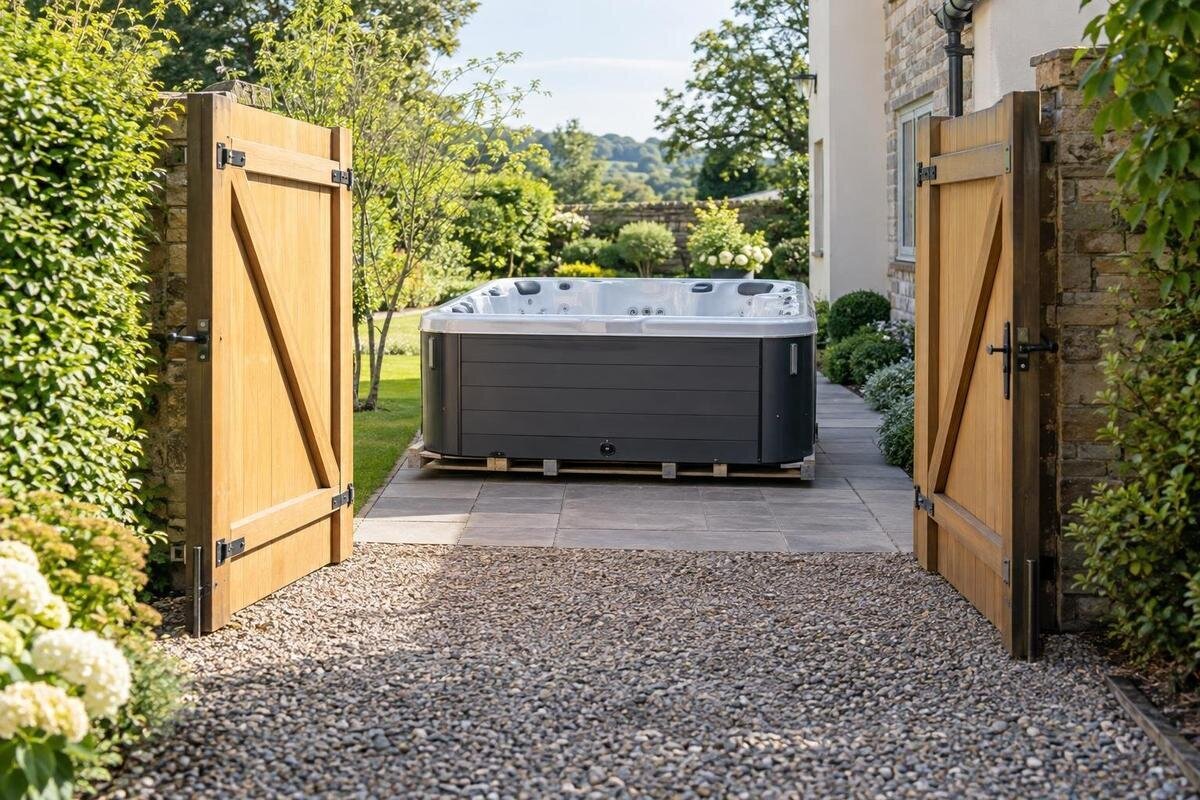
An outdoor hot tub can fit the planned spot and still be difficult to deliver along the route you have in mind. The important comparison is between the exact model’s transport envelope and handling method and every gate, turn, step, slope and overhead obstruction between the delivery vehicle and its final location. Before ordering, get the supplier’s transport details, document the route and ask the delivery team or a qualified lift provider to assess any uncertainty. A crane is one option to investigate, not a guarantee that the site is reachable.
01
Confirm the delivery method and transport measurements
Start with the exact model and ask the supplier for current transport information, not just the hot tub’s finished footprint. Request the overall width, length and height in the form in which it will be moved, plus its transport weight. Ask what is included in those figures: packaging, a pallet, a protective frame or other handling components may change the envelope. Confirm whether the measurements describe the tub itself or the complete delivery unit, and note the orientation to which they apply. The Bloomcabin Hot Tub Cove 2 product page identifies a candidate by name; it does not establish transport dimensions, weight or a delivery method. Save the supplier’s response with the model name and date.
Request the manufacturer’s current written handling instructions. Ask whether the unit must stay in a particular orientation and whether turning or tilting is permitted; do not assume that a delivery crew can change its position to make a tight opening work. Get any specified lifting points or handling restrictions from the manufacturer or supplier rather than guessing how the unit can be moved. Then ask the delivery provider what equipment its proposed service includes, where it will move the tub, and what it considers an access issue requiring a different arrangement. If a key figure or instruction is missing, treat the route as unconfirmed until you have it.
Measure every gate, door and narrow opening
Walk the full route with a tape or measuring tool and record clear openings, not the nominal size of a gate or doorway. With a gate fully open, measure between the closest obstructions, including posts, hinges, latches and handles. Check the narrowest point at more than one height if the sides are not parallel, and record the clear height below any frame or beam. Note where each measurement was taken and use the same units as the supplier. If you are considering Bloomcabin Hot Tub Haven 6, label the measurement sheet with that model name so transport figures for another shortlisted tub are not accidentally used in the assessment.
Check how far a hinged gate or door can actually open and whether it can stay in that position without meeting a wall, slope or fence. For a doorway, include the threshold, door stops, handles and the overhead frame. If the route may be widened by removing a gate or fence panel, record both the existing opening and the proposed opening, and identify who would arrange the work and confirm permission. Treat the wider route as a possibility, not a fact, until the responsible person agrees and the delivery provider accepts the revised measurements. A single measurement from the front of the gate may miss a pinch point farther in.
02
Map turns, steps and changes in level
Draw the route as a sequence from the delivery vehicle’s position to the final location. At each turn, record the approach width, the space beyond the corner and any wall, railing or planting that reduces room to manoeuvre. A diagonal measurement across a corner does not show whether the delivery unit can be turned using the proposed method. Ask the provider to assess the actual transport envelope and route geometry, including whether any change of orientation is allowed. If Bloomcabin Hot Tub Fjord 8 is your preferred model, have the provider use its confirmed transport details and handling instructions rather than assuming every model can be moved in the same way.
For steps, note the number of steps, their width and height, the size of any landings, and the position of handrails. Mark slopes, curbs and abrupt transitions between surfaces on the sketch, and take photos from the side as well as along the route. These details help a provider assess whether its proposed equipment and method can handle the route; a clear flat passage does not answer that question. Do not assume that a crew can carry or roll a hot tub over stairs or a slope. If the plan depends on changing a route or adding equipment, have the delivery provider confirm that arrangement before relying on it.
Check overhead clearance and fixed obstructions
Look above the entire route, not only at the gate. Record low eaves, gutters, door frames, covered walkways, balconies, pergolas, branches and light fixtures that could limit movement. Note the lowest obstruction and where it occurs, particularly where the ground rises or the route turns. The required space depends on the confirmed transport configuration and handling method, so ask the supplier or delivery provider what clearance they need rather than estimating from the finished product dimensions. Keep the exact model name, such as Bloomcabin Hot Tub Aurora 10, on the route notes so the clearance assessment is tied to the model you are considering.
Check for obstacles that project sideways too, including fence caps, railings, wall features and vegetation. If an item could be moved, state that separately from fixed obstructions and identify who can arrange its removal; do not count on a change that has not been agreed. If overhead utility lines are near a proposed route or lift, tell the qualified provider and ask how they affect feasibility. Do not try to judge a safe clearance yourself. Where delivery is planned for a different season, describe any expected changes to branches, snow storage or access conditions that are not shown in current photos.
03
Assess the route for delivery equipment
The hot tub is only part of the transport envelope. Ask the delivery provider what equipment and handling method its quote assumes, and whether that equipment needs extra width, height or room to turn. Depending on the provider’s proposal, the moving equipment may need a different route from the unit itself. Ask whether unloading, movement through the property and placement at the final location are all included, or whether the service stops at a particular point. If your shortlist includes the Bloomcabin Hot Tub Cove 2 listing, request an assessment based on its confirmed transport configuration, not on a general description of the model.
Trace the approach from the road or delivery vehicle as well as the path inside your property. Ask the supplier to confirm where its vehicle needs to stop, what space is needed to unload, and how the unit and equipment will get from that point to the site. Identify uneven paving, loose gravel, soft ground, narrow driveways, drains and changes between surfaces. These are route details for the provider to evaluate, not proof that a surface will or will not support particular equipment. If parking, vehicle access or a separate unloading position needs to be arranged, identify who will confirm it before you place an order.
When to discuss a crane or specialist lift
If the supplier cannot confirm a workable ground-level route, ask whether a specialist lift should be assessed before you order. A crane is not a guaranteed workaround: the provider must consider the exact unit, its weight and manufacturer handling instructions, the proposed set-up position and the path to the landing area. Straight-line distance from a road to a backyard does not establish that the crane or another lifting method can reach the intended spot. Give the provider confirmed details for the shortlisted model, such as the Bloomcabin Hot Tub Haven 6 listing, rather than asking for a general estimate based on a product name.
Share information about overhead lines, trees, roofs, neighbouring structures, fences and the space available for lifting equipment. The provider also needs to consider access to its proposed set-up area, the lifting path and the final landing position. Ask whether photos are enough for an initial assessment or whether a site visit is needed before feasibility can be confirmed. If the plan may involve access across another property or arrangements for a road or parking area, ask who will coordinate those details and whether any local permissions need to be checked. Do not assume that a crane can reach the site simply because there is an unobstructed view.
04
Prepare measurements and photos for the supplier
Send the supplier a concise site record: exact model, confirmed transport dimensions and weight, handling instructions, route sketch, clear measurements at every pinch point, and notes on turns, steps, slopes and overhead obstructions. Identify which measurements apply to the existing route and which depend on a planned change, such as removing a gate. Ask the supplier to review the specific route and say whether its delivery provider can assess it. Keep the model information and route record together: for an enquiry about Bloomcabin Hot Tub Fjord 8, the supplier should be able to tell immediately which transport details go with your sketch.
Take photos in route order, starting at the vehicle’s likely stopping point and continuing through each gate, turn, level change and the final area. Include views from both sides of a narrow opening and show overhead obstructions where possible. A tape measure in a photo can help explain a measurement, but perspective can distort apparent width or height, so write the figures on the sketch as well. Label each image with its location and direction of travel. Include obstacles rather than cropping them out; an attractive view of the final spot is less useful than a complete record of what the delivery unit must pass.
Give a lift provider the information it needs
If a lift is being considered, send the provider the same route record plus the confirmed transport weight, dimensions and manufacturer handling guidance for the exact unit. Include the delivery vehicle’s access point, the proposed equipment set-up area, the planned lifting path and the intended landing location. The Bloomcabin Hot Tub Aurora 10 listing can help identify which candidate you mean, but the supplier must provide the technical details the lift provider needs. Ask whether the provider requires additional measurements, a site visit or specific photos before it can give a firm assessment.
Ask for the proposed method, assumptions and site conditions in writing. Clarify what the lift provider supplies, what the hot tub supplier or delivery team supplies, and what you must arrange. Confirm who coordinates the two providers, who prepares the access area, and who handles any agreed arrangements involving neighbours, parking or local permissions. Ask what could change the assessment or quote, including a route that differs from the information supplied. Clear responsibilities matter before purchase: two companies may otherwise make different assumptions about who is providing equipment, confirming manufacturer instructions or preparing the site.
05
Compare alternative routes and shortlisted models
If the first route is not confirmed, compare practical alternatives before ordering. Another gate, a different approach from the road, or a planned change to a barrier may be worth assessing, but each option needs its own measurements and the relevant owner’s agreement. A change that looks simple on a sketch may still leave a turn, step or overhead obstruction unresolved. Ask the supplier which route details it needs to approve the revised option, and include any separate work or site visit in your planning. Do not treat a hoped-for alteration as an available access route until the responsible person and delivery provider have both confirmed it.
If you are comparing models, request transport dimensions, weight and handling instructions for each one separately. Do not read a number in a model name as a capacity specification, footprint or transport measurement, and do not assume a different finished footprint means the delivery unit will fit. Ask the supplier to state which exact model and delivery configuration its route assessment covers. If no model has a confirmed method of reaching the proposed location, pause the purchase decision or reassess the location rather than choosing on the strength of a product image or an unverified size assumption.
Confirm feasibility, responsibilities and extra charges in writing
Before ordering, send the supplier and, where relevant, the lift provider your measurements, photos, exact model details and proposed route. Ask them to confirm in writing whether the stated delivery method has been assessed for that route, and list any assumptions, such as a gate being removed or a particular area being available. If confirmation depends on a site visit or further manufacturer information, arrange that before treating access as settled. Keep the response with the quote so you can see which model, transport configuration and route it covers; a general statement that delivery is available is not a site-specific assessment.
Request a current, itemized quote in Canadian dollars for the agreed delivery method and any specialist assessment or lift. Ask which charges may apply for equipment, additional handling, site visits or access preparation, and which of those are included or excluded; do not rely on a general estimate or another property’s quote. Put responsibilities in writing as well: who books the lift, arranges any agreed route changes, confirms access to other areas, and addresses a change in conditions or an unsuccessful route assessment. Ask about possible extra charges or rescheduling before ordering, rather than discovering that the supplier and lift provider assumed different responsibilities.
Frequently asked questions
Which dimensions should I request from the supplier?
Ask for the exact model’s transport width, length, height and weight, and confirm what packaging or handling parts are included. Request the manufacturer’s current handling instructions and the delivery provider’s planned method as well; the finished footprint alone does not establish whether the unit can follow your route.
How should I measure a gate or doorway?
Measure the usable opening with the gate or door in the position it would be in during delivery. Include the narrowest points created by hinges, handles, posts, thresholds and frames, and note any overhead obstruction. Give the measurements and photos to the supplier and ask what additional clearance its proposed method requires.
Can the delivery team tilt a hot tub to get through a narrow space?
Do not plan around tilting or changing orientation unless the manufacturer’s handling instructions and the delivery provider confirm it for the exact model. A unit that appears to fit when tilted may still have restrictions or need different handling equipment.
Will a crane solve a difficult access route?
Not automatically. A qualified lift provider needs to assess the set-up position, lifting path, overhead obstructions, landing area and the exact unit’s weight and handling requirements. A clear line of sight or a short straight-line distance does not confirm that a lift is feasible.
Who pays for a specialist lift?
That depends on the written arrangements between you, the supplier and the lift provider. Before ordering, ask who books the lift, what the quote includes, which site arrangements are your responsibility and whether extra charges or rescheduling may apply if the agreed route or conditions change.
A successful access plan connects three things: the exact hot tub in its transport configuration, the method the supplier or lift provider will use, and the complete route to the final location. When any one of those is still an assumption, get the missing measurement or professional assessment before ordering. That gives you a clearer basis for choosing a model and a delivery arrangement that has actually been considered for your property.
