
Whiteflies in Your Greenhouse: Find, Track and Control Them
Greenhouse care · Integrated pest management
Whiteflies in Your Greenhouse: Find, Track and Control Them
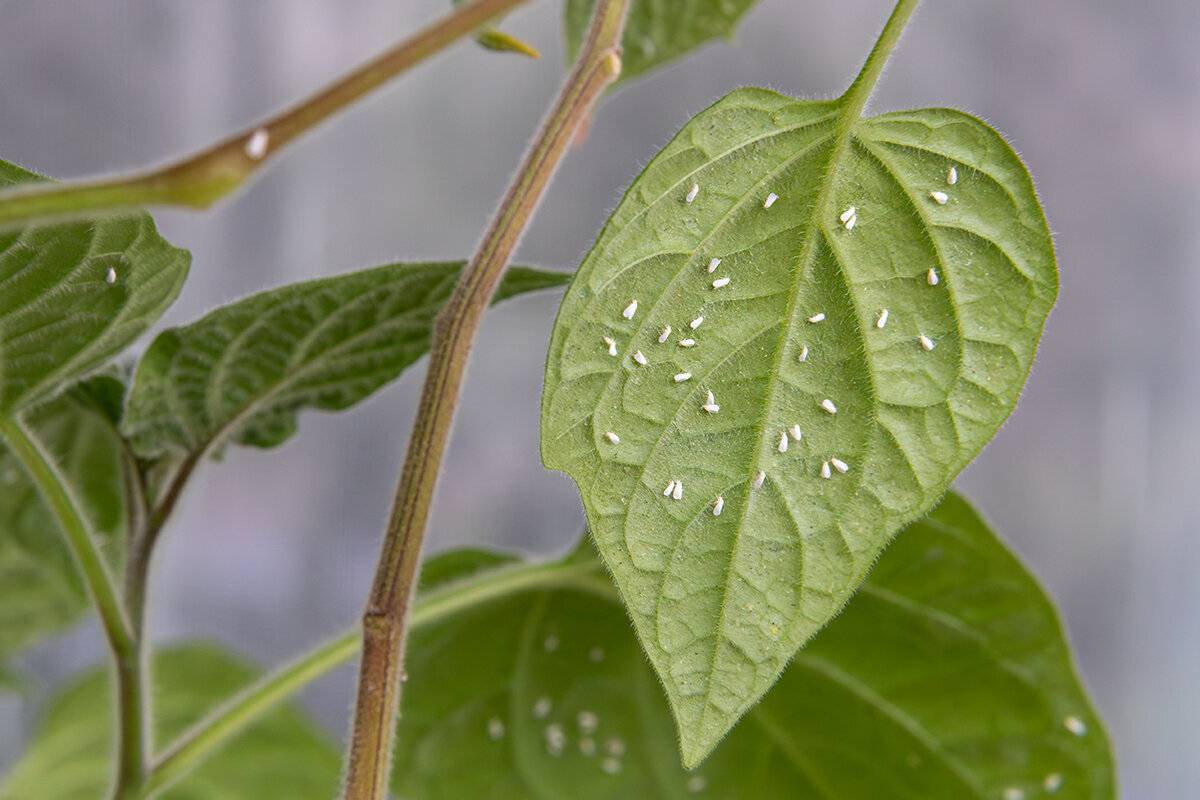
The insects that flutter into view are only the visible fraction. The real starting point is the back of the leaf, where eggs and immature whiteflies can continue the infestation.
01 / What the flutter tells you
The airborne insects reveal only part of the colony.
Disturb a tomato, cucumber, pepper, eggplant or fuchsia and tiny white insects may lift from the foliage. That movement is useful evidence, but it accounts only for the adults. On the reverse of the leaves, eggs, newly emerged crawlers and settled immature whiteflies can remain unnoticed. They are often the reason flying adults appear again after the greenhouse briefly seems clear.
Whiteflies feed on plant sap. Sustained pressure can reduce vigour and productive foliage. Honeydew provides another clue: sticky residue builds up on leaves, fruit, pots and benches, where dark sooty mould may follow. Greenhouse whitefly is often encountered in protected crops, and incoming plants can also carry Bemisia tabaci . The best response depends on the host plant, the whitefly involved, the scale of the problem, greenhouse conditions and whether biological controls are planned.
An orderly growing space makes scouting easier because foliage, aisles, ventilation points and work surfaces can be checked in a consistent sequence. In a durable structure such as the Classic Aluminium Greenhouse , build leaf-back inspection into watering, pruning, ventilation and shade management.
02 / Identify the stages first
Let the back of the leaf guide your next step.
Viewed through a hand lens, a general pest complaint becomes a much clearer life-stage assessment. Species, host, temperature and greenhouse conditions affect appearance and development, but a careful inspection remains useful in every case.
Sample foliage from several plants instead of reaching for the nearest leaf. Examine veins, fresh shoots, the centre of the canopy and older shaded foliage. Distribution can be patchy: a protected plant may support a growing colony while the plant beside it shows only a few eggs or adults.
Eggs
Pale, tiny and often arranged close to veins.
Crawler
Briefly mobile after hatching.
Attached immature stages
Flat, scale-like and easy to miss.
Adults
Powdery white; fly up when disturbed.
One leaf can yield four observations: use this sequence to get oriented, then confirm the pattern across several plants and growing areas.
Treat the diagram as an inspection aid, not as final identification. Whitefly eggs are minute and may alter in appearance as development proceeds. A newly hatched crawler travels for only a short period before choosing where to feed. The later immature forms stay largely in place and can look like pale, flattened scales. Adults are easier to notice, yet represent only the flying portion of the colony.
Also look for fresh stickiness, sooty mould, pale feeding marks, cast skins and a rise in settled immature forms. Details vary with age, host, temperature and species. Between greenhouse whitefly and Bemisia tabaci , a single visible trait may not provide a dependable distinction. Recognizing the stages is often sufficient for routine home-greenhouse decisions. Ask a plant-health adviser, diagnostic service or knowledgeable biological-control supplier for identification when valuable plants, unusual symptoms or a species-specific programme are involved.
03 / Confirm which insect you have
Separate whiteflies from other small greenhouse fliers
Whiteflies
When disturbed: A powdery-looking group of tiny white insects lifts from the leaves.
Confirm the finding: Turn young and mature leaves, looking for eggs and flattened immature forms fixed to the underside.
Typical clue: Increasing pressure commonly brings sticky honeydew followed by dark sooty mould.
Fungus gnats
These dark, delicate flies are usually seen near damp growing media. The larvae occupy the medium rather than forming flat, scale-like stages on foliage.
Thrips
Look for narrow-bodied insects, silvered feeding marks, misshapen growth and small dark specks rather than a powdery white flutter.
Winged aphids
Their bodies are generally pear-shaped, and wingless groups are often easy to see on soft stems or shoots. They may produce honeydew too.
Correct identification determines what to do next. Sticky cards can collect several kinds of flying insect, whereas turned leaves expose the fixed whitefly stages. A remedy intended for aphids, thrips or fungus gnats should never be assumed safe or effective for whiteflies.
04 / Turn scouting into a repeatable routine
Use the same route on every weekly check.
An occasional sighting cannot show whether whiteflies are expanding, retreating or confined to one corner. Establish a practical circuit: inspect doors and vents, incoming plants, dense crop groups, fresh shoots, older lower foliage, then weeds and debris below benches. Carry a hand lens and use a notebook or digital record simple enough to update consistently.
1
Entrance zone
Inspect the door, ventilation openings and newly arrived plants.
2
Hot spots
Tag plants that release visible adults.
3
Upper canopy
Look over fresh tips and newly laid eggs.
4
Lower canopy
Examine mature foliage for settled immature whiteflies.
5
Floor area
Clear weeds and leftover plant matter.
For a compact collection, sample several useful plants from every crop rather than returning only to the pot nearest the entrance. In a larger structure, define permanent growing sections and keep the sampling effort consistent within each one. Log the date, crop and position along with flying adults, immature forms, honeydew, removed foliage, treatments and biological releases. A repeatable record is more informative than a universal threshold invented without evidence.
Pay extra attention to vigorous plants, sheltered corners and foliage that is awkward to reach. Whiteflies can multiply quietly behind a crowded canopy. Mark a few affected plants for comparison at the next inspection and, if possible, mark one plant that appears clear. That comparison helps separate a changing population from old damage that is simply still visible.
05 / Make yellow-card counts meaningful
Sticky cards reveal adult movement; they do not clear the leaves.
What the count means
TrendThe count reflects adults, while eggs and immature forms remain out of view.
Keep the procedure consistent
- Assign a number to each card.
- Return it to its established position.
- Measure an identical counting section.
- Log both the date and the count.
Yellow attracts adult whiteflies, so consistently managed cards can show new arrivals and whether flight activity is rising or falling after a response. They say nothing conclusive about eggs or immature insects still feeding on the crop. Use them as one source of evidence within a broader scouting plan rather than as an eradication method.
Keep cards in established growing areas and near the canopy, moving them upward as plants gain height. Either count the full surface or define a fixed section and use it throughout the growing cycle. Results lose their value if the sampled area changes. Install a fresh card when water, dust, plant material or catches obscure the adhesive, then compare it with earlier records from that precise position.
A compact greenhouse is usually better served by several deliberately placed cards—such as one by the entrance and others among separate crops—than by a single card in an arbitrary spot. Always inspect foliage alongside the count. A decline in flying adults is welcome, but newly hatched crawlers or numerous live immature forms mean reproduction continues. Keep cards clear of biological-control releases, spray splash, intense heat and frequent foliage contact.
06 / The infestation runs on overlapping clocks
A single action seldom reaches the whole population
Whiteflies within one greenhouse are rarely synchronized. Some adults may be laying eggs while another group is hatching and older immature insects remain fixed in place. Warm, protected conditions can accelerate development and increase this overlap. As a result, an action that reaches exposed adults or crawlers may leave other stages untouched.
Respond with better timing rather than heavier or indiscriminate applications. Decide on the follow-up at the outset: remove concentrated sources, reassess the stages that survive and combine sanitation, biological controls or direct measures when they are suitable and permitted. Revisit your marked plants before an unnoticed cohort builds strength.
Several generations in motion
Egg laying continues among the adults.
New crawlers emerge, travel briefly and begin feeding.
Settled forms develop while another group of adults appears.
These staggered stages explain why follow-up is part of the original plan rather than an optional last step. Set timing from what you observe in the crop and from current product directions. A generic schedule cannot account for the host, greenhouse conditions, pest pressure or the requirements on a Canadian label.
07 / Take away the sources of reinfestation
Separate new plants, remove only what is necessary and manage entry points
Isolate plants
Set seedlings, gift plants and new containers apart from the main crop at first. Disturb the foliage gently and examine several leaf backs for every stage before moving a plant into the collection.
Remove heavily infested leaves
Where whiteflies are concentrated, take off the most heavily occupied foliage only when the plant can spare it. Place the cut material in a bag immediately, before moving through the growing space.
Remove hidden host plants
Volunteer seedlings, weeds, unused stock plants and old crop remains can bridge the gap between plantings. Search below benches, beside pots and along walls, then clean those areas.
Be selective rather than stripping a plant. Removing too much foliage may slow recovery, reduce vigour and leave fruit or tender growth exposed. Start with leaves that support the densest concentrations of eggs and immature whiteflies. It may be reasonable to remove an expendable plant when it has become a major source of adults. Seal discarded material and follow local waste guidance; do not leave it loose in the greenhouse or add it openly to compost.
Screens are most useful before a population becomes established. Fine mesh may limit entry at openings, but it must not restrict the airflow needed during warm Canadian growing conditions. Everyday practices matter as well: shut doors promptly, keep affected plants away from entrances and inspect new arrivals instead of leaving them in a crowded holding area. The Classic Aluminium Greenhouse can make clear access, reachable plants and an organized ventilation routine easier to maintain.
Clean glazing and uncluttered benches contribute directly to integrated pest management. Sticky residue is easier to notice, foliage can be reached from more angles and monitoring cards can remain in dependable positions. Browse Aluminium Greenhouses with access, defined crop areas and regular maintenance in mind.
08 / Bring in biological controls early
Beneficial insects succeed through a well-timed programme.
Parasitoids and predatory insects
For greenhouse whitefly, one established parasitoid is Encarsia formosa . It is most useful while the colony remains limited and previous incompatible treatments will not undermine the release. If the pest is Bemisia tabaci , the programme may need a different specialist approach, including a suitable Eretmocerus species. Ask a biological-control supplier or plant-health adviser to consider the pest, crop, temperature, light, greenhouse size and treatment history together.
Predators may also contribute. Macrolophus pygmaeus can have a role in greenhouse fruiting crops, but that does not make it suitable for every small mixed collection. Choose by matching the organism to the host crop, whitefly, population density, environment and previous applications. Biological-control species perform different jobs and cannot simply be substituted for one another.
Look for evidence that parasitoids are working before taking off every darkened immature whitefly. When Encarsia formosa is active, parasitized greenhouse-whitefly pupae may become dark. A hand lens and trustworthy identification material can help you retain useful parasitoids instead of discarding them with the affected leaves.
A biological programme needs repeated scouting, sound identification, workable environmental conditions and time to develop. Practical access matters too: reachable foliage and clear aisles make inspection and even distribution easier than an impressive but impenetrable canopy. A Classic Aluminium Greenhouse can supply that accessible framework.
09 / Choose each tool for the stage it can reach
No single product performs every part of whitefly control.
Sanitation
Takes out concentrated colonies and occupied foliage.
Yellow sticky cards
Provide a record of flying-adult activity.
Beneficial insects
Develop pressure on the pest population gradually.
Contact measures
Depend on reaching the reverse of the foliage.
Sanitation and removal take concentrated eggs and settled immature whiteflies out of the greenhouse when occupied leaves, host weeds, debris or isolated source plants are removed. Insects elsewhere in the crop will remain.Yellow sticky cards provide a relative measure of adult movement, not a census of the insects developing on foliage.Parasitoid wasps and predators may establish continuing pressure when the species is properly matched, introduced early and protected from incompatible residues. Suitable conditions and sufficient establishment time remain essential.Contact products affect only the organisms they reach. Wetness on the upper surface does not demonstrate that the reverse of the leaf received adequate coverage.
A contact product cannot work at a distance
Soaps, oils and comparable contact products depend on direct exposure. Whiteflies usually shelter beneath foliage, making technique, plant tolerance, temperature, water stress and manufacturer instructions important. Where directed—or when crop sensitivity is uncertain—test a limited area first. Never create an improvised mixture or treat household dish detergent as an equivalent substitute. Warm greenhouse conditions can make tender foliage especially vulnerable.
Before treating an edible crop, confirm through the current Canadian registry and label that the product is registered for the intended crop, whitefly and greenhouse setting and is available for your type of use. Apply it only as directed, including the rate, method, application limit, pre-harvest interval, precautions and warnings concerning beneficial insects.
10 / Keep chemical decisions specific to the situation
Use Canadian-registered products cautiously and document every application
A Canadian home greenhouse cannot be managed with one universal spray sequence. The crop, whitefly, plant condition, intended setting, product registration and presence of beneficial organisms all affect the choice. Search Health Canada's current product and label records before use and read the complete label. The intended crop, pest and greenhouse application must be covered, and every stated rate, limit, interval and safety direction must be followed.
If a registered treatment is justified, changing brand names does not provide sound resistance management when the mode of action stays the same. Repeated reliance on one approach can select for harder-to-control whiteflies. Use the registration, product information and qualified advice to plan any rotation. Some Bemisia populations are notably difficult to manage. A complete application log supports later decisions and helps a biological-control supplier assess residue risks.
Consult regional plant-health expertise when pressure persists, rises or cannot be identified confidently. Advice is also warranted for unusual symptoms or uncertainty about a registered application. In an integrated plan, a chemical product is a carefully chosen component—not a substitute for identification, sanitation, underside coverage and follow-up.
11 / Measure what happens next
A quiet greenhouse immediately after action is not proof of recovery.
Removing occupied foliage, applying a direct measure or releasing beneficial organisms can quickly reduce visible movement. Real progress appears over later inspections: comparable cards collect fewer adults, young foliage carries fewer new eggs and crawlers, living settled stages decline and fresh honeydew becomes less common. Existing mould, cast skins and feeding marks may remain. Judge the trend from new evidence rather than expecting an overnight cosmetic change.
A
Revisit the source plants
Go back to the tagged hot spots and examine several leaf backs. Log the remaining stages, taking off newly crowded foliage only where the plant has enough healthy growth to spare.
B
Read the records together
Compare each numbered card with its own earlier results, then interpret that count alongside the foliage inspection. A smaller catch is useful evidence, but it cannot settle the question by itself.
C
Reassess the weak point
When immature whiteflies continue to increase, revisit the identification, sanitation, treatment coverage and compatibility with beneficials. Also inspect incoming plants, weeds and greenhouse openings as possible routes back into the crop.
Keep scouting after numbers fall. Resilience does not mean excluding every insect forever; it means detecting a new arrival before it spreads across the crop. Clear aisles, an established storage spot for the hand lens and records, workable ventilation and shade, and access behind the benches make the routine sustainable.
FAQ / Whiteflies in Canadian home greenhouses
Practical answers for ongoing whitefly management
Can yellow sticky cards clear whiteflies from a greenhouse?
No. They intercept and measure some flying adults, but eggs and most immature whiteflies remain beneath the foliage. Use card records to locate activity and read the trend, always checking leaf backs at the same time.
Does every affected plant need to be discarded?
No. Separate the plant, determine how extensive the colony is and identify the stages present. Remove only the most occupied foliage when sufficient healthy growth will remain. Disposal may be the practical choice for a severely infested, replaceable plant that is supplying adults to the rest of the collection.
Why can whiteflies appear again after treatment?
Different stages were probably present together. An action that reduces adults may leave eggs or settled immature forms, while poor access to leaf backs can limit a contact product. Whiteflies may also return on incoming plants, survive on overlooked hosts or enter through openings.
Is a beneficial-insect release possible after treatment?
Sometimes. The answer depends on the particular product and active ingredient, when and how it was applied, its residual activity, the crop and the beneficial species. Keep the application record and have the biological-control supplier or plant-health adviser check it before release.
Can whiteflies damage tomatoes, cucumbers, peppers and herbs?
Yes. Continued feeding may reduce plant vigour and productive foliage. Honeydew soils leaves and fruit and can support sooty mould. For edible plants, choose only methods suited to the crop and use registered products strictly according to the Canadian label, including harvest and safety directions.
What inspection frequency is useful?
Inspect weekly at minimum while plants are actively growing. Check more often in warm conditions, near known colonies, after introducing plants or when adult counts rise. Consistency makes the records comparable. Any treatment interval still comes from the individual product label rather than the scouting routine.
Canadian registration resources
Check the live product record before making a treatment decision.
Whitefly species, biological-control programmes and registered uses can change. Health Canada's public registry is the Canadian starting point for current product status and labels. Before use, ask the relevant provincial or municipal authority whether any destination-specific rule also affects the proposed application.
More from Bloomcabin: Setting up a greenhouse: layout, plants & care · Summer greenhouse care · Bloomcabin greenhouse overview
- Health Canada — Search registered pest-control products and labels
- Government of British Columbia — How to use pesticide labels
- Health Canada — Current pest-control product label database
- Health Canada — Pesticide public registry
- Health Canada — Pest-control product and label records
- Government of British Columbia — Canadian registration and label guidance
- Health Canada — Current pesticide product and label searches
- Health Canada — Public registry for pest-control products
