
Growing Full-Flavoured Melons in an Irish Greenhouse
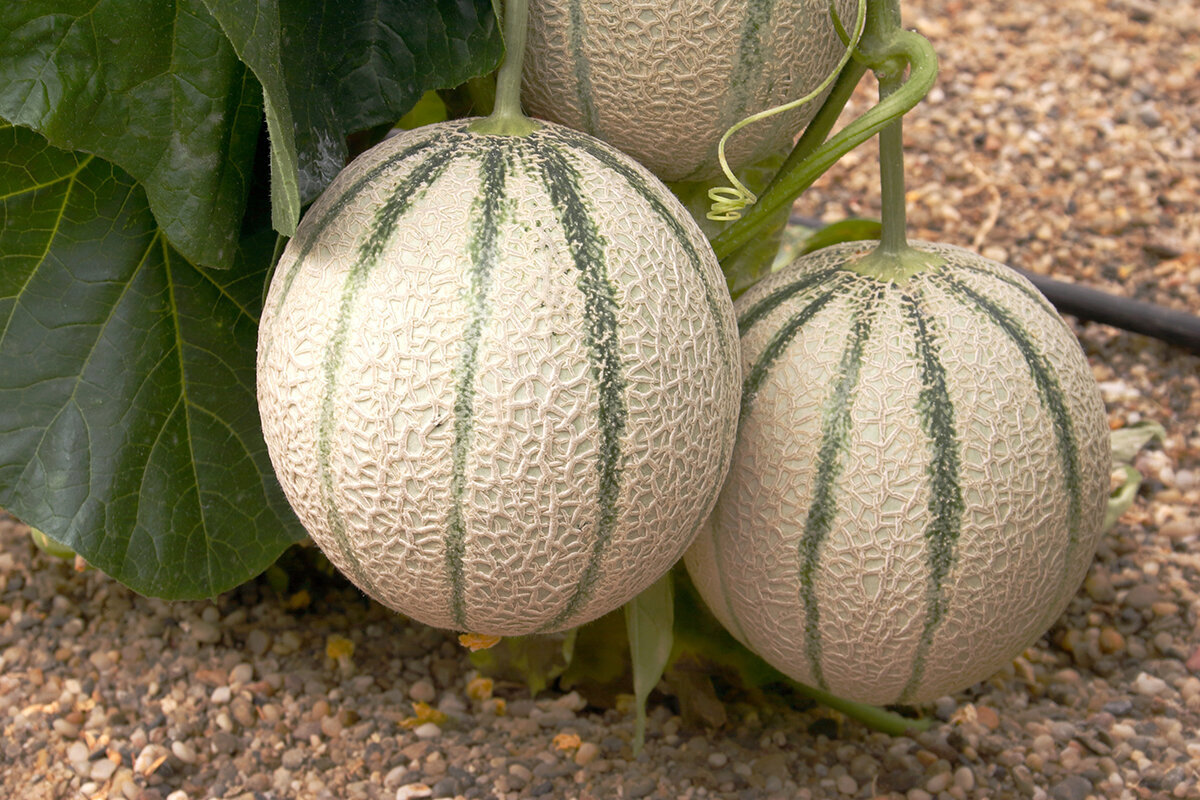
Protected growing · Ireland
Melons under cover
richly scented from your own
greenhouse
A melon crop beneath glass depends less on creating a tropical imitation than on managing heat, moisture, ventilation and climbing room together. Provide a dependable upward route and the vine can reward you with scented fruit while the greenhouse remains pleasant to work in.
From a warm start to late-summer fruit
The idea to remember
Organise the warmth
so flavour has time to develop.
These energetic, warmth-seeking vines favour heated roots, plentiful light and porous soil. Developing fruit also needs regular moisture, while circulating air should dry the leaves without leaving the greenhouse draughty.
Under cover, the grower can coordinate these needs more deliberately. Several jobs otherwise shared with weather and insects also become yours: venting, watering, guiding shoots, limiting the fruit load and helping with pollination if required. Small and medium muskmelons usually make efficient use of a home greenhouse. They climb readily, often signal ripeness through scent, and can be held in broad slings. Small-fruited watermelons are possible too, though they require additional room, stronger load-bearing support and thoughtful choice of cultivar. Plan around available light, working height and reachable paths, not merely the unused ground.
Match the melon to its climbing system
Four choices
for summer cultivation under cover.
The packet name matters, but the plant’s eventual use of the greenhouse matters more. Look for descriptions such as quick to mature,restrained growth,modest-sized fruit,intended for growing under cover or manageable on a climbing frame.
In an unsettled or abbreviated Irish summer, an early-finishing cultivar offers a practical advantage. For a first attempt, resist choosing the biggest possible melon. A fruit that can be guided, checked, supported and ripened fully is more rewarding than one that blocks the aisle or shades neighbouring crops. Check the cultivar notes for likely fruit weight and vigour, together with any special requirements for successful pollination.
- Galia and reticulated types Their juicy green-gold flesh sits inside a recognisably netted rind. Fabric cradles suit many cultivars, but both maturity cues and the way fruit parts from its stem vary between selections.
- Charentais and cantaloupe types Usually small or medium-sized, these intensely aromatic melons can suggest apricot, blossom and sun-warmed soil. They suit growers who prize perfume above bulk.
- Honeydew and smooth-rinded types Maturity can be understated in these smooth, elegant fruits. Read the cultivar notes, then assess background tone, rind development and texture together rather than depending on strong perfume or a single expected colour.
- Compact watermelons An arresting crop for a tall greenhouse, provided the trellis is substantial and each fruit receives a roomy cradle. Seedless selections also need an appropriate companion that supplies pollen.
The journey from seed to support
Start warm. Handle gently.
Wait until the growing space is ready.
01 / Seed
Warm germination
02 / Seedling
First leaves
03 / Transition
Gradual acclimatisation
04 / Bed
Set into warm soil
Begin with warmth. Sow from mid- to late April, giving every seed a generously sized pot of its own. Because melon roots dislike damage, individual sowing avoids later thinning and unnecessary repotting. Maintain even moisture in the compost, but do not leave it waterlogged. Germination needs noticeable warmth, so bottom heat can be useful in a cool room. Once seedlings emerge, abundant light becomes more important than extra heat and keeps their growth compact instead of drawn, pale and soft.
When true leaves appear. Bright conditions encourage sturdy, compact seedlings. Avoid repeated repotting simply to follow the calendar. A young plant with a cohesive, well-rooted ball establishes more safely than an overgrown melon whose roots circle a small container or break apart when transplanted.
Acclimatise before final planting. Introduce seedlings gradually to stronger light, moving air and the daily temperature cycle inside the greenhouse. At first, give them short periods in a protected position, avoiding cold draughts and an abrupt move into fierce midday sunshine. Conditions differ between Irish coasts, inland sites, elevations and seasons, so plant only when the structure and root zone stay reliably warm. Keep the root ball intact and set it no deeper than before. Two to three true leaves are a useful stage, although actual warmth should govern the timing.
Preparing the roots’ environment
Establish drainage before refining the watering routine.
Melons need nourishment but perform poorly in dense ground with little air. Prepare a deeply loosened, warm and freely drained root zone, mixing in a moderate amount of mature compost. Do not confine the plant to a small rich planting hole within compacted, chilly earth.
Prepare the full width and depth of the greenhouse border, removing depressions where water might collect. Good soil should hold moisture while recovering air space after irrigation. Mature compost supports establishment; provide further nutrients only where the crop indicates a need. A raised bed may improve a site that drains slowly. Keep the surface clean and water carefully so soil is not splashed onto foliage. Heavy, cold ground responds better to improved structure, warmth and time than to continually increasing the fertiliser.
For container culture, choose the largest practical volume. A cramped pot can warm excessively, lose moisture unevenly and limit fruit growth in summer. Treat about 30 to 40 L as a sensible lower guide for one vertically trained plant; additional volume makes water and feeding easier to manage. Use a stable, free-draining growing medium, unobstructed outlet holes and a secure base. Container moisture will need checking more often than soil in a greenhouse border.
Arranging the climbing plant
Direct growth onto its route
before it wanders across the room.
Roots
Clear crown
Flowers
Fruit
Turn beneath roof
Principal shoot
Ventilated base
Place lateral growth
Redirect the tip
Examine the plant in stages, starting at soil level. Guide a principal shoot upwards against the chosen cord or frame without fastening it tightly. Open the lower canopy sufficiently for air to pass beneath, but do not remove sound leaves indiscriminately. Place selected side shoots where their foliage, flowers and fruit will not combine with the neighbouring vine into a damp, shaded mass. Growth touching the ground may be removed when hygiene or access requires it.
Once the leader reaches its available height, turn it onto a second secure cord, lay it across, or limit further growth in line with vigour and the intended number of fruits. For ideas on arranging paths, beds and fixing positions together, see Bloomcabin’s Classic Aluminium Greenhouse. Upright melons are easier to tend when safe fixings, air exchange, cultivation zones and access are designed as one arrangement.
A brief morning appointment
Pollination takes only a moment,
but timing and a light hand matter.
Bees and bumblebees may find their way inside through roof openings and the doorway. Visits can still be patchy, while melon flowers remain receptive only briefly. A newly opened female flower may therefore pass without timely attention.
Recognise
Visit early
Move pollen
Record
Male flowers have slim stems without a swollen base behind the petals. A female flower carries a tiny ovary at its base that already resembles the future fruit. If too little pollen reaches it, the melon may fail to form, remain undersized or develop unevenly. On a clear morning, identify the blooms that have just opened and note their positions.
Choose a clear morning after condensation has dried. Lift pollen from an open male flower with a soft brush and dab it gently onto the receptive centre of the female flower; the detached male flower can also be used directly. Repeat this for other fresh blooms, then mark the day on a tag or coloured ribbon. Do not judge success the following morning. Over the next week, look instead for steady and even swelling of the ovary. Avoid wet flowers and work slowly so the surrounding tender shoots are not knocked or bruised.
Seedless watermelons still require pollen. Follow the chosen cultivar’s instructions and grow the recommended fertile companion, because an unrelated variety may not provide effective pollination.
Select the crop deliberately
A restrained fruit load often gives
a more satisfying result.
A vigorous vine can appear capable of ripening a miniature orchard, yet its resources are finite. Every melon left in place draws from the same foliage, moisture, nutrients, sunlight and remaining length of season.
After several fruits start developing, select those growing evenly in positions that remain easy to reach. Favour melons on sound shoots with adequate light and enough surrounding space for a sling. Remove misshapen, injured, pinched or extremely late young fruits early. How many remain depends on the cultivar, final melon size, root volume, light, weather and time available for ripening. Review the balance repeatedly as growth proceeds rather than applying one fixed number to every plant.
Surplus nitrogen creates a related imbalance: long growth and lush, tender, dark foliage may look impressive while flowering and fruiting fall behind. Measured nutrition combined with a realistic load helps direct the plant towards maturity.
Retain
evenly formed
evenly formed
Retain
open to light
open to light
Cull
trapped
trapped
Cull
damaged
damaged
Cradle
the chosen fruit
the chosen fruit
Keep clear space around the rind, stalk and fruit-bearing shoot. A melon hidden within a humid knot of foliage is difficult to monitor and dries slowly after moisture accumulates. Selecting early is kinder to the plant than later discarding a heavy fruit because it is shaded, rubbing against something or cannot be supported safely. Also make sure the shoot carrying it stays sound and accessible.
A modest engineering job
Fit the supporting sling
before the fruit grows heavy.
Wide bearing area
Expansion allowance
Load-bearing fixing
Frequent inspection
Use soft mesh, wide clean fabric strips or a suitable net designed to support fruit, spreading the weight across a broad area instead of one narrow pressure point. Create a hammock beneath the melon rather than tying the material around it. Leave generous growing room, since a sling that looks comfortable initially may later constrict, distort or rub against the maturing rind.
Transfer the load to a strong upper support or climbing frame, not to the fragile stalk or a thin side shoot. Check the suspension at least twice weekly during rapid growth and following irrigation. Look for tightening material, damp fabric, strain near the stem, contact with glass, or a sling that has slipped and now carries weight unevenly. Supporting fruit is continuing crop care rather than a one-off fitting task.
The pattern of ongoing care
Keep moisture steady and nutrition measured.
Avoid sudden dryness as maturity approaches.
Planting
Climbing growth
Fruit set
Maturation
Once planted: Soak the rooting area sufficiently to bring the root ball and surrounding medium into close contact. Before the next irrigation, permit slight surface drying while maintaining even moisture lower down. Roots require oxygen as well as water. Increase the quantity gradually as the canopy expands rather than alternating a drought with saturation. This matters particularly in containers, whose small reserves warm and empty quickly.
At flowering and initial fruit development: Reliable root moisture matters greatly while flowers open and fruit begins to form. Direct irrigation onto the ground, or regulate a drip system carefully, to avoid keeping the leaves wet. Examine moisture beneath the surface instead of assuming that warm greenhouse air means dry soil. Thorough watering at intervals determined by actual need usually reaches the root zone more effectively than frequent shallow sprinkling.
As fruit matures: Do not withdraw water suddenly from a ripening vine. Prevent wilting and marked swings in moisture while also avoiding unnecessary excess. A long dry interval followed by heavy watering can encourage cracks and disrupted growth. Mature compost supports establishment, and later feeding may be balanced and applied as directed on the product. Soft leaves of an unusually deep green, accompanied by endless vine growth, can indicate excessive nitrogen. Bring the crop towards ripeness steadily rather than trying to concentrate flavour through abrupt drying.
Give the crop breathing room
Stored heat is useful.
Motionless air is not.
A melon house should feel sunny and alive rather than sealed. Moving air tempers sharp heat rises, helps wet leaf surfaces dry, encourages sturdy development and makes morning pollination and maintenance more comfortable.
When outdoor conditions are suitable, combine an upper opening with the door or a vent lower down. Rising warm air can then leave as fresher air enters beneath it. In intense midday sunshine, light temporary shading fitted outside where possible reduces stress without creating permanent gloom. Water the ground early, keep paths unobstructed and prevent thick growth from pressing against glazing or walls. Moisture condensed during a cool night should be allowed to clear promptly the next morning.
The Bloomcabin Accessories range includes useful equipment for shade, air exchange and directing crops. Whatever arrangement you choose, keep it straightforward enough to operate consistently during warm weather.
A five-minute crop inspection
Keep each check focused and repeat it often.
1 / Turn over young leaves
Look beneath new leaves for aphids, eggs, fine webbing, pale speckles or sticky deposits. Hot, arid conditions suit spider mites; spotting an infestation while it is limited allows a more precise response.
2 / Interpret the foliage
A flour-like film, yellow tissue, brown edges or dead patches deserves investigation. Consider moisture on leaves, ventilation and other possible causes before selecting a treatment or plant-protection product.
3 / Examine stems and fasteners
Inspect the crown, ties and clips closely. Replace any fastening that chafes or tightens, and clear fallen foliage, damaged fruitlets and decomposing plant matter promptly using clean practices.
4 / Review the ground and cradles
Pools of water, algae and decaying scraps raise humidity and shelter pests. During the same inspection, check each sling for dampness, pressure damage and stable positioning. Keeping the path tidy also supports plant health.
Prevention begins with adequate spacing, air movement, quickly drying leaves, hygienic tools, moderate nutrition and prompt clearing of dead plant matter. Avoid directing water against the stem, and examine any injury or unusual colour at the crown. Determine the cause and identify the pest or disease before choosing a response. Remove badly affected material carefully. Irish home gardeners should use only products authorised in Ireland for amateur use, obey every label instruction and prevent contamination of water. If the diagnosis is uncertain, seek local horticultural advice rather than treating speculatively.
Reading the final changes
Choose the picking moment by combining
several signs from the fruit.
Maturity appears through a collection of subtle changes rather than one decisive signal. Because their sequence differs between melon types and cultivars, the stated cultivation period offers guidance, not a prearranged harvest date.
01
Aroma
02
Surface
03
Stalk
04
Season
Aroma. A ripe muskmelon often develops a warm, clearly sweet fragrance at its flower end. Smooth-skinned types can be much less aromatic. Regard scent as one clue and weigh it alongside the other indications of maturity.Rind pattern and background tone. Compare the rind’s netting, sheen and underlying tone with the description supplied for that variety. Depending on type, green can shift towards cream, gold or a warmer base shade. A hard, glossy-green rind commonly indicates that the fruit needs longer.
Separation at the stalk. At full ripeness, some muskmelons form a natural separation zone and release more easily where fruit meets stalk. The response is variety-specific and is not a dependable general indicator for watermelon. Record the fruit-set date, then relate likely development time to expected weight, fragrance and rind changes. If softness at the flower end is a relevant clue, press with great care; firm handling can damage fruit that has taken months to mature.
Harvest in the cooler morning. Where the variety does not release by itself, sever the stalk using a clean blade or scissors rather than tugging the vine. Handle netted rinds carefully, wash the exterior, and clean both cutting board and knife before opening the fruit. Refrigerate sliced melon without delay. Whole muskmelons can spend a short period at room temperature, although extended storage reduces aroma and texture. Serve the crop simply while its fresh greenhouse fragrance is still evident.
Questions from beneath the vines
Greenhouse melon questions answered
How many plants should go into a modest greenhouse?
Start with fewer vines than the bare footprint seems able to hold. One plant in a substantial pot or one clearly assigned border position is a sensible first arrangement. Retain a working central path, separation from the glass and sufficient height to reach shoots, flowers, ties and slings without stretching awkwardly. Open foliage receives better air and gives fruit a stronger chance of finishing than a greenhouse crowded across its entire floor.
Is manual pollination always required?
Not necessarily, though doing it yourself is often the more dependable approach. Natural pollinators may visit through the doorway or roof openings. When activity is limited or young fruit repeatedly fails, gentle morning transfer between newly opened flowers makes successful set less dependent on chance.
What makes blossoms fall before melons form?
The earliest flowers are often male, making some drop entirely normal. Once female blooms arrive, poor pollen transfer, excessive daytime heat, cold nights, uneven watering or too much nitrogen can reduce fruit formation. First check which flowers are present, then review temperature, moisture and feeding.
Will a melon grow successfully in a pot under cover?
Yes. Use a compact cultivar or one producing smaller fruit, provide a stable pot of roughly 30 to 40 L, and add a strong climbing frame. Ensure water can escape freely and monitor the compost more closely than border soil, since pots warm and lose moisture quickly in summer.
Must foliage beside maturing fruit be cut away?
Remove only foliage that is diseased, damaged, touching the ground or causing persistent crowding. Healthy leaves manufacture the assimilates that support fruit development and sweetness. Improve light and air by redirecting the vine thoughtfully, without suddenly exposing a previously shaded melon to fierce midday sun.
What structure works well for upright melon vines?
Look for sufficient height at the ridge, secure fixing points for climbing lines and room for supported fruit above a walkway you can use easily. Ventilation matters just as much: even after foliage expands, warm rising air needs a clear exit through the roof vents and door.
Reference material
Research sources and further guidance
Bavarian LWG — 2025 German melon trial
German trial findings on varieties, yield, fruit weight, crop health and protected cultivation.
Bavarian LWG — 2024 German melon trial
Applied Bavarian horticultural results for varieties and crop-management methods.
LVG Heidelberg — 2024 German greenhouse melon study
A German comparison of muskmelons and watermelons, reporting yield, fruit characteristics and plant health.
Weihenstephan-Triesdorf University — German indoor and outdoor melon examples
Foreign practical examples showing vine direction and suitable nets for safely carrying suspended melons.
Bingenheimer Saatgut — German notes for watermelon crops
German instructions for sowing, planting, tending, pollinating and judging watermelon ripeness.
University of Minnesota Extension — American melon-growing advice
US extension advice addressing warm soil, cultivar selection, pollen transfer, irrigation and harvesting.
One last invitation
Plan a dependable and attractive climb.
Successful melon growing involves more than available ground. Provide height for the leader, enough ventilation to serve the enlarging leaf canopy, clear routes for tending and pollinating, and sound fixing points able to carry cords and ripening melons. Plan every element as part of one growing environment, from the warmed rooting zone through to the fragrant crop at harvest.
For an adaptable traditional starting point, explore the Classic Aluminium Greenhouse. Its balanced geometry provides a calm setting for vertically trained melons. Beds or large pots, support lines, roof vents, slings and usable passages can all be arranged coherently, with room remaining for herbs and relaxed summer tending under glass.
Classic Aluminium GreenhouseRefine your plan
Consider the structure and proportions offered by the Classic Aluminium Greenhouse as you allocate generous paths, upright growing zones and support points that are comfortable to reach.
See other ways to organise sheltered garden growing with the Classic Aluminium Greenhouse.
For guidance on durable construction, style, siting and ventilation, browse Bloomcabin Accessories and apply the ideas to a light, well-aired space for next season’s melons.
