
Garden Shed Doors That Stick: Seasonal Movement and Adjustment
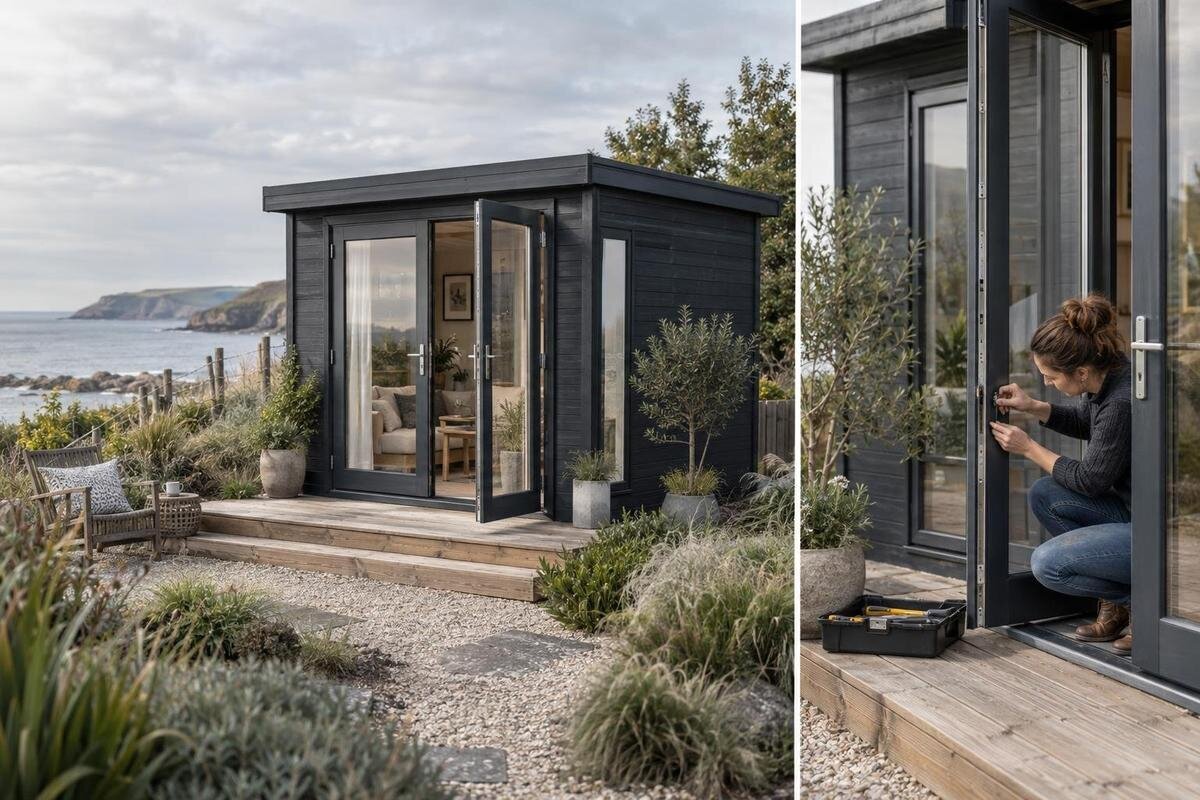
Garden shed care
Garden shed doors can begin to rub after a change in the weather, but trimming the edge is rarely the best first response. Timber may swell or shrink as its moisture content changes, while a loose hinge, shifted frame, unsettled support or misaligned latch can create similar symptoms. The useful first step is to find exactly where the door catches and whether the problem changes over time. This guide covers the checks to make, the adjustments that may be appropriate and the signs that call for professional help.

Why garden shed doors can stick seasonally
Timber takes in and gives off moisture as the conditions around it change. During a damp spell, a door or its frame can swell; as the timber dries, it can contract again. The door and frame may not respond by the same amount, because board layout, joints, finish and exposure differ. A small change can narrow the clearance at one edge or bring the latch out of line. That can make a door feel heavy even when its hinges and latch are sound. Movement may be too small to see directly, so a change in fit is often the first sign. This is only one possible explanation: the frame or support may also move, and a non-timber door can bind if its surrounding structure shifts.
A seasonal pattern is useful evidence, not proof. Note whether the problem appears after prolonged wet weather, changes as conditions dry or remains much the same throughout the year. A door that catches once and then frees up may need observation; one that becomes progressively harder to open needs a closer look. Do not assume that seasonal sticking is harmless, or that one episode means the shed is damaged. The location of the rub and the condition of the frame, hinges and latch give better clues. Open and close the door gently: forcing it can strain fixings or make a slight misalignment worse. Use weather as one part of the diagnosis, not as a reason to wait indefinitely.
Find the point where the door catches
Begin with a clear path in front of the shed and enough room to open the door slowly. Do not push hard against resistance or let the door swing freely in wind. As it starts to move, notice whether it catches immediately, part-way through the swing, at the threshold or only when it reaches the frame. Look at both vertical edges, the top and bottom, then the latch side. Fresh scuffs, rubbed finish, polished spots or loose debris can show where contact occurs. Keep fingers away from hinge gaps and stop if the door is loose, heavy or at risk of dropping. This first check should help you describe the symptom, not force the door into working.
Then separate a latch problem from a rubbing door. With the door safely open, operate the latch by hand if it is accessible and designed to do so; note if it sticks without touching the strike plate. Close the door gently and listen or feel for the first point of resistance, rather than repeatedly slamming it. Clear loose leaves, grit and stored items from the threshold, but do not dig at the frame or scrape the door. Write down the date, weather and catch point, and take a photo if helpful. A second check after conditions have changed can show whether the fit is temporary or persistent.
Read the gap around the door
Study the gap with the door closed, without expecting it to be identical all around. Construction and the maker's instructions determine the intended clearance, so an uneven-looking line is not automatically a fault. A gap that narrows sharply near a top corner, a door edge sitting proud of the frame or a fresh rub mark can point towards movement or a hinge issue; none proves the cause by itself. Compare the gap at several points and note whether its shape changes when the door is open. Check whether the bottom edge meets the threshold or floor before the door reaches the frame, and look for paint build-up or grit at the contact point. Use instructions or an earlier photo as a reference if available.
If you are weighing up a replacement, turn this observation into a buying check: compare the stated opening dimensions and the space needed for the door to operate, not just the shed's overall size or a photograph. The page for Verdana 1 garden house can be one product to review, but the model name alone does not establish door clearance or opening direction. Check the product details and ask the seller for anything missing before ordering. Also measure the space in front of the planned shed, so its door can open without hitting a wall, fence or stored equipment. An advertised footprint is not the same as the clear area needed to use the door.
Check the frame and shed base
Look at the frame and surrounding structure before changing a hinge. With the door open, check whether the frame joints look secure and whether one side appears to lean or has pulled away; when it is closed, note if the top and side gaps narrow around the same place as the rub. Inspect for fresh separation, loosened fixings or signs that the building's base has shifted. Water collecting near a support or a visibly uneven base is worth noting, but it does not identify a defect on its own. If safe, look at the whole opening from inside and outside rather than judging by one corner. Do not lift, wedge or re-pack the shed to alter the opening; that can affect the whole structure.
An adjustment at the hinge will not correct a frame that has moved, so establish whether the issue is local to the door or part of wider movement. If a replacement is being considered, compare its assembly and base-preparation instructions with the place where it will stand. The page for Verdana 2 garden house can help you identify a product to check, but its name is not evidence that it can sit on uneven support or use any particular base arrangement. Confirm the requirements in the product information or with the seller before placing an order. Support and assembly suited to the product help the frame sit as intended; one base instruction does not suit every shed.

Inspect the hinges and their fixings
Inspect the hinges where they meet the door and frame. Look for a hinge leaf lifting away, a pin moving unexpectedly, a visibly bent part, corrosion, screws backing out or timber split or compressed around a fixing. With the door stationary, a gentle check for play may reveal looseness; keep fingers away from hinge gaps and do not try to hold a heavy door in line while testing it. Note whether movement is at the top, middle or bottom hinge and whether the clearance changes around that point. A loose hinge can lower or shift the door, but tight fixings do not rule out movement in the frame. Avoid taking a hinge apart just to see what is inside.
Only consider tightening a clearly loose, accessible screw if you can do it without trying to shift or hold up the door. Use a correctly fitting hand screwdriver and stop when the fixing is snug; if it spins, will not seat, or the surrounding timber moves or cracks, do not keep turning it. Avoid fitting a longer screw or moving a hinge to a new hole without advice, as the frame may be damaged further. If the shed is new or came with terms about alterations, read them and contact the supplier or installer before changing the hardware. For a future purchase, ask about hinge fittings and assembly guidance for Durano garden shed; the model name does not establish the hinge type or how it is serviced.
Is the latch catching, or is the door rubbing?
A latch can catch even when the door itself clears the frame. If the door swings freely until its latch reaches the strike plate or catch on the frame, focus on whether the latch meets it centrally and retracts smoothly. Test the latch with the door open only if it is safe to operate, then close the door gently to compare. If the edge rubs before the latch reaches the strike, moving the plate may hide the symptom without fixing the fit. A latch that fails to engage should not be forced or relied on to secure the door. Check for loose fittings, visible movement of the frame or an obstruction at the strike instead.
Adjust the strike only if the fitting is designed to move and the maker's instructions explain how. Mark its current position before making a small, reversible change, then test the door gently; stop if screws resist, the holes are damaged or the latch still misses. Do not enlarge holes or cut the door edge to make the latch reach. If choosing a new shed, confirm the door's opening direction and closure details rather than inferring them from a photograph. The page for Veltor 1 garden house may help identify a candidate, but ask the seller to confirm any latch or locking detail not stated in the product information.
Keep adjustments small and reversible
Once the source is clear, keep any adjustment limited and reversible. If a hinge or latch includes an adjustment feature, follow its instructions and change one thing at a time; support the door as directed, and keep clear of pinch points. After each small change, close the door gently and check whether the same point still rubs and whether the latch aligns. Record the original position or take a photo so it can be restored. There is no universal turn, shim or screw sequence for all shed hardware. If you cannot identify an intended adjustment, or the door needs to be lifted to align it, leave the work to the installer or a competent carpenter rather than improvising.
Timing matters too. If a timber door began to catch during unusually damp conditions and the structure looks sound, note the problem and reassess when conditions settle before making a permanent change. Do not plane, sand or trim the edge as a first response: the fit may alter again, and cutting can damage a finish or leave material exposed. If a replacement is on your list, request the assembly and adjustment instructions before ordering; a listing such as Orello garden house is not a substitute for those details. This information helps you understand what installation involves without assuming how that model's door or hardware is built.
When a door needs professional attention
Stop and seek help if the frame visibly twists, the base appears to have shifted, joints are pulling apart, timber is split around a hinge, a fixing will not hold or the door has dropped suddenly. The same applies if it binds severely, a hinge is bent, the door is difficult to control, or the latch no longer engages reliably. Repeatedly adjusting the latch or trimming the edge will not address a structural cause. A newly assembled shed should be checked against its assembly instructions; if the problem appeared soon after installation, contact the supplier or installer before making changes that could complicate diagnosis. If the door appears unstable, stop using it until its safe operation can be assessed.
A carpenter or shed installer can distinguish a repairable hinge or strike issue from movement in the frame or support, then explain what work is appropriate. If you are considering replacement, use that assessment to avoid ordering a shed that repeats the same site or access problem. For example, Modano 1 garden house may be included on a shortlist, but confirm its stated dimensions, base requirements and door arrangement with the product information or seller; none can be inferred from its model name. Ask what assembly guidance and maintenance information are provided, and whether the planned layout gives the door room to open. A professional's findings provide a clearer basis for comparing repair and replacement.

Keep track of seasonal changes
Once the door works properly, a brief seasonal check can help you spot a change before it becomes a persistent bind. After a wet or dry spell, look for new rub marks, a changing gap, loose accessible hinge screws or a latch that has begun to miss. Keep the route clear of pots, tools and loose debris, and remove obstructions rather than forcing the door past them. Follow the shed maker's care instructions for the door, hinges and finish; do not add lubricant or alter a coating unless those instructions allow it. A short note about when the symptom appears is more useful than repeated adjustments made without a record. If the assembly instructions call for checks after installation, follow them.
Use what you learn if planning another shed: the door should suit the route you actually use, and the space needed to open it should not be blocked by a boundary or stored items. Compare stated dimensions, door operation, assembly guidance and base preparation, then ask about details not shown. A page such as garden tool shed M can be considered alongside other options, but the product title is not a measurement or proof of a particular door arrangement. Check how the product is described and confirm any point that affects access before committing to an order. This is more useful than choosing from a name or image alone.
Deciding whether to repair or replace a shed
Repair is often the more straightforward choice when the door and frame are sound and the cause is limited to an accessible loose fitting or an adjustment the hardware is designed to allow. Replacement deserves consideration if a professional identifies damage or distortion that cannot sensibly be corrected, or if the problem keeps returning despite a suitable repair. First establish whether the fault comes from the door, frame, support or site; otherwise a new shed in the same unsuitable position may develop a similar problem. Compare the extent of the repair with the practical work of replacing the structure, including available space and access for installation, rather than responding to one difficult opening.
Before ordering, check the product's actual dimensions, the door's opening direction and clearance, base and assembly requirements, and any fitting or maintenance details relevant to your site. Confirm what is included and how delivery access and assembly will be handled; do not assume a photograph or model name answers those questions. The page for garden shed S may form part of a shortlist, but verify every detail that affects fit with the product information or seller. Make sure the planned opening clears your usual route and that the support arrangement follows the instructions. A comparison based on confirmed details is more useful than choosing a replacement solely because the existing door is frustrating.
Frequently asked questions
Can rain make a timber shed door stick?
It can contribute. Timber may take in moisture and swell, changing the space between a door and its frame. But a tight hinge, shifted frame, loose fixing or misaligned latch can cause similar symptoms. Check where the door catches before deciding that weather is the cause.
Should I plane or sand a sticking shed door?
Not as a first step. The fit may change again as the timber dries, and removing material can damage the finish or expose the surface. Check the gap, frame, hinges and latch first; if material needs to be removed, ask the supplier, installer or a competent carpenter.
Will tightening the hinge screws fix the problem?
It may help if a screw is clearly loose and the surrounding timber is sound. Use a correctly fitting hand screwdriver and stop if the screw spins, will not seat or the timber moves or cracks. Tightening a hinge will not correct a shifted frame or base.
Why does the door catch only at the latch?
The latch may be missing its strike plate, or the frame may have moved. If the door swings freely until the latch reaches the frame, check how they meet. If the door edge rubs first, moving the strike plate may hide rather than fix the underlying fit issue.
When should I consider replacing the shed?
Consider it if an installer identifies damage or distortion that cannot sensibly be repaired, or if the problem keeps returning after an appropriate repair. Establish whether the cause is the door, frame, support or site first, so a replacement does not inherit the same problem.
Seasonal timber movement can explain a door that rubs, but the catch point tells you what to investigate next. Check the gap, frame, support, hinges and latch, make only adjustments the hardware is intended to allow, and pause if the structure has shifted or fixings are damaged. A door that changes with the weather may need watching, while a persistent or worsening problem deserves a proper diagnosis. Understanding the cause also makes any decision to repair or replace the shed more reliable.
