
Greenhouse Hydroponics: Beginner’s Guide
Bloomcabin Journal · Practical greenhouse growing in Ireland
Hydroponics
under glass
A starter guide
Leaves grow above the waterline. Beneath it, a quiet cycle of water, air, nutrients and attention determines success. This guide makes that cycle clear and manageable enough for a first trial.
Chapter 01 · Start with the essentials
Hydroponics means growing without soil, not growing without care.
The key distinction
Hydroponic roots are supplied by a controlled mixture of water and dissolved mineral feed rather than soil. Oxygen, suitable warmth, support, light, moving air and hygienic surfaces are still essential, as is regular attention from the grower.
A greenhouse suits this work because it provides shelter, access and an orderly place for plant care and water handling. Even so, it cannot prevent heat, humidity or equipment faults. Leave the layout open rather than crowded, with walking room designed in from day one. Consider the Classic Aluminium Greenhouse with ventilation, crop space and maintenance access treated as one plan.
Reservoir A covered, opaque vessel holding the water and dissolved feed.
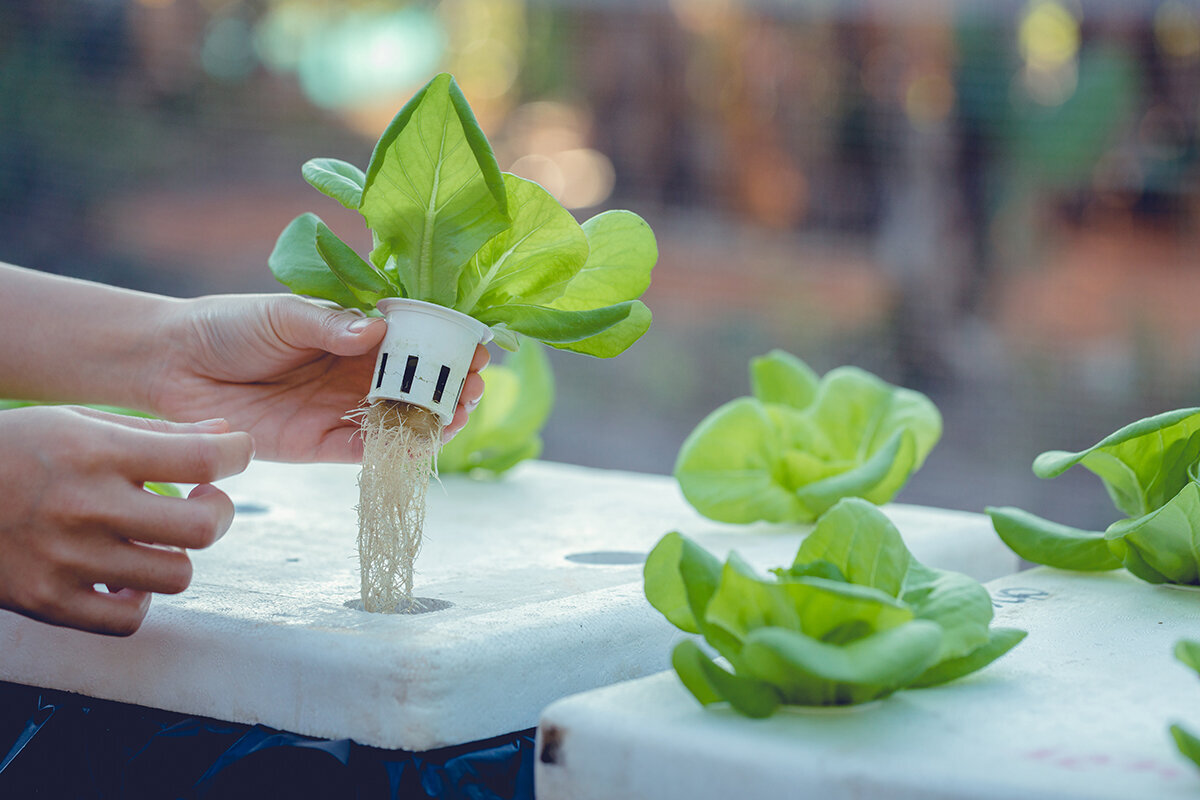
Net pot An open-sided insert that steadies a plant while its roots can enter both solution and air.
EC A conductivity reading used to indicate how much dissolved salt the feed contains overall.
Root zone Everything surrounding the roots: feed solution, oxygen, temperature, supporting medium, contact surfaces and cleanliness.
Chapter 02 · Make the first crop forgiving
Choose plants that reveal how the setup is behaving.
Best first crop: Leaf lettuce develops quickly, occupies little room and shows environmental stress clearly. Basil is another approachable choice where the greenhouse is bright and warm. Either crop supports practice with readings and harvesting without prolonged management, pollination or elaborate supports.
Use one crop, and preferably one variety, in the first reservoir. Leaf crops and herbs reveal change clearly: pale new growth, slow root development, a falling water level or a changed pump sound are easier to notice before dense planting hides the view. Pak choi and Asian salad leaves suit cooler early and late seasons.
Hydroponics can produce excellent tomatoes, cucumbers and peppers, but leave them until you have completed a simpler crop. They call for bigger reservoirs, robust supports, additional light and room, extended training and pruning, and steadier climate management. Your first harvest should build observation skills rather than exhaust your patience.
Choose healthy, compact young plants, or germinate seed in clean cubes intended for hydroponics. Keep garden soil out of net pots because its fine material, organic content and potential pathogens can contaminate the circuit. Begin with only several evenly sized plants; a sparse, readable reservoir teaches more than an overcrowded trial.
Chapter 03 · Trace the circulation
Four approaches, judged by how their roots obtain oxygen
No single design suits every hydroponic grower. A good starter method has a water path, failure points and cleaning routine that you can readily follow. The summaries below explain where the feed rests, how it circulates and which component deserves immediate attention during a fault.
Still · aerated
Deep-water culture (DWC)
Reservoir + diffuser stoneThin moving film
NFT
Pump + inclined channelMetered supply
Drip irrigation
Emitter + growing mediumPeriodic flood · free drain
Flood-and-drain
Bench + scheduled returnDWC, the deep-water method: Each plant is held over a tank, with its root mass dipping into the prepared feed. A pump drives air through a diffuser to keep that liquid moving and oxygenated. Lettuce and herbs make this a particularly readable introduction: there are few joints, both roots and waterline can be seen, and maintenance does not involve lengthy channels.
NFT, the nutrient-film method: Here, pumped feed travels as a thin stream along channels set at a gentle incline. Root surfaces meet the moving liquid while much of the channel remains open to air. The method is efficient for leafy plants, but depends on a consistent slope, clear returns and clean runs; a blockage or stopped pump can affect growth rapidly.
Drip-fed systems: Individual emitters meter feed onto plants rooted in an inert medium such as expanded clay, coir or rockwool. Run-off may be discarded or collected back in the main tank. The medium holds some moisture between cycles and can support larger specimens, although each emitter, drain and length of tubing needs routine inspection.
Flood-and-drain systems: Feed periodically rises across a growing bench before flowing away. As the medium drains, air is drawn back into its pore spaces. Propagation blocks and pots both suit this adaptable arrangement, but correct scheduling, a level bench, dependable outlets and cleanliness matter. Many domestic growers will nevertheless find a modest oxygenated DWC tank easier to interpret at first.
Whatever method you choose, build the routine around careful observation before intervention. Favour an arrangement that leaves sufficient access and time for inspection, washing and measured changes whose effects you can follow.
Your first DWC layout
Four parts you can inspect
01Lightproof reservoir
02Net pots with propagation cubes
03Aeration pump with diffuser
04Plant feed plus test meters
Keeping light out matters just as much as tank capacity, because a fitted opaque cover discourages algae. Clean starter cubes and net pots hold each crown securely without burying it. The pump, tubing and diffuser keep oxygen moving through the root environment. Calibrated pH and EC instruments turn repeated checks into evidence rather than guesswork.
Chapter 04 · Buy with restraint
Buy the essentials first. Automate later.
Essential An opaque lidded reservoir, net pots, an aeration pump and diffuser, hydroponic feed, separate pH and EC instruments, their calibration and cleaning fluids, and an accurate measuring jug reserved for this setup.
Useful soon A replacement diffuser, spare tubing, solution thermometer, marked refill can, plant labels, record book and low catch tray for any connection likely to drip.
Unnecessary for the first crop Dosing computers, remote monitoring, large multi-channel circuits, complex vertical towers, CO₂ equipment and automatic top-up systems. Buy extra complexity only once a simple routine clearly shows where time is lost or safety is lacking.
A greenhouse also leaves room for careful expansion over time. The Classic Aluminium Greenhouse offers a durable, visually ordered home for a modest reservoir, workbench and unobstructed maintenance aisle. That extra room is no reason to turn an initial lettuce crop into an engineering laboratory.
Chapter 05 · Before the first plant
Build it dry. Add water gradually. Trial it empty.
Commissioning may seem uneventful, yet it is valuable protection for the first planting. Assemble everything on a flat, structurally sound floor that can be washed easily. Sockets, plugs, power units and extension blocks must remain accessible, dry and above any leak path; include a downward drip loop in each cable. Reserve one unobstructed service side for every reservoir so no one must step across plants.
01Position
Shade the tank from continuous direct sunshine and identify a controlled, safe drainage route before filling.
Shade the tank from continuous direct sunshine and identify a controlled, safe drainage route before filling.
02Fill
Run the assembled system with clean water and inspect every connection, hose, lid and outlet.
Run the assembled system with clean water and inspect every connection, hose, lid and outlet.
03Listen
Check that the pump runs evenly and bubbles reach the whole reservoir reliably.
Check that the pump runs evenly and bubbles reach the whole reservoir reliably.
04Mark
Indicate the usual operating level. This reference line simplifies refilling and helps reveal an unexpected loss of water.
Indicate the usual operating level. This reference line simplifies refilling and helps reveal an unexpected loss of water.
When arranging crop areas and work aisles, keep plant handling physically distinct from technical equipment; the Classic Aluminium Greenhouse is one possible framework. Sound planning keeps tests, washing and inspection comfortably accessible.
Chapter 06 · Below the waterline
Water carries nutrients. The recipe remains a record.
Preparing hydroponic feed involves more than mixing fertiliser into water. The result varies with the incoming supply, chosen crop, development phase, tank capacity, heat, plant consumption and product formulation. Read the latest report from your Irish water supplier, then take your own measurements. Drinking water can be safe to consume while carrying enough hardness, alkalinity or dissolved minerals to influence hydroponic management.
EC represents overall electrical conductivity, giving a broad indication of all salts dissolved in the liquid. It can reveal concentration as plants drink or as repeated refills accumulate minerals, but it cannot distinguish one nutrient from another. Because pH changes nutrient access, use the feed maker’s directions for the particular crop and growth stage instead of imposing one target on everything.
pH 5.4–6.2A common mildly acidic working range
about 20–24 °CPractical temperature guidance only
EC ≠ recipeInterpret for the crop and its stage
Use these figures as working references, not universal rules. Incoming water, crop requirements and product directions take priority. Record a baseline, then note date, crop, water level, EC, pH, solution temperature and each change. Trends make individual readings meaningful.
Chapter 07 · Vigorous roots stay pale, firm and oxygenated
Root space and greenhouse climate must work together.
Water alone is insufficient for roots; oxygen matters equally. In DWC, aeration continually moves liquid over their surfaces. NFT exposes them to a narrow moving stream while leaving much of the channel open. Media-based arrangements rely on free drainage so that oxygen returns to the pore spaces after irrigation.
Clean, oxygenated root environment
- Lightproof reservoir
- Moderately cool solution
- Steady air supply or flow
- Pale, branched, firm roots
Overheated, sluggish root environment
- Light ingress
- Solar warming
- Weak circulation
- Dark, soft or musty roots
The greenhouse climate
Weather still governs conditions inside a hydroponic greenhouse. Sun can warm a bright structure quickly, and poor siting or insufficient shade may also heat the reservoir. Ireland’s Atlantic influence often brings cool, windy spells, while conditions differ by location and inland frost can occur late in spring. Ventilation must remove excess warmth and dampness around foliage without leaving young crops in a persistent cold draught.
- Light Place the first crop where light is bright and even. Shade the opaque reservoir itself so no sunshine can enter the prepared feed.
- Heat Use roof vents, doors, shading and air movement early. Protect solution from solar warming instead of waiting for wilted plants or sluggish roots.
- Humidity Allow space between plants so condensation clears quickly and leaf undersides, crowns and root openings remain available for inspection.
- Air movement A modest recirculating fan may disperse still pockets of air, but during hot weather it cannot substitute for proper venting or prompt shading.
Chapter 08 · Routine keeps the system simple
Let the greenhouse show you something every day.
Mon Observe
Tue Listen
Wed Test
Thu Inspect
Fri Refill
Sat Pick
Sun Reflect
- Monday: Observe foliage, roots, the marked waterline and aeration.
- Tuesday: Listen to the pump, inspect its lines and leave the surrounding area unobstructed and dry.
- Wednesday: Record the solution’s temperature together with fresh pH and EC readings.
- Thursday: Look for algae, pests and the earliest signs of leaf stress.
- Friday: Top up if needed, allow mixing, then measure again.
- Saturday: Pick outside leaves, clear away plant remnants and dry any splashes.
- Sunday: Review notes and make a considered correction only when several observations support it.
Your schedule will shift according to plant development, prevailing weather and the tank’s capacity. Water demand can jump during an unusually warm Irish spell, whereas uptake and growth ease in cool, dull conditions. The aim is not constant adjustment, but a brief daily check that catches gradual change.
Chapter 09 · Read the whole system, not one leaf
Beginner difficulties usually leave clues.
When the system looks clean but plants stall
Pale shoots or stalled development may follow an unsuitable feed strength, movement in pH, inadequate light, low temperatures or a tank that the crop has outgrown. Take fresh readings, judge the greenhouse against that crop’s needs and examine the youngest leaves closely. Make only one well-supported adjustment after completing those checks.
Sudden wilting calls for an immediate technical check. With NFT and drip systems, inspect pump, lines, even flow, return and fill level. In DWC, aeration must run, while roots must not sit in markedly overheated, oxygen-poor solution. A local flow fault often acts faster than nutrient deficiency.
Leaf-edge damage does not by itself call for additional fertiliser. First assess EC, water temperature, airflow and access to moisture. Excessively salty feed may injure the roots further and compound stress already caused by heat or limited water.
When the root zone becomes warm or unclean
Algae develop where illumination, dampness and opportunity coincide. Seal the tank, block illuminated gaps around hoses and net pots, remove growth you can see and wash every surface between plantings. Trace and eliminate the incoming light before reaching for a chemical response.
Roots that turn brown, slippery or stale-smelling indicate that their environment is failing, perhaps through overheated feed, weak oxygenation, stagnant liquid, poor sanitation or disease. Isolate severely affected plants. Restore aeration, circulation, water level and temperature before anything else, and sanitise the full setup prior to planting again.
Recurring leaks usually point to a layout problem. Route hoses so they stay visible and free of strain, and place trays below vulnerable connections. Do not locate the reservoir where even a little water can reach electrical connections, unprotected timber, thresholds or walkways.
A particularly damaging habit: altering light, water level, feed concentration and pH together. Change only the single factor justified by your observations, then wait long enough for the plants’ response to become clear.
Chapter 10 · Harvest, clean, then expand
Expand your understanding before your pipework.
Pick leaf lettuce progressively, taking outside leaves while preserving the centre, or harvest whole heads once they reach your preferred size. At the end of the crop, resist filling again immediately. Drain and wash every component, examine the roots and residues, and study the log. What you learn from that first planting becomes the reliable baseline for the next one.
Continue with one tank
Alter a single factor
Preserve the working aisle
Repeat the original crop until the work becomes calmer and cleaner, and only then introduce a different method.
Experiment with either another variety, increased tank capacity or a different season, rather than changing all three together.
Scale up only while every crop, drain, pipe, electrical joint and working surface can still be reached easily for inspection and washing.
For lasting materials, planned ventilation choices and a restrained garden structure, read more about the Classic Aluminium Greenhouse. A well-run hydroponic growing space should feel both inviting and organised: pleasant to enter, yet sufficiently legible that routine maintenance never becomes an obstacle.
Ireland · Practical questions
Irish greenhouse hydroponics: common questions
Is ordinary mains water suitable for hydroponics?
Often yes, but not automatically. Check the current analysis from your local water supplier and measure the source water’s pH and EC. Water is not a neutral, mineral-free starting point: hardness and alkalinity in particular affect how steadily nutrient solution can be adjusted. Hygienically sound drinking water may still bring a substantial hydroponic starting load. Water from a softener is not automatically better because of possible salts.
Which hydroponic system is best for greenhouse beginners?
A modest DWC arrangement with opaque walls and reliable aeration is usually approachable for herbs and leafy crops. Its operation remains easy to see, the root mass can be examined directly, and fewer emitters or lengthy channels mean fewer potential blockages. Shield the tank from sunshine, watch both fill level and aeration, and keep all electrical connections beyond any plausible water path.
Do I need heating and supplemental light for year-round hydroponics?
A lettuce or herb trial running from spring into autumn will not usually require both. Continuous production is different: location, crop, glazing, insulation, daylight and controllable temperature all matter. Ireland’s short winter days may not provide enough natural light for demanding uninterrupted growth, while excessive summer heat remains possible. Begin with a seasonal crop, adding heat, lamps or shade only when your records demonstrate a specific need.
When does the entire nutrient feed need changing?
No single timetable suits every reservoir. Consider plant uptake, tank size, source-water quality, temperature, crop stage and reading stability. After each crop, replace the solution and clean the equipment thoroughly. Renew it sooner if readings will not stabilise, contamination appears or problems persist after environmental checks. Your log will make the decision increasingly specific to each crop.
Does hydroponic produce count as organic or pesticide-free?
No. Hydroponics describes how plants receive water and nutrients; it does not confer organic status or guarantee pesticide-free produce. A clean, closely monitored circuit may avoid some soil-related problems, but hygiene, pest checks and crop-appropriate care remain necessary. In Ireland, amateur gardeners may use only products authorised for amateur use and must follow the label.
References and useful follow-up reading
Background material for planning another crop
More from Bloomcabin: thoughtfully planned aluminium greenhouse · Bloomcabin greenhouse curtains · aluminium-greenhouse sliding-door choices
- German agriculture portal: soilless fruit and vegetable growing
- German Environment Agency: German drinking-water quality data
- Weihenstephan-Triesdorf University: hydroponics and indoor growing
- University of Minnesota guidance on small hydroponic setups
- Purdue Extension guidance for reading pH and EC
- Penn State Extension overview of hydroponic plant nutrition
Planning your opening season under glass
Begin by filling one reservoir rather than the entire greenhouse.
Settle on a single crop, a method whose operation you understand and an unobstructed maintenance aisle. Together, these choices produce a growing space you can interpret, tend and enjoy now, with a sound basis for expansion later.
A single crop
Become familiar with its foliage, roots, pace and changing needs.
Become familiar with its foliage, roots, pace and changing needs.
A readable method
Arrange the circulation so its route remains obvious and straightforward to wash.
Arrange the circulation so its route remains obvious and straightforward to wash.
An open maintenance aisle
Retain easy access for testing, washing, venting the greenhouse and gathering produce.
Retain easy access for testing, washing, venting the greenhouse and gathering produce.
