
Growing and Safely Harvesting Figs in a Greenhouse
Bloomcabin guide for Ireland
Growing and Safely Harvesting Figs in a Greenhouse
A fig thrives under glass when its vigour is directed: abundant light and warmth, firmly contained roots and branches, and every ripe fruit within easy reach.
01 / Why restraint matters
Glass offers no natural size control, so regular shaping becomes more, rather than less, important.
The practical advantage
A greenhouse extends the warm growing season, shelters fruit from cold rain and provides a drier picking period. In Ireland, that extra warmth can decide whether late figs ripen with flavour or remain hard as autumn arrives.
Figs are naturally vigorous and can quickly shade a modest glazed space. Treat yours as a permanent fruit tree with defined room, not a fruiting houseplant. Good planning starts with controlled root volume, a branch framework below the ridge, checkable watering and a route for picking without brushing continually against latex-bearing leaves and shoots.
A properly aired classic aluminium greenhouse creates a durable setting, combining ample daylight and practical high-level vents with a frame sized for the eventual crown, not merely today's sapling.
02 / Choose for climate and fruit type
A single harvest is worthwhile; a second would be an added benefit.
Choose a named common fig for fresh eating, matching its ripening schedule to conditions where you live. These common forms normally set edible figs without pollination, unlike every other group. Smyrna and related figs depend on different pollination arrangements and are therefore unreliable for a simple Irish domestic greenhouse.
Previous year's wood{
Breba crop
Shoots produced during the preceding year bear breba figs. Their early ripening can be valuable where autumn cools quickly. Because this wood remains exposed through winter, severe or late frost, as well as hard dormant-season pruning, may destroy a large share of the initial harvest before growth resumes.
In colder or exposed places, the greenhouse should chiefly protect the permanent framework and encourage early growth. Where summers are short, locally proven early varieties are a wiser choice than the promise of a particularly large but very late main crop.
Current-season shoots{
Main crop
New growth carries the principal crop. Greenhouse warmth encourages it, yet excessive nitrogen, water and unoccupied space readily produce oversized foliage and drawn-out shoots while delaying maturity. Seek illuminated fruiting branches and figs that complete ripening before both temperatures and daylight decline, rather than pursuing the longest possible growth.
For cool northern European conditions, nurseries commonly offer Brown Turkey, Ronde de Bordeaux and Madeleine des Deux Saisons. Regard them as candidates, not promises of a crop. Ask a reputable nursery nearby about fruiting type, season of maturity and regional performance; the plant's age, available light, pruning and each summer's weather also matter greatly.
Examine each branch before making cuts. Last season's smooth brown or green growth may hold breba buds; shoots arising after budbreak support the later harvest. Consider which cropping period a substantial cut might sacrifice.
03 / The key space decision
Define where roots may travel before they choose for themselves.
Good fruiting does not depend on starving a fig, nor is containing its roots an instant remedy. The purpose is to keep a powerful tree proportionate to the house. A known rooting volume also simplifies irrigation, nutrition, potting-on and eventual renovation.
Most domestic houses suit either a substantial, steady container or a specially built bed enclosed along its sides. Plant directly into the greenhouse floor only when space is generous and long-term canopy discipline is realistic. If roots escape freely into adjoining soil, maintaining both restrained growth and a household-scale crown becomes challenging.
Below ground: three root spaces
Large container
Restricted planting pit
Open ground
Large container
Moveable yet completely confined. Select a durable peat-free growing medium containing mineral material, provide plenty of outlets underneath and use a pot that buffers summer moisture changes. Follow a deliberate repotting schedule and refresh spent medium.
Restricted planting pit
A pit lined at the sides with robust boards or a suitable root barrier offers more soil volume and thermal mass while maintaining a firm limit. Around 60 cm deep and wide is a useful planning starting point. Drainage, watering access and renewability remain essential.
Open ground
This produces the strongest growth. Choose it only where soil is deep and drains well, overhead capacity is ample, and lasting pruning can preserve a short, open, accessible framework.
04 / Position and access
Allow for its eventual size.
Choose the brightest appropriate side while keeping the entrance, high-level vents, controls and central walkway clear. Along a freestanding house, train a short fan or open-centred bush beside the sunniest long wall. Leaving about 30 cm beside the panels supports airflow and cleaning while preventing foliage from remaining pressed against heated glass.
Take both eaves and ridge measurements before purchasing the plant. Keep its intended mature height well beneath whichever part of the frame is lowest, retaining hand access above and around its crown. A range of about 1.8 to 2.2 m is frequently workable. Requiring a ladder whenever fruit is picked defeats sensible greenhouse planning.
For the layout, compare the classic aluminium greenhouse alongside the classic aluminium greenhouse. Treat the footprint, headroom, entrances, vents, staging and irrigation as an integrated layout, not as isolated choices.
05 / Training and pruning
Keep the framework calm and fruiting wood productive.
Shape the young tree from the outset. Either form a short stem supporting three to five evenly arranged main limbs, or train a fan against an appropriate rear wall. Both approaches keep figs visible and admit light. Lead growth away from the walkway, removing surplus rivals and basal shoots while wounds remain small.
A simplified greenhouse branch framework
Use the illustration to organise the tree rather than as an inflexible botanical prescription. Seek a short, airy crown whose principal limbs can be reached, whose cropping growth is evenly placed and whose remaining foliage shields bark and fruit from abrupt exposure.
- Permanent framework branches Maintain strength, low height and clear gaps between these limbs. Where the structure has aged, replace it in stages instead of drastically reducing every branch during a single growing season.
- One-year-old shoot Breba figs may appear here. Inspect this growth ahead of dormant pruning, because a severe cut could eliminate the entire first harvest.
- Current summer shoot This growth helps create the later harvest. During summer, reduce only shoots that become excessive, darken developing figs, interfere with airflow or enter places you cannot subsequently reach.
- Suitable reduction point Make each reduction to a sound lateral pointing outwards, or to a well-positioned bud. Leave no long stubs. Deal first with dead, frost-injured, crossing, rubbing or inward-directed wood.
Reserve major framework adjustments for the end of winter or the opening of spring, keeping summer intervention light. Preserve ample healthy wood from the preceding year when brebas matter. If crowding develops, remodel the principal limbs before repeatedly pinching random tips, an approach that often produces a congested mass of weak shoots. Make no severe cuts beyond midyear.
06 / Water, food and controlled growth
Give roots rhythm rather than excess.
Spring
Once buds begin moving, restore irrigation progressively. Wet all of the rooting medium adequately, waiting until its upper layer has become mildly dry before watering again. Build the quantity slowly and apply only restrained nutrition initially, especially to a tree already showing vigorous development.
Summer
During hot greenhouse weather, inspect moisture often, with pots receiving particular attention. A controlled slow application or drip system is preferable to occasional drenching. Start airing the house before heat stagnates and drives unnecessary water loss from the tree.
Late summer and autumn
Maintain steady moisture while figs enlarge and mature, without using nitrogen-heavy fertiliser to force luxuriant growth late in the year. Aim for finished fruit and firm, mature wood instead of tender new stems immediately ahead of winter.
Winter rest
Following leaf fall and the end of active growth, irrigate very little. Do not let the rootball become completely parched for an extended period, although a resting tree in cool conditions requires minimal water. Saturated cold compost poses the greater danger.
Where the hottest part of the day passes unattended, dependable vent control becomes especially important. Include the classic aluminium greenhouse among the options, and confirm that heated air can leave before dangerous temperatures gather around the crown.
07 / Holding fruit
Look beyond pollination when diagnosing trouble.
Common garden figs usually set edible crops without either hand pollination or a fig wasp. Confirm the fruiting group with the seller before purchase. Making that check at the outset avoids an unnecessarily complicated search for causes later.
When an appropriate common variety sheds immature figs, investigate timing and stress first. Possibilities include an abrupt moisture shortage, poor illumination, excessive fruit on a young plant, fluctuating temperatures, a recent move into another pot, pests or late setting. Extra greenhouse warmth cannot supply missing autumn daylight or alter inherited maturity dates.
Do not remove every small fruitlet as a precaution. Keep the tree balanced instead, take off clearly damaged fruit and focus on even soil moisture, good light distribution and a variety whose ripening time suits the local season.
08 / Summer under glass
Warmth helps. Trapped heat does not.
Although figs appreciate warmth, sunshine can drive temperatures too high inside a shut house with surprising speed. Begin ventilation promptly, arranging a path that admits cooler air near floor level and releases heated air overhead. Add shade only if scorch is occurring or irrigation cannot satisfy the rooting medium. Circulating air helps disperse humid, motionless pockets among crowded branches, but adequate natural vent openings remain essential.
Prevent branches and foliage from touching the panels. Selectively remove a small number of interior stems instead of taking leaves from broad areas. Those leaves power maturation and protect vulnerable bark from sun. In wet conditions especially, clear dropped fruit and senescent foliage promptly, limiting places where flies, mould or souring can develop.
09 / The harvest zone
Use the fruit's stance and feel, not merely its colour.
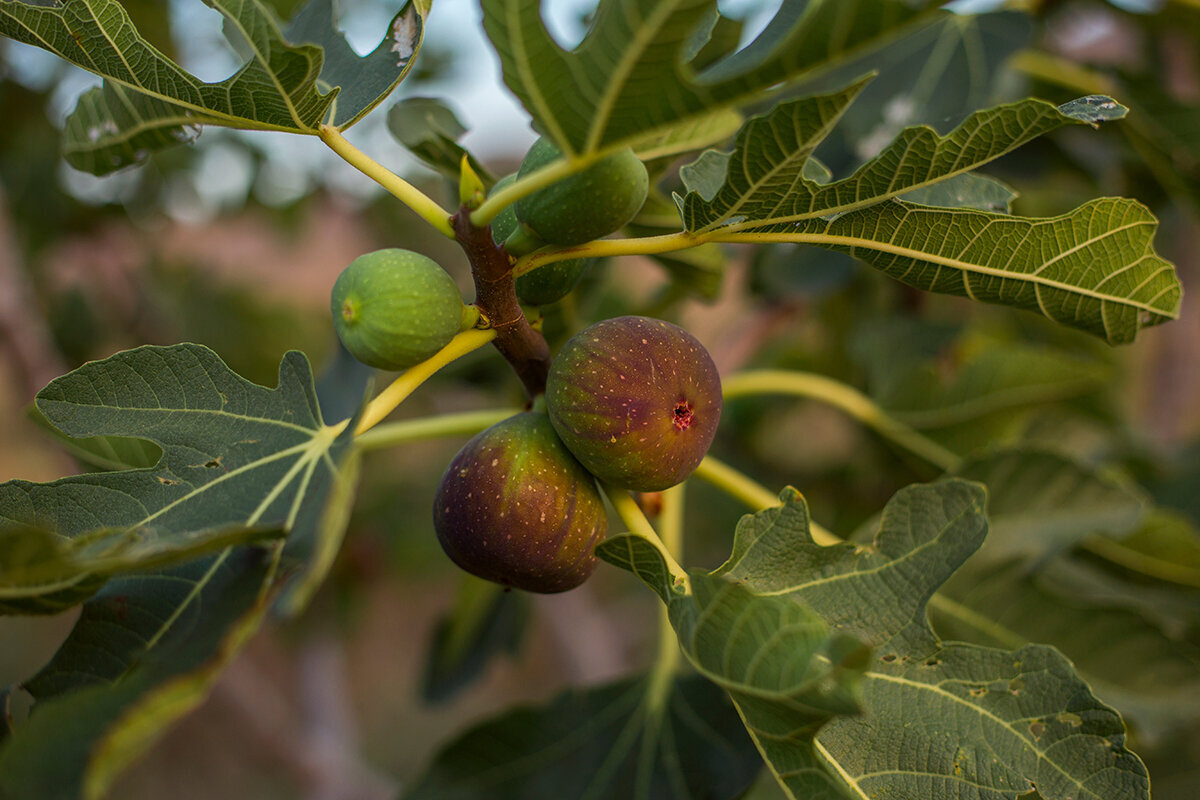
Cultivars differ widely in skin colour: some green figs stay that way at maturity, whereas others become yellow-green, brown or dark purple. Assess several clues together, including increased plumpness, softer skin, a yielding neck, downward droop and reduced white sap around the stalk. Little further ripening occurs once figs are detached, so revisit the tree for successive pickings.
1 / Upright
Wait
Firm body, tight neck, upright posture: this fig should stay on the tree.
2 / Swelling
Watch
The fruit becomes fuller and yields slightly. Continue watering evenly.
3 / Hanging
Harvest
A supple fruit with a bending, softened neck is ready. Support it gently, lift slightly and separate the stalk cleanly without bruising the skin.
4 / Split
Check immediately
A neat minor opening may be harmless in a fully mature fig. Throw away any fruit showing leakage, mould, obvious insects or a fermenting odour.
Take care with latex
Cover your arms and hands for pruning and larger picking sessions. White sap released by stalks, shoots and foliage may irritate eyes or skin. Whenever practical, progress upwards from lower growth so it cannot trickle across your forearms and hands. Rinse any contact promptly, and disinfect equipment after cutting suspect or diseased material. Pick fragile figs during the cool morning while handling is easier.
10 / The winter zone
Respect the tree's dormant season.
Figs naturally shed their foliage. In a greenhouse, this signals the opening of dormancy and seasonal maintenance, not unsuccessful cultivation. Study the exposed framework, clear dead leaves and leftover fruit, then examine the buds and wood. Postpone structural cutting until the most severe frosts have passed, when injured growth and surviving fruit buds are easier to identify.
Where conditions are cold or exposed, roots in pots, young specimens and delicate shoot ends are particularly vulnerable to severe frost. Rest the container on insulation, bring it towards a protected inside wall and wrap the pot when required. Avoid enclosing the whole tree without ventilation for prolonged periods, and withhold rich feeding that would induce tender pre-winter growth.
Shut the openings ahead of exceptionally cold nights, adding permeable horticultural fleece where necessary. Resume airing whenever days are frost-free because winter sunshine may still raise temperatures sharply under glass. Check saucers and drainage outlets too. During dormancy, reconsider the rooting volume, crown level and picking access in preparation for the coming season.
11 / Common trouble spots
Identify what the symptoms indicate before altering the entire routine.
Fruit drop
Consider whether the cultivar fits the site, then investigate abrupt moisture loss, saturated roots, recent disturbance below ground, inadequate light and fruit that formed too late. Address the clearest source of stress first; a large emergency feed will often aggravate matters.
Splitting
Both weather and irrigation practice generally contribute. Keep moisture changes gradual, ensure water has an escape route, admit fresh air following humid nights and gather mature figs without delay.
Spider mites
Watch for dull speckling, fine webbing and weakened foliage in warm, dry, still areas. Check leaf undersides and young shoots regularly, isolate badly affected neighbouring plants and improve ventilation and growing conditions first.
Scale insects
During the resting period, examine growth from each of the previous two seasons. Immobile shell-like marks and tacky honeydew warrant action. Cut away heavily colonised material, maintain an airy crown and apply only a product whose Irish label authorises that use, following its directions precisely.
Rotting or sour fruit
Promptly clear figs that have cracked, begun leaking, developed a fermenting smell or suffered insect injury. Shorten the interval between pickings, increase airflow and remove all windfalls from below the branches.
Poor ripening
Open a crowded crown carefully, bring an excessively tall, self-shading tree down onto suitable laterals and limit nitrogen. Review the cultivar's stated maturity period as well. Where summers are brief, preserving early breba wood may give a steadier result than depending on a particularly late principal harvest.
If control is necessary, home gardeners should choose only products authorised in Ireland for amateur use on the stated crop, then follow every label instruction, including measures to protect water. Begin with accurate identification, cleanliness and better growing conditions. Routine observation inside an enclosed greenhouse is far preferable to hurried, indiscriminate spraying.
12 / Annual calendar
A dependable year for figs.
Regional conditions, the course of frost, greenhouse design and cultivar all move the timing. Read the calendar as an ordered set of signs and jobs, rather than immovable dates. Irish weather continues to govern progress inside an unheated house.
| Period | Observe | Act |
|---|---|---|
| January–February | Dormancy, framework, overwintered buds, container condition and frost damage. | Keep only slightly moist, protect roots and young tips in frost, vent on mild days and plan pruning carefully first. |
| March–April | Budbreak, retained breba buds, dead shoot tips and direction of new shoots. | Increase water slowly, remove damaged wood, correct framework branches, repot if needed and avoid heavy feeding. |
| May–June | Temperature build-up, fruit set, shoot length, canopy density and first pest signs. | Vent early, water evenly, guide selected shoots, pinch obstructive extensions lightly and inspect leaf undersides regularly. |
| July–August | Swelling fruit, ripening order, water demand and splitting risk. | Harvest often, remove fallen fruit, keep water steady, maintain an airy fruit zone and avoid soft late growth. |
| September–October | End of the main crop, late unripe figs, leaf colour and falling night temperatures. | Pick ripe fruit continuously, remove spoiled and clearly hopeless large unripe fruit, feed less and water more sparingly as growth slows. |
| November–December | Leaf fall, bare framework, standing water and next season's space needs. | Ready frost covers, prevent humid air from stagnating, and review headroom, vents, picking access and root limits ahead of budbreak. |
13 / FAQ
Questions from the fig greenhouse.
May a fig stay under glass throughout the year?
Yes, when sunlight, airflow and contained rooting space are adequate and pruning and picking remain accessible. An unheated structure in Ireland lengthens useful growing conditions without guaranteeing freedom from frost. During hard freezes, pots, young trees and delicate tips require targeted insulation that still allows air to pass.
Is pollination required for figs under glass?
Named common varieties intended for gardens can produce edible figs without being pollinated. Other groups depend on specialised pollination, making them poor choices for ordinary Irish greenhouse culture. Unless you maintain the necessary specialist system, select a confirmed common cultivar.
How large should a pot for a fig be?
Choose a large, stable, very freely draining container that supports a healthy rootball without driving the canopy out of control. Pot young plants on gradually. More important than a fixed litre figure is reliable summer watering, rootball checks, renewed compost and easy access to the mature tree.
Does a fig require severe pruning each winter?
Generally, no. Take out dead, injured, crossing or badly positioned branches, lowering the crown by cutting onto suitable laterals. Severe dormant cutting may sacrifice wood intended for brebas and encourage forceful replacement shoots that soon congest the available space.
What causes abundant foliage without mature fruit?
Possible reasons include excessive nitrogen, too much rooting volume, deep shade created by the tree itself, uneven moisture, inadequate warmth near autumn or a cultivar whose maturity date exceeds local conditions. First clarify the framework, then tackle the most evident stress or growth imbalance instead of modifying every part of the routine together.
What should an effective fig greenhouse provide?
Prioritise practical headroom, sufficient footprint, unobstructed picking access, convenient doors, adjustable vents and sound foundations. The overview of the classic aluminium greenhouse can help compare dimensions and available fittings. Design the completed house for the tree at maturity, rather than solely for the small specimen planted during year one.
14 / Sources and further information
Plan further with reliable sources.
Cropping performance depends heavily on the site. The specialist links below are German, British and North American references covering winter care, root containment, pruning, fruiting groups, irrigation and plant health. Use them alongside local observation when forming a suitable cultivation plan.
More from Bloomcabin: Garden planning for quality aluminium greenhouses in Ireland · Quality aluminium greenhouses and conservatories · Bloomcabin gardening journal
- Bavaria’s State Research Centre for Viticulture and Horticulture:Winter preparation for container-grown plants
- RHS practical advice:Growing fig trees at home
- RHS advice on pruning:Pruning guidance for fig trees
- UC Agriculture and Natural Resources:Fig fruiting groups, pollination and seasonal crops
- UC IPM cultivation advice:Cultural guidance for growing figs
- UC IPM diagnostic notes:Why figs drop or fail to fruit
- UC IPM crop overview:Fig care, pests and plant health
Design the house to fit the tree
Set useful limits for a flourishing fig.
Match the available greenhouse volume to controlled roots, an accessible crown, effective ventilation and safe picking space. Thoughtful design replaces each year's struggle against excessive shoots with an orderly, productive cycle of tending, watching and gathering fruit at maturity.
Classic aluminium greenhouse